


 SHARE:
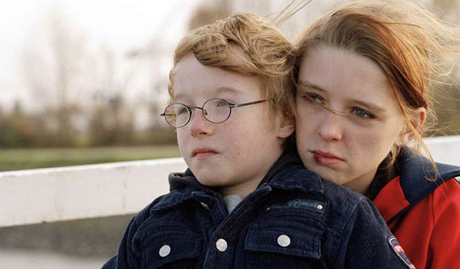
It’s innocuous at first, a bump from behind, a note pasted on her back, but as things get slowly worse, the life of a 12-year-old girl begins to fall apart. The journey to and from school becomes a terrible no man’s land marked by humiliation and rejection. Soon enough she’s sporting a black eye and a split lip, and missing her beloved skateboard, thrown into a canal by her tormentors.
Director Mijke de Jong’s Blue Bird was Holland’s submission to the Academy Awards a few years back. The story, at first glance, is deceptively simple. Merel lives in a modern European city. Everything in her life looks under control. Everyday she rides the tram to school, takes her little brother Kaspar for walks, sings in the school musical, and practices her diving. But one day for no real reason other than she’s perhaps a bit too smart, too independent or just a little too easy in her own skin, she becomes the target of a school bullying campaign.
If this was a Hollywood film, you’d being cuing up the violin section and preparing the ground for a great blaze of triumph at the film’s resolution: underdog gets back at the bullies, and teaches them the error of their ways. But that doesn’t happen here. There is no music, no third act vindication. Instead something far worse begins to happen.
Even while she appears to be the same on the outside, a subtle frost has begun to coat Merel’s heart, crippling her normally generous nature. She starts to pass on her pain to those even more vulnerable than herself, including her disabled little brother Kaspar. Merel’s parents have decided to put Kaspar in a rehabilitative facility for children in order to help him learn to walk. He also suffers from seizures, which are apparently getting worse. When he has an attack at the swimming pool, Merel says, “He’s not my brother.” This betrayal that cuts far deeper than any schoolyard taunts, as Kaspar’s trust and love appears to suffer a body blow.
Whether Merel will be able to stop the hardening of her heart, I cannot say. You’ll have to go and see the film.
Trickle-down meanness
Children and cruelty has formed the bitter seed of a great many books, films and the occasional radio program. But despite the attention paid to it, the fundamental facts of bullying don’t appear to have changed very much. You can blame the hypocrisy of adults for that. Even while schools institute anti-bullying campaigns, life on the playground goes on pretty much the way it has since the time that I was in short pants. Meanwhile, a maybe a not-so subtle shift in culture has been underway. The other day a small child walked up to me and said matter-of-factly, “I’m going to punch you right in the face.” A casual acceptance of the loss of manners is especially evident in film, where the trend of trash-talking children and infantilized adults has become something of a well-established pattern, from Step Brothers to Role Models.
Crudity mixed uneasily with comedy might be aimed mostly at adults, but it has a way of filtering down. I had the distinctly unpleasant experience of sitting through the remake of The Bad News Bears recently. If someone approaches you with this film threaten to scream down the house or bring in the authorities. Do whatever you have to do to protect yourself. The change between the original film and the Billy Bob Thorton version is almost startling grotesque. Any lingering sweetness is banished, replaced by a mean and ugly vein of swearwords and scatological jokes. It’s difficult enough to winnow out the coarser elements in young minds, without actually subjecting them to a full on wallow in the muck. But it seems that’s what we’re passing on to little kids: cruelty coated in marketing, nastiness very thinly disguised as humour.
Hardened by isolation
A classic tactic of bullies from time immemorial is “Can’t you take a joke?” Which is exactly what happens to Merel in Blue Bird, when her tormenters claim it was all in good fun.
The one thing this film gets especially right is that terrible sense of isolation that kids feel when cruelty and injustice begins to mark their lives. Merel carefully keeps all of things that she endures entirely to herself, making up elaborate stories to explain her missing skateboard and vandalized bike. Even as the dark circles under her eyes deepen, the adults around her blither on, hardly even noticing that something is terribly wrong.
With one exception. A young black man whom Merel meets on the train, seems to take heed and gifts her with a little gentle advice and a snatch of Beatles music. The remarkable kindness of strangers, lightly offered, is a wonderful thing. It is a testimony to Merel’s inherent soundness that she is able to take it and use it. One of the film’s most remarkable scenes is one in which pain is met and matched by plain old kindness. Merel, holding her brother in her arms in the shower at the swimming pool, embodies the power of trust and communion. It so simple and lovely a moment, that it requires complete silence.
Blue Bird is only one film about the pain of bullying on offer. We Shall Overcome, which picked up The Glass Bear at the Berlin Film Festival, is also about bullying, although this time, it is between adult and child. The film, which opened the Reel 2 Real Festival two years ago, is currently screening at the European Film Festival at the Pacific Cinematheque. It is particularly timely given the recent American election. A young boy named Frits coming of age in 1960s Denmark becomes fascinated by Dr. Martin Luther King Jr. after he is victimized by his school principal. The film does not stint on the repercussions of violence, yet, at its heart, it is a story about hard-fought courage. I thought about this film when Obama gave his victory speech the other day, with its purposeful echoes of King's famous speech.
What the injured understand
Oddly enough both Blue Bird and We Shall Overcome share a similar plot device, as each of the film’s young protagonists is helped by a person of colour. Meaning perhaps, that only someone who’s been a victim of society, in one way or another, can fully understand what it means to be on the outside looking in. Even a film like Let the Right One, which looks at first glance to be a vampire story, is really more about the pain and loneliness of being a victim. The film’s central character, a milk-pale slip of boy finds solace and companionship with a vampire, who is the only person, living or undead, who appears to understand and sympathize with his plight.
The ending of the film is probably not the best way to solve bully issues, involving as it does severed heads and a great deal of gore, but the one commonality that these films share is that when it comes to coping with the pain of being a geeky kid, adults are of little help. More often than not, they’re blatant hypocrites, easily manipulated, lacking in courage, or simply oblivious to the squalls and storms of childhood.
I was describing the plot of We Shall Overcome to someone the other day, who exclaimed in horror, “You took your son to see this?!” “Well, yes,” I said, and thought about launching into an impassioned speech about how something like Madagascar: Escape 2 Africa was innately more problematic since beneath the funny voices and the bright colours lurked a far more ugly truth: casual racism packaged up pretty. I refrained from letting that harangue erupt forth. Bullying happens in adult world as well, and we're not much better equipped to cope with it.
Young film critic in your midst?
Blue Bird screens this Sunday, as part of the Reel 2 Real’s Family Film Series, at 1PM at the Vancity Theatre in Vancouver. If you’d like to be a part of things, there is a film criticism workshop being offered after the film screening from 3 to 5 PM. The festival’s youth jury is an integral part of Reel 2 Real, so if you have a budding film critic on your hands, poor you. Stick them in the youth jury and expect them to expound upon about the vacuity of Hollywood soon enough.
Related Tyee stories:
- Beyond 'Bullying'
You won't hear me say that word, as I work to protect kids. - B.C.'s Least Safe Teens
The roots of gay bashing need more focus, says head of B.C.'s new Institute for Safe Schools. - The Grim Lives of Virk's Attackers
Rootlessness, poverty, trauma marked their youths, a book finds.
![[Tyee]](/design-article.thetyee.ca/ui/img/yellowblob.png)
Read more: Film












Tyee Commenting Guidelines
Comments that violate guidelines risk being deleted, and violations may result in a temporary or permanent user ban. Maintain the spirit of good conversation to stay in the discussion.
*Please note The Tyee is not a forum for spreading misinformation about COVID-19, denying its existence or minimizing its risk to public health.
Do:
Do not: