


 SHARE:
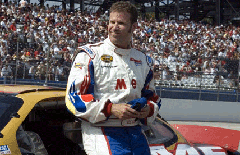
You might not think that Little Miss Sunshine and Talladega Nights: The Ballad of Ricky Bobby would have much in common, and you'd be right. One was a Sundance favourite that had distributors hopping up and down like rabid rabbits. The other had Will Ferrell in his underwear. Yet again.
But while superficially they don't share many similarities, if you look closer, they're united by the cult of the almighty automobile. It seems car culture is alive and well on both sides of the political fence, albeit in very different ways.
If you're a liberal loser, a blue-state booby, depressed, Proust-loving, Nietzche-spouting tree hugger, then, according to the movies, your vehicle of choice is an ancient VW van, painted a sad sunshine yellow, like the fading light of '60s liberalism. As you drive along the highway of life, other bigger, faster, more expensive cars zoom by. Still, you cling to your tattered values, even while you know that deep in your heart, the American dream has passed you by. In fact the dream cut you off, and then ran you off the road.
Winners or losers
Little Miss Sunshine is about the Hoover family, in their decrepit van that has (literally) run out of gas. Mother and father Hoover (Toni Collette and Greg Kinnear) are in the last bitter tailspin of a dying marriage. Brother Frank (Steve Carell) has lost his boyfriend, his job and his MacArthur genius grant to a lesser rival. Grandpa (Alan Arkin) snorts coke and swears, and their teenage son Dwayne (Paul Dano) won't speak at all. The only one who seems pretty okay with life is little Olive (Abigail Breslin), and that's only because life hasn't had time to beat humiliation into her. When Olive is chosen, by default, to compete in the Little Miss Sunshine pageant, the road unfurls before them, and along with many other hopeful families like the Clampetts and the Joads, they head west to the golden promise of California.
Little Miss Sunshine is ostensibly about the binary culture of winning and losing in the good old USA. If you're not a winner, you're a loser, says dad Hoover, whose nine-step program to becoming a winner is lacking more than a few steps. Each member in this dysfunctional tribe is one form of sad sack or another. This is of course, supposed to be their charm. On the metaphorical journey through life, the Hoovers were born luckless and they don't even know it. But maybe, if they learn to accept themselves for who they are, loser-ness and all, everything will be all right.
The film is strictly paint by numbers, although in a slick and polished way. You barely notice you're being manipulated. When Olive comes close to understanding that some are blessed and some are not, her attention, not to mention her self-image, is salvaged by a Napoleon Dynamite dance-off scene. (The ubiquitous dance finale deserves a semiotic decoding all of its own, but that's another story.) The Hoovers pile back into their lame duck vehicle and keep on trucking. Okay, we get it. You are your car. Any number of advertisements would like you to believe that very same thing. And it's a sentiment that comes to its fullest fruition in Talladega Nights: The Ballad of Ricky Bobby.
American robots
Like Little Miss Sunshine, Talladega Nights is about winners and losers, and in order to be a winner you need a kick-ass car, preferably a Chevelle with the number 13 painted on its door, that plays the Rebel Yell on its horn. You need a NASCAR car! Just like Ricky Bobby: born in car, raised in car, and who will probably die in a fiery wreck of car. Car, car, car.
"If you're not first, you're last," says little Ricky Bobby's bad dad when he visits his son on career day at school and then is egregiously thrown out the door. This sentiment informs everything that little Ricky Bobby becomes: a big, hairy, American winning machine; a husband to a robotic trophy wife who has a "tractor beam of hotness"; a father to two messed up kids; and more endorsements than you could wave a Slim Jim at. Ricky Bobby is so far to one side of the blue/red state divide that he has practically turned alizarin. But in the red states, driving is more than a metaphor, it's the American way of living free, dying free and heading fast down the highway to hell.
Stock car racing started out with bootleggers who needed cars that could outrun the law. Eventually they started racing each other and a religion was born: the cult of speed, around which the entire strip mall world of Applebees, KFC, POWERade, fat stupid kids, vain stupid women and big, dumb men sprang up.
Schtick shift
The characters in Talladega probably aren't very much exaggerated from the genuine article. It's also a typical Ferrell vehicle, meaning it has his usual flat delivery and inside jokes. This particular style of comedy is odd, it's slow, it's kind of dumb and people seem to love it. Why, one might ask? I don't know. Talladega does have one thing going for it, and that's Sacha Baron Cohen as Formula "Une" driver Jean Girard: gay, effete, cultured and completely worth the ticket price. Cohen is too smart for a film like this; he deserves better. He is more than a match for Ferrell, both in character and out, and his Jean Girard is an infinitely more interesting creature than plain old Ricky Bobby, who's just another redneck with a stick shift.
Like most cultural products, films are coded. Sometimes the code is dead simple. In the split between Sunshine and Talladega: it's the right (apple pie, feel good, you're the greatest, winner take all) versus the left (global warming, political corruption, GMOs, guilt, feel bad). Which one would you choose, souped-up NASCAR or crapped-out VW van? When Ricky Bobby loses his ability to drive, he becomes less than a man. He becomes a bike rider. Oh, gross! He doesn't become fully male again until he's back behind the wheel, with his new lady well-humped, and the basic order of the universe reasserted. Nothing unusual here, in fact, nothing that hasn't been established, and then re-established in practically every Hollywood film ever made. The patriarchal nuclear family, along with its beloved motor vehicle, triumphs again.
The age of the car has ripped up the silver screen for most of the past year. There have been a variety of other "Cars R Us" movies this summer, Cars for one, The Fast and the Furious: Tokyo Drift, and even a documentary or two: Who Killed the Electric Car? and Tire Tracks, a short documentary about the fine art of laying rubber. A review from the New York Times describes the phenomenon of rubber tire art by saying: "It is a spectacle, sometimes generating enough smoke to obscure the vehicle and accompanied by enough noise that it can make a NASCAR race sound like a chamber concert...There are also class dimensions to burning; one man's folk art is another's rend in the social fabric."
Ghost riding
We love our cars to death. Witness the "going dumb" notion of ghost riding, the latest car craze to come out of the Bay Area, which has resulted in a number of deaths. Or Vancouver's own street racers, whom I sometimes hear at 3:00 am, roaring up the street towards gory mangled death, or some type of fleeting glory. Ah yes, it's the stuff of social fabric, since the car pretty much determines your place in society. But maybe not for long.
Bryant Urstadt, in his essay, "Imagine There's No Oil: Scenes from a Liberal Apocalypse," in the August Issue of Harper's Magazine writes: "The idea that cheap oil had gone the way of the passenger pigeon was seeping into casual conversation, as drivers watched the prices at the pump creep steadily up." More and more often, I look forward to the day when we do run out of oil and the world slows down. No noise, no horrific car accidents.
Sure it will take weeks to get to Surrey, via horse team, but the world will get big again. If you want to get to Borneo, you won't be able to hire a helijet and have them drop you and your buddies and a six-pack into the deepest jungle to party, with your ATV and your SUV. No more will you hike to the pristine mountain only to hear the whining buzz of snowmobiles, cutting like wasps through the air. No more will the lakes be crowded thick with motorboats, or jet skis or any other consternating motorized vehicle. Silence and stillness will reign supreme.
The future is almost upon us, as witnessed by the resolution of Talladega Nights, which ends not with sleek vehicles going upwards of 200 miles per hour, but on foot, much like we may all be.
I can't wait.
Dorothy Woodend reviews films for The Tyee every second Friday. ![[Tyee]](/design-article.thetyee.ca/ui/img/yellowblob.png)





Tyee Commenting Guidelines
Comments that violate guidelines risk being deleted, and violations may result in a temporary or permanent user ban. Maintain the spirit of good conversation to stay in the discussion.
*Please note The Tyee is not a forum for spreading misinformation about COVID-19, denying its existence or minimizing its risk to public health.
Do:
Do not: