


 SHARE:
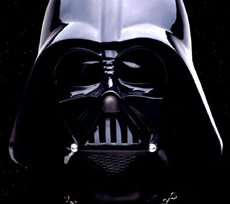
This is the end, my friends. Finally, the last installment of the Star Wars saga arrives in swirl of darkness this coming Thursday. A momentous occasion for some, a relief for others. More than a series of films, the sextet have become a vast cultural edifice, and at the centre, having supplanted the mewling puker Luke, stands big bad daddy, Darth Vader.
The fact that Vader has come to occupy the central role in the whole enterprise is a curious development, since it requires that audiences, both adults and children, come to understand and have some compassion for what is arguably a monster.
So how did we get here, Darth and us? We have watched him grow from a towheaded munchkin in The Phantom Menace to a surly teenager in Attack of the Clones to full grown towering evil in Revenge of the Sith. This final film, wherein we witness his embrace of the dark side, is played as a tragedy. But the moment when Anakin Skywalker becomes a monster has also been captured in Lego form. Just the other day I bought my son Louis some Star Wars Lego, and after suffering through the three hours it took to assemble, I looked closely at it. Here is Anakin, cut and bleeding, with a wobbly look, like he's about to cry, but still demonstrably and pinkly human. And here is Darth Vader, underneath the helmet is the same expression, except he's turned an ashen grey. He still looks, however, as if he's about to burst into tears.
"Darth Vader is my new friend!" Louis informed me. I didn't have the heart to tell him that perhaps Darth wasn't such a good friend. That he should stick with his gay pal Sponge Bob Squarepants, who as far as we know, hasn't killed anyone yet. But I am not entirely unsympathetic either. How can I be? I wanted to be Darth Vader too when I was a kid.
Knee deep in Darth
Critics may rant and rave about why we ought to be entirely sick of the Star Wars ways and indeed many people are, but on the playground, Darth is alive and well. Venture into any area where children congregate and what you will hear is shouts of "I'm DARTH VADER!" and the buzz of pretend light saber battles. In fact Darth is everywhere, hawking M&M's, Slurpees, enough toys to sink a battleship, and every time a little child pipes up "I want that!" the cash registers ring and the cold hard cash pours in Lucas coffers.
Star Wars merchandise is worth somewhere in the area of $9 billion and Lucas, having famously forgone his directing salary in exchange for a share of the merchandise, is sitting comfortably. Although, it's unlikely there will be another unfortunate marketing tie-in like the infamous JarJar Binks Sex tongue that had parents seeing red. A big red tongue in fact, the JarJar Binks Monster Mouth Candy Tongue, that their little darlings sucked face with. Don't think too long on this image, you may never recover.
Lucas is sticking with proven success of Vader to bring in kiddies, despite the fact that this is the film where evil is triumphant. Even while Mr. Lucas is quoted saying that it isn't a film that young children ought to see, the entire world is deluged in Darth. Knee deep in Darth. Darth is everywhere. But in all the hype and marketing, one little tiny bit of information seems to be lacking: Darth Vader is evil. He kills entire worlds, slaughters children, he tortures his own daughter, tries to kill his own son. He's bad. It doesn't matter how he became bad, or that eventually he felt sorry, he's a villain.
Watching The Downfall
But villainy isn't quite what it used to be, when even the biggest villain of the 20th century gets some sympathy. The recent film Downfall depicts the final days in the life of Adolf Hitler, a man at the very end of his life, failing in body and mind, and still failing to grasp that the end of the Third Reich is at hand. The two films are entirely different in their intent, one is inspired by the real events of history and the other had Jar Jar Binks in it, but there are strange echoes between the two. Not the least of which is the figure at the centre of each: Darth and Adolf. Both tortured men, who become something else over the course of history and mythmaking.
There are other parallels: in Downfall, Hitler hides his crippled palsied hand. So too, Darth Vader is a ruined human, propped up by his black suit. Each has suitable musical accompaniment: Hitler had Wagner and Vader has John Williams. Steven Moss writing in the Guardian sums it up succinctly, "Hitler adored Wagner and they shared a common ideal: that life is a disappointment, almost a delusion. That only in death and through sacrifice does man fulfill himself. It is a powerful credo, dressed up by Wagner in transcendent, soul-wrenching music. In Tristan und Isolde, who can resist the lure of the Liebestod, redemptive death through love?"
This too, is the motif in the final Star Wars film: evil springs out of love. In seeking to save his wife, Anakin makes a deal with the devil. And let us not forget that after the word Star, is the Wars part, and the biggest influence on Lucas' films, is the Big One. World War II figures large in the entire drama from the consciously anachronistic screen wipes of 30s serials to the black and silver uniforms that recall the colours of the SS. Stormtroopers and stormtroopers: fascists have always had good fashion sense. They dress well, nice suits, well pressed uniforms, shiny rows of medals, as opposed to the ragged and messy forces that oppose them.
Lucas as villain
In the original Star Wars, the death stars positively gleams with dark purpose, unlike the raggedy rebel forces. Lucas has described his film series as the story of "how democratic society turns itself into a dictatorship." Whereas Downfall shows what happens after that has occurred. It is not a pretty picture, no dancing beams of light, no cant about nobility and honour, war is just ugly and stupid. Lucas' version has always been the dress up and pretend version, hence its attractiveness to children. If Downfall seeks to make human what is monstrous, the intent of Star Wars is perversion of that same impulse, but the effect is the opposite. The figure of Darth Vader takes the banality out of evil and makes it larger than life, big, black and shiny.
This past week, World War II seemed very present. From VE Day to the new Holocaust memorial in Berlin to the new series Heimat from German director Edgar Reitz. Despite all the operatics at the center of the Third Reich, it was often remarkably mundane, men trying to figure out how to get rid of the most bodies in the most efficient and easiest way possible. This was the point of the 2001 film Conspiracy in which all the principal architects of the final solution meet in a Berlin mansion for the 1942 Wannsee Conference and make plans to kill six million people over coffee, lunch and brandy.
This is also what Downfall seeks to make evident, that Hitler wasn't a monster as much as ordinary man, who took advantage of the opportunity that history gave him. Making him into a monster, is simply a way of evading responsibility. Star Wars is a fantasy, a space opera, whatever. It's not really smart enough to pose cogent questions about good and evil, but since its cultural impact is felt so deeply and by so many people around the world, is it really more than the sum of its parts? And if so, what does Darth Vader's transformation teach us about the nature of evil?
Well, not much really. Except that in certain circles, George Lucas is the embodiment of it. Professional hysteric Dale Peck in the New York Observer tears the Lucas a new one as does the blog The Bynk Zone in the rant I Hates Lucas. I'm sure George Lucas cares not, and why should he really? He has made a series of movies for children, of all ages, but I don't mean that in a good way.
Dorothy Woodend reviews films for The Tyee. ![[Tyee]](/design-article.thetyee.ca/ui/img/yellowblob.png)







Tyee Commenting Guidelines
Comments that violate guidelines risk being deleted, and violations may result in a temporary or permanent user ban. Maintain the spirit of good conversation to stay in the discussion.
*Please note The Tyee is not a forum for spreading misinformation about COVID-19, denying its existence or minimizing its risk to public health.
Do:
Do not: