

 SHARE:
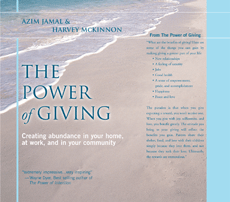
[Editor's note: Azim Jamal is an accountant by trade, and Harvey McKinnon is a fundraiser. They each decided that giving back is more beneficial than "fear."
Now, in The Power of Giving: Creating abundance at home, at work, and in your community, they argue the benefits of "giving." Their philosophy is that the more you give - in time, love, kindness, and sometimes money - the more you have. And that "giving" is the most productive way to increase the well being of the giver and the world. In this neo-liberal economic climate, their ideas challenge and also complement mainstream thought.
All profits from this book will be donated to charities and to promote giving.
The Tyee will be running a five-part, weekly series of excerpts in our section "Citizen Toolkit."]
The Trappist monk Thomas Merton once wrote, "Souls are like athletes who need opponents worthy of them if they are to be tried and extended and pushed to the full use of their powers." That's an insightful analogy, for just as your muscles weaken without physical exercise, so does your soul weaken without its special kinds of exercise. A great exercise for your soul is the practice of giving. As with physical exercise, the more you do it, the easier it is, and the stronger you will become.
Giving can also reduce your fears. That's because giving promotes social connections, which provide you with greater security.
Do you live in fear of economic disaster? Do you worry about caring for your parents or getting your children through college? Do you worry about losing your good health? Do you fear that crime, war, or terrorist attacks will disrupt the economy and your security? These are legitimate concerns that many people share. We live in difficult and uncertain times, but are these fears real?
Research shows that people who watch a lot of news on television overestimate the threats to their well-being. Why? Because television focuses on news that makes the world seem like a more dangerous place than it actually is. Afraid of the world that is portrayed on TV, people "cocoon," staying in their homes with close family, and do not build bonds with their neighbors. Thus they become more vulnerable.
The best way to confront your fears is to begin the process of making a difference. The root causes of "dangers" are often the result of social problems that have been ignored. But you can make a commitment to do what you can to eliminate the conditions that cause the potential crises. By facing your fears and working to change their root causes, you overcome them.
Giving is a key part of this process because giving reduces self-centeredness. It can make you more connected to others, and this connection will reduce fear and isolation. Author Robert Putnam's massive research project, which culminated in the book Bowling Alone, clearly demonstrates the benefits to staying connected with others - for security, health, happiness, and even income.
Have you ever heard of a job opportunity through a personal connection? Have you ever had neighbors help you out during a difficult situation? Has a friend ever cared for your child when you were exhausted?
These are just a few of the benefits that occur when you are connected with other people. The list is endless.
Good health
Academic research demonstrates that giving to others benefits people physically and emotionally. An article in the May 1988 issue of American Health magazine described a study in Michigan that showed regular volunteer work increases life expectancy. The study found that men who did no volunteer work were two and a half times more likely to die during the study than men who volunteered at least once a week. The article described other benefits that the researchers measured. Giving, in the form of volunteer work -
- enhances your immune system,
- lowers cholesterol levels,
- strengthens your heart,
- decreases the incidence of chest pains,
- generally reduces stress.
The world can be a different and better place if, while you are here, you give of yourself. This concept became clear to Azim one day when he was watching television at an airport terminal while waiting for a flight. A priest was sharing a story about newborn twins, one of whom was ill. The twins were in separate incubators, as per hospital rules. A nurse on the floor repeatedly suggested that the twins be kept together in one incubator. The doctors finally agreed to try this. When the twins were brought into contact with each other, the healthy twin immediately put his arms around his sick brother. This instinctive exchange gradually helped the sick twin to recover and regain his health. The babies' family and the doctors witnessed the intangible force of love and the incredible power of giving.
Living to your potential
Rumi, a 13th-century Persian mystic, told of a man who walked past a beggar and asked, "Why, God, do you not do something for these people?" God replied, "I did do something. I made you."
When Rumi wrote these words, he was addressing our ability to choose what we do, our ability to reach our potential.
Most people use only a tiny portion of their potential, and many never find their true gift or calling in life. They never find a worthwhile cause to support, a cause that really means something to them and makes a difference in their lives.
But when you give to others, or give of yourself to meaningful causes, things change. You expect more of yourself. You discover new feelings of self-worth. Indeed, you begin to tap into your true gifts and talents. And when you do that, you can achieve your full potential as you help yourself and others…
Maslow's 'Hierarchy of Needs'
Some people claim they can't give because they haven't yet achieved a certain level of self-actualization. They may be basing their claim on Abraham Maslow's famous Hierarchy of Needs. Maslow was a psychologist who studied human motivation, leading him to create a pyramid showing what people need to be fulfilled.
The base of Maslow's pyramid starts with our core physiological needs: air, water, food, shelter, warmth, sleep, sex, etc. The second level comprises our security needs: protection from the elements, social order, law, etc. The third level includes our social needs: love, family, relationships, work group, etc. The fourth level consists of our ego needs: achievement, reputation, responsibility, independence, prestige, status, etc.
Maslow originally placed self-actualization needs at the top of his five-stage model. These needs were satisfied through personal growth, self-fulfillment, and the resolution of personal potential. Later models placed self-actualization as a seventh stage (above two new levels: cognitive needs - knowledge, meaning, and self-awareness - and aesthetic needs - beauty, balance, and form). Others have added an eighth and final level: our spiritual needs, achieved through transcendence and helping others to achieve self-actualization.
The Power of Giving is available for purchase online from both Chapters and Amazon. Or at Banyan Books 1-800-663-8442. All profits go to charities.
It's also available as free download.
Harvey McKinnon is a leading fundraising expert, author of the fundraising bestseller Hidden Gold, and documentary filmmaker. He founded and runs the Vancouver -based fundraising consultancy, Harvey McKinnon Associates.
Azim Jamal is a international inspirational speaker and author of several books including The Corporate Sufi and the best selling 7 Steps to Lasting Happiness. He was a senior partner in an accounting firm for 15 years before making the transition to "accounting for life." ![[Tyee]](/design-article.thetyee.ca/ui/img/yellowblob.png)











Tyee Commenting Guidelines
Comments that violate guidelines risk being deleted, and violations may result in a temporary or permanent user ban. Maintain the spirit of good conversation to stay in the discussion.
*Please note The Tyee is not a forum for spreading misinformation about COVID-19, denying its existence or minimizing its risk to public health.
Do:
Do not: