

 SHARE:
- That Which Makes Us Haida: The Haida Language
- Haida Gwaii Museum (2011)
"We're waking up after decades of silence; we're decolonizing our minds. Central to this process is the Haida language. Our language is who we are; through it we are turning back the tide of cultural unlearning and creating a Haida future rich with history, language and a worldview for our children and their children, as id Kuuniisii (our ancestors) did for us." -- Nika Collison, Haida Gwaii Museum curator.
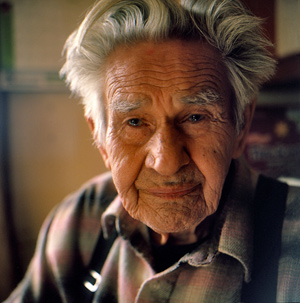
Larger than life, the faces of some of the last fluent speakers of the Haida language line the wall at the Haida Gwaii Museum. The stunning portraits of elders in Skidegate, Old Massett and Alaska who are keeping the language alive were taken by Vancouver-based photographer Farah Nosh, and are documented in a new book, That Which Makes Us Haida: The Haida Language.
Nosh began taking the photos in 2004, when she realized that the world's languages were being lost at an astonishing rate. She'd lived on and off on the islands, and felt the need to not only honour those who continued speaking their language in the face of all efforts made to stamp it out, but to inspire young people -- those who were not raised with the language vibrant in their homes, like these elders were -- and show them it wasn't too late to learn. Over the next several years, she went to 30 elders' homes to take a large format portrait, and gather stories about what the Haida language means to them.
Others got involved. Nika Collison, a curator of the exhibit and accompanying catalogue writes in the book that she remembers 30 years ago, when her chinaay (grandfather) Bill Reid's totem pole was raised in Skidegate. Since then, an artistic and cultural revival has swept her island home, and she hopes her children will think back 30 years from now and marvel at the revival of the Haida language too.
"The Haida language is not just a different way of speaking, it is a different way of thinking," she says. "It's how we understand our connection to the natural and supernatural. It is how we understand who we are."
The scary part, says Collison, is that half of the elders passed away before the exhibit and book about the revival of the Haida language were completed.
Reviving a endangered language
The Haida language is at a critical stage. There are many learning the language and others known as silent speakers (those who understand and might speak the language with a little extra effort), but there are fewer than 40 fluent speakers left.
Much work has been done. Dictionaries, glossaries and phrasebooks in the three remaining dialects (Massett, Skidegate and Alaska) have been developed, as well as orthographies used to write these dialects down. Instructional CDs have been recorded. Place names mapped. Songs transcribed and translated. Dinners have been organized in which participants speak only Haida, and some students have committed themselves to immersion learning by spending day after day with fluent speakers.
The writing and production of the play Sinxii'gangu in the Haida language was another milestone in getting new people involved and interested in learning Haida. New technologies are also being used. Animated films of Haida stories have been made in the Haida language, and a new app is available for iPods and iPads, with 2,000 Haida words and phrases written and paired with audio recordings of elders speaking the words.
The elders have said they'd be happy if one more person became fluent in Haida as a result of their work, said Collison. "Let's make it 100."
Below, meet a few Haida speakers, and hear how they work to keep their language alive.
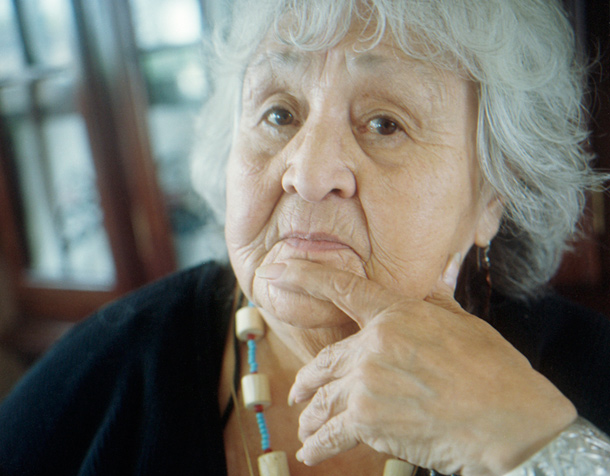
K'iis Gwaay Naan, Mary Swanson: K'iis Gwaay Naan has taught Xaad kil for almost 30 years, at Tahayghen Elementary School in Old Massett, the Xaad Kil GwaayganGee, night classes and the mentoring program. She is particularly crucial to the Xaad kil learning as she can speak, read and write fluently.
"We were born with the Haida language; we didn't know a word of English. This I tell to the kids quite often, because some of them think we never, ever spoke Haida. They think we just picked it up from somewhere. When we had to start talking English, that was a tough thing to learn too. Now we are trying to revive our language, and I'm hoping that we win it while I am still here."
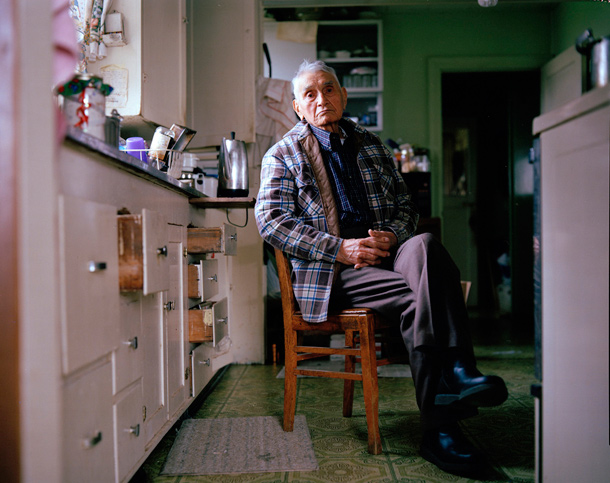
Kúng Skiís, Claude Morrison. 1910-2011: Kúng Skiís grew up speaking the K'íis Gwáay (Alaskan) dialect, and only began speaking English when he started school. He always maintained his fluency and taught the language to his grandson, Benjamin Young, during the last five years of his life.
"When I teach Ben, you know, we just have our own time. I keep correcting him. We talk Haida back and forth, he'd ask me, and I would make a sentence out of it for him. Any work he does here, he has a gin aa tl’áng gúusuugangs [digital recorder]. Those square things you talk Haida on. That's the way it is these days."
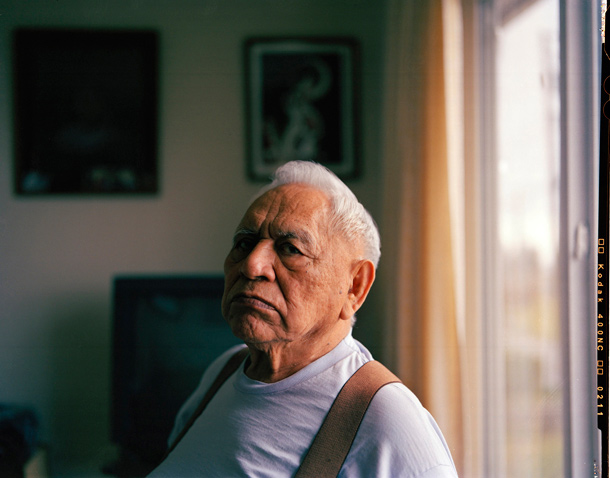
Nang King.aay 'uwans, James Young. 1923-2008: Nang King.aay 'uwans led his clan, the Naa 'Yuu'ans Skidegate Gidins, or the Big House People of the Skidegate Eagle clan, until his passing on Jan. 27, 2008. Nang King.aay 'uwans was the last trained oral historian in the Haida Nation. He learned this skill from his father.
"In the evening, it's only the grey-haired men that can sit at this fire: the Storytellers. They would tell my dad a story, the next night he has to tell the same story back to these grey-haired men. If he missed one word, just one word, the story’s over. The next night they’d tell him the same story again, and the next night he has to tell that same story again. When he gets it word for word, then they will tell him another story. This is how my dad was raised, to carry on the Haida history.”
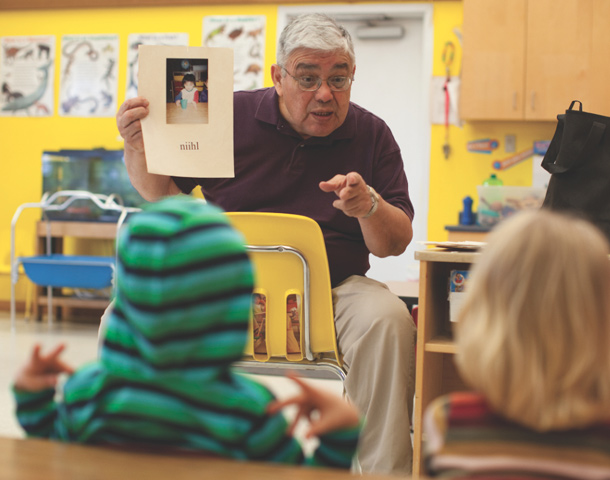
Gandaa.uu.ngaay, Herb Jones: Gandaa.uu.ngaay, meaning "always ready," was born to Frank and Dorothy Jones in Skidegate on Sept. 2, 1937. Gandaa.uu.ngaay began learning English when he was seven, just before he began Indian day school in Skidegate. He didn't speak Haida in school, but was able to keep speaking it in other parts of his life, especially when he traveled on the water with his family. He worked as a logger for 22 years, but when he retired, he and others started up the first Skidegate Haida Immersion Language Program in 1998.
"That was my life, travelling around with my grandparents. I didn't care if I came to school, that meant nothing to me. I learned practical things out there, like one of my uncles was teaching me, he told me in Haida, that if I ever got lost and had to stay in the bush overnight, to take a part of cedar bark and put it in between your clothing and yourself. If you had two shirts on, you put it in between. You won't get cold, that bark will keep you nice and warm all night."
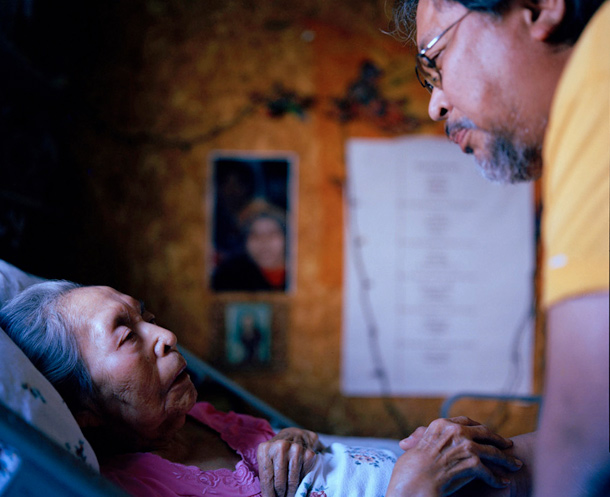
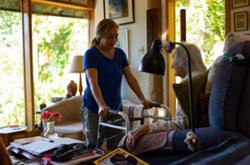
Mona Jackson: Mona Jackson was the last fluent speaker in the village of Kake, Alaska. Photographer Farah Nosh went to visit her before she died, and wrote these words about meeting her in her artist's statement in the book.
"Mona Jackson was approaching the end of her time in this life, and one of her final requests was to have a Haida speaker with her at her bedside, a request that was ultimately unfulfilled. As isolated as that may seem, Mona's bedside was not a lonely place, as there was always one of her children by her side. And while it pained me to know that there were not any other Haida speakers to share Mona's language with her in her final moments, her son Michael told me that his mother could be heard speaking Haida into the night; the Ancestors, he said, were starting to call her over. Mona Jackson died in Nov. 2005 with her daughter Cheryl by her side."
Cover image: Stephen Brown: Tsinnii Stephen divides his time between working at three language programs: Xaad Kil GwaayganGee, Chief Matthews School with Rhonda Bell, and George M. Dawson Secondary School. He also helps students in the Xaad Kil Mentoring program and uses his spare time to tape Haida language lessons, which he then copies and distributes to the community.
"All over the world, languages have changed, same as ours. Something that I seen in the modern Haida is that they shorten up on the words, like when they say 'dalang,' and in the modern Haida they say 'dl'ang.' That’s what makes it so different. I bring it up with the school kids every chance I get. I like to listen to real old people talk on tape, the Haida language sounds so perfect."
That Which Makes Us Haida: The Haida Language is available on the Haida Gwaii Museum website. You can find more about photographer Farah Nosh on her personal website. ![[Tyee]](/design-article.thetyee.ca/ui/img/yellowblob.png)
Read more: Indigenous, Education





Tyee Commenting Guidelines
Comments that violate guidelines risk being deleted, and violations may result in a temporary or permanent user ban. Maintain the spirit of good conversation to stay in the discussion.
*Please note The Tyee is not a forum for spreading misinformation about COVID-19, denying its existence or minimizing its risk to public health.
Do:
Do not: