

 SHARE:
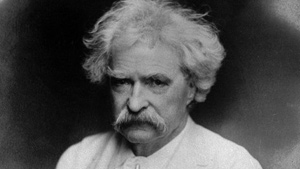
I'd been looking forward for months to reading Samuel Clemens's The Autobiography of Mark Twain -- until I actually set eyes on a copy.
Over 700 pages long (and just the first of three volumes), the book looked physically unmanageable without being read on a lectern. Having escaped carpal tunnel syndrome through 60 years of typing and keyboarding, I dreaded spraining my wrists by the mere act of reading.
So when I learned that the Autobiography was available as an e-book, I bought an e-reader, set it up, and downloaded a copy.
It was a wise purchase, both economically and ergonomically. An iPad, for my purposes, would have been overkill. I chose a Kobo because it lets me borrow e-books from my public library (no overdue fines: they vanish on the due date). It also comes with 100 free books, twice the number Kindle offers.
The Kobo is comfortable to hold, with simple controls. The main button is slightly awkward, placed in the lower right corner; my thumb wants it to be halfway up the right side. Text on the screen is highly readable, and I can choose serif or sans serif typefaces in several sizes.
Navigation: Easier on a Mississippi steamboat
Navigation, however, is kludgy. Even turning a page seems to take a long time. Skimming is possible, but only on a chapter-by-chapter basis. I can go back to the table of contents to find another chapter, or look for another book altogether, but it's a slow process.
Searching for a particular passage is impossible. Just as fast computers have trained us to be impatient, the ordinary book has trained us to flip back and forth at speeds the Kobo can't match.
So when I found myself plowing through the Autobiography's long, long introduction, I hesitated to fast-forward into Clemens's own text; I was afraid of getting lost. And indeed I did: At one point I thought I'd finished the whole thing because I'd completely missed a major section in the table of contents.
But Clemens himself on an e-reader is extremely congenial. The Autobiography began as a series of false starts over a long period before he settled down in 1906 to dictate it. His principle was to talk about whatever part of his life he felt like discussing that day, without regard for chronology.
Hypertext without the links
This is strikingly like hypertext, but without the links. Clemens himself surfs through his life, and we follow in his wake. It's worth trusting him; he can make any subject interesting, and he's surprisingly timely.
Sam Clemens was as interested in "new media" and copyright problems as any of today's tweeting journalists and blogging authors. Huckleberry Finn was the first novel delivered to a publisher as a typescript. Twain wasted a fortune investing in a new typesetting machine (and then wrote entertainingly about the horrendous experience). To get himself a better deal than publishers would offer, he went into self-publishing, selling his books by subscription.
Any modern author today will sympathize with Clemens's account of rescuing Ulysses S. Grant from the clutches of a publisher who was grossly underpaying him for a series of magazine articles. The ex-president, dying of throat cancer, wrote his memoirs to leave his family some money; Clemens made him a better deal than the publisher, and brought out the memoirs as an enormous best-seller.
Sitting on Sam's verandah
Clemens was writing in a time when readers' attention span was a lot longer than 140 characters. His sentences and paragraphs go on far too long for comfortable reading on a computer screen.
But on a Kobo screen, his text sparkles in easy-to-manage chunks. The conversational cadence of his prose carries me on from one sentence to the next, from one topic to the next. I feel I'm sitting with him on his veranda, listening to his stories while he smokes his cheap cigars. Whatever he's talking about, I'm eager to hear about it.
He is, after all, the great patriarch of our tribe, and in his pre-historic hypertext/stream of consciousness Clemens moves from one register to another as few writers can. At one moment he's writing with lyrical love about the summers he spent as a boy in the 1840s on his uncle's farm in Florida, Missouri, making us hungry for the meals and eager to join the fun. Then he's sadly recounting the lives and deaths of his classmates.
Scaring the dogs
Nostalgia vanishes in the prophet's wrath as he flays the "uniformed assassins" of the US Army conducting a genocidal war in the Philippines in the early 1900s.
And the moment after that, Sam Clemens is the funniest man in the English language, firing off one-liners that reduced me to convulsive laughter that alarmed my dogs. (He did the same thing to me in 1950 when I read Tom Sawyer in Grade 5.)
Another of his careers was that of a lecturer. He was the greatest standup comedian of his age -- far better than Petroleum V. Nasby, whose act he brilliantly describes. (See Hal Halbrook's Mark Twain Tonight for a sense of what he must have been like.)
The Autobiography reveals a man who is notably free of prejudice. As a boy in Missouri he took slavery for granted, but even then he respected blacks. Jim, in Huckleberry Finn, is based on a slave Clemens knew as a wise and competent man. In the Autobiography, when a black person has rendered a judgment on a person or situation, Clemens regards it as the last word on the subject.
I'm still not quite finished with the book, but it's become an enjoyable companion like old Sam Clemens himself. I look forward to the next two volumes.
Too much junk fiction
With luck, however, a new version of Kobo will be available by then -- faster, with search, bookmarking and annotation features. When one of the free books it offers is a 60-page Kobo user's manual, you know it's not as user-friendly as it should be.
An improved version of Kobo's website would also be welcome. It's searchable, and easy to shop on, but it's built too much around mass-market genres. Browsing the titles is about as rewarding as it would be at your local Safeway.
Romance fans have evidently taken to e-readers in a big way, and Kobo is offering countless titles in the genre. Science fiction is dominated by Star Wars franchise novels. Many of these books are free and worth every penny. (In fairness, I did enjoy a free fantasy novelette by Charles Stross).
Will the Kobo, Kindle, Nook and iPad eventually replace the printed book? No more than the web has replaced the library, and no more than later writers have replaced Mark Twain. ![[Tyee]](/design-article.thetyee.ca/ui/img/yellowblob.png)
Read more: Science + Tech











Tyee Commenting Guidelines
Comments that violate guidelines risk being deleted, and violations may result in a temporary or permanent user ban. Maintain the spirit of good conversation to stay in the discussion.
*Please note The Tyee is not a forum for spreading misinformation about COVID-19, denying its existence or minimizing its risk to public health.
Do:
Do not: