
Books

Tom Flanagan's Playbook for Ultimate Harper Victory

Rule one: Fear works. And more Conservative battle strategy laid bare by an early architect.

By Crawford Kilian, 8 Apr 2011, TheTyee.ca

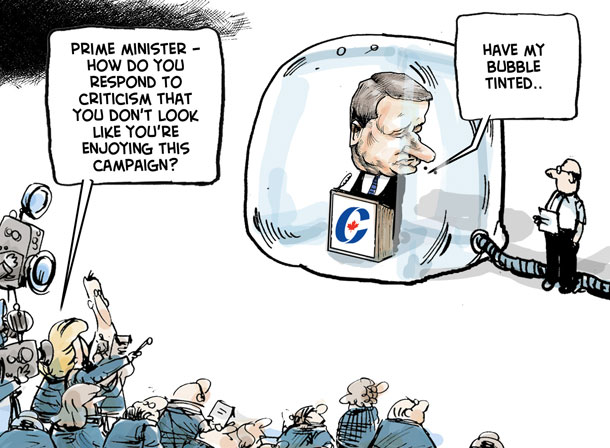
Cartoon about the 2011 federal election

Cartoon by Greg Perry.

Related

  • Reading Michael Ignatieff

    Whether writing on Iraq, Rwanda or Kosovo, the central character is himself.

  • Canada through Stephen Harper's Eyes

    What might he do with a majority? Well, he once called his country a "welfare state in the worst sense." Here's that speech.

  • So What DID Harper Say?

    The Conservative Leader's sound bite file on everything from taxes to Iraq, health care, gay marriage, nature, left wingers and keeping

  • Harper's Team: Behind the Scenes in the Conservative Rise to Power
  • Tom Flanagan
  • McGill-Queen's University Press (second revised edition) (2009)

Tom Flanagan is a likable guy. He shows up on TV political panels looking like your favourite uncle with some wicked wisecracks (OK, recommending the assassination of Julian Assange was maybe over the top).

He is also a serious academic at the University of Calgary. As he tells us in the second edition of Harper's Team: Behind the Scenes in the Conservative Rise to Power, he reveals that he is not just a political scientist; he is a political technologist, eager to learn the mechanics of gaining power and -- like any good teacher -- happy to pass his learning on to us.

While Flanagan no longer advises Stephen Harper, he was deeply involved in Harper's progress from right-wing propagandist to prime minister. In the 1980s, Flanagan says, Reform was "just another fringe movement, of which Alberta has seen so many."

But in 1990 he read Reform's "Blue Book" and loved it. It echoed his own views, which were inspired by the Austrian-British right-wing economist Friedrich Hayek. Hayek in those days was very much a fringe item, but was to give some kind of philosophical justification to thousands of conservatives who have never read him (very much like the left-wingers who've never read Marx).

As a full-time professor and part-time dabbler in Reform politics, Flanagan clearly saw Reform as a vehicle for Hayekian changes. His involvement with the young Stephen Harper was tentative at first, but before long they were close associates. They co-authored an important essay: "Our Benign Dictatorship: Can Canada Avoid a Second Century of Liberal Rule?"

Flanagan and Harper learned the ropes of backroom politics as Reform staggered through changes in name, brand and leadership early in the decade. Through it all, Flanagan was clearly taking detailed notes and drawing lessons from the experience.

Fear works

The key lesson: Fear works. Raising money to support Harper's leadership campaign taught him to follow "the time-honoured advice for raising money by direct mail -- make people angry and afraid, and set up an opponent for them to give against."

Even when success was assured, Flanagan wanted to ensure a good turnout of Harper's supporters in the Canadian Alliance leadership race: "We wanted them to be alarmed over the possibility that the Alliance might continue its disintegration... We were happy to let the media wallow in their own disinformation because we wanted our supporters to be motivated to vote."

He also learned "There's nothing so dirty that your opponents won't try to use it against you" -- and that was when Harper's opponents were other members of the Canadian Alliance.

Harper briefly hired an outspoken radio "shock jock" as his press secretary, and quickly learned the importance of message control. Harper, says Flanagan, "wants self-effacing media people around him."

These lessons served Harper well when he engineered the merger of the Alliance and the faltering Progressive Conservatives, and then became the leader of the Conservative Party of Canada. Soon he was planning a campaign against the Martin Liberals in 2004, with an energetic application of attack ads.

That campaign failed, but the Harper team drew more lessons from it -- including the Liberal attack ads that blasted him for supporting Bush's adventure in Iraq. The answer was to increase the use of feel-good Harper ads: "We still feared that hard-hitting negative ads would reinforce the 'scary' image that the Liberals were pinning on Harper." And when Harper talked about forming a majority government, it was a mistake. Flanagan cites an observer who noted that Harper was "scaring voters who might have trusted him with a minority but certainly not with a majority."

'Scaring the shit out of the Dippers'

"You cannot win," says Flanagan about the Liberals, "without a complete arsenal of negative ads to offset the effect of their attacks."

Harper's team also recognized and respected another Liberal tactic, which the Liberals themselves call "scaring the shit out of the Dippers" by posing the Conservatives as the greater evil.

Through this and later campaigns, Harper, Flanagan, and the team learned both to exploit and to survive the tactics of fear. "If chronically fearful moderate or left-wing voters become convinced that Conservatives are a threat to civilization as they think they know it, they are likely to vote for the Liberals rather than the NDP or Greens, because they may think only a Liberal government can keep the Conservatives out of power."

Hence, he argues, "a Conservative government must align itself tactically in Parliament with different parties or segments of parties over different issues" -- that is, form coalitions.

Flanagan's commandments

Flanagan's chapter "Ten Commandments of Conservative Campaigning" sums up what he learned:

1. Unity. The various factions and splinter groups within the CPC coalition have to get along.

2. Moderation. "Canada," says Flanagan, "is not yet a conservative or Conservative country. We can't win if we veer too far to the right of the median voter."

3. Inclusion. This means francophones and minority groups.

4. Incrementalism: "Make progress in small, practical steps."

5. Policy. "Since conservatism is not yet the dominant public philosophy, our policies may sometimes run against conventional wisdom. The onus is on us to help Canadians to understand what they are voting for."

6. Self-discipline. "The media are unforgiving of conservative errors, so we have to exercise strict discipline at all levels."

7. Toughness. "We cannot win by being Boy Scouts."

8. Grassroots politics. "Victories are earned one voter at a time."

9. Technology. "We must continue to be at the forefront in adapting new technologies to politics."

10. Persistence. "We have to correct our errors, learn from experience, and keep pushing ahead."

Judging from Flanagan's account, all these points could have been learned in Harper's first campaigns to lead his fellow Alliance members. Later experience seems to have driven those first lessons home rather than leading on to deeper and more respectful understanding of Canadians and the Canadian political process. As it is, Flanagan's and Harper's view of Canadians is that of a border collie facing 33 million sheep: a mighty challenge, but not one to be spurned.

Flanagan is no longer involved with the Conservatives except as a right-wing pundit. But the 2011 Conservative campaign still looks like another battle of a self-righteous paranoid fringe whose advocates will happily lie rather than admit what their real dreams are: a Canada where Friedrich Hayek would be happy.  [Tyee]

17  Comments:

Login or register to post comments

  • Rolf Auer

    1 year ago

    Wasn't Flanagan Harper's campaign manager?

    Not only that, he's a Fraser Institute acolyte.

    "Why War In Afganistan?" (article)
    "Harper Government Stifles Freedom of Speech" (article)
    "The Harper Government Mismanages The Economy" (article) and more..

    My federal politics blog: clearpolitics.wordpress dot com

    (Click "About" re reading posts, or on my picture.)
    @Rolf_Auer

  • G West

    1 year ago

    Don Tomaso

    Little is known about the shadowy, sixty-year-old professor who is staying on Harper’s post-election payroll as a senior advisor from Calgary. Flanagan declined to be quoted in this story. In Ottawa, where he has refused interviews for the last three years, some journalists regard him as a modern-day Rasputin manipulating a leader sixteen years his junior. But in Calgary, one of his former students, Ezra Levant, publisher of the eight-month-old Western Standard magazine, cautions against that generational cliché. These days, Levant sees Flanagan and Harper more as “symbiotic partners.” But he does not disagree with a Globe and Mail report that once referred to Flanagan as the original godfather of the city’s conservative intellectual mafia. “I call him Don Tomaso,” Levant says. “He is the master strategist, the godfather — even of Harper.”

    From Marci MacDonald in the Walrus...
    http://www.walrusmagazine.com/articles/the-man-behind-stephen-harper-tom-flanagan/

  • Jeffrey J.

    1 year ago

    Fear Works - Truly Anti-Democratic

    "The key lesson: Fear works...follow "the time-honoured advice for raising money...make people angry and afraid, and set up an opponent for them to give against."

    This says it all. Manipulative. Dishonest. Deceitful.

    A sad era for Canada. Let's hope we can change course.

    Excellent coverage!

  • jim1966

    1 year ago

    Good Story

    One wonders though why Canadians have not elected to have a Conservative majority. I do believe that the Cons policies have impaired their goal in achieving a majority. On May 2/11 the Cons will once again feel this impact from voters and guess what?, no majority!

  • freebear

    1 year ago

    Harper announced Platform today!

    I call it the "I.O.U.' Platform; or the 'Cheque is in the mail' Platform; with many promises (with strings) coming about when and if they balance the budget in 2014-2015; or 2015-2016?

    Trust us!

    Oh, and a week after their budget; they are all of a sudden a year earlier in balancing the budget!

    Just give us a majority, repeat:

    Trust us!

    Thanks, but no thanks, eh!

  • Nimno

    1 year ago

    Maybe it's time

    Any politician who counts on the ignorance of the voter is rarely disappointed. It may well be time to realize a Conservative majority and put our hand into the fire.

  • OhCanada

    1 year ago

    Fear Works for those who can't think for themselves

    I agree with Jeffrey J. "Manipulative. Dishonest. Deceitful."

    Absolutely. And you must ask yourself these question and your friends, coworkers these questions...

    - Would you choose differetly if your decision was not based on fear?
    - Why would a government want you to make a choice based on fears? Would it be because they want to manipulate you?
    - Why would any calling themselves democratic government want you to be fearful? Whose purpose would that serve?

    In a truly democractic and respectful society choices aren't based on fear, people aren't bullied into decisions based on fear.

    People who think for themselves and pride themselves to be intelligent enough to see through the BS will choose a government that will propel the society to prosperity and growth.
    People who think about themselves only and/or are fearful will choose a government that will constrict personal freedom and bully/rule its citizens where no growth and no prosperity will exists for the majority but only for a very few minority who preys on the majority's fear. Good concept (?) - that is how Hitler ruled.

    Think about it for a moment and watch the body language of Harper, their manipulative behaviours and many of the little clues that the media seems to miss ...

    To be able to go and vote = you use your power - regardless of the current choices.

    This is how thing will start to change.

    Giving that power (your vote) away to a handful of minority is foolish and down right stupid. Harper won because people didn't bother to vote.

    I say time to take back your power if you have not voted in the last election.

  • SharingIsGood

    1 year ago

    Riding the Fox's Tales

    The facts are in, rather than technology simplifying our lives, it has caused life to become more stressful. Traditional blue collar jobs have been replaced by jobs that require reading technical manuals, using computers and operating and fixing highly complex equipment. White color positions now require managers to word-process and distribute their communications themselves - no more secretaries and typing pools. There are no secretaries, only personal assistants and communications staff. "Pink collar workers" have been replaced by people taking and punching in orders while simultaneously making change, bagging and handing another customer his or her completed order through a window. Educators, nurses and other professional people have had to up their game as well. If one can't keep up, there are plenty of other unemployed people waiting for a job; and if you are in manufacturing, your job may be shipped t Asia on any given day. The world of work for many is a fast-paced, stressful place - let alone a daily commute home to the burbs.

    No longer dealing with adrenaline-inducing work and commutes, many older voters watch a great deal of TV. It's my experience that many of these retirees continue taking the emotion-numbing anti-depressants they took to get them through the last 10-15 years of their ever-more-stressful work. It's my experience that many have become addicted to disaster TV. They tell me that at night they watch shows like CSI, NCIS, Law and Order, and Crimminal Minds. In the wee hours when they difficulty sleeping and during the day they watch CNN if there is a hurricane in Louisianna or Haiti, a tsunami/earthquake in Asia, or a major offensive in Iraq or Libya. When the real-life disasters ebb, they switchto over-the-top, fear-mongering pundants and analysts like Glenn Beck and Bill O'Reilly found on Fox News. When listening to the radio, it's talk radio they listen to. They listen to the likes of Rush Limbaugh, Charles Adler, Bill Good and Christy Clark. The Harper gang has gotten a boost from the cable and satellite TV (Fox News). As Fox has pandered heavily to the Tea Party/hard right of the Republican Party, it seems natural for the talk radio listeners/Fox News watchers to agree with Harper logic - physiologically it feels a lot like going to work used to feel, only without having to actually do anything.

    Right wing main stream media is the only mains stream media left in Canada. Even the CBC has been forced to the right in order to maintain life support funding. Peter Mansbridge's inclusion at last year's Bilderberger convention speaks volumes about the direction that the CBC gone.

    All Canadian MSM declare the Libs, the NDP, the Greens and the PQ to be left wing. Of course, the separatist PQ and the socialist NDP are the scariest. Yep, it's better just to give the hard right a majority, and we can have a wonderful country like the Tea Pary wants for the USA.

  • OhCanada

    1 year ago

    RE: Riding the Fox's tales- a.k.a - 51st State of the US

    And let me add to this
    "it's better just to give the hard right a majority, and we can have a wonderful country like the Tea Pary wants for the USA."

    ... and Canada just became the 51st State of the USA ... isn't that wonderful?

    SharingIsGood - Nice summary.

  • morechatter

    1 year ago

    I do believe

    It is Harper's kingdom and not the party in power. Harper takes Canadians government pokes holes in it, makes fun of it, has his way with it, and then makes it his own. I was reading Carson helped Harper come into power in 2004. He was invaluable, Harper wins a minority, on accountability, no more- no less. If Harper's bubble bursts he doesn't have to worry he has enough Conservatives on board to keep it full of hot air?

  • janetvickers

    1 year ago

    Inundated with bad news we are deer in a headlight

    If the majority of Canadians can't see where we are heading, and can't see that self-interest includes justice for all, then we shall have plenty more to fear. World War III where our streets are potholes and our windows shattered - all to keep the oil companies and arms industries rich. We are letting the manipulators turn our world into one where only the powerful can survive.

  • greengreen

    1 year ago

    All Non-conservatives had

    All Non-conservatives had better get off their ass and vote or we are doomed. No excuses, no wimpiness. Get out their and vote: ABC Any body but conservative.
    Get off your ass!

  • Pro Sequitur

    1 year ago

    Conservative Majority

    Reply to:
    jim1966
    1 day ago
    Who said:
    Good Story
    One wonders though why Canadians have not elected to have a Conservative majority. I do believe that the Cons policies have impaired their goal in achieving a majority. On May 2/11 the Cons will once again feel this impact from voters and guess what?, no majority!
    ............
    Agreed, good story and good comments.

    To me, the reason Canadians have not, and will not elect a Conservative majority is rooted in their authoritarian psychology. Authoritarians, people whose psychology is primarily integrated around relating to the world in terms of power and control over it, and the primacy of dominance and submission in human relationships only constitute a minority in any society (say 10 – 15%). Their polar opposite, the anti-
    authoritarians, who abhor such a way of relating, also constitute a similar minority. The vast majority of people lay somewhere in between alternating between the two modes of relationship – power, dominance and submission, and empathy, compassion and egalitarianism.

    The authoritarian minority of the population responds to the authoritarian “leadership's” bullying and fear mongering as expected, very fearfully and submissively; while the anti-authoritarian minority tend to react in opposite fashion, with anger and revulsion directed at the “leadership”. But the vast majority are somewhat ambivalent, often responding ambiguously to the authoritarians' bullying bombast and fear mongering. They may experience an ongoing dissonance and unease with the ongoing authoritarian messages, so the full support of the major can never be long assured, unless they can be kept terrified. Hence their Rule One: fear Works.

  • lynn

    1 year ago

    how we vote

    Agree, good article and comments.

    Pro Sequitur: An interesting and worthy analysis.

    In regard to that ambiguous often ambivalent middle ground of the majority it is also important to remember these words from Marci MacDonald's article in 'The Walrus":

    "But back in Alberta, Ted Byfield, the unabashed voice of the West since the Calgary School’s professors were pups, sees it another way – in terms Leo Strauss might have approved. “All these positions which Harper cherishes are there because of a group of people in Calgary – Flanagan most prominent among them,” Byfield says. “I don’t think he knows how to compromise. It’s not in his genes. The issue now is: how do we fool the world into thinking we’re moving to the left when we’re not?”

    Thus, that ambivalence (of the vast majority in the middle) that you aptly mention, Pro Sequitur, holds its own dangers - precisely in the ease in which that middle ground are often convinced, some would say seduced.

    But there is definitely differing psychologies at work here -and there is often a profound, and often over-looked relationship between the candidate and who ultimately votes for him/her. (Similar to the values and psychology behind a photographer selection of which image to shoot... and thus make permanent. The result, the final image, is both determined by and inextricably linked to the personal choice made.)

    There in lies individual accountability for good, or for bad.

    So while we focus on candidates, it is good, indeed highly revealing, to ask questions like:

    What kind of person votes for an authoritarian government like The Harper Conservatives?

    Polonius from Shakespeare's Hamlet Act 3, Scene 1:

    "We are oft to blame in this,

    'Tis too much proved - that with devotion's visage

    And pious action we do sugar o'er

    The devil himself."

  • Hughes

    1 year ago

    I Stand on Guard for thee -- not -- In God We Trust nor Hape

    Stand on Guard for thee -- not -- In God We Trust, or Harper for that matter.

    I've been very suspect of Flanagan 'n' the cagey Harper ever since I read Marci MacDonald's article, The Man Behind Stephen Harper, in The Walrus half a dozen years ago, and cited by GWest above.

    The deeper I delve into Harper's past, and witness his current praxis, the more I fear a Harper majority.

    http://www.youtube.com/watch?v=fGXGwr3nr7g

  • Zandoli

    1 year ago

    The dangerous Prof./Dr. Flanagan

    I'm rarely more chuffed than when I see this American import being bad-mouthed.

    Having had an eye on his anti-Aboriginal efforts for two decades now, I can say he is indeed a piece of work.

    Just imagine how many of us he'd like to have assassinated! I don't imagine that if the shoe was on the other foot and it was his ox being gored that he would respond with twinkly-eyed bonhomie, but would love to find out.

  • brg61

    1 year ago

    Consumed by the game.

    Harper conservatives are obsessed with politics; they either don't believe or deliberately ignore their obligation of service to all Canadians.
    The line between responsible government and partisan politics vanished 5 years ago as Harper's top priority became winning 155 plus seats. Legislation and policy is crafted to appeal to isolated demographic groups identified as potential tory voters.
    A tight club of insiders operate in the PMO where Harper has firm control.
    Harper's control only tightens as dubious spending estimates without credible detail raise questions dodged by ministers left out of the loop.

    • The discussion for this story is closed. No more comments can be added.