


- Death of the Liberal Class
- Knopf Canada (2010)
Chris Hedges' latest book, Death of the Liberal Class, argues that American liberalism is not just dead; it's been rotting for a century or more. He makes a persuasive case, especially as we watch the Arabs rise up in disgust against the masters the Americans imposed on them.
Liberals have always placed themselves on the "progressive" left: against slavery and war, for freedom of speech, for extending the franchise and for dealing fairly with the rest of the world. If the conservative right supports the private enterprise of the corporations, the liberal left sees solutions in government acting as the agent of the voters.
Liberals may talk a good game, Hedges says, but they always give in to right-wing and corporate pressure. He argues that American liberals have been effectively dead since Woodrow Wilson (a Virginia-born racist) took over from Teddy Roosevelt (a New York-born racist).
Roosevelt, after all, was an imperialist who detached Panama from Colombia so he could get a better deal for the canal he wanted to build. He also made an illegal deal with Japan, giving it a free hand in Korea, and conducted a genocidal war against the just-conquered Filipinos. Wilson got re-elected by keeping the U.S. out of the First World War, and then went to war anyway. In the process, he also suppressed dissent, censored the media, and launched the first American Red scare.
A scrapbook of grievances
Hedges is a good journalist. He's done his homework. But his book is a kind of scrapbook of grievances, all of them real yet going nowhere.
He persuades me that self-described liberals long ago deserted their own values. They prefer to fight wars of conquest, pump tax dollars into armies and defence industries, desert their working-class and middle-class base, and allow corporations to set the American (and Canadian) agenda.
Like Periclean Athens, the modern U.S. has coerced its client-allies into doing its bidding. Poland, barely freed from the Soviets, provided the Americans with secret prisons for suspected terrorists. Canada resisted going into the Iraq War, but it was already in Afghanistan and allowed the U.S. to kidnap Maher Arar. Our own Liberals have gone from UN peacemakers to U.S. powder-monkeys, while the Conservatives spend our money on American fighter planes.
Crowding the left out of the frame
As well, Hedges argues that our freedom of speech has been steadily reduced by the concentration of media corporations. They have re-framed political discourse so that the "centre" is now the right, and liberals themselves are cast into the darkness of the "far left." The implication is that truly liberal or socialist ideas might have gained support if they hadn't been silenced.
This is true. The socialism of Eugene Debs and J.S. Woodsworth could well have evolved into a major force in both countries. The American Communist party, in the 1930s and 40s, was the only party advocating genuine racial equality.
But none of those parties could respond to the imaginative tactics of their adversaries. Canada's New Democrats gave us medicare, but they're a permanent minority, surviving only by moving right. As historian Tony Judt noted in his last book, we don't even know how to talk about our problems any more.
With no left wing to voice their grievances, America's unemployed have moved, ironically, to the right-wing Tea Party movement funded by the corporations that deprived them of work. But as Tony Judt also pointed out, when middle-class and working-class Europeans lost work after the First World War, they went to the fascists.
No democracy for client states
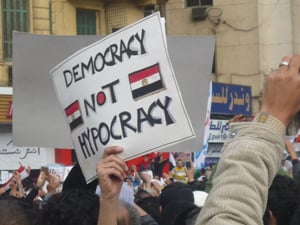
Tunisia, Yemen, and especially Egypt have enabled us to reconsider the post-Soviet status quo we have dozed through for 20 years. The people of Tahrir Square remind us that for all its professed love of democracy, the U.S. doesn't like it in its client states. Better to support a military dictator for 30 years rather than deal with a fairly elected government that might dare to disagree with American policy.
Egypt also reminds us of all the other countries who saw their democracies strangled by the U.S.: Guatemala, Guyana, Iran, Nicaragua, Chile, Haiti, even tiny Grenada. And the countries where local democracies were ousted by local military: the Americans tolerated the juntas of Greece, Algeria, Argentina, and Brazil.
Even clienthood is no guarantee of security. Noriega ran Panama until he became inconvenient. Saddam Hussein went from "force for stability" in the 1980s to arch-villain in 2003. Mubarak, also once a force, is now an embarrassing has-been.
It doesn't take a stretch of the imagination to foresee instant hostility even to us if we ever dared to part ways with American policy. (LBJ famously shook Lester Pearson by the lapels for criticizing the war in Vietnam.)
A parallel world
Imagine a parallel America in which the Democrats in Washington fund Republican state politicians who promise to support Obama. Anti-Obama Republican governors see federal money dry up, while the news media demonize them. In some cases, the National Guard throws out such governors (and state legislators), replacing them with military governments. When "democracy" does return to such states, Republicans are barred from running.
No, it wouldn't be very democratic at all, but that's the way the U.S. runs the world outside its borders.
Internally, functional democracies deal with their citizens' competing interests and opinions, and work out compromises. If Egypt's post-Tahrir democratic government includes the Muslim Brotherhood, the U.S. should be able to deal effectively with that government, rather than automatically trying to subvert it.
This seems not only reasonable, but in American interests: Time and again since the end of the Second World War, U.S. subversion of foreign democracies, and support for cooperative dictators, has only lent legitimacy to extremists. The most glaring example is the overthrow of the democratic Iranian prime minister Mohammed Mossadegh and the restoration of the Shah, which led inexorably to the rise of the ayatollahs.
A sold-out liberal class
Hedges would say, rightly, that respect for other democracies is not on the agenda of the corporate state. (He would also say that the parallel-world argument is irrelevant because the liberal class has already sold out to the corporate state; democracy is as dead in the U.S. as it is in Haiti or Saudi Arabia.)
For most of his book, Hedges ricochets from one outrage to the next, going back to forgotten scandals of the 1930s and forward to very recent failures of the Obama government.
I can't disagree. These outrages did happen, and are happening still. Canada is complicit in them, from the rendition of Maher Arar to the ongoing imprisonment of Omar Khadr.
But what, I wonder, is the point of Hedges' jeremiad? It emerges only at the end, and he expresses it in the overheated rhetoric of Jack London's prophetic 1911 novel The Iron Heel. But it boils down to "duck and cover."
Bad to the last drop
Having overwhelmed and subverted democracy, Hedges says, the corporate state is now hell-bent for an environmental catastrophe. It will suck the last drop out of the tar sands and use it to fire one last drone-mounted missile on some wretched family trying to stay alive, whether in Tahrir Square or Pakistan or the suburbs of Washington, D.C.
Faced with this cataclysm, all we self-styled liberals can do is hunker down in environmentally sustainable farming communities and hope to God we survive the collapse.
Well, that was the solution for the fall of the Roman Empire, and for the collapse of the Mayan kingdoms. The 100-mile diet was not a lifestyle choice for the post-imperial Mayans; more like a one-kilometre diet.
But I think Hedges gives corporate America too much credit. The people in Tahrir Square are showing us that we can at least cripple our oppressors, and maybe drive them out of office. We just have to be desperate enough to have some hope, and scared enough to find some courage.
The Mayan priest-kings finally couldn't feed the peasants who supported them. The priest-kings vanished but the peasants endured. The corporate America that kept Mubarak in power for three decades will one day know how the priest-kings felt. The sooner we teach them that, the more of us will survive. ![[Tyee]](/design-article.thetyee.ca/ui/img/yellowblob.png)
Read more: Politics










Tyee Commenting Guidelines
Comments that violate guidelines risk being deleted, and violations may result in a temporary or permanent user ban. Maintain the spirit of good conversation to stay in the discussion.
*Please note The Tyee is not a forum for spreading misinformation about COVID-19, denying its existence or minimizing its risk to public health.
Do:
Do not: