

 SHARE:
Look into just about any theatre and catch an odd paradox at play: The audience, grey haired, watches actors much younger pronounce and emote.
For aging actors facing a dearth of roles to begin with, and who find themselves losing parts to the next generation, it can feel like a tragicomedy.
Veteran theatre actors like Julie Walters and Ian McKellen have recently spoken about the discrepancy between the age of theatregoers and the number of roles for the older actor.
"Youth is not everything. Now we have all the baby boomers in their 60s, like me, who are actively engaged in life -- we're not retiring, we're not just being put out to grass once we hit 60," Walters told the Sunday Telegraph.
With one in five Canadians over 50 in just a few years, why don't we see more stories on the stage about them? What would that look like? Would it make for compelling theatre?
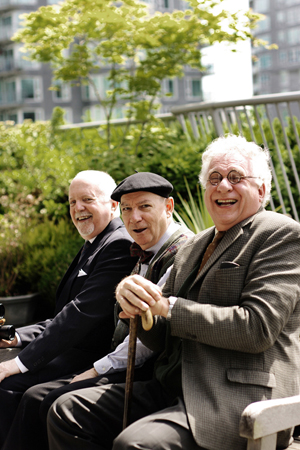
One group in Vancouver is taking on the challenge. Four local actors in their 60s -- Terence Kelly, Michael Dobbins, William Samples and John Innes -- recently launched a theatre co-operative, "The FOG Theatre," to help provide work for older actors, to promote a mentoring environment in which younger and older talents can work together, and to put their venue, The Performing Arts Lodge Theatre, on the map.
Canada's young canon
"Vancouver is definitely a city where you have to create your own work," FOG actor Dobbins told The Tyee. "And so just as I've been saying to young people all my career: 'I don't have enough work to go around, you'll have to create your own work,' now that's exactly what we're doing."
The group's aptly chosen first production is Tom Stoppard's Heroes, which features a trio of First World War veterans talking on the veranda of their retirement home. Often compared to Waiting for Godot, it's a musing on the human condition -- one in which very little happens. There are battles with machine gun fire, a moving statue, and treacherous adventures across rivers, all taking place in the characters' imaginations.
Warm and darkly funny, the play is nevertheless a reminder of the complexity around age in theatre. Some critics consider it a one-dimensional portrayal of older people. The FOG chose it because of its gentle musings on universal themes of friendship and age.
As a script, Heroes bucks a trend. From Euripides to Shakespeare, Wilde to Walker, the number of roles written for younger actors outweighs all others.
"For every Lear there are five Hamlets," estimated Jerry Wasserman, professor of English and theatre at the University of British Columbia.
The FOG's Innes believes that the development of Canada's theatre culture -- still in early stages compared to other Western theatre tradtions -- accentuated this discrepancy with a canon primarily created by young people.
"When we were beginning... you had the whole field dominated by experienced, trained older actors. As we aged, a new, younger generation came in. And they wanted to tell their story, writing about their experiences, their age."
"I spent my whole life involved in Canadian plays. Storytellers were young, and they wrote stories about their lives and about how they saw the world," Dobbins added.
Profilic U.S. theatre critic Scott Walker echoed these sentiments in a recent post on his website, Theatre Ideas, defending older demographics in arts: "Our entire culture is set up to worship youth…You want to talk about diversity? Maybe that's something that ought to be addressed."
Bringing the UK home
In the UK at least, there appears to be more happening for older performers. Culture writer Mark Lawson recently profiled a number of British productions that feature baby boomers in lead roles for The Guardian, though some of the productions mostly cater to boomer nostalgia, with activities of the '60s fully regaled.
("That's enough plays knocking the radicals of the 1960s, thanks! If only we could be as radical in these times of crisis. New hippies now!" dramatist Mark Ravenhill tweeted upon hearing about the influx of such stories.)
But others not only employ older actors, they dig deep into some of the emerging societal tensions around age. Love, Love, Love by Mike Bartlett looks at two radicals from the '60s, now-turned divorced, rich and pompous in old age. The conflicting political values of the characters and those of their children echo real-world clashes between Gen Ys and Boomers over wealth distribution and the fact that today's children will be less well-off than their parents. One cutting line says it best: "You didn't change the world. You bought it."
Similar themes are explored in Ella Hickson's Boys, and The Last of the Haussmans, by Stephen Beresford. Such diversity of age and content on stage is welcome and needed, say members of FOG.
"Unless you really go looking for it, primarily you're receiving information that will make you feel more comfortable in your world," said Innes. "But one of the things about theatre is that it asks you to expand, it lets you expand. It's an opportunity to be challenged by one another."
The FOG actors hope their example will encourage other older artists to take to the stage and produce their own ventures, especially in the Performing Arts Lodge where Heroes launched and where Samples, Innes and Dobbins live. The company's production is the longest-ever run within the theatre, a record they hope will soon be broken.
As director Kelly put it, "In a way we're crusaders -- it's kind of a crusade for us -- particularly for our age group."
The FOG Theatre's city premiere of Heroes runs from Sept. 6 to 30 in Vancouver. For ticket information, go here. ![[Tyee]](/design-article.thetyee.ca/ui/img/yellowblob.png)
Read more: Local Economy









Tyee Commenting Guidelines
Comments that violate guidelines risk being deleted, and violations may result in a temporary or permanent user ban. Maintain the spirit of good conversation to stay in the discussion.
*Please note The Tyee is not a forum for spreading misinformation about COVID-19, denying its existence or minimizing its risk to public health.
Do:
Do not: