
Artsculture

'The Trotsky' and 'The Maid'

Two small films offer an antidote to Hollywood's idiotic portrayals of class division.

By Dorothy Woodend, 21 May 2010, TheTyee.ca

Still from 'The Maid' movie

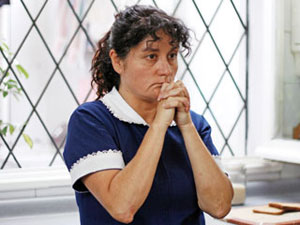
Raquel, played by Catalina Saavedra in 'The Maid.'

Related

"Art, it is said, is not a mirror, but a hammer: it does not reflect, it shapes. But at present even the handling of a hammer is taught with the help of a mirror, a sensitive film which records all the movement..." -- Leon Trotsky

There are not a large number of films that deal directly with the hoary issue of class differences. But you don't need to look hard to see the issue of class is there anyway, squatting in the centre of things, obdurate and immovable and never mentioned.

This elephant, in American film, is practically everywhere, from the middle-class wieners buying more stuff than is right or proper (witness the phenomena that is Sex in the City) to the perpetual triumph of the stupid and the crass over the educated and refined. This particular theme seems to have been the foundation of almost every American comedy since about 1972.

I know this. So how is it that I still am boggled that something like The Blind Side even gets made, much less celebrated? The sheer horror of this film is compounded by the frightening reality of race and class relations that look to be getting more insane every day in the good old U.S. of A.

Only in the movies, you say?

Not a big deal in, say, laid back Lotus Land?

Well, if you live in Vancouver, as I do, you see class playing itself out in discussions on school playgrounds and at kids' birthday parties, places where different groups of people are brought together purely through their children being in the same school. I have seen people's eyes close down, like a garage door rolling shut, when they ask me about my mortgage, and I say, "I don't have one, I rent." I might as well have said, "I am an untouchable. If you stand here talking to me, you too might catch the taint." I exaggerate, but only a little. Any means for humans to differentiate ourselves through wealth or class, and we will still generally take it.

'The Trotsky'

At least, however, at the moment there are a couple of films playing in the theatres that poke a bit at the notion of class differences in society and the struggle for humans to live more easily with each other. 

Jacob Tierney's The Trotsky relocates the struggle for the proletariat into a particularly burnished section of Montreal. A teenager named Leon Bronstein (played by Jay Baruchel) is first depicted staging a hunger strike at his father's factory. Leon's plans for a mass uprising meet with bemusement from the workers and apoplexy from his father (played by Saul Rubinek).

Seems little Leon fancies himself the reincarnation of Big Leon (Trotsky that is) and is determined to relive his idol's life, right down to his ice pick in the brainpan.

Why Leon wants to do this exactly is never really made clear. Whether he is suffering from some odd form of adolescent megalomania, or incipient mental illness, Leon's delusions simply are. And so, things proceed accordingly. 

After he gets kicked out of his private school, Leon sets up shop in the local high school and begins to foment unrest. The film owes a great deal to other precocious youth in angst films, most notably Wes Anderson's Rushmore. He may lack the dapper red beret of Max Fisher but Leon has the skinny tie, sharp suit and little round glasses of a true revolutionary. After securing the services of an older social activist-cum-lawyer, Leon also meets and attempts to immediately bed the woman of his dreams, the aptly named Alexandra (the name of the real Trotsky's wife naturally).

Meanwhile, the turmoil in the trenches of high school slowly begins to boil. A hostage situation, a few dream sequences featuring the famous baby carriage scene from Battleship Potemkin, a stand off with the cops and the school board, and it's all over. What was achieved is unclear, but the call for permanent revolution rings out. Whether anyone is actually listening is hard to say.

Toying with revolution

When I first saw The Trotsky at the Whistler Film Festival, I must admit I was confused. It's amusing in places, wadded full of familiar Canadian actors (Rubinek, Colm Feore, even Geneviève Bujold) and reasonably entertaining. But what exactly is its purpose? An Orwellian Animal Farm analogy it is not. There are no Napoleons or Snowballs, masquerading as political figures or vise versa.

Even as Leon thrashes about, trying to find his own Lenin and Stalin, doubting the revolutionary zeal of his comrades, and being hauled off by the cops, there is no sense that his struggle is little more than a game of make believe. So is the class struggle, all those big ideas from big thinkers, merely akin to a teenage pipe dream? If this ultimately is the film's intent, a form of diminishment, a diminutive version of big moments in history, it's worth actually getting the real goods, whether that means reading Trotsky's own memoir or the slew of recent biographies of the man. Of these, Robert Service's book Trotsky: A Biography, is worth checking out. Here's a little taste.

It's a letdown to go from such mammoth ideas to something like The Trotsky. Certainly the film is cute in places, but the larger ideas that little Leon is messing about with are never any more than cardboard cutouts, a child's approximation of political thinking. The issues of power, authority, revolution are tossed about like toys, but the kids in Leon's high school, if they are truly to stand in for the proletariat, seem ultimately as little interested as the genuine article.

Or in the real words of the real Trotsky: "We would be compelled to acknowledge that Stalinism was rooted not in the backwardness of the country, but in the congenital incapability of the proletariat to be a ruling class."

'The Maid'

A more complex and complicated examination of the way class and economic difference manifests in human relationships takes place in Sebastian Silva's The Maid (playing next week at Vancity Theatre in Vancouver). The titular character of the film is one Raquel, a grim-faced wretch, who has worked as the house cleaner for the Valdezes family for more than 20 years. On the eve of her 41st birthday, Raquel (Catalina Saavedra) looks to be standing on the edge of madness, or some other form of breakdown.

Even as the family that she has cared and cleaned for bring her a birthday cake and a few gifts, Raquel retains her solitary air; a deep cloud of loneliness hovers around her like an odour. Even though she has lived with the Valdezes family for most of her adult life, Raquel is never a part of them. It is this distinction, essentially the division between people with money and those without, that is almost unassailable. 

When Raquel suffers from a fainting spell, the decision is made to hire some additional help. To Raquel, who seems to regard the Valdezes house and people as her personal fiefdom, this is the ultimate betrayal. The entire Valdezes clan appears a little afraid of her, with the exception of their teenage son, whose robust new masturbatory habits keep him preoccupied.

As each new maid is scared off, or forced into quitting after suffering through Raquel's hostile attitude, the atmosphere of the house deepens into an extended cold war. It takes a force of nature, a farm girl named Lucy who is possessed of an impenetrable cheer, and an extra supply of joie de vivre to break the ice. The Maid is lovely film, thoughtful, intelligent and deeply human. As a portrait of one individual struggling with the socio-economic forces that define her role and relationships, it very gently takes apart the forces that disallow equality.

'What is the way forward?'

The larger issue for films like The Maid and The Trotsky is that they are essentially smaller niche market films. They will play a number of film festivals and art house cinemas, while something like The Blind Side has an audience of millions. In an early speech, the real Leon Trotsky heralded the ability of the cinema to advance society to some new type of evolution. "What is the way forward? Fundamentally, it is the growth of literacy, education, special courses for workers, the cinema, the gradual reconstruction of everyday life, the further advance in the cultural level..."

Just don't tell this to Sandra Bullock.  [Tyee]

23  Comments:

Login or register to post comments

  • mightyfastpig

    1 year ago

    Class-blindness

    Forget about race... the real unspeakable taboo in North American society is class. It is best approached through misdirection and comedy, like other taboos. Consider the "Stuff White People Like" book and blog, which is really about a particular strain of middle-class bohemian. Or the post-1972 comedies Ms. Woodend mentioned, which are largely about class conflict, though from a populist, "stick it to the man" perspective.

    It's kind of sad that the life of Trotsky is remembered, not as tragedy, but as farce (to paraphrase Karl Marx).

  • charlesdemers

    1 year ago

    The Trotsky

    Another great essay, Dorothy. I saw The Trotsky this week, and, though I agree that the script was a bit of a mess, I have a soft spot for it (most likely because I spent my teens in a Trot sect, and, like Leon, led a walk-out from my high school).

    I also wrestled with what the film was trying to say, whether it was mocking or diminishing the ideas of social change and even revolution. Though it was certainly having some fun with them, ultimately I don't think it was dismissing them -- the key scene, for me, was the once-cynical, now-inspired old Berkeley lawyer's exchange with the Stephen Lewis Foundation-working school board president.

    His defense of the ridiculous in the age of the "post-post-modern" reminded me a lot of Zizek's injunction to reclaim Communism, or his idea that 'the true act creates the conditions of its own possibilities' -- I thought the film basically settled on the thesis that for someone to break out of the narrow political strictures of our dysfunctional world, it would involve risking looking (and even being) ridiculous by our cynical, irony-tempered sensibilities...

  • Janie Jones

    1 year ago

    All that murder for nothing.

    "We would be compelled to acknowledge that Stalinism was rooted not in the backwardness of the country, but in the congenital incapability of the proletariat to be a ruling class."

    Oh gee too bad. Guess those tens of millions of bourgeoise Russians were looted, enslaved and murdered for nothing.

    Looking forward to The Hitler, The Pol Pot and The Idi Amin. Guess which one had the highest body count. EDITED -- PLEASE REVIEW OUR COMMENT CODE -- TYEE MODERATOR

  • Janie Jones

    1 year ago

    Yes, it was

    The Trotsky.

  • RickW

    1 year ago

    Gee How nicely this article dovetails with.......

    http://thetyee.ca/Opinion/2010/05/17/HarpersChristianWing/
    Oh, and JJ:

    Quote:
    Oh gee too bad. Guess those tens of millions of bourgeoise Russians were looted, enslaved and murdered for nothing

    It's called "cannon fodder", and it is quite a common global phenomena. Has been for millennia.

  • Janie Jones

    1 year ago

    The Tyee

    Forgot to mention "starved." Estimate: seven to nine million bourgeoise Ukrainians.

    I wonder why it is that The Tyee can publish the above fear-mongering about some perceived threat to our supposed abortion/gay marriage shared national values by nasty fundamentalist Christianity and yet censor any mention of Trotsky aka Bronstein's Jewishness.

    A little sensitive there The Tyee?

  • Robert Verdon

    1 year ago

    Dorothy Woodend's quote from

    Dorothy Woodend's quote from Trotsky's The USSR in War taken is out of context (see para 3 of the quote below, found at http://www.marxists.org/archive/trotsky/1939/09/ussr-war.htm):

    'If this war provokes, as we firmly believe, a proletarian revolution, it must inevitably lead to the overthrow of the bureaucracy in the USSR and regeneration of Soviet democracy on a far higher economic and cultural basis than in 1918. In that case the question as to whether the Stalinist bureaucracy was a “class” or a growth on the workers’ state will be automatically solved. To every single person it will become clear that in the process of the development of the world revolution the Soviet bureaucracy was only an episodic relapse.

    If, however, it is conceded that the present war will provoke not revolution but a decline of the proletariat, then there remains another alternative: the further decay of monopoly capitalism, its further fusion with the state and the replacement of democracy wherever it still remained by a totalitarian regime. The inability of the proletariat to take into its hands the leadership of society could actually lead under these conditions to the growth of a new exploiting class from the Bonapartist fascist bureaucracy. This would be, according to all indications, a regime of decline, signalizing the eclipse of civilization.

    An analogous result might occur in the event that the proletariat of advanced capitalist countries, having conquered power, should prove incapable of holding it and surrender it, as in the USSR, to a privileged bureaucracy. Then we would be compelled to acknowledge that the reason for the bureaucratic relapse is rooted not in the backwardness of the country and not in the imperialist environment but in the congenital incapacity of the proletariat to become a ruling class. Then it would be necessary in retrospect to establish that in its fundamental traits the present USSR was the precursor of a new exploiting régime on an international scale.'

  • Robert Verdon

    1 year ago

    Dorothy Woodend's quote from

    Dorothy Woodend's quote from Trotsky's The USSR in War is taken out of context (see para 3 of the quote below, found at http://www.marxists.org/archive/trotsky/1939/09/ussr-war.htm):

    'If this war provokes, as we firmly believe, a proletarian revolution, it must inevitably lead to the overthrow of the bureaucracy in the USSR and regeneration of Soviet democracy on a far higher economic and cultural basis than in 1918. In that case the question as to whether the Stalinist bureaucracy was a “class” or a growth on the workers’ state will be automatically solved. To every single person it will become clear that in the process of the development of the world revolution the Soviet bureaucracy was only an episodic relapse.

    If, however, it is conceded that the present war will provoke not revolution but a decline of the proletariat, then there remains another alternative: the further decay of monopoly capitalism, its further fusion with the state and the replacement of democracy wherever it still remained by a totalitarian regime. The inability of the proletariat to take into its hands the leadership of society could actually lead under these conditions to the growth of a new exploiting class from the Bonapartist fascist bureaucracy. This would be, according to all indications, a regime of decline, signalizing the eclipse of civilization.

    An analogous result might occur in the event that the proletariat of advanced capitalist countries, having conquered power, should prove incapable of holding it and surrender it, as in the USSR, to a privileged bureaucracy. Then we would be compelled to acknowledge that the reason for the bureaucratic relapse is rooted not in the backwardness of the country and not in the imperialist environment but in the congenital incapacity of the proletariat to become a ruling class. Then it would be necessary in retrospect to establish that in its fundamental traits the present USSR was the precursor of a new exploiting régime on an international scale.'

  • RickW

    1 year ago

    So Janie....

    ....you are saying there shouldn't have been a revolution in Mother Russia - that the Czar was cherishing of and generous with his "children", and that when the revolution DID occur, it was instigated by the few who somehow coerced and forced the peasants to collaborate?

  • Glen Murtz

    1 year ago

    Our Dorothy

    Ma'am, you are, without hesitation. the ever loving bomb.
    What I love about Ms Woodend is that she will never and could never accept the myth that films exist in a cultural vacuum. There's no doubt she knows there are no art forms so calculated and monitored for consumption than films. Each cultural form (books, movies,music) must meet its intended market on those demographic terms, and all kowtow to its prevalence of opinion, prejudice of thought and satisfaction of belief. I love that Dorothy brings her own biases to a film and expects a complex and intelligent challenge to them at every turn... this woman's a treasure.

  • Janie Jones

    1 year ago

    "The chief mission of all other races & peoples . . ."

    The so-called "Russian Revolution" was neither Russian nor a revolution but a foreign takeover of trillions of dollars worth of assets that belonged to the people of Russia.

    According to a book called Under the Sign of the Scorpion by Jiri Lina, the US Federal Reserve was set up (illegally according to the US Constitution) with money stolen from the Tsar of Russia.

    It was not the Romanovs who murdered tens of millions of Russians and other ethnicities but the foreign "revolutionaries" (in reality genocidal mass murderers) who were sent in by their bankster funders and controllers:

    "January & February 1849 issues of his journal ‘Neue Rheinische Zeitung’, Karl Marx called for the extermination of whole races in Europe. In a book of the teachings of Marx, Engels & Lenin published in 1902 and again in 1913.
    “ The chief mission of all other races & peoples, large and small, is to perish in the revolutionary holocaust”.
    Amongst such ‘racial trash’ (Völkerabfall) were listed Scottish Highlanders, Bretons, Basques, South Slavs (Slovenes, Croats, Serbs) and Czechs."

  • David Beers

    1 year ago

    Administrator

    Janie Jones

    RE: "...and yet censor any mention of Trotsky aka Bronstein's Jewishness. A little sensitive there The Tyee?"

    Your attempt to essentialize Jews today by emphasizing that Trostky was a Jew while assigning him blame for the deaths of millions after the Russian revolution, is anti-Semitic and violates The Tyee comment code. Since you refuse to see that, and instead choose to disparage those who edit The Tyee, you are blocked from comments. It's simple folks. Follow the Tyee comment guidelines, and when you don't and you are reminded to do so, if you choose instead to pick a fight, you're commenting privileges will be revoked.

  • Frank

    1 year ago

    Janie Jones

    Your view of the history surrounding the Russian Revolution is so far out there I expect Obee Won Kenobi to be involved somehow.

  • Jerry Munro

    1 year ago

    The working forces of evolution and revolution...

    I enjoyed this article very much. Thank you very much for it, Dorothy.

    As a lower working class person, the issue of class has of course been central to my life... even if much of my class brothers and sisters, at least to relatively recently, has much themselves sought to ignore it, along with the rest of society of course. (Even casual working class conversation on the issue however, has, much to my surprise, even if to be expected in the times, begun to open up on the subject of their "classness". Which, unless I'm making a total misread, is destined to have a big impact on status quo sensibilities again, very soon. For the genie, once out of the bottle, is extremely difficult to again restrain and contain.)

    The elephant in the room is at least being "some" acknowledged by them again... though of course, it has been part of their lives all along, as much as mine. Though much of my class has still not yet gotten to what to do about it... for fear of still, the can of worms it will open up. No one is anymore thinking it will go away again anytime soon though, is my "feeling", though they might still wish it would.

    As for the capacity of the working class to which I belong to rule itself, and over the affairs of the economy and state of society, as much as all doubts are understandable, even their own, and the historical record, with important exceptions, not often seeming to be positive, the species continues to evolve, and the common working masses along with it. And so long as the forces of species, economic and social evolution, which ever contain the possibility of profound revolution, as in radical and profound change, no less than do all the other aspects of material existence, what has not been may yet become possible.

    Deep within the bowels of Greek and Roman slavery and later feudalism, what is in current bourgeois society must have looked no less impossible. And yet...

    So too for the working class masses of our time. Indeed, I'm counting on it... and is why I yet consider myself a libertarian communist, of a crude and unpolished sort :-), to whom all working class and revolutionary experience is still an important reservoir upon which to draw.

    The revolution is still on. :-) And evolving, no doubt as it should.

  • RickW

    1 year ago

    coyoteman

    And I thought that "libertarian communist" was an oxymoron. My apologies, sir!
    http://flag.blackened.net/liberty/libcom.html

  • Robert Verdon

    1 year ago

    Well put, coyoteman!

    Well put, coyoteman!

  • Jerry Munro

    1 year ago

    A working class person...

    Apology, of course, accepted my friend Rick. The concept of libertarian communism is certainly not well known or understood, in at least this part of the world.

    And the link you posted was interesting. I will leave it to those with an interest, to seek out for themselves and consider what is actually a great wealth of historical and other information about "libertarian communism" out there, even just on the net.

    And thank you as well, Robert Verdon. I appreciate your comment.

    Revolutionaries, including those few left of us who call themselves "communist" :-), are not unlike Christians, or even Jews etc in at least one broad a way. :-) Which will raise some hackles, I appreciate. But as there are christians etc., and then there are christians. Likewise there are socialists and there are socialists, ditto communists and communists, or even anarchists and anarchists. :-)

    The really important point is, that we have to resolve the problem of current capitalist society together, collectively (as opposed to individually). And to do that, we will have to work it out together, regardless of what we may choose to call ourselves in other regards.

    I am first and foremost a working class person. That is my paramount loyalty. (Groups and parties etc, per se, may as they do, come and go.)

  • RickW

    1 year ago

    Those Who Call Themselves Libertarians....

    ....must be peeing their pantaloons.

    The way I see it, "libertarianism" is the "all for one", whereas "libertarian communism" is the "one for all" (this part of the equation being completely foreign to those who profess to be libertarians).
    Here is what I consider a practical example of libertarianism at work:
    http://www.heraldtribune.com/article/20100525/ZNYT03/5253013/2055/NEWS?Title=Shaky-Rule-in-Madagascar-Threatens-Trees
    "God gave us the forest so that we could take what we need. My ancestors are not angry. There are still many trees in the forest."

  • barney

    1 year ago

    Theory / Praxis

    This discussion reminds me of my youth spent in one of the seemingly infinite number of Marxist groupings. I remember the rallies in downtown Toronto fondly. There was the CP, the CPML, the MLCP, the LMCP, the YCL, the YCLML, Socilaist Workers Party, New Socialist Workers Party, the Real Socialist Workers Party,...

    Evil Trotskyites, an umnbrella ideology that had its own 15-to-20 splinter factions, the names of which escape me.

    The Maoists and the various names they went by? No way, they were clearly RCMP shills or CSIS moles. Anything remotely Maoist - not to be trusted. At least not after about 1971.

    At the rallies back then the number of Marxixt/Maosit/Trotskyite/[Insert Left Flavour of MOnth here] usually outnumbered the people in attendance, strange as that may be to grasp. Or at least their homemade zines outnumbered us all.

    Ah, those endless hours spent arguing with comrades and Trotskyite enemies on the issue of Lenin's NEP....

    Aside from all this, a suggestion. It's JUST A MOVIE!

  • guanolad

    1 year ago

    movies that deal with class successfully

    To start another thread: what are some movies that deal with social class effectively? Off the top of my head:

    - Charles Burnett's "Killer of Sheep"
    - "Matewan," "Lone Star," really any John Sayles film;
    - in a strange way, Whit Stilman's "Metropolitan"
    - a recent great example: Lucrecia Martel's "The Headless Woman"

    Others?

  • barney

    1 year ago

    more movies on class

    Re: guanolad's post

    The list is long, but if I had to choose one film that encapsulates the harsh brutality of class exploitation, it would have to be John Ford's 1940 classic, The Grapes of Wrath. Although, Steinbeck's book is much more detailed and hard-hitting.

    Matewan certainly is up there near the top, too.

    I wouldn't discount Oliver Stone's Wall Street as a great contemporary examination of class. Looking forward to see the follow-up just hitting theaters now.

  • Jerry Munro

    1 year ago

    Again, a New Man/Woman...

    I agree with barney re Grapes of Wrath, which would be my choice. It's been a long time since I saw that one though. Didn't Jane Fonda's dad, Henry Fonda, play a leading role in that?

    I didn't see Wall Street in the original, but must see the latest, if for no other reason than to be able to critique it. :-)

    But speaking to a point raised by Rick, it is to expected, I think, that there would be a different "aware" working class concept of "libertarianism", as much as there is a different notion of "liberty" and/or what constitutes "freedom". Though Rick gets it about right with his "all for one" and " one for all" comparison.

    I think we are looking for something closer to what was "presumably" the more ancient understanding of the relationship of the individual to the group, before the evolution of class society out of the chieftain/warrior practises of same. We are, at least at some point, in my view, going to have to stand it all back on its feet again.

    It's part of the struggle to create the new man/woman that must and is going on, with a different understanding of what class and freedom is, and social responsibility. And what it is not, as it has become distorted by capitalism.

  • RickW

    1 year ago

    Perhaps Something Approaching This, Coyoteman?

    Quote:
    I think we are looking for something closer to what was "presumably" the more ancient understanding of the relationship of the individual to the group

    http://faculty.marianopolis.edu/c.belanger/quebechistory/encyclopedia/IroquoisConfederacy.htm
    Apart from the fact that the Iroquois had passed from the purely nomadic stage, and were agricultural, their chief distinction lay in their political organization. This was based on the idea of kinship; and kinship was traced through the female line. The family was composed essentially of the progeny of a woman and her female descendants; though, by a legal fiction, even those of alien blood might be adopted into the family. Families were organized in clans; clans in tribes; and tribes in a confederation. In each case the smaller units surrendered part of their autonomy to the larger in such wise that the whole was closely interdependent and cohesive. The establishment of the higher unit created new rights, privileges, and duties. In each unit, legislative, executive, and judicial functions were exercised by chiefs, who were organized into councils, and of whom there were three grades. In the simpler political units, the chiefs were hereditary; but in the higher grades the chief was nominated by the suffrages of the child-bearing women, and the nomination was confirmed by the tribal and federal councils. The government of the Iroquois confederation was thus only a development of the government of its component tribes, clans, and families; and in it the women exercised an influence greater than that exercised by the women of any other Indian tribes.

    • The discussion for this story is closed. No more comments can be added.