
Artsculture

Who Needs Art, Anyway?

Politicians don't value it. Why would they? It threatens them.

By Dorothy Woodend, 4 Sep 2009, TheTyee.ca

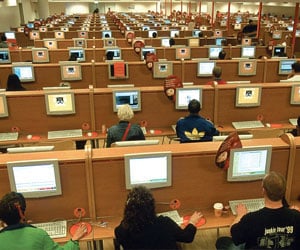
the-trap-cubicles.jpg

Scene from Adam Curtis's documentary 'The Trap'

Related

A few years back, I had one of those annoying conversations with someone that began, "If the arts are so great, they should be able to pay for themselves." I sputtered on about countries around the world, even other Canadian provinces (Ontario and Quebec) that pour money into culture. But nothing seemed sufficient to stand up to the almighty dollar sign. My conversational partner sniffed something about taxpayers footing bill for whingy artists. I muttered "philistine" under my breath, and we went our separate ways.

Now of course, the question has reoccurred all over again, brought up by Harper in the last federal election, and now by the cuts the B.C. government has made to the arts. It continues to rankle just as hard. Even posing the question makes me feel tired all over, but here I go. 

So, how important is art? I don't mean the question facetiously, or worse, fatuously. When you work in the arts, all day, every day, it occasionally comes as something of a shock to realize that there are large sections of the population that do not care one whit about the so-called 'arts'. Inside the great hullabaloo over the cuts in funding to schools, libraries, the environment, and yes, the arts, is an ongoing tired old argument about what is truly important enough to spend money on. Your kid's education may certainly take precedence, the environment, yes... yes. But some modern dancer somewhere spinning in circles, or an artist immersing a crucifix in dubious fluids saved up in a mason jar?

It's too easy to poke at the arts with a stick -- that could even be interpreted as some kind of performance piece -- but what is central in this debate is the notion the arts are somehow peripheral to society, off in a corner somewhere, playing with bits of clay or torn up paper.

I would argue otherwise.

Dehumanized

If you go to a restaurant, for example, if there were no artists, there would effectively be no restaurant. No architect to design the building, no potter to make the plates, no designer to sew the clothes on the sexy waitresses, no sign maker to draw the menu, etc. You take my point, it is an obvious one, after all. So, yes, why should we support the arts? Simply because without them, we'd be sitting in a mud puddle, banging rocks together for fun and entertainment. Sure... but, there is another even more fundamental idea beneath this equation of money and value.

In the most recent issue of Harper's magazine, Mark Slouka's essay "Dehumanized" does a very fine job of summing up the debate over humanities and the arts versus math and science. He makes the argument that by winnowing all of human behaviour and culture into demonstrable, controllable numerical values, the U.S. (which includes the rest of Western society) is effectively turning into a nation of "employees, not citizens."

Writes Slouka: "What is taught, at any given time, in any culture, is an expression of what a culture considers important... In our time, orthodoxy is economic. Popular culture fetishizes it, our entertainments salaam to it (how many millions for sinking that putt, accepting that trade?), our artists are ranked by and revered for it. There is no institution wholly apart. Everything submits; everything must, sooner or later, pay fealty to the market; thus cost-benefit analyses on raising children, on cancer medications, on clean water, on the survival of the species, including  -- in the last, last analysis our own. If humanity has suffered under a more impoverishing delusion, I'm not aware of it."

Slouka is writing about the American education system, but it's an interesting place to begin since this is most often where things do begin -- in grade two with a section on poetry or Van Gogh or the music of Beethoven. Yes, they still teach such things. Dangerous, subversive stuff, it is too. What does any fascist society start with destroying, but the arts. Just think about the Nazis, or Stalin, rounding up those troubling, troublesome artists, burning them and their works into ash. Of course, now the means and methodology of getting rid of artists isn't nearly so messy or time consuming. Merely take away their funding, and they'll have to get service jobs like everyone else.  Every time I think about this stuff, all I hear is Blake's poem "London" running through my head. Mind-forged manacles indeed... not much has changed, although we've swapped state-sanctioned hypocrisy for big business controlling how we are all supposed to think.

What about jobs?

But will teaching your kid how to write a poem earn them a job in the future? Probably not. More importantly, will teaching them to think critically and understand in the broadest possible sense pose a problem for corporations in the future? Quite possibly. After all, corporate thinking seems to be, it's not a very big step from puddling about with poetry in elementary school to raging anarchism in the streets. Slouka's point, although he stops short of conspiracy theorist territory, is that there is something of a master plan at work. He describes it thusly, "Rein in the humanities effectively enough  -- whether through active repression, fiscal starvation or linguistic marginalization -- and you create a space, an opportunity. Dogma adores a vacuum."

Reading this, I think about films, naturally enough, and primarily documentaries. If you watch very many docs about the state of the world, you cannot help but feel that there is actually some master plan at work. Filmmaker Adam Curtis in his film The Trap typified it as turning human beings into mindless, easily directed drones, churches replaced by shopping malls, everything whittled away into ones and zeros. (Even documentaries are no longer as clean as they once were, witness Art & Copy, which is funded in part by the very thing it celebrates, advertising.) But, you don't have to go too far or watch too much to start to feel like there is a war going on that far exceeds the borders of little old British Columbia.  Slouka lays it out in terms of humanities versus big business, but it surpasses even those labels. Charlie Booker (who, coincidentally, I think I've fallen in love with) writing about Adam Curtis's new film in The Guardian sums up the ability of art to surpass even the limitations of itself. 

Writes the luscious Mr. Booker about Mr. Curtis' new film, "One particular segment, set to 'River Deep, Mountain High', feels like being repeatedly stung on the mind by a hallucinogenic jellyfish while inhaling huge clouds of history through a pipe." Which makes me want to see it immediately... But more importantly, says Curtis about his own work, "The politics of our time are deeply embedded in this idea of individualism... The notion that you only achieve your true self if your desires, your dreams, are satisfied... It's a political idea. That's the central dynamic of our life." Just reading about this makes me excited. God bless old Blighty! Where difficult, odd, strange, intractable stuff continues to get made. 

What they fear

Of course, over here, in pallid underfunded British Columbia, the only place you may get to see Curtis's work is at the Vancouver International Film Festival. Unless of course, their funding gets pulled too. Then you're out of luck, sucker. 

What Curtis, Booker, and Slouka have in common is the idea that if art can take apart ideas and muddled dogma, it can also dismantle the infrastructure of power and control. If so, why would the grey-suited corporate types have any interest in funding the means of their undoing? The obvious answer is that they don't. Thus libraries, education and the arts take it in the teeth, because if we cannot think or write or understand clearly, we cannot know what is being done to us. Nor can we fight back.  [Tyee]

31  Comments:

Login or register to post comments

  • muddled

    2 years ago

    I love it when the confused

    I love it when the confused thoughts rattling around inside my head get clearly expressed by one of your excellent writers. In this case, thank you Ms Woodend. As a public school user, library worker, early literacy teacher and arts supporter it gets downright depressing when you see everything you believe in repeatedly get underfunded and swept aside. Let the undoing of power begin!

  • Karen D.

    2 years ago

    Life without art would not be worth living

    From a young age we are all introduced to the arts in such areas as music, drawing/painting, play acting, and forming objects out of different mediums. These experiences help us to be interesting individuals and versatile in how we think .

    We tend to take a lot of the arts for granted because it is around us day in and day out. Where would we be without pictures on our walls, movies and sitcoms to help us wind down from hectic days, music to relax by, being able to choose a beautiful object as a gift for someone or even art classes to get away from the grind and give us something to be proud of?

    Without the arts in all of our lives, life would be pretty depressing. Unfortunately, Harper and Campbell seem to have lost what it means to be creative, appreciative, content human beings.

  • Chris Keam

    2 years ago

    Who can you trust

    The power brokers' need to silence dissent just shows their ignorance. The Jester was really the only person a King could really trust.

  • dude

    2 years ago

    Who needs government,anyway...

    Make art without them. That is don't worry about writing grants (which is asking to bite the hand that feeds you)and make the statements and work you feel compelled to make. I won't repeat what I wrote in Charles's piece here - but yes my friend you are free-free to do without government money and free to criticize and make art -
    Also just a note Dorothy to say that I am a great admirer of your writing.
    Grant Shilling

  • dirtmeister

    2 years ago

    Professionalism

    The real creative people in society are the engineers that give us our ipods, computers, software cars and gadgets we want. Today's artists are to attached to the taxpayers tits. Create something that the public wants and make a living. If not to bad.

  • aroundtown

    2 years ago

    I wish I could agree...

    As a long-time lover and supporter of the arts, I dearly wish I could agree with your analysis. Unfortunately, it's been my experience that the arts community is an increasingly closed, self-serving and elitist one. Good art speaks to everyone. Too often, however, the "modern dancer somewhere spinning in circles, or an artist immersing a crucifix in dubious fluids saved up in a mason jar" are the ones who received federal or provincial grants, and these artists and their cadre of followers seem to have little interest in speaking to anyone but themselves and those like them.

  • carfreed

    2 years ago

    whimps

    art is for whimps or those attempting sophistication has long been an attitude.
    also, art is for "sissies" and ofcourse the homophobes support this underlying attitude about art.
    Our "culture" has been dedicated to the blood sports and the auto industry. Governments support that.

  • Bobby Peru

    2 years ago

    Art of the Game

    Of course great art speaks to everyone, but you have to bear alot of bad public art before a Picasso or Pollock emerges. Publicly funded art, which we are talking about here, is always to first to suffer in an economic downturn and it suffers alot more in BC, because artists are very dependent on govt funding.

    Unlike rich cities like NY, London or Hong Kong where there are plenty of rich people and corporatations who patronize or buy art, Vancouver lacks the rich private sector that is interested in art. Rich people here relatively don't have the wealth of Americans, Chinese or the British to buy international quality art and create public interest in art. Many of the world's great museums are funded by private money. Asking govt to support BC art is simply asking too much.

    Sadly, BC is not exactly a thriving intellectual and artistic culture. Pro hockey, snowboarding, skiing and sports are what interest most people in Vancouver.

  • Glen Murtz

    2 years ago

    Hang on Dorothy... you missed a spot

    The "Arts" is an industry too and you'd better believe there's a "way" of doing, being and saying within it. It has, like any self respecting corporation, a multitude of fixed, rigid expectations of those who wish to belong. It's very much a class based system dahling.
    Art - is *DEEPLY* conservative.
    Sounds crazy right?

    But it's true.
    The big kahuna’s of Vancouver’s arts scene do their yoga in the morning, Exec Direct an Fest in the afternoon, get home in time to give the kids nanny a birthday card, and then run out to vote Liberal or Conservative or Fascist, or whatever political group runs on a liberal social agenda and hyper-conservative fiscal one.
    The Arts folks in this town really care about poor people, as long as their not stinking up their neighbourhood. They can't be accused of discrimination when it's "markets forces" that prevent people with low incomes from living on the west side, right?
    But I digress.

    And hey - since we're on the topic - I can't remember the last time I saw overtly political art coming out of Vancouver. Mr Peanut was a long time ago, but you know, of late, I don't remember any arts groups defending the nurses back when their contracts were being torn up. I don't remember any artists or art group or curator or art person standing up for any member of society but themselves.

    And you know why?

    It's because the "Arts" in Vancouver would *CRUCIFY* anyone who made Art political.
    Making overtly political statements with your art or within the art community is a kiss of death.

    Which is why, it's fine and dandy to throw up a bunch of stop signs in a small park and toss it some bullshit "reframing the narrative" artist statement and call that art - because it treads a perfectly apolitical line of "somewhat controversial", without telling us why the BC Liberal Party (or hey - the NDP, or the Greens, or Christian Heritage or whatever) sucks.
    Like a shitty ad campaign run by a corporation, or a 21st century newspaper, it creates some word of mouth/discourse/chatter on the "product" now and then by stepping outside cultural or acceptable social boundaries, but does nothing too contentious - and certainly nothing political.
    How gauche!
    If you don't know where the next cheques coming from - why be political?

    Piss Christ is the same thing as American Idol or Big Brother.
All heat, no light.
    Just like the Vancouver art crowd.
    Soulless, class-based zombies sucking off the tit of government because they haven't the intellectual guts or social capital to actually say anything politically relevant in most people's lives.

    Typically, this latest salvo of "why art is good for us" shows that the arts community lives as a pathetic beggar, pleading, sniveling and whining for more money, so it can continue a life of banal, impotent political indifference.

  • VanFitz

    2 years ago

    wow, bitter

    Jeez Glen, woke up on the wrong side of the bed this morning? So what you're basically saying is that the Arts don't deserve to be funded because they don't conform to your idea of political relevance? Entertainment not good enough for you? Beauty not good enough for you? How about this? The arts >put people to work< creating that thought-provoking, beautiful, entertaining art, and they buy things and pay taxes; and the people they buy things from grow their businesses and pay taxes.

    It's a statistic that's going to become very familiar to you: by the Liberals' own research, they get $1.38 back in tax revenue for every dollar they invest in the arts sector. Investing in the arts is investing in the overall economy IN ADDITION TO the cultural well-being of our society.

    Maybe you should make a nice cup of tea, go back to bed and try to start your day again.

  • Ernest Black

    2 years ago

    Hang on dorthy

    Glenn, I am about to offend every artist I know. But I largely agree with you. Every example given in the main article is a variant of commercial art that would continue to exist because it is funded by (dirty word warning) 'commerce'.

    However the main points made in the article are true. Art is necessary to a civilized society. But then again we continually prove that we are not civilized, so perhaps it is not working or we do not need it.

    To deal with those, including myself, who say that arts should be self sustaining, and we (the public) should only subsidize that which is profitable to the general public good. Let me use a term that I keep seeing over and over again.

    FULL COST ACCOUNTING

    Artists and corporations will both have a fit about this concept. But if truth be told, most art will pass the test, and very few corporations. Very, very few corporations produce more benefit to the public then the damage they cause. If, and only if you factor in ALL the ramifications of what they do. As an off the wall example, arms dealers make a lot of money and employ a lot of people, but at a cost of millions of lives and the destruction of the environment. Would not pass the test of FULL COST ACCOUNTING.

    Sports nourish the body (sometimes) create a form of cooperative behaviour etc. But professional sports create hyper greed and competitiveness. Major sports and arenas live off government largess and also would not pass the test.

    Just goes to prove that the economists we vote in to run our lives know shit about the true realities of economics. It's not just about how much money you make, but also about what you destroy/damage in the process.

    Art will continue, no matter whether it is government funded or not. The Govt. has that figured out. Most artists I know create because they have to, not because they are funded. However the broad spread of art and the support of creativity requires public funding.

    If it was not clear in my comments I would not cry too much if art lost govt. funding, the public would soon step up to the plate, but I would cheer and applaud if things like the Olympics and arenas lost their funding. And if the "Corporate Welfare Bastards", lost all their bailouts and subsidies, I would probably die of joy.

  • dave49

    2 years ago

    Art vs. guns

    Years ago I read a speech by a historian who claimed the USA's attachment to the right to bear arms was really a misinterpretation of the Constitution's intent. I asked a friend who attended university in Kentucky. He disagreed. The right to bear arms is about the ability to "overthrow a corrupt government".

    So, what we gentle, peaceful Canadians have going on here is a parallel. The corrupt government does not want to fund it's critics and detractors in the arts 'sector'.

  • Ernest Black

    2 years ago

    Dave

    The corrupt government does not want to fund it's critics and detractors in the arts 'sector'.

    Too true, and well pointed out by other commentators as well. Needs saying frequently.

    Any guess as to why they are also destroying the education system?

    Or why the education system is becoming more and more a place to create complacent, consuming sheep?

  • CourtGQuinn

    2 years ago

    Good article and comments...

    Here's a quote from the article that i'm not sure if i agree with:

    "Of course, over here, in pallid underfunded British Columbia, the only place you may get to see Curtis's work is at the Vancouver International Film Festival. Unless of course, their funding gets pulled too. Then you're out of luck, sucker."

    Why is an expensive film fest needed to display some artists work? Couldn't Curtis charge a couple bucks and allow any artistic person access via the Net/Youtube/iTunes? I'm all for supporting the arts...but with new technology the arts community can be located anywhere...and sell to anyone anyhwere. Bands/singers can download there music to myspace...sculpters/painters can advertise their wares via eBay and reach a worldwide community for their artistic creations. Perhaps more specialized forms of art (ballet, opera, circus, orchestra) performances need not be in every city all the time. Maybe Vancouver isn't a big enough market for 365 days a year access regarding certain performances...

    Here's a plan for some of those in the arts community (or even those not) who are going to experience economic problems because of decrease in funding...move to Ocean Falls on the central coast. Create a new artistic community there where the cost of living is next to nothing. Bring your drums and guitars...digicams and scripts..notebooks and pens/pencils...paint brushes and canvass...chisels and saws...sewing needles and fabrics...but most importantly..bring your creative ideas and help fashion a new community where arts creation can prosper. With existing electrical infrastructure 7000 people could move to Ocean Falls right away to build a new united artists settlement. With an internet connection certain "arts" can be made/sold from anywhere to anywhere. Imagine Ocean Falls as a new "creative commons"...a super-affordable place to live and work.

  • seawitch

    2 years ago

    how about doing a wee bit of research

    how about doing a wee bit of research dirtmeister, before you make such silly and demonstrably untrue statements? When exactly did you fail to notice that the arts contribute 5 BILLION (yes, billion) to the provincial economy annually. They continue to provide income to the province even at a time of recession. The arts return $1.38 for every single dollar spent on them, while corporations - auto industry, forestry, etc - whine and ask for handouts.

    But that isn't the real values of the arts. Artists work harder than most people out there, for less money AND contribute far more than the culturally impoverished lost in game fantasy. People umbilically attached to their tech need to get a life and recognise their slavish addiction to adverts.

  • ME2

    2 years ago

    Seawitch

    I have some difficulty with understanding your 5 billion figure.

    Does this mean that if $3.1 billion is spent on "art", $1.9 billion is returned as revenue to the Crown?

    Who, exactly, spends that $3,1 billion?

    Can't corporations utilize exactly the same reasoning when asking for "handouts"?

    It's been suggested that the arts give great value in providing the necessary training ground for commercial artists of various kinds - primarily in movies and TV.

    I was told a long time ago that the best expressions of our culture were to be found in advertising, the reason being that advertising companies attract the best and the brightest of our artists of various kinds, and years of observation has convinced me of that, like it or not.

    So, may I suggest you reconsider your snobbish and somewhat effete inference that the only artists of worth are those starving in a garret, and recognise that there are as many artists as the rest of us who are slavishly addicted to TV and adverts?

  • Chris Keam

    2 years ago

    arts and culture

    "I was told a long time ago that the best expressions of our culture were to be found in advertising"

    Probably true. But the best critiques of our culture come from the kinds of work that everyone loves to sneer at as inaccessible.

  • ME2

    2 years ago

    Chris Keam

    What do you mean by "inaccessible"?

  • Chris Keam

    2 years ago

    inaccessible

    The kind of art that might require one to read the little plaque beside it to gain a better understanding of the artist's intent! :-)

    If it ain't pretty flowers in a vase, some folks don't want to be bothered IMO.

  • The Blackbird

    2 years ago

    Of course Gordo's ilk wants to pull arts funding ...

    ... we make stuff like this:

    http://www.flickr.com/photos/blackbird_hollow/3772914448

  • ME2

    2 years ago

    Chris Keam

    As I understand it, good art is art that speaks to you without needing a roadmap to understand it.

  • The Blackbird

    2 years ago

    Two Questions for ME2 and Chris Keam

    Is the work I provided a link to just above accessible or inaccessible?

    Should I, as an artist creating such works such, be considered deserving of arts funding from the government to pursue this avenue of artistic expression?

  • Chris Keam

    2 years ago

    Blackbird

    I LOL'ed right away, so I choose 'accessible'.

    I don't think I could render judgement on whether or not you should get funding without knowing more about the project's monetary requirements and your financial need however. No offence.

  • Chris Keam

    2 years ago

    Good art

    "As I understand it, good art is art that speaks to you without needing a roadmap to understand it."

    A while back I saw a piece of work by a native artist whose name escapes me. It was a 'sisiutl' but it was made in the image of an automobile. Without reading the artist's rationale for mixing modern and ancient one missed out on a number of important aspects of the piece. I don't think it's fair to suggest that a piece of art isn't good because one can't apprehend its intent at first glance.

  • The Blackbird

    2 years ago

    Or at second, or third glance ...

    Often, an artwork - a poem, song, sculpture, film, painting, photo, etc. - will possess layers of meaning that are revealed over time, as we mature and our experience broadens we take on a more universal outlook. They help us find, or recognize, layers of richness in our souls and inspire us to reach beyond our more base insincts. Art that helps people accomplish these things has an enduring quality.

  • wayfarer

    2 years ago

    what they fear?

    I don't buy the "what they fear" conspiracy theory. Politicians are economists before they are artists. It boils down to bottom line and PR optics. The optics (not to be confused with the reality) of public funding of the arts is that it's a taxpayer extravagance, a luxury to be indulged in during good times and to not be indulged in during bad times. The object of the game for our state reps is re-election. Faced with mill and plant closures, cuts to core services, the Fringe festivals and obscure back alley off-off-off-off East Hastings theatre troop of the day just don't, in the minds of politicians, make for good austerity fiscal policies. It has nothing to do with said troop's threat to the state.

    What Curtis, Booker, and Slouka have in common is the idea that if art can take apart ideas and muddled dogma, it can also dismantle the infrastructure of power and control.

    This is the type of delusions of grandeur that lead to the fallacious conspiracy theories mentioned above, and essentially diminish art to something that is necessarily revolutionary, progressive and life-enriching. It ain't. There's a lot of 'muddled dogma' in the art world.

    If so, why would the grey-suited corporate types have any interest in funding the means of their undoing? The obvious answer is that they don't.

    Corporate philanthropy has, in many artistic corners, singularly ensured many a group or organization's financial survival. Behind every successful symphony orchestra, there always seems to be some really filthy rich, retired old person who has the good will donate a large stash of his/her/their estate every year to the cause. Moreover, who among us can afford to drop $10k-$100k on a Tony Onley water colour or a Roy Vickers or Ted Harrison original? Certainly not working stiffs like me. Enter the 'grey-suited corporate types'. I just don't buy the polemic that pits the struggling, noble artist against the forces of evil (right-wing governments and 'grey-suited corporate types'). It's more sophisticated a problem than that.

  • ME2

    2 years ago

    The Blackbird

    I freely confess to not having any expertise whatever as to the relative merits of art forms. While your efforts do not particularly appeal to me, I note that there are others here to whom it definitely does - which is typical of most art.

    Would I fund your efforts? I would refuse to make such a choice, preferring to leave that to others who might know what they're doing.

    To which I might add, by seconding wayfarer's obsevation

    "......What Curtis, Booker, and Slouka have in common is the idea that if art can take apart ideas and muddled dogma, it can also dismantle the infrastructure of power and control.

    This is the type of delusions of grandeur that lead to the fallacious conspiracy theories mentioned above..."

  • Chris Keam

    2 years ago

    Power and control

    Some works of art are so powerful that men with vast armies at their disposal won't be seen in their company.

    Feb 6, 2003 - "Earlier this week, U.N. officials hung a blue curtain over a tapestry reproduction of Picasso's Guernica at the entrance of the Security Council. The spot is where diplomats and others make statements to the press, and ostensibly officials thought it would be inappropriate for Colin Powell to speak about war in Iraq with the 20th century's most iconic protest against the inhumanity of war as his backdrop."

    http://www.slate.com/id/2078242/

  • ddiamond

    2 years ago

    for Glen and another reason why

    Mmmmm....Headlines Theatre (I am the Artistic Director) has been making political art for almost 29 years in Vancouver. in fact we are preparing a project right now, created and performed by people who know homelessness. There are a lot of artists in Vancouver (and art) that is engaged in social issues - just so you know.

    also - a reason to support the arts? it is the psyche of the Province; the psyche of the Nation. Of course I agree that in this world that is more and more obsessed with externals, "we" might be very afraid of this territory, but we need to explore it, in order to have healthy communities, a healthy province, a healthy country.

    Doing so isn't a frill. It is a community health issue.

  • blujaycan

    2 years ago

    artists and politicians ?????

    What difference is between the two? Lets not leave the subject of the article.
    Firstly, anyone at one time or another had the experience, an inclination, a wish, and actually had created something in their lives that they considered meaningful and considered the arts as an option. What happens next that our world and its functions, the environment, provides the hints/solution, and choices we make is our life story.
    So as an artist you make a choice of living on a poverty line, unless someone comes along and reaches out to give a helping hand, sees an opportunity and etc.
    How politicians become beings of another world is a learning process seen and more then likely understood mainly by artists, whom generally have to maintain the integrity to their conscience. Something the rest of society, does not have to, and generally does not as they "all" prescribe to the same ????philosophy????? /mindset more likely.
    So, an artists will survive, poor perhaps, but enriched by his will, and struggle. Politicians and businesslike struggle is the creepy reality of todays world. If everyone had remembered their first inclination for self expression and maintained its original concept of quizzing, and questioning, the world would be a different place. Meanwhile, lets concentrate on the cuts in medical and educational environment so we can see who we are represented by, and who we really are!!!
    Good article, crazy and ridiculous comments, unnecessary if you ask again. Socialism, new world, communism, capitalism? How about humanity? Naive, hey?

  • Inklings

    2 years ago

    Arts Funding

    I was once told that I could become a good fine artist. I gave it up, though, when I realised that I couldn't earn a living at it.
    In the old days, before government largess, artists either did commercial work to pay their way or had private funding from a patron or group. I don't think it's fair to ask the taxpayer to fund the arts (although I absolutely think it's a value to society) when they can barely find the money for health care and education (yet they can fund the Olympic games all right). We need more individuals to step up and put their money where their mouths are. It's the only way.

    • The discussion for this story is closed. No more comments can be added.