

 SHARE:

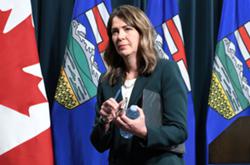
It’s official: Premier Danielle Smith can now call herself Queen of Measles.
And not just in Alberta. Try North America.
That’s right. Alberta now leads the continent in a preventable childhood disease that leaves at least two of every 1,000 infections with severe intellectual disabilities, pneumonia or hearing loss. Or dead.
Measles also poses substantial risks to unvaccinated women carrying a child, including birth defects, premature deliveries, miscarriages and, yes, more death. As the Canadian Medical Association Journal recently warned, “The risks of measles infections and postexposure management may make anyone who is pregnant or contemplating pregnancy in Canada uneasy, given current outbreaks.”
In Alberta, the vaccine normally is not given till a child reaches 12 months of age (though under certain circumstances the age can be six months). That means in the province all babies under six months and most under a year old are vulnerable to measles.
Stunningly, Alberta has already recorded nearly half a dozen cases of measles present at birth in the province.
And every measles infection leaves a child with a disabled immune system, stripped of memory about how to fight other routine infections. As a result, any unvaccinated child who battles measles will probably be sicklier, possibly for years afterwards. Brazilian researchers recently found a high correlation between having measles and later dying of another infectious disease.
Thanks to Smith’s weak and chaotic leadership, vaccine skepticism and open disregard for public health experts, the number of cumulative measles cases had as of Friday passed 1,179 in Alberta.
The last time Alberta came close to that number was 1986. That’s when the province reported 843 cases.
To appreciate the significance of Alberta’s ever-expanding measles crisis and the global resurgence of the highly contagious virus, I called up James Talbot.
He’s a former chief medical officer of health, or CMOH, for Nunavut and Alberta and teaches at the University of Alberta’s school of public health. The public health veteran has battled record floods, influenza, tuberculosis and two small measles outbreaks. He knows that if you don’t put out a viral fire quickly, the number of people caught in its flames will grow with biological and economic consequences for the greater community.
“We have a situation basically in which the province wasn't properly prepared or led and which has slow walked virtually everything. If they had had this kind of response to the forest fires in Alberta — that same kind of slow don't worry about it and you know this is all individual choice — the province would be a smoking ruin by now.”
Worst by far in North America
Talbot placed Alberta’s shocking measles numbers in perspective. They are the worst in Canada and North America. Even by global standards they are appallingly poor. “We’re at around 200 cases per million population," he said.
Ontario's total number of cases, 2,223, is higher than Alberta's. But Canada's largest province "has been battling measles longer and has a bigger population of about 137 per million," said Talbot. "So we are by far the second worst in terms of total numbers in the country and the worst in terms of rate per million."
In sheer number of cases, Alberta virtually matches the entire United States, where vaccine skepticism is now official government policy. The U.S. has recorded 1,274 cases of measles this year. The majority of those cases, 750 of them, popped up in a rural Texas outbreak where two children died. So Texas, with its population of 31 million, has far fewer total and per capita cases than Alberta, population five million, noted Talbot.
Next comes Mexico, which, compared with Alberta, has 50 per cent more measles cases in total, but a population of 130 million people. “Their case rate stands at 11.5 per million compared to Alberta’s 200 per million. So, yes, we are the worst-performing part of North America,” Talbot said.
Alberta is also performing badly by global standards. Yemen has the world’s highest rate of measles cases thanks to war and famine. Measles is particularly deadly among malnourished children. As a consequence, it’s probably not fair to compare Alberta to that country, said Talbot.
But India is another matter. It ranks second in the world in terms of total measles cases, about 10,000 this year. Still, given India’s population of 1.46 billion, that gives the country a rate of six cases per million. “So Alberta’s rate is worse than the second-worst country in the world, and India has huge challenges,” concluded Talbot.
He added: “There's no question that the situation in Alberta is of concern not just to the people of Alberta but to adjacent provinces and states and anyone that travels to the province.” If you haven’t been vaccinated, said Talbot, Smith’s Alberta will surely expose the unwary to measles.
Measles as unheeded warning
Why do public health types and pediatricians fret so much about measles? Why do they call it “the canary in the coal mine”?
Every measles outbreak tells the observant something about the general health of children as well as the level of trust in public health. It’s a barometer of vaccine hesitancy and the quality of political leadership.
Most profoundly a surge in measles tells you about the state of childhood immunization programs.
“It’s a bellwether for how the rest of the childhood immunization programs are going,” said Talbot. “You can take a look at Alberta’s own statistics. Any place that has very low measles immunization rates has identically low immunization rates” for other preventable childhood diseases, such as diphtheria, pertussis, polio and meningitis.
Memory of these childhood killers has mostly faded in the general population. But in the 19th century diphtheria killed one out of 10 young children. Polio caused paralysis in one out of 200 cases. A bad case of pertussis or whooping cough could stop a child breathing. Meningitis or “brain fever” was a regular killer of the young.
“As bad as measles is, I don't think I'm putting the case too dramatically to say that most pediatricians would consider losing control of these other diseases as terrifying,” said Talbot.
Because of the success of immunization programs, few people now have any experience of the ravages of diphtheria or polio. Many have wrongly concluded that these childhood killers have gone away. In fact, wilful neglect, complacency, misinformation and distrust actually are bringing these diseases back.
Failure at the top
Talbot attributes Alberta’s measles resurgence to a broad failure of leadership beginning with the premier. And he is not alone in this assessment.
A recent Angus Reid poll, for example, found that most Canadians reject the United Conservative Party or Smith view that measles isn’t as bad as you think. They understand that the infection can be problematic, resulting in pneumonia, brain swelling and a damaged immune system. In fact, only 10 per cent of the population believes that measles is a piece of cake. Just about all voted Conservative in the last federal election and they comprise approximately 13 per cent of the population in Alberta.
The Angus Reid poll also found “the seriousness of the disease has not been matched with a serious response, according to residents in the provinces with the two largest outbreaks — Ontario and Alberta.” Moreover, citizens perceived a lack of leadership on the issue, from premiers to chief medical officers of health. Approximately 37 per cent of Albertans have no confidence in their government’s ability to respond to the measles outbreak in a judicious and effective way.
In Talbot’s view, Alberta hasn’t had an appropriately qualified public health expert as chief medical officer of health since Smith, a COVID skeptic, fired Deena Hinshaw in 2022 for her handling of the pandemic.
Alberta’s current CMOH is Dr. Sunil Sookram, an emergency physician. Smith appointed him last April after the previous CMOH resigned as measles cases exploded. Talbot compared having a CMOH with such relatively small public health experience dealing with a measles crisis to appointing “a thoracic surgeon to operate on your brain.”
As a result, it shouldn’t surprise Albertans “that measles would get out of control in the province.”
No jurisdiction can afford to treat measles in a lackadaisical way because of its impacts on children and pregnant women, emphasized Talbot. “But that's exactly what this government is doing. They have just sat back and allowed these numbers to go up without any sense of urgency and without any sense of investing significant amounts of capital in ensuring that we're getting the message out about risks.”
In Alberta, said Talbot, “we have heard by far less about measles... than any other province or territory has heard from their chief medical officer of health.”
Price tag for outbreaks
The premier has also ignored another aspect of wildfire measles outbreaks. They come with real and substantial economic costs.
It takes money to respond and warn vulnerable citizens. It takes money to alert travellers to the province. It takes money to treat infected children who develop pneumonia or brain swelling in the hospital.
To date, the province has recorded 96 hospitalizations and 15 intensive care unit admissions for a disease preventable by a cheap and effective two-dose vaccine.
According to U.S. calculations, the median cost per case in a measles outbreak is about $33,000. If it’s similar today in Alberta, that means the cost to the province of its historic measles outbreak has passed $55 million.
Now comes summer — the season when children gather at family gatherings, baseball tournaments and church camps. Given the highly contagious character of measles, Talbot expects cases to accelerate through July and August. The Calgary Stampede, which routinely attracts more than a million visitors from across North America, could even serve as super-spreader event for the unvaccinated.
Doctors are already warning pregnant moms, parents with unvaccinated babies under the age of one and the immunocompromised to stay away.
Talbot pointed out that life expectancy remains one of the major determinants of how well a civilization is doing in the grand scheme of things.
“If you want to see life expectancy start to drop in a country, the quickest way is to increase infant mortality. And the quickest way to increase infant mortality is to lose control of the childhood diseases.”
What does this say about the premier and others making health policy decisions in Alberta? ![[Tyee]](/design-article.thetyee.ca/ui/img/yellowblob.png)






Tyee Commenting Guidelines
Please note that email notifications for replies are not currently working due to a software issue which may be resolved in a future update.
Comments that violate guidelines risk being deleted, and violations may result in a temporary or permanent user ban. Maintain the spirit of good conversation to stay in the discussion and be patient with moderators. Comments are reviewed regularly but not in real time.
Do:
Do not: