- Ms Kaye is a Tyee Builder. You can be, too.
- Mary Carlisle is a Tyee Builder. You can be, too.
- Prem Gill is a Tyee Builder. You can be, too.
- Nancy Flight is a Tyee Builder. You can be, too.
- Justin Everett is a Tyee Builder. You can be, too.
- John Westover is a Tyee Builder. You can be, too.
- Nora Etches is a Tyee Builder. You can be, too.
- Edward Henderson is a Tyee Builder. You can be, too.
- Bharadwaj Chandramouli is a Tyee Builder. You can be, too.
- Dean Chatterson is a Tyee Builder. You can be, too.
- Marius Scurtescu is a Tyee Builder. You can be, too.
- Robert Parkes is a Tyee Builder. You can be, too.
- James Murton is a Tyee Builder. You can be, too.
- Susan Doyle is a Tyee Builder. You can be, too.
- Vincent Strgar is a Tyee Builder. You can be, too.
- Helen Spiegelman is a Tyee Builder. You can be, too.
- Subir Guin is a Tyee Builder. You can be, too.
- Kimball Finigan is a Tyee Builder. You can be, too.
- Joanne Manley is a Tyee Builder. You can be, too.
- David Leach is a Tyee Builder. You can be, too.
How to Create a Depression
Why we're in this mess despite so many warning signs.
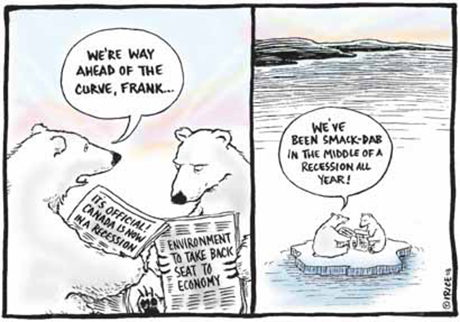
Cartoon by Ingrid Rice.
I watch the automobile giants lurch towards bankruptcy, slowed -- but only slowed -- by government hand-outs. I see the economy continuing its slide into depression. And I can't help asking this question:
If my wife and I had had enough of the bull market in 2003 and sense to get out accordingly, how come the seven-figure prognosticators in New York and Toronto didn't know?
I'm not trying to toot my own horn in times of such pain for so many people. I simply ask why the signs we saw weren't seen by those who make markets go? (While I'm not tooting my own horn, I'm bound to tell you that when people say how lucky we were, I emphatically reply that luck had nothing to do with it.)
When we started to get scared, we knew no more than anyone else, indeed much less than the "experts." We'd had the savings and loan scandal, bailed out by the U.S. Congress and the Enron stench.
We could see that the U.S. was $750 billion in its trade deficit, mostly to China, which held most of the outstanding U.S. dollars.
We knew that unlike Japan in former times, China wasn't a benign creditor and it would use its leverage to best advantage.
Danger signs abounded
To us, the U.S. economy looked like a big glass ball with a jillion little cracks in it. You knew that a relatively slight blow would smash it.
We knew that the U.S. was running about a three quarters of a billion dollar annual deficit and was nearly eight trillion dollars in debt. That's as if Canada's national debt was 800 billion dollars, which, sad to say, it is. The U.S debt is now more than 10 and a half trillion dollars and climbing.
The U.S. debt and deficit had, since Reagan's time, for the most part financed a false prosperity.
This was no secret. Anyone who looked could see that far from reducing the debt and deficit, the American economy was adding to it with ever more cheaper and cheaper money being loaned out while the politicians and the man in charge of money, Alan Greenspan, acted as if everything was peachy.
The housing market was red hot and you had to know that it was riding for a fall. I would look at all those real estate ads and ask: How many people are there around with credit ratings of a million dollars or even several million dollars?
We were to learn that there were not nearly as many as the market thought there were, with foreseeable consequences.
Greed feeds on optimism
What happened?
It probably started when "junk bonds" passed muster in the money-raising business. Then we had derivatives and hedge funds and a host of other "investments" that weren't really investments at all but wagers. It was gambling with all the certainty and speed of a floating crap game.
In 2003, it was obvious that the war in Iraq was a hugely expensive and ongoing mistake. In short, in 2003 when Wendy and I made our move out of the market, all signs pointed to very bad economic news ahead.
The answer as to what happened has I think, two levels.
First off, the monetary system around the world is a nest of optimism. Every banker and financier must loan money or he's not in the game. When money is not "tight," that is, the prime lending rate is low, financiers have more money available. Because times seem to be so good, optimistic lenders find optimistic borrowers and the race is on to see who can loan the most money at the lowest rate. If the people and businesses see nothing but big profits ahead, the sky's the limit and it's not long before a sturdy economy becomes a house of cards.
The crash of 1929 ought to have taught us that if moneylenders on the stock exchange allow too much margin or leverage, which is to say they require "investors" to put up less and less money, sooner or later it all hits the fan.
Stockbrokers never tell any but the most sophisticated of their clients to "sell short." Selling short means selling what you don't have and buying the shares later when they have dropped in price. This transaction acts as a brake on the market. One has to wonder why a broker will advise you to bet on stocks going up even when the better bet is that they'll go down?
Secondly, because everything seemed to be so perfect, RRSP portfolios swelling, and the price of homes going up 30 per cent a year, what was there to worry about?
Why, nothing much happened to these good things when the U.S. government bailed out the savings and loans corporations, did it?
The Enron scandal didn't seem to hurt the economy much, did it?
Why worry? The "dotcom" collapse only really hit the high rollers, didn't it?
If the markets and the players all said that they could police themselves and that if the government poked its nose in it that would ruin everything, why not believe them?
What could go wrong with companies like Merrill Lynch and Lehman Bros. looking after things under the watchful eye of Alan Greenspan. He was a financial genius, wasn't he?
1929's unlearned lessons
Lastly, we were convinced and let ourselves be convinced that things were much different than in 1929. There were safeguards in place -- though no one seemed to know what these were.
In fact, 2008 isn't much different than 1929. Over optimism bred careless credit controls and in due course the bubble burst. The more things change, the more they stay the same.
It's all governed, of course, by Mair's Axiom I, which is, in case you've forgotten: "You make a very serious mistake thinking that people in charge know what the hell they're doing."
We will have a depression. We've felt the earthquake but the tsunami has yet to arrive. In the agony, we'll tighten our rules so it will never happen again.
And, as sure as God made little green apples, it will happen again. It always has and it always will.
Related Tyee stories:
- Big Idea for 2009: Biophysical Economics
In the future, economists will return to earth. - The Meltdown, Seen from Below
What union leaders, labour experts and anti-poverty activists say needs to be done. - Risk Written on Their Faces
Harvard researchers: Blame stock market meltdown on too much testosterone.


17
Login or register to post comments
alive
3 years ago
just asking
Yeah, right Mair is back, and even after "a long deserved vacation" he has nothing to say!
Why exactly is he hired?
Grumpy
3 years ago
Liberal shills
I see that the Liberal shills are hard at it as they cannot debate the subject, they attack the messenger. Here lies the problem with the economy - the shills ran the show.
Example: - Gordo and his brother (I mention his brother because he comments on political things on the radio) are percentage men. Gordo was a land developer, which was paid a percentage of revenue, the same is true of mini-Gordo.
Percentage shills only make money when the economy expands in a reverse pyramid fashion, where the least money goes to the poorest. When the economy falters, the percentage men do not make money. As they know, no other trade, they beat the expanding economy drum, trying to inflate the economy. This is why everyone is so desperate for 'infrastructure' money as billions will be spent on needless projects which will artificially warm the economy for only a short time and then we fall flat on our arse again.
The world's economy is a massive ponsie scheme and it will come to grief, as it is doing now.
To make a clumsy story short - we are in a hell of a mess and the stock market is feeding our ills, not solving them.
Cynic
3 years ago
Pretty much a useless
Pretty much a useless article, recycling the tired old mumbojumbo that passes for economic analysis while missing (or avoiding) the crucial point. Rafe, when will you ask the simple question: where does money come from? Only the answer provides the necessary insight. Do you hear me, Mssrs Mair, Beers, Dobbin, et al?
Over 95% of Canada's money supply is loaned into existence by the private banks. That's where our money comes from and that is why depressions, recessions, "tough economic times" are inevitable. That is why an undeserving elite exists.
Yes Grumpy, it's a ponzi scheme. The banks create money "out of thin air" by making an entry in a database, but only the principal of the loan is created. Yet, principal plus interest is demanded in repayment. Unearned money must be repayed with blood sweat and tears. The debt now exceeds the money supply by over three to one, there is never enough money in circulation to repay the banks, and every new loan exacerbates the situation. It's simple, elegant, and evil. Money reform is the only way out. Do you hear me, Mssrs. Mair, Beers, Dobbin, et al? Do you hear me, gentle reader?
Jeffrey J.
3 years ago
Many Saw it Coming Except Elites
Bang on Rafe. Many, many people actually DID see this unholy collapse of the neocon house of cards. Everyone who even remotely looked at things objectively. Except the elites. The corporate, political and media elites who "run" our society. As a ruling class become ever more rarified and undemocratic, this is exactly what you get.
Examples abound. The 1789 French court laughed at the thought of a revolution. Stalin's regime thought it was invincible before it fell. Hoover supported new IPO issues in 1929 and 1930. Bush was telling us all was fine this summer. Harper and Campbell are still racing to lower taxes in-spite of the damage it does. All are examples of elite "group think". They all drink the same cool-aide. All comply with the party line.
If we want more democracy, we have to become involved. Immediately. Democracy was NEVER just given to citizens. It always took the effort of many, many people.
As always, great stuff Tyee.
come again
3 years ago
Smarts
Rafe, you may be arguing that the floor is still to fall (although you don't), but you state you withdrew your funds in 2003.
The TSX Composite is still worth more now than then. Maybe you'd look smart if you sold around the peak. Your self-congratulation misses the mark.
Van Isle
3 years ago
Yes Rafe I saw it coming too
Yes Rafe I saw it coming too and did get out of the game.I was advised by my financial adviser that "all was well and don't worry about it", even a year ago. A couple of months ago a was talking to a retired financial councillor from Vancouver who said that they whole scheme was unraveling in '06 but certain actions by our new CONservative Government delayed it. On Michael Campbell, he just rolled his eyes and said he's just a huckster sales man.
Wilfred Laurier
3 years ago
Easy to see, Rafe
The dumbing down of America started with Regan, along with the raising of "patriotism." The Clinton years reversed the process somewhat but basically, America has turned into a form of fascist corporatism.
As with any great empire, when the rich are only concerned with making themselves more rich, the process eventually breaks down. All empires get into a situation where short term gain becomes the goal. Building your national economy becomes secondary to this. Society spirals into disorder, the empire seeks to fill its coffers with booty from foreign wars and the costs of both of these make them counterproductive.
Watching the US media, I don't see much hope for optimism. The basic problems that America faces such as health care and poverty are not really issues at all. All I see is "pundits" seeking to maintain the status quo or go back to an era that really didn't exist.
Rafe is entirely correct in his assertion that what has happened in the USA is practically identical to 1929. The main reason it could happen again is that there really aren't too many people alive who lived through the Great Depression.
Obama has quite a tough row to hoe; his biggest challenge will be overcoming ignorance.
MalcolmIslander
3 years ago
1929 Safeguards Well-Known
Mair writes: "Lastly, we were convinced and let ourselves be convinced that things were much different than in 1929. There were safeguards in place -- though no one seemed to know what these were."
I'm not an economist, but I know pretty much what these safeguards were. It's hardly rocket science.
The key regulation preventing a repeat of 1929 was the 1933 Glass-Steagall Act that separated commercial and investment banking.
Glass-Steagall was repealed in 1999 by the Rubin-Summers Treasury Dept (with distinguished lobbying by Phil Gramm).
Other important regulations, such as that governing debt to capital ratios, were similarly gutted.
The history of this deliberate de-regulation is well understood, and makes it difficult to see what Mair is trying to say in the quotation given above.
bun
3 years ago
of course 'they' knew
>how come the seven-figure prognosticators in New York and Toronto didn't know?
Who says they didn't know ? I know someone in the biz who knew the dot.com bubble was to burst, and so got out, and knew this was to burst as well, so got out 18 months ago. But it is not his business to go trumpeting this to his clients.
They knew, BUT it doesn't matter to them. They'll make money, lots of it, one or or another, and so their ludicrous prognostications have _little effect_ on their own well being.
it makes perfect sense, except for the fact that most people, aided and abetted by the press of course, continue to listen to the crap spewing from these people, rather than doing their own digging, or even just using their common sense.
Skywalker
3 years ago
Good one Rafe.
The whole system is based on a human characteristic which will be the cause of its decline. Greed! That Rafe and others saw it coming may be a simple appreciation that the greedy people who run it did not really know that you can not keep taking without one day having to account. That kind of clarity of thinking only comes when you have a few miles on the clock. Why keep investing in a system which is fueled by greed? You can't take it with you.
I think Cynic has a point but I still think Rafe's article is worthy. Once we accept Rafe's axiom "1 then maybe a discussion of who manipulates our currency to their advantage will happen. As for Alive, friend is isn't ground hog day yet>
PeteL
3 years ago
A random thought or two
Ok, so this upcoming Provincial election should be about shutting down the "Gateway" infrastructures projects. These are solely for the purpose of moving mass quantities of cheap goods quickly and more cheaply from Asia through to Central Canada and USA. This infrastructure is to be paid for by the taxpayer in order to profit corporate North America. So lets stop this and save our children's children the $ billions in needless government debt.
Obama seems to be taking his economic strategy from the Bush policies. A few hundred in tax reduction for business and families.
What?
So America can go to the mall and shop their way out of this? Whats the percentages in that? Saving mall jobs and a few transport jobs? Nothing sold in the mall is made in North America.
It sounds to me that this economic strategy is really coming from Beijing to the Washington.
Unlike Rafe I wasn't so smart. I could see it coming, but as a typical Canadian worker I really didn't have a great big nest egg to protect. Mine is in my workplace pension and matching contributions. So I guess I could have elected not to contribute to my pension. I saw this coming, but was in no position to really control my destiny. I suspect this is the reality for most of us.
When everyone's buying Bre-X you know the show-stopper is about fall out of the sky.
morechatter
3 years ago
And we all come tumbling down
Canada's stock market loses 700 Billion or 35% for the 2008 year while economists predict the housing market grumbles as prices in the west fall. And The Bank of Canada is predicting many will lose their homes if the economy continues to suffer. And your right its depressing and apparently we are not as infallible as lead to believe.
The The
3 years ago
Got out in 2003?
Rafe, this doesn't make any sense. You say you got out of the market in 2003. Got out how? Did you transfer all of your investments to cash? Property? What?
What worries me about this article is that it refers to a desire to get out of the bull market way back in 2003. Yet it ignores the fact that the dot-com bubble burst in 2000, resulting in the TMT crash that occurred between 2000 and 2002, wiping out a lot of value on the NASDAQ index and taking companies down with it. It was between 2003 and 2007 that we had the big bull market that has now crashed.
Getting out in 2003 meant getting out when the markets were only just recovering from the dot-com crash. Sure, the TMT crash was more a blip in comparison to what we have now, but if we want to talk about bull markets, we have to talk about 2003 as being the beginning of the most recent one.
Also, as articles about the recent financial crash go, this is a weak effort. If you want to learn more about where all this money came from and how it all went wrong, listen to the episode of This American Life on NPR titled "The giant pool of money" and "Another frightening show about the economy".
http://www.thislife.org/Radio_Archive.aspx?year=2008
morechatter
3 years ago
Cheer Up Folks
Things are not going to change that much at least not the consumer as the real changes will have to come from industry as its not only ironic but its paradoxial as jaded consumers pass on shopping while revolutionary industry leaders morphe themselves into Conservatives. Is it possible that in the constant pursuit of more and more that the fat cats have not just broken the banks but the backs of their consumers along with their spirits as well as they are beaten to death with over kill?
The future is bright in new ideas cleansed of the old as old ideas like stripping the last pound of flesh from a consumer who has been trained to buy fashion over substance as they follow the crowd.
And the collapse of the US economy and the prospect of other Countries being sucked into this vortex of Greed is not going to mean a change in life as we know it so much as there will be little adjustment required of the consumer. But is sure as hell is spelling a change in the way that businesses conducts itself as business schools readily add regulation to studies in management.
And the irony here well Obama has a big job ahead of him as he saves Industry from their Greed along with freeing the Blue Collar Worker out of their slavery.
demotto
3 years ago
There is
There is no need for anyone to lose their homes. As Cynic pointed out money is created out of nothing. The money is created when we sign the promise to pay, it is the money. The Banks put nothing into the contract, no consideration no contract, all we need to do is get them to state under oath in court that they only made a book entry to make the so called loan. Wake up people the only money is our promise to pay.
lynn
3 years ago
short and to the point
Thanks for that, demotto.... brilliantly put.
I plan to pass that along to others as you explained it so succinctly and so well.
Worrywart
3 years ago
Ponzi rolls in his grave
Amazing, Rafe could see the writing on the wall and got out of the market in 2003. Meanwhile, in October 2008 our Prime Minister and Finance Minister were telling us "the economy is fundamentally sound", and they then increase their number of seats in the federal election. So these are the guys who will get us out of this mess? Man we just got fooled again!
The same insanity exists in the USA as Bernanke and Paulson have been wrong on all their theories and prognostications, yet they are the "goto" guys in the effort to solve the economic mess. Paulson lobbied congress to increase the financial leverage of the investment banks from 10 to 1, to 30 to 1, and now they are all bankrupt. Even though the government and federal reserve have so far sunk over $8T into their balance sheets.
The current economic problem was caused by too much debt and easy money, used to finance consumption. Yet the solution provided by our "leaders" is to try and re-start the consumption binge through more debt and easy money. How can the economic problem be solved by using the same policies that got us into this mess? Obviously it is impossible and the eventual result will be a hyper-inflationary depression. The bad debt needs to be liquidated so the economy can rebuild. This easy money policy will create more mal-investment and put downward pressure on the the US dollar.
Politicians are fools and are just making the problem worse. We the public will pay for this for the rest of our lives. God help us all.