Opinion

Growing Suburbs May Reroute BC Politics

Gordon Campbell's party faces strains after he's gone.

By Richard Warnica, 10 Sep 2007, TheTyee.ca

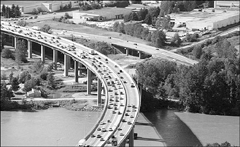
Port Mann Bridge (black and white)

Across the great divide.

Imagine B.C. run by a party without a single representative from Vancouver, a province where divisions of power break down on strictly geographic lines and ballooning suburbs eventually triumph in a slow and steady demographic war for resources, values and interests.

It's far from impossible, according to experts tracking the trends. As B.C.'s suburbs swell and growth in the already congested city levels off, the balance of power in this province could shift dramatically. And when and if the economy cools, alliances -- which have traditionally spanned city, country and suburb -- could strain and even fracture under the pressure of competition for dwindling public dollars.

Such a future was foreshadowed by the release last month of the electoral boundaries commission report. Most stories on the report focused on the lost seats in B.C.'s Interior. What went less noticed were the gains in suburbia: Three new seats for the 'burbs that surround Vancouver, a fourth for the largely suburban Okanagan Valley.

It's one small part of a cross-Canada trend. Over half of Canadians could soon live in suburbs. And as I wrote about two weeks ago, there is a small but growing body of academic literature that suggests Canadian suburbanites don't just hold more conservative values than do their big city cousins, they also tend to vote that way too. Researchers, pundits and politicians are all scrambling to find out what that trend will mean.

Here in B.C., some people I spoke to for this article foresaw a possible future where a growing rift emerges between Vancouver's inner core and its outer 'burbs. It's a rift that could see the city's power wane and the alliance that binds the governing Liberals buckle.

But the future is hardly set. While everyone agrees that the suburbs will grow, not all are sure what that will mean. Far from the homogeneous sprawl many imagine, B.C.'s suburbs are a fluid patchwork of demographics. With a kaleidoscopic mix of incomes, religions, ages and races, it is tough to firmly predict how the more than 20 cities, municipalities and villages of Greater Vancouver will vote down the line.

Big divide

If you drive far enough east from Vancouver, over the clogged Port Mann Bridge and past sprawling Surrey, you end up in the Langley office of John Dyck. In many ways Dyck represents the increasingly powerful suburban voter. He's highly educated, Christian and almost never visits the big city. Dyck, who teaches political science at Trinity Western, a private Christian university, has no problem imaging a potential future where voters in the outer suburbs use their growing clout to wage a battle for resources with their neighbours in the inner core.

It is, in a way, all about access, Dyck told me. The physical distance from his home in Abbotsford to the waterfront in Vancouver isn't that great. But getting there typically involves a lengthy trek through jammed up roads and bridges. So, most of the time, he just stays put.

That creates a problem, he said, and not just for suburbanites. If Vancouver wants provincial money, whether for Olympics or the Canada line or Stanley Park, there needs to be a way for everyone in the greater region to access those attractions. If there isn't, it's hard for those in the 'burbs to justify paying their share. "Stanley Park may be seen as the jewel of the Lower Mainland," Dyck said, "but not if you don't go there."

You haven't yet seen that kind of open jockeying for resources for a simple reason, Dyck added. Both major political parties draw support from both city and suburb and neither can afford to come down to strongly in favour of either one. For the Liberals, though, that might not be true for much longer. The glue keeping the party's disparate mix together is their leader, Gordon Campbell. And whether his coalition survives his eventual retirement remains an open question.

Strains within BC Libs?

Jordan Bateman, a long time organizer for Liberal cabinet minister and suburban heavyweight Rich Coleman, agrees with Dyck's assesement. "As long as [Campbell]'s there, things will be held together," Bateman said. "That's his great strength.... Will there have to be a split [when he's gone]? I think it depends on the next leader."

Bateman, a first term district councilor in Langley, is an unabashed supporter of what he considers the suburban lifestyle. "There's a distinct difference between the way urban and suburban people live," he said. Suburbanites want their own clutch of land. And once they have it, they want to make sure it's in a place where they can raise their kids in safety. It's a type of lifestyle that makes it easy to support a low tax, tough on crime platform, he added.

The challenge for the B.C. Liberals right now is to appeal to the suburban voter without alienating his big city cousin. But that challenge may become a lot less pressing as the suburbs continue to grow and the importance of the city shrinks in comparison.

'Burbs will morph

Of course, all of this relies on a particular idea of suburbia. For any of this to come true, it must also be true that suburbanites really are different and act different and vote different than do city folk. And while there is evidence that that is true, at least as far as voting goes, not everyone is convinced it will remain true as B.C.'s suburbs grow and mature.

"We can't assume these places will stay the same," said Dennis Pilon, who teaches B.C. politics at the University of Victoria. "As people are pushed out of the city by housing prices etcetera, the demographics will change." The beginnings of that change were already evident in the last provincial election, Pilon added. "One thing that's fascinating is to look at the changing voting patterns," he said. "The NDP support in Chilliwack speaks to the changing demography. This is not your parent's Fraser Valley."

Immigrant voters

Another element to consider is the enormous and fast growing immigrant population in Vancouver's 'burbs. While the research shows that suburbanites tend to vote conservative, it's not nearly so clear for suburban immigrants, according to Alan Walks a professor of urban geography at the University of Toronto. In the Progressive Conservative Ontario governments of the 1990s -- considered the prototype for suburban dominance in Canada -- booming 'burbs didn't always mean added support.

"The Mike Harris government removed much of the regulations on developing green field sites and in turn it led to this huge building boom at the edges," Walks said. "So you might think it would have been this great constituency for the Harris government. But no, it's not true. Most of those moving into these new developments are immigrants who are more likely to vote for the (Ontario) Liberal party. So that cancelled out whatever benefits the expansion would have had."

Fraser River 'a wall'

Whether as isolated bergs or thriving outposts in a connected region, how B.C.'s suburbs grow and mature could be the single biggest political story of the next 20 years in this province.

Will that story play out as one of a single maturing region with political competition that weaves in and out of municipal boundaries?

Or as a war between an increasingly isolated core and its booming 'burbs?

The answer has everything to do with the decisions politicians make right now.

Jordan Bateman, the Langley city councilor, isn't optimistic. "The Fraser River is a wall between two completely separate regions," he said. Will there have to be a split between them? "I hope not. But I think we're headed that way."

Related Tyee stories:

 [Tyee]

32  Comments:

Login or register to post comments

  • Chris H

    4 years ago

    What?

    " 'Stanley Park may be seen as the jewel of the Lower Mainland,' Dyck said, 'but not if you don't go there.'

    Stanley Park is a municipal park and its operation is paid for by the taxpayers of the city of Vancouver. I don't get his point. His taxes do not go to the operation of the park. He can equate the disaster relief that the province contributed to the park with the massive influx of dollars from the province to help protect the Fraser Valley from flooding last spring.

  • RickW

    4 years ago

    Peter C. Newman...

    ...suggested that cities are heading in the direction similar to the city-states of old, because energy and resources will be dictating consolidation, rather than sprawl.
    The problem with suburbs is that they are enrgy-intensive, and I notice this wasn't touched upon by Richard.

  • zalm

    4 years ago

    I found myself nodding in

    I found myself nodding in sympathy with John Dyck, having grown up in a suburb in the 1960s (more like the country at the time, I guess) till I got to the conclusion.

    Dyck and others are welcome to have their slice of suburbia, their low taxes and their lifestyle, as well as to slag the city as the great Satan, as soon as they agree to forgo all the subsidies that make life in suburbia worthwhile at a lower cost than life in the city - the massive transportation subsidy amounting to $1.6 billion in BC, the even more massive capital gains subsidy on primary residences in BC estimated by MLS at $7 trillion a year in increased capital value the past couple of years, the medical establishment subsidies estimated at in excess of $1.2 billion to maintain trauma tertiary care centres outside the City, education subsidies, recreation subsidies, and every other tax break that the suburbs get in order to maintain their inefficient lifestyle.

    (Oh, where's a Fraser Fellow when you need him? Too busy sucking back a beer in front of the barbie in his suburban home, I guess.)

    That's to say nothing of being able to ship their drug addicts from abused Christian homes to the Downtown Eastside to keep them out of sight, out of mind, for companionship, detox, housing, treatment, and recovery, but never, never, NEVER to return.

    Because I visit the suburbs occasionally, I make few bones about it. But when there's talk of disenfranchising the city voters along the lines Warnica talks about.....

    EDITED FOR INSULTS == TYEE MODERATOR

  • Grumpy

    4 years ago

    Now here is the real story........

    As we approach 2014, the valley's population will reach a point that gridlock reigns supreme, even with the Gateway project (which proved more a boon to the road Builder's Association than commuters) gridlock was moved away from the Port Mann Bridge to the next choke points on the #1 highway. The Port Mann Bridge will now be understood as acting as a passive traffic calmer to areas west of the bridge, just like what the three land Lion's Gate bridge does for Vancouver.

    Valley politicians will now realize that they have been 'sold down the river' by Campbell's Liberals, with public transit spending as Vancouver has 3 highly subsidized metro routes (Expo, Millennium & Canada Lines), yet the valley has nothing at all except the sporadic West coast Express.

    The provincial in desperation will extend SkyTrain down the Fraser Hwy. to 152nd (SkyTrain points this way) and fund a heritage tramway. It will achieve nothing but animosity with valley voters.

    By 2015 SkyTrain will be almost 30 years old and expensive refurbishments will have have to be made. Also the the aging mini-metro will be more erratic in operation as the signaling system wears out. This means more money spent on Vancouver's metros.

    Ridership on SkyTrain will have peaked by 2015 as more and more jobs flee from Vancouver to the 'burbs'in areas poorly served by transit.

    TransLink will collapse as a massive debt load of the metro and bus system overcomes revenue and the region's public will reject paying more and more property taxes to fund Vancouver's metros. TransLink will be split in three areas:
    1) The municipalities serviced by SkyTrain/metro.
    2) The municipalities not serves by SkyTrain/metro.
    3)SkyTrain/metro.

    Only then will regional politicians understand the true cost of the metro system on the taxpayer. Vancouver, Burnaby, New Westminster, Richmond, Surrey, ratepayers will then fund only the metro system (or portion of), leaving valley ratepayers to fund transit in their own region.

    On the whole, transportation in the region will be chaotic, with the car the only reasonable means of transport.

  • monty

    4 years ago

    with any luck

    Campbell will be gone in 2009.

  • oeanda

    4 years ago

    if i was a selfish bastard,

    if i was a selfish bastard, if i wanted a false sense of security, if i wanted a house that had vastly more space than i could use, if i wanted to drive 1/2 hour for a roll of toilet paper, if i didn't want to be able to get anywhere except by car, if i never wanted to see my neighbours except from my car, if i didn't care a lick about living an energy-intensive life, if i wanted to be isolated from the cultural diversity of the city, if i thought it was reasonable to turn agricultural land into tracts of identical mcmansions, if my primary motivation for working was to buy expensive crap that marketers have convinced me that i need, if i thought it was beneath me to ride on public mass-transit or walk or ride my bike, if i wanted to spare my children the exposure to others of different races and religions, and if i thought my personal comfort trumped any and all other considerations, i might move to the suburbs.

    and if i was a selfish bastard, i would vote for the [insert current powerful right-wing political entity here].

    funny how purposes converge, and frightening how a lifestyle predicated on selfishness can become a powerful political force.

    a client once asked me, "who votes in anything but self-interest?" "me," i replied, and i think that that is the primary difference between urban and suburban voters. not that all - or even most - urbanites are altruistic angels, but the concept of community is real and vital in the city, whereas in the 'burbs, it's a buzzword. it's only a community as long as everyone identifies with the same bogeyman.

    also, allow me to make a distinction between the scattered but close-knit rural communities of old and the selfish urban "refugees" of today. not even close.

  • Rhea

    4 years ago

    Wow, stereotype much?

    Quote:
    funny how purposes converge, and frightening how a lifestyle predicated on selfishness can become a powerful political force...the concept of community is real and vital in the city, whereas in the 'burbs, it's a buzzword.

    Care to add any other misinformed generalizations or useless stereotypes in here? If you want to see "a lifestyle predicated on selfishness", go on down to Yaletown, Robson or over to West Point Grey or Shaughnessy. Check out all the idiots driving to Starbucks in their SUVs, even when it's within walking distance. Watch the people walking right past the homeless guy who's asking for food (not change for drugs or alcohol, food), or do a poll on how many people voted for Campbell in the last election. Commercial Drive ain't what it used to be either - it's become trendy, and a lot of people I know who lived there for years are leaving due to the change in attitudes and the stupid real estate prices.

    (cont'd next post)

  • Rhea

    4 years ago

    continued from above

    Also, how do you think your food and other goods get to your little urban oasis? Here's a hint - all those polluting trucks clogging the freeways and byways into Vancouver aren't just going to the port. Unless you're part of a community garden or are buying pretty much exclusively local food, you're not living a terribly energy efficient lifestyle no matter how much money you spend at Capers.

    I live in the burbs. We grow about 50% of the vegetables we eat in our own backyard, as do several neighbours. We support our local farmers and get a large percentage of our other food right within our community. One guy runs his home on geothermal power, and geothermal has been proposed as a heat source for the entire downtown city core. My neighbourhood has block watches, block parties, everyone knows everyone else. Most people I know who commute any distance take transit or rideshare. As for cultural diversity, I think if you ever bothered to open your eyes and look, you'd find a large number of cultures happily coexisting in various suburbs. I have neighbours who are South Asian, Chinese, Italian and French, to name only a few. Most people live in the burbs because they simply can't afford Vancouver prices. Others have pets and kids or have elderly parents living with them and cannot realistically live in a one-bedroom apartment. A large number work in the Fraser Valley or Tri-Cities areas and never go near Vancouver. Most of us vote NDP - in fact, our current MLA is NDP. And my neighbourhood isn't that unique, either.

    Yes, Vancouver has some horrible issues in the burbs with sprawl which must be addressed before peak oil addresses them for us. However, it is entirely possible to live a more energy-efficient lifestyle in a modest single-family home (NOT a McMansion) than in a condo in Vancouver - especially if you take into account that many people no longer work in Vancouver at all. Everyone keeps trying to pretend that Vancouver is still the centre of the universe and living in the city makes you an environmental saint. Guess what...time to wake up to the fact that it's a misconception.

    Ignorant, misinformed "us vs. them" attitudes like yours, coupled with smug self-congratulation really drives home to me why I can't stand Vancouver city any more.

  • oeanda

    4 years ago

    my attitude is really more

    my attitude is really more "us vs. us"

    congratulations on being an exception, though. it really is heartening.

    but i've been around. i've lived outside of BC and outside of Canada, in the country, in the burbs and in the city. i've seen a lot of different lifestyles. i've driven through california's owens and central valleys (where our fruit an veggies come from), i've been to saskatchewan farms, i've lived in a lumber town, i've lived in the big city, downtown and in the burbs. really, i have meaningful experiences, too!

    i know well that generalization is a flawed method, but we do it because it works. you may think that your progressive lifestyle is the rule for all suburban communities, but it isn't. you may like to think of city dwellers as an insular, ignorant lot, and that's fine... but you're generalizing too.

    i know that many of the SUVs parked in front of starbucks in Kits are from the burbs. we're mobile people. where you are isn't necessarily where you live.

    and as much as you might think that having fluorescent bulbs in the chandelier makes yours a low-energy-footprint kind of life, it is not true that a single detached house can be made more energy efficient than similarly outfitted communal housing. it is not true that diving to the nearest mall to buy food is more efficient than walking down the block to a bodega. it is not true that consuming precious land resources for new, sparsely populated neighbourhoods - fracturing wildlife habitat, and eliminating agricultural and forest reserves - is smart land use. it is not true that there is enough space for everyone to have their little piece of paradise. i get my food from farms and so do you. if you can grow a few veggies to offset the waste of transportation, good for you, but if you live in the Fraser Valley, chances are, you live on what used to be a farm.

    the point about cultures is interesting. while in los angeles i noticed that high-end gated communities that at one time would have been exclusively white, they are now fairly racially mixed. this i attribute to the emergence of class as a more important delimiter than race. while you might complain about the rich who walk past the homeless in the city, you fail to recognize those who stop to help. you fail to acknowledge that suburban communities are mostly free of a homeless problem. why do you suppose that is? could it be that there are more opportunities for the down-and-out to receive assistance in the city? could it be that there are communities there where anyone can find a place? the old sundown town isn't a dead, it's just underground. maybe, since the city is so cold and unforgiving, you'd like to bus a few of 'em out there to live in your neighbourhood?

  • JIm

    4 years ago

    Oeanda's sanctimonious rant

    Oeanda's sanctimonious rant is the exact reason there is a growing rift between suburbia and urbanites.

    Could you blow your own horn a little more? Classic urban arrogance.

    Your arrogance is sickening and a reason I could never live in the self absorbed holier than thou environment known as the city of Vancouver.

    The most ironic part is when suburbanites do move back to the city they are lambasted because they're contributing to gentrification and "kicking people out of their homes". If they live in the suburbs they're inefficient scum destroying the earth. No matter what "suburbanites" are either wrecking lives or the environment.

    City dwellers have become a bunch of bigots. You are so self absorbed in your socialist wasteland that you've become what you supposedly hate most.

  • oeanda

    4 years ago

    socialist wasteland? how

    socialist wasteland? how could i afford to live in the supposedly exclusive city if i wasn't a money-grubbing capitalist?

  • dr evil

    4 years ago

    sanctimonious rant?

    I really enjoyed your post oeanda. Though I don`t live there...except for the car traffic I enjoy visiting and grubbing about a little...take in some hipness and awareness.

  • oeanda

    4 years ago

    live where? vancouver? i try

    live where? vancouver? i try to avoid vancouver ;)

  • alive

    4 years ago

    be happy

    I think it is just great to see so many posters here being so happy with wherever they happen to live!

    Now, if you could only learn tolerance and be happy that everybody seem to be where they fit in!

    I see nothing new in the article, the biblebelt has always voted for some neo-conservative party.

    Capturing the new immigrants may be tricky as in many cases they have bad experiences with "democracy".

  • Rhea

    4 years ago

    Quote:i know well that

    Quote:
    i know well that generalization is a flawed method, but we do it because it works. you may think that your progressive lifestyle is the rule for all suburban communities, but it isn't. you may like to think of city dwellers as an insular, ignorant lot, and that's fine... but you're generalizing too.

    Precisely where did I say that my lifestyle is the rule for all suburban communities? I said it wasn't unique, not that it was the rule. And yes people generalize. But not all of them come across as sanctimonious preachers.

    Regarding "building on farmland", Vancouver and a good deal of Burnaby used to be farm and productive timber forest as well. What's your point? I don't support taking productive land out of the ALR - in fact, I think densifying the existing 50's and 60's suburbs and concentrating housing around existing transit corridors is the way to go. My neighbourhood is all 50's-70's housing...there's a lot of it still around. If they

    Quote:
    you fail to acknowledge that suburban communities are mostly free of a homeless problem. why do you suppose that is? could it be that there are more opportunities for the down-and-out to receive assistance in the city? could it be that there are communities there where anyone can find a place? the old sundown town isn't a dead, it's just underground. maybe, since the city is so cold and unforgiving, you'd like to bus a few of 'em out there to live in your neighbourhood?

    Ah, here we go. There is in fact a homeless problem in the burbs. It's significant. However, in Maple Ridge we have a higher level of treatment/assistance available than in the sewer that's the DTES. People are treated in the community rather than being shipped out like a lot of Vancouverites want. After all, the sight of hungry and addicted people with no treatment might ruin the scene for the 2010 tourists! Before you start in on the sob story about how uncaring the burbs are, take a good hard look at how Vancouver handles its addicts.

  • oeanda

    4 years ago

    Quote: I think densifying

    Quote:
    I think densifying the existing 50's and 60's suburbs and concentrating housing around existing transit corridors is the way to go. My neighbourhood is all 50's-70's housing

    fair enough, but burnaby is a suburb of vancouver in the sense that brooklyn is a suburb of new york. it stopped being a frontier long ago, and densifying it to prevent further sprawl is the correct course. however, that process will inevitably result in burnaby becoming an urban core. not that anyone would mistake it for a residential suburb now. i think the issue here is nomenclature.

    the suburbs i'm thinking of build on the american postwar autocentric model. they're carved out of forests, deserts or farm fields to make way for new homes and are zoned strictly residential. people have to drive long distances to buy essentials. the planning of neighbourhoods like these specifically excludes the mix of residential and commercial zoning that exists in cities and favours car culture. if you want to claim that burnaby is one of these suburbs, well... it's not.

    anyway, according to the GVRD's data, 63% of homeless people are found in vancouver, followed by 18% in surrey. burnaby and maple ridge come in at 2%. services for the homeless are easily overwhelmed, especially considering the numbers of homeless have doubled recently and will continue to rise. thankfully, to take you at your word, burnaby's homeless problem is manageable. expect that to change.

  • Birch

    4 years ago

    Everyone's gotta live somewhere...

    What an intriguing group of antithetical rants!

    At the risk of falling into a sanctimonious category of my own, what I sense from the above "conversation" is a lot of people identifying the merits of the choices they have made regarding where to live, what to do, etc., largely by contrasting them with the perceived demerits of others' choices.

    I'm in the outback, and we, too, have rich, poor, homeless, gardeners, SUV's, and all the other accoutrements of 21st century existential (in the more concrete sense than some kind of abstract search for meaning) angst.

    Everyone's got to live somewhere and try to make a living/survive in the process.

    Come to the generally ignored Northwest, where jobs are few but space is ample, where houses that would sell for a million in the lower mainland can still be had for under a quarter million, where we all bitch at each other as much as you "Sutheners" do, over many of the same issues.

    As for the article, the idea that the Liberal Party's fragile urban/suburban consensus might fracture is the least of our worries.

  • grapeman

    4 years ago

    Not really about choice

    Wow! Many of the urbanites who are commenting here seem really smug, and in desperate need of reality therapy. For one thing, the City of Vancouver is as much to blame for urban sprawl as any suburban municipality. Vancouver seems to have zero interest in affordable family housing (which is different from "affordable housing"), and development after development appeals entirely to singles and childless couples. Most people say this is the result of fewer families, rather than considering its role as the cause of fewer families. No wonder the Vancouver school district has about 10,000 unfilled spaces.

    Most working class and middle class families don't choose the valley - they are forced here because of mathematical necessity. I know; my family is one of them. Many years ago we left Burnaby because there was simply no way we could afford family appropriate housing for 4 people on $40,000. Life out here is pretty good. I miss many of the cultural benefits of Vancouver, but I enjoy a much more family friendly environment in the valley. I know a lot more neighbours here in Chilliwack than I ever did in Toronto, Vancouver and Burnaby, and our schools are not bleeding from declining enrollment.

    Until the City of Vancouver starts to bring families back into the city (and address a very distorted demographic that's developing in many Vancouver neighbourhoods), perhaps Vancouverites should look in the mirror before they pontificate about sprawl.

  • North of Hope

    4 years ago

    contradiction

    Quote: It was said, "i know well that generalization is a flawed method, but we do it because it works."
    To me this appears to be a contradiction. Many of the comments appear to be justifying their owners situation. What we have to start to do is see if our life style is sustainable or will it cause too much drain on our ecosystem.

  • rac

    4 years ago

    This is really a quite

    This is really a quite simplistic view of suburbs and cities.

    The reality is that each of the municipalities has areas that are urban and suburban. Look at Vancouver south of 16th and east of Victoria. It is as suburban as many places in the Valley and these areas tend to be conservative. Burnaby, New West, Coquitlam Centre, Port Moody and Downtown PoCo are becoming quite urban. Even areas of Surrey and Langley are becoming more urban. Most housing starts in this region are multi-family units and with the shortage of land and prices continuing to rise, this will continue. Yes, the burbs will get more political power, but will they all vote Liberal. I doubt it.

    Regarding transit. The reason why their is not good transit in the Valley is that the money has been spent on building more roads instead of expanding transit. As well, when suburban politicians rallied to defeat the vehicle levy, that left TransLink $100 million short per year. The province has not given transit another source of funding so it can improve transit in the Valley.

    A good opportunity to write the Premier asking for more funding for transit.
    Premier Gordon Campbell
    MLA Vancouver-Point Grey

    604 660-3202

    Your MLA can be found here:
    http://www.leg.bc.ca/mla/index.htm

  • Budd Campbell

    4 years ago

    REALLY STUPID URBAN BULL

    "if i was a selfish bastard, if i wanted a false sense of security, if i wanted a house that had vastly more space than i could use, if i wanted to drive 1/2 hour for a roll of toilet paper, if i didn't want to be able to get anywhere except by car, if i never wanted to see my neighbours except from my car, if i didn't care a lick about living an energy-intensive life, if i wanted to be isolated from the cultural diversity of the city, if i thought it was reasonable to turn agricultural land into tracts of identical mcmansions, if my primary motivation for working was to buy expensive crap that marketers have convinced me that i need, if i thought it was beneath me to ride on public mass-transit or walk or ride my bike, if i wanted to spare my children the exposure to others of different races and religions, and if i thought my personal comfort trumped any and all other considerations, i might move to the suburbs."

    This is really stupid stuff. I quote it in its entirety only because it's so typical of a certain, smug and insular urban attitude, that of the poseur type who craves fashionability in all things, including politics. It's sort of like reading one of Steven Schelling's moronic fashion pieces in The West Ender.

    The write of these remarks is, in my opinion, infinitely more selfish and self-righteous than the imaginary people he subjects to ignorant ridicule. And did I mention that he is obviously incredibly narcissistic, ... rather like a typical sociopath?

  • Ed D

    4 years ago

    City/suburban divide

    The aspect that received all but token comment in this article is that almost no significance is given to the rural and small town reality that makes up about 90% of the landmass in BC. I haven't looked at how many ridings this actually area represents but I know there is growing resentment towards the Liberals in the "hurtland" over a perception that they are a government by and for the urban areas.

    As an example of unequal treatment, 21 years later we still pay a toll every time we drive over the Coquihalla Highway. Will Vancouverites pay a toll every time they drive the Sea to Sky to go skiing? Of course not, yet the highway spending in 1986 was for almost the same reason as the Sea to Sky upgrade now.

  • rac

    4 years ago

    Liberals Silly Tolling Policy

    The liberal's tolling policy states they will only toll a route if there is another free option. That is why the Coquihalla was tolled and not the Sea to Sky. Don't worry though, the Golden Ears Bridge and the Twinned Port Mann will have tolls.

    We actually need tolls on existing bridges and highways to encourage people not to drive as much.

  • Stump

    4 years ago

    Stupid Bull

    Quote:
    if i thought it was beneath me to ride on public mass-transit or walk or ride my bike, if i wanted to spare my children the exposure to others of different races and religions, and if i thought my personal comfort trumped any and all other considerations, i might move to the suburbs."

    I'm not so sure Budd. I certainly hear variations on those statements (saying the same thing but with a great deal more prevarication and rationalizing) quite often from people who live in the 'burbs.

    Whether or not folks do all those things (including the ones I didn't include in the quote to keep it succinct) on purpose or due to brainwashing, it's a fairly accurate description of what life in the suburbs is like.

  • RickW

    4 years ago

    rac

    Quote:
    The liberal's tolling policy states they will only toll a route if there is another free option. That is why the Coquihalla was tolled and not the Sea to Sky.

    But there is an option to get to Whistler - namely Hwy 99 from the north. It may not be convenient, but it IS an option.

    And besides, the BC Ferry System is a highway toll, and the users have little choice there..........

  • G West

    4 years ago

    here's another interesting little tale

    http://www.canada.com/vancouvercourier/news/story.html?id=6c262e25-83d2-4db1-83b6-12d250591400&k=6334

    How much would anyone like to wager that the good offices of the NEW CAR DEALERS of BRITISH COLUMBIA and their well-paid lobbyists are somewhere in the woods behind this little gambit?

    SO much for the Gordo's commitment to Green, eh?

    Can't have anything interfere with the profitable operations of the corporate enablers and sponsors of Cambellism can we?

    Anyone who thinks that the Car Dealers of BC aren't jealous of their success and their ability to continue to pocket currency exchange windfalls (rather than passing them on to their loyal customers) ought to read this Tyee story again:
    http://thetyee.ca/Bigstory/2007/08/20/BlackPress/

    I can just imagine how it rots Jim Pattison and his close personal friends' socks that growing groups of British Columbians are sharing a few cars among a lot of them rather than each buying one for themselves.

    Sounds like socialism to me - better stamp it out - or at least tax the bejeesus out of it. The fact the co-ops aren't profit oriented is just too dangerous for words.

    Build some more of those bridges Gordo.

    I hope the managers of the car co-ops are aware of the savings they can make by purchasing cars stateside - best way to counter this kind of nonsense is to fight fire with fire - at the same time they should take the SS Tax people to court...

    Interesting that the story ran in the Courier and not in the Sun or the Province too...I guess all their reporters are still on summer break and their editors are husbanding resources.

    For more on managing editors and their standards, have a look at this:
    http://houseofinfamy.blogspot.com/

    The top story entitled Journalism and Ethics! Oxymoron? is the one I'm talking about.

  • Stump

    4 years ago

    tax the co-op, cut the new car buyers a deal

    meanwhile, the prov. gov't offers a tax break to people buying hybrids. "New cars" if you will.

    How convenient to quote the Church Lady

  • G West

    4 years ago

    did you see this stump?

    Georgia Straight September 13, 2007
    Straight Talk

    Burnaby won't budge on Gateway

    By Carlito Pablo

    Burnaby city council isn't backing down from its opposition to the B.C. Liberal government's Gateway program.

    "We're into a major showdown with the province on the Gateway project," Mayor Derek Corrigan told the Straight. "The City of Burnaby has indicated to the government that we're not prepared to sign a memorandum of agreement or negotiate a memorandum of agreement until they answer the questions that we posed in our earlier reports."

    Corrigan said the provincial government hasn't addressed concerns previously raised by the city, from increased air pollution to the upkeep of city roads that will be affected by increased traffic. According to a Burnaby staff report, a provincial analysis indicated that the Gateway program "will single-handedly increase the region's traffic-related greenhouse gases by 2.6%".

    "We're concerned about the Livable Region strategy and the induced growth that's going to occur in the Fraser Valley as a result of this," Corrigan said.

    The province wants Burnaby to sign an agreement on the transfer of city properties that are needed in the plan. The Gateway program includes widening Highway 1 and twinning the Port Mann Bridge.

    Burnaby city council voted 7–2 at its August 27 meeting to decline the provincial government's request to negotiate an agreement, according to Coun. Nick Volkow.

    Volkow told the Straight that council expects the B.C. Liberal government to play hardball. "They can expropriate the properties and use other clubs to beat Burnaby into submission," he said.

    Both Corrigan and Volkow pointed out that the cities of Vancouver and New Westminster are also opposed to the Gateway program.

  • RickW

    4 years ago

  • Budd Campbell

    4 years ago

    CORRIGAN STRIKES AGAIN!

    "We're into a major showdown with the province on the Gateway project," Mayor Derek Corrigan told the Straight.

    Yeah. Right. What Corrigan and Volkow are really into is a major piece of political gamesmanship.

    Anyone reading Burnaby's submissions on this issue can see that for them the real issue has been obtaining more provincial funds to fix up Burnaby streets that will be impacted by Gateway, that is, that have interchanges with Highway 1 or are closely connected to roads that do have interchanges.

    By refusing to negotiate and instead saying, "Go ahead and expropriate", Burnaby's lawyers have concluded that the City can to better in expropriation than it can through negotiations, especially when you deduct the staff costs involved in negotiating a deal. Once sections of the Burnaby street network are taken over by the BC Govt, they become the provincial government's responsibility for maintenance. Forever. That saves Burnaby some money. Corrigan is just happier than Hell to up-load fiscal responsibilities to the provincial level, and then turn around and make them seem like bullies into the bargain!

    It's really very clever, and it shows that Corrigan has improved his game considerably since his notoriously amateurish "Saab 900" days at the old BC Transit Board.

  • Budd Campbell

    4 years ago

    STUMP TALKS TO SUBURBANITES?

    I certainly hear variations on those statements (saying the same thing but with a great deal more prevarication and rationalizing) quite often from people who live in the 'burbs.

    Stump, ... where and under what circumstances do you ever talk to residents of Surrey, or Langley, or Maple Ridge? I find it hard to believe that you know anyone outside Vancouver, North and West Vancouver, Burnaby, and just possibly Richmond as well when you're in a particularly loose and reckless frame of mind.

    If you ever did talk to people from the suburbs, you'd know very well that they moved there to afford a home large enough to live in, though with today's revoltingly high prices that is no longer possible for first time buyers, at least not for a detached dwelling. They made that move knowing they are giving up the easy access to good restuarants and other urban amenities (besides the better eateries, what are those better amenities, ... I keep forgetting.)

    They do so because Vancouver has used its zoning policies to intentionally price family sized apartments out of reach. Vancouver doesn't want middle and low-income families living in the City, because that would be less profitable from an overall {tax revenue/social spending} perspective than having towers choc-a-bloc full of able-bodied, childless Yuppies.

    Here in Maple Ridge we have a very good bike shop, LocalRide (www.localride.ca), and I will be going there shortly to pick up my 12 year old Kona Cinder Cone after its annual cleanup.

    I really must find time later today to send a message to The WestEnder and ask them if columnist Schelling is a joke or the real thing. His column a couple of weeks ago consisted of a pathetic whine that he and his fashion pate pals had to pile into someone's car, all crowded and squished up, and drive all the way out to the Coquitlam Centre mall to shop at the new H&M store. It was just such a total injustice that the new H&M had not been situated Downtown! When I mentioned this yahoo column at work to a colleague from Coquitlam, he immediately started laughing and mentioned two others on the floor who had said the same thing, ... for real!

  • G West

    4 years ago

    Budd

    Whatever else you may think of Corrigan and the Burnaby (and Vancouver) councils, you can't deny that the prospect of 10s of thousands more flow through commuters arriving like Topsie at the Burnaby border to further clog its arteries several times a day must give the municipality pause.

    Have you been on the 401 in Toronto lately?

    Moreover, they HAVE some half-decent mass transit.

    This is a poorly planned half-baked idea and not just for the core municipalities either. I say this without for a moment disagreeing that Vancouver's development model has been a gilt-edged five-alarm disaster.

    • The discussion for this story is closed. No more comments can be added.