If Salmon Could Vote
Where are Lib candidates on fishery? Nowhere.
Sockeye: sinking fast.
All my life the Pacific salmon has held me in awe. When I was a little boy my parents would take me to my grandparents' little cottage at Granthams Landing and we would often go salmon fishing, they with their big cane rods and the Peetz reels, me with my hand line. I wasn't trusted with a rod and to ensure I didn't get a big salmon strike I was equipped with a small Tom Mack spoon for bait and I wasn't allowed to let much line out. Occasionally I would catch an immature salmon, which we wrongly called a grilse, but on one occasion a salmon did strike and tore the line from my hands but not before giving them a bad burn. Far from discouraging me, it made salmon all the more thrilling.
Over my years of youth and early adulthood, there were plenty of fish. I can remember casting strips of herring at coho and chinook salmon at Thrasher Rock, near Nanaimo, and virtually filling the boat. When I lived in Kamloops, my son and I would come down to the coast and fish for chinooks at Pirate Rock on Thormanby Island near Pender Island. There was an abundance of coho and chinooks that beggars description -- plenty for commercial interests, plenty for the sports fishery. Now there is nary a coho to be found in the Georgia Strait.
Why is this? We haven't enough fingers to point at all the culprits, but it boils down to Pogo's aphorism: "We have met the enemy and he is us."
But this must be said. Governments, until recently mostly the Feds, have had the authority over salmon, so what has happened is largely bad planning, bad enforcement and bad allocation of fish to be caught.
Save the sockeye
There are seven varieties of Pacific salmon: the chinook, the coho, the chum, the pinks, the sockeye, the rainbow (steelhead) and cutthroat. Only the first five are important for this dissertation.
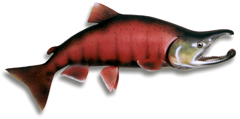
I've often said that the Pacific Salmon is the soul of British Columbia; it's what marks us out as British Columbians and it is our trademark around the world -- especially the sockeye. They are anadromous, meaning they spawn in fresh water. Five to 12 pounds at maturity, sockeye are the bright red fish starring in countless documentaries of crystal green rivers brimming with hundreds of thousands of these wonderful fish. Typically four years old, sockeye often travel long distances to reach the spawning grounds. The most important of these are found in the Fraser, Nass and Skeena Rivers, as well as in the Rivers and Smith Inlets.
Sockeye are the preferred eating fish not just for their firmness and taste, but also because of their red flesh. (It should be noted that Atlantic salmon farmers dye their fish red so as to imitate the sockeye.) The most spectacular run is that which turns right at Lytton into the Thompson River and exits in huge numbers into the Adams River. Thousands of tourists make their way to the Adams River to see this remarkable act of nature.
Tragically, we may soon see the end of this and other Fraser River runs of sockeye. The 2006 return of Adams River sockeye shows graphically and tragically why we must change our ways or lose our fish. Fisheries and Oceans Canada has the mandate to determine how many sockeye will return and then make an appropriate allotment to the commercial and sports fishermen. This year they were out by 50 per cent! This means the allotments were based on a guess that was twice as big as what actually happened.
No accountability
Put another way, fishermen harvested twice as many fish than they should have. To make matters worse, many fish having survived the wild died before they could spawn because water levels in their home streams were too low or water temperatures were too high because of an unusually dry summer. (A situation those of us who opposed Alcan lowering the Nechako river further predicted.)
Many causes of this catastrophe are put about by the federal government. El Nino, warmer waters bringing new predators into the sockeye's fascinating odyssey, habitat destruction and abnormally high temperatures in rivers where they spawn or, as in the case of the Nechako, pass through on their way to the spawning grounds. The trouble is that Fisheries and Oceans makes its calculations based on pure guesswork and, I'm reliably told, on outdated guidelines. In this past year, Fisheries and Oceans counted the fish in late August, saw that the number was unnaturally low and assumed that the other half were on their way. They weren't. Moreover, this is scarcely the first time this has happened.
What's truly puzzling is why there has been no political accountability, indeed culpability.
Easy questions for you: in the 2006 election, how many questions on Pacific fisheries or indeed the environment were put to the leaders in the televised debates? Answer? None. Dick all. Two times the square root of S.F.A.
How many times has the current government shown concern for the B.C. fishery, especially the Fraser sockeye runs? Same answer.
Fishery is key issue
OK, there is a competition for the man who may be the next prime minister. Which of the candidates for the Liberal leadership has said a single solitary word about our fishery? You're right again.
And do you think you've seen this movie before? Like in Atlantic Canada where the feds allowed the cod fishery to be so abused that it was shut down and mostly remains so. Unless the Department of Fisheries and Oceans radically addresses the Fraser sockeye ongoing catastrophe, we will reach the stage (if we haven't reached it already) where we must have a total fishing ban.
There's a very tough economic problem here. Fishermen have millions of dollars tied up in boats and equipment. They're not interested in fishing closures, and when they happen, they blame the problems on Indians and sports fishermen. That leads to a very difficult political situation -- politicians fear the backlash of fishermen at the polls more than they care for the salmon. Their attitude reminds me of the story of a baseball manager who, in a long tough game, used his very last pitcher.
"What'll you do for pitchers for the big game tomorrow, Skipper?"
"Tomorrow it might rain" is the reply.
Since 1871, our salmon fishery has been run by the federal government. Most of the ministers couldn't tell a salmon from codfish and, moreover, couldn't have cared less.
The current Liberal leadership convention is carrying on that legacy to perfection. After Dec. 2 there will be one more political leader who doesn't give a fiddler's fart about British Columbia or its unique salmon.
Plus ça change, plus c'est la même chose. ![]()


45
Login or register to post comments
Grumpy
5 years ago
Comments on "If Salmon Could Vote"
It's so sad, that our politico's are so ignorant, so evil to let the salmon suffer so. We live in a great new dark age where money and the making of money is the great religion and to 'hell' with everything else.
The brain
5 years ago
Excellent writing on the right subject once again, Rafe. Present jobs today are more important than the future jobs of tomorrow... history paints an apathetic record of dismal failure from government on down.
Its interesting, watching the lifestyle of pigs change from adjustments to numbers and space. You get a pig by itself, and it doesn't sleep in its own feces, doesn't walk in it, doesn't really even smell all that bad, seems more cleanly...
And then a few friends join him. And a few more. And next thing you know, the space runs out and they start walking, even sleeping in their own feces. "Everyone else is doing it", "haven't got a choice, nothing I can do, its the farmers choice, the system", seems the logical thought amongst the growing numbers.
And the farmer has to feed his family. And the banks... they have to make money. And as long as they farm it properly... as long as human populations continue to grow and brains remain washed with banking priorities, demand will continue to grow and they will make more money!
MMMMMmmmm... money $$$$. :-) Yummy money $$$$$$$$$$$$$$$$$$$$. Must make money $$$$$$$$$ $how me the money$$$$ All mu$t bow down to the golden calf. Money is your God $$$$ Fix environment later... money comes first!!! You can take it to the bank! Money can buy anything, make money first!!!
murdock
5 years ago
Time for British Columbia to start giving 'fiddler's farts' to Ottawa and 'the Canada' so as to better take care of our own.
Remember the environment - It is ours to loose!
Percy
5 years ago
Mr. Harper has promised an inquiry into the collapse of the Fraser River salmon, as well as into the racially-divided fishery regime presiding over that collapse. Since (as Mr. Mair points out) no Liberal leadership candidate has uttered a peep on this, I guess the fish would vote Conservative.
freebear
5 years ago
This is an ongoing story, until there are no wild salmon left; but hey you can eat factory farmed fish with your choice of flesh colour.
And when there are no wild left, watch what happens to the price of farmed (never have tasted, never will!) salmon.
Of course once the food fish used to make the farmed salmon food pellets are fished out, what then?
A DEAD OCEAN, AND SOON A DEAD (from our perspective!) PLANET
skumeek
5 years ago
Thank you. I have been trying to say the sockeye are in trouble and nobody seems to be listening. And not a lot of concern if they do hear me. The sea lice really bother the mature sockeye on the way home. The late runs ,specificly, those fish wait for water levels and tempertures right outside the fish farms and become terribly infested so much so they die on the way home.In regards to fishing there should be no big nets,not in the river ,not in the gulf,not in the straight,not commerically, not native.No big nets.Let some of every pocket or school of fish go by. (I don t believe the numbers are big enough to call them schools any more).And we may have to close all fishing for a period of time with the fish farms farrow when the runs are coming by
doggone
5 years ago
Used to eat big (Chum?) very near the end of their run forked out of Fortune Creek near Armstrong. about 300 miles from the salt. By '60 they were gone and not because I had forked them all out. The creek itself became suddenly brown and slime grew where it had not before. The neighbour up stream had taken to dumping manuer and bedding directly into that stream
doggone
5 years ago
Electrical power is browning out here just now but since there is no point going out in this snow I'll rabbit on till the computer shuts down:
I doubt that the chum stopped coming that far up the Thompson river system just because of me and my farming neighbour (neither of us had read "Silent Spring" at the time) but something did kill that run. So the combination of pressures is simply too much for the natural species to survive. Very likely no matter what we do now the "Flywheel effect" will continue to whipe out salmon runs and other threatened species but that does not mean we should not do the best we can.
This site is one of the few places where I read any reasonable discussion (and some of it is not reasonable even here as far as I'm concerned but better that than nothing).
I ask myself: what should we do? Stop all fish harvesting? Stop all effluent, pesticide, fertilizer from entering watersheds? Hunker down and kiss my ass goodbye?
Suggestions are welcome
Bailey
5 years ago
Speaking of dumping things into habitat.
In a recent conversation with a friend who has a military background, I heard that the Pacific has developed "dead zones" where no life exists.
His premise was that the largest of these zones, some tens of thousands of square kilometers in extent, surrounds the place where Allied forced dumped thousands of drums of mustard gas and other chemical weapons after WWll. He thought that was somewhere around 175 miles off shore. He wondered whether those drums might have started to rupture, and generally what condition they were in.
Just speculating, you understand. He claimed no direct involvement or special knowledge.
He also seemed to be convinced that a second similar dumpsite exists in deep water somewhere in Georgia strait.
Is anybody else aware of these dead zones, or verifiable details of this dumping after the war?
doggone
5 years ago
Bailey: Though I have no specific information regarding your question I have flown in to Prince George and seen the Fraser: the upstream Pulp mill muddies about a third of the river, the next contributes and the brown stuff covers more than half, just below the third mill the guck spread completely across the river. The salmon (if they make it back) have to face that and everything washed down river with it.
I used to fish fairly successfuly just south of Dodds Narrows and still spend time on those waters. I have seen PAPER on the shores and on the bottom while SCUBA diving. That is: Mills occassionally mix a bad batch and dump it into the chuck (like your source mine is also heresay) but I saw what I saw. I do not fish these waters anymore. Towards the end of my local fishing I noticed tiny bright red beads under the skin of the cod. I do not mind (and did not mention) the increase in the curled up worm parasite observed, but the red beads put me off before Fisheries closed the area.
MickFinn2001
5 years ago
So, protect the salmon? Well then, protect their home - and ask the govts. why they haven't implemented the Habitat and Restoration Agreement from the 1999 Pacific Salmon Treaty 'fix'? Of course, the simple answer is that they (both Cdn and US, both provincial and state) would have to own up to allowing the spawning, rearing and migratory habitat of salmon to get trashed . . . and they'd much prefer to fight over the last salmon (and appear to be saviours in doing so) than do the heavy lifting . . .
eight
5 years ago
If the salmon voted Conservative, Percy, they'd be making a big mistake. Ex Conservative cabinet minister John Fraser has been making a living chairing back-to-back commissions into the salmon fishery in BC for at least the last 12 years. He writes reports and makes recommendations that are ignored by politicians of all stripes. But he keeps getting the next gig, so what does he care?
Gordon Campbell is the latest to use Fraser to escape responsibility for his detestable fish farm policies by setting up yet another commission. No doubt Fraser will issue another mildly-worded report that will be ignored again except for the usual recommendation for another study or commission. And Fraser will get to chair that as well.
If John Fraser hasn't figured out what is wrong in the past 12 years of muddling along with these commissions, then he is the wrong man for the job. And if he has figured it out and won't stand up and challenge the feds and Campbell loudly and publicly, then he is worse than just the wrong man. He has become a major part of the problem, not the solution.
freebear
5 years ago
Good points 'Eight'
Jeffrey J.
5 years ago
Keep up the grear work, Rafe!! Your voice is very much appreciated in this hugely important resource!!!
Right to Bear
5 years ago
Great article again Rafe...!!
People will believe it now or believe it later, but eventually everyone will believe... We don't need more money, we need more respect when it comes to the way we treat our earth ...
Peace,
Bear
Okanagan Orchardist
5 years ago
Hi,
I sent this website to my brother-in-law at fisheries Nanaimo with this message:
"You have probably got this (Rafe's comments) hanging up in half dozen offices where you work by now. How's the weather?"
This was his reply:
"I've sat in many boardrooms negotiating with "conservationists" from the sport fishing sector. They were without doubt the single biggest impediment to conservation mainly because they were represented by Lodge owners and guiding outfits. They should blame themselves for the $$ now philosophy, but alas it's always easier to point the finger at someone else. Weather is snowing and we're snow bound today."
anne cameron
5 years ago
Lodge owners and guiding outfits can't be said to be "protecting" salmon or their habitat, it's a conflict of interest for them. Anything they might seem to "put into" the resource is just to ensure future $$$ for them from the people who are willing to pay big money to come here from elsewhere and vie for the last few fish.
I send a chatty letter every couple of weeks to the fisheries minister. Finally got a reply. Bafflegab and "I am told" and "I am informed" but no substance.
Cuts to fisheries budgets will impact the hatcheries, and that is bad news. Of course once all the wild fish are gone there will be plenty of room for the fish feed lot net pens, and I guess we can watch in puzzlement as they find other ways to feed them once they've wiped out all the ground fish and what used to be called "trash fish". But , hey, not to worry, there's all that stuff on the slaughterhouse floor, you know, the stuff mad cow scare won't let them put in cattle feed any more..chop that up..throw in the heads and feet of the chickens from the poultry processing plant, throw in the road kill from the freeway and HEY, tie the big bib around baby's throat and feed her the yum yum farmed fish...if we are what we eat we'll soon all of us be garbage...
And while the rest of the province might be paralyzed by the weather..no snow in Tahsis yet. Cold enough to..you know, the brass monkey and all that...
Alcibiades
5 years ago
Anne Cameron
I always enjoy your posts and anyone who writes bi-weekly to any politician has sticking power.
Drop me a line and I'll let you in on a little project
Umslopogaas
5 years ago
Salmon in the Kootenays? We do have lots of Kokanee, which are a land-locked variety of salmon. It is nice to go and see them spawning on the small creeks that feed into the lakes and in certain places they attract the bears and the bear watchers. Almost a micro system of the west coast.
How long will this last, as more and more Albertans find their way into the mountains and buy up anything with water front? They build monster homes and tame the wilderness with grassy lawns and killex. The effluent and septic systems drain into our small mountain streams and the environment faces more stresses.
We have a little river, the Elk with dozens of float-fishing guides (mostly from Alberta again.) On some summer days you risk your life if you canoe down the Elk River as dozens of drift boats thrash the water to foam, with out-of-town anglers paying hefty fees for the catch and release angling.
For nearly 30 years I have put on my wet suit and snorkeled down the Elk River each summer. The fish are just not there any more. The deeper holes that always had large fish in them are empty now and others have only fingerlings. The sight of a large fish in the river is a rare sight indeed.
Some resentful locals have taken to vandalizing out-of-town anglers vehicles. (That sure created a stir.) Is this sort of thing going to evolve? Are we facing eco wars? Will pro-salmon guerrillas begin to make strikes against fish farms?
Maybe it is time as nothing else seems to be working.
adamah
5 years ago
I have for most of my professional biologist's career worked with salmon and trout and now just about everything that "swimmeth, creepeth and flyeth". I have managed in my own little inner city neighbourhood to avoid hatcheries, nurture wild salmon coming back each winter and slowly raise some awareness amongst the local urbanites that there is something other than themselves living on this planet. While much of the salmon conservation focus above is on marine issues, very few have mentioned the habitat issue. I sat through wild salmon policy discussions last week with DFO, fisherman, FN's and other conservationists. The bottom line was - DFO get some balls and start enforcing your legislation and stop sleeping with the Province. Until those who really ARE responsible at every level of government start actually upholding their legislation and regulations and the feds stop supporting BC to use cherry picked pseudo science and politicians to manage our natural capital we will be most certainly be relegated to seeing such icons as salmon in zoological parks or museums. Its time that those who continue to cowtow to the economic self righteous and believe that private land rights are sacrosanct over everything else were made accountable. Otherwise community efforts like mine and the multitude of others like me will be all for nothing. And frankly that would really piss me off!
anne cameron
5 years ago
Adamah..spot on. I've written the fish minister about out-of-province people working as "fish guides", even out of country people (yanks) who come to Tahsis towing these huge tupperware boats and then get "visitors" ..and you KNOW they're collecting money below the border, doing business below the border and doing professional fish guiding up here in violation of the law...but no matter how many letters I write or whose name I report or ...**** all gets done. I've reported dead fish from feed lot net pens being just dumped in the inlet..again, five times the square root of sweet eff all was done...we've got yank boats over-wintering here, again in violation of the law, they're supposed to go back down below the 49th every few months...same math equation five times zip diddle gets done...we're too small, we're "unimportant", hell, it took huge outcry to even get them to put a roadblock on the ONLY road going out of here to check how many fish were being trundled out...first and only day it was up they collected more than twelve hundred dollars in fines...but... so, yeah, I'll keep on writing my letters, because I'm just not prepared (yet) to start burning illegal boats but by god it gets more tempting all the time!! There's something about the "gotta get mine" mentality that really leaves a sour taste in my mouth. Everyone knows the BIG halibut are the breeding females, and that alone should encourage anyone who hooks one to cut her loose. Kill one of them and you just killed a million babies but no, they want their Big Smiley..last year it took FOUR fat bastards to wrestle a big grandma to the weigh scale and pose to get their pictures taken. I just cried. She was worth more than all four of them.
relayer
5 years ago
Problem is, this gov't refuses to impose any penalties on those who don't live up to the rules. To give just one example, last year inspectors from the Liquor Control & Licencing Branch did a "sting" operation on 20 Licencee Retail Stores (cold beer and wine stores) in the Prince George area. A man went in to each store, posing as a severely intoxicated person, staggering, slurring his words, even smelling of booze (they spilled some on him to make sure the smell was there). Out of 20 stores, NOT ONE refused him service.
Know what the penalties would be for a Gov't Liquor store employee who did that? 1st offence: minimum one day suspension without pay. 2nd offence? You'd likely end up being fired.
Know what the penalty was for the 20 LRS operators?
Nothing.
IAMC
5 years ago
Relayer; The reason that none of the evil ( cold beer and wine stores ) , retail as they were, didn't refuse service to the obvious Trojan horse, was because the horse was an ass that they all saw through probably.
No retailer wants to risk income by being on the wrong side of the law.
You are so stupid to say what you said. You probably made it up.
The very notion that the only people who can make rational judgments work for a Public Sector Union, goes beyond the pale.
SharingIsGood
5 years ago
IAMC, I think what relayer was saying was that the government employees stick to their rules because they make no more, nor no less, pay by following the guidelines. Government Liquor Store employees are providing a service to the public. There is no profit incentive.
Private relatailers have profit as the incentive. Selling more is generally better. Private sector employees who sell more are helping the bottom line, thereby making it more likely they can get a raise, increased hours, etc.
The brain
5 years ago
Don't mind IMAC, Relayer. IMAC is, as they say, special. :-)
freebear
5 years ago
I M (ake) A (ss) of myself C (onstantly)
is on a permanent lunch break it seems!
Join the Club and just ignore hime/her/it!
freebear
5 years ago
Why would the salmon bother voting, as it seems that either governing parties have done little, if anything, to ensure the sustainability (re: perseverence/resilience) of wild salmon.
Soon they will be gone and so will our future
clubofrome
5 years ago
It would appear there is much liturature on the dumping of mustard gas in the oceans. I've read about this beofre while looking for information on Radioactive dumping, which means there is a bunch of trouble bubbling up from the depths!
doggone
5 years ago
Still - it ain't a bad idea: all species (races,minorities and silent majorities) not only are allowed to vote, they are fined if they do not vote.
Why not require every PC user to not only register his/her vote but also make the terminal available to PC-less neighbours (and animals and whatnot).
Most places I have travelled have "Internet Cafes" and many travelers have some form of web access now. Could this be the basis of world 'DEMOCRACY'?
Regarding dumping in water courses and oceans: we have all seen it and most of us have done it whether we know or acknowledge it or not. Like many of our old habits it has to stop now.
And Yes, the crap is going to bubble up or pollute the bottom for many years.
On the bright side: most pollutants find their way up the food chain. What better final resting place for poisons than the fatty tissue of the human?
doggone
5 years ago
Now I do not enjoy commenting on my own comment - quite often I am simply trying to stir up reponses and I suspect that's what a number of commentors here are also doing.
So when I "Log" in or out do I get the latest comment? Quite often I wander off for a while and come back "fresh" to see reaction.
doggone
5 years ago
I been chastised: according to Tyee I just posted too many comments in too few minutes
Ever happen to you?
relayer
5 years ago
IAMC, I was in PG when it was reported in the PG papers. This happened, look it up. Or ask the LCLB. It's on the public record. By any standard, that man should have been refused service, and WOULD HAVE BEEN in a gov't liquor store. And not only do gov't stores provide a service, it is their duty to refuse service to minors (something ELSE the LRS's are notoriously bad at doing) and impaired persons. The profit motive drives the private sector, and to hell with the human cost.
I never even hinted that only public sector workers can make rational decisions- thats your bizarre projection, but the record speaks for itself. The point (since you seem to have missed it), is just as Sharing Is Good said, plus the fact that when you contribute money to Gordo's cabal, and you get caught breaking the rules, a slap on the wrist is the worst you can expect if the gov't is feeling really seriously annoyed. BTW, on average, prices in LRS's are 30% higher than in gov't stores. With lousy service, poor selection, and non-existent product knowledge to boot. So much for the Liberal lie that competition would result in better service and lower prices.
Next time, try checking the facts before you make accusations- you look damned silly with your foot in your mouth.
Are you actually as dense as your posts make you out to be?
doggone
5 years ago
I'm sorry but what did the original article have to do with prices of liquor?
Scroll up scroll down
At the risk of being thrown off the site
I'm asking contributors to at least pay lip service to the topic
Alcibiades
5 years ago
doggone,
relayer's point was not off the topic. He said the problem with fisheries regulation in the province is that:
And he used the LRS sting in PG to illustrate his point. Which is as far as it needed to go - until Ron came along and muddied the waters.
Skookum1
5 years ago
This item from the NYT a few days ago seems a propos:
http://www.nytimes.com/2006/11/28/business/28fish.html?_r=1&th&emc=th&oref=slogin
Since that link probably doesn't work without a login, might as well post a copy-paste, too?
Free or Farmed, When Is a Fish Really Organic? (copyright New York Times)
By ANDREW MARTIN
Published: November 28, 2006
(picture caption)Fish being harvested at a fish farm on Bainbridge Island near Seattle. With fish, the organic label depends largely on what the fish eats.
Buying a pork chop labeled “organic†is relatively straightforward: it comes from a pig that ate only organic food, roamed outdoors from time to time and was left free of antibiotics.
Should wild fish receive an organic label? Or should it be reserved for farm-raised fish?
But what makes a fish organic?
That is a question troubling the Agriculture Department, which decides such things. The answer could determine whether Americans will be able to add fish to the growing list of organic foods they are buying, and whether fish farmers will be able to tap into that trend and the profits that go with it.
Organic foods, which many people believe to be more healthful (though others scoff), are grown on farms that shun chemicals and synthetic fertilizers and that meet certain government standards for safeguarding the environment and animals.
An organic tomato must flourish without conventional pesticides; an organic chicken cannot be fed antibiotics. Food marketers can use terms like “natural†and “free range†with some wiggle room, but only the Agriculture Department can sanction the “organic†label.
To the dismay of some fishermen — including many in the Alaskan salmon industry — this means that wild fish, whose living conditions are not controlled, are not likely to make the grade. And that has led to a lot of bafflement, since wild fish tend to swim in pristine waters and are favored by fish lovers.
“If you can’t call a wild Alaska salmon true and organic,†asked Senator Lisa Murkowski, a Republican from Alaska, “what can you call organic?â€
Instead, it appears that only farm-raised salmon may pass muster, as may a good number of other farm-raised fish — much to the delight of fish farmers.
But a proposed guideline at the Agriculture Department for calling certain farmed fish “organic†is controversial on all sides. Environmentalists argue that many farm-raised fish live in cramped nets in conditions that can pollute the water, and that calling them organic is a perversion of the label. Those who catch and sell wild fish say that their products should be called organic and worry that if they are not, fish farmers will gain a huge leg up.
Even among people who favor the designation of farmed fish as organic, there are disputes over which types of fish should be included.
Trying to define what makes a fish organic “is a strange concept,†said George H. Leonard, science manager for the Seafood Watch Program at the Monterey Bay Aquarium, which offers a consumer guide to picking seafood. “I think the more you look at it, particularly for particular kinds of fish, it gets even stranger.â€
The issue comes down largely to what a fish eats, and whether the fish can be fed an organic diet. There is broad agreement that the organic label is no problem for fish that are primarily vegetarians, like catfish and tilapia, because organic feed is available (though expensive).
Fish that are carnivores — salmon, for instance — are a different matter because they eat other fish, which cannot now be labeled organic.
to be continued in next post
Skookum1
5 years ago
continued (Note to Editor: hope this isn't violating copyright restrictions)
The Agriculture Department panel that recommended adding farmed fish to the organic roster was willing to work around the issue, and offered various ways that fish-eating fish could qualify.
But those work-arounds have infuriated some environmentalists, who take issue with the idea that a fish could be called organic if it ate meal made from wild nonorganic fish. This constituency complains, among other things, that demand for fish meal is depleting wild fisheries.
“When it comes to carnivorous fish, it seems to be a complete deception of what organic means,†said Andrea Kavanagh, director of the Pure Salmon Campaign, an advocacy group working to improve conditions for farm-raised fish. “Organic is supposed to be on 100 percent organic feed.â€
As the purists balk, the market for organic foods grows. Consumer sales reached $13.8 billion in 2005 compared with $3.6 billion in 1997, according to the Organic Trade Association. What started as a farming technique for crops has expanded into everything from processed foods to flowers and cosmetics. There was even a federal task force to evaluate organic pet food.
Fish farmers and retailers are painfully aware of what they are missing, and some of them are taking matters into their own hands. As things stand, a limited amount of seafood is being sold as organic at stores in the United States, usually because it was certified by other countries or by third-party accreditation agencies.
(Page 2 of 2)
A company in Florida called OceanBoy Farms is selling what it says are organic shrimp to Wal-Mart, Costco and some other retailers. And at the Lobster Place, a seafood store in Manhattan, “organic†king salmon from New Zealand is offered for $13.50 a pound, compared with $22.95 for wild king salmon and $9.95 for farm-raised salmon.
“People will go for organic salmon when wild king salmon isn’t available,†said Todd Harding, director of wholesale operations for the Lobster Place. He said that the taste of organic salmon was more consistent, but that he generally preferred wild salmon.
While most consumers say they prefer wild-caught fish, 72 percent would buy organic fish at least some of the time, according to a recent survey by the New Jersey Department of Agriculture and Rutgers.
If the Agriculture Department ultimately approves organic fish, it would certainly complicate the debate about what types of seafood are best in terms of taste, nutrition, price and environmental impact. Farm-raised? Wild-caught? Or farm-raised organic?
There is plenty of history to the debate. In 2000, when the Agriculture Department sought to weed out some of the food industry’s murkier organic claims, it named a task force to evaluate requests from fish farmers for organic eligibility.
The farmers argued, then as now, that with demand for seafood growing and many wild fisheries being depleted, farm-raised seafood should have a competitive edge. On farms, they said, the number of fish remains stable, and the quality of water and feed are controlled.
One thing the task force did was rule out the possibility that wild fish could be labeled organic.
“It takes some thinking about,†said Rebecca J. Goldburg, a senior scientist at the advocacy group Environmental Defense, who was on the advisory panel. “What it comes down to is organic is about agriculture, and catching wild animals isn’t agriculture.â€
The task force recommended that farm-raised fish could be labeled organic as long as their diets were almost entirely organic plant feed.
The Agriculture Department shelved those recommendations and let the issue lie fallow. In 2005 a second task force was convened — this time, with more members affiliated with the aquaculture industry.
to be continued (and completed) in next post.
anne cameron
5 years ago
Both the federal and provincial governments, neither exactly worthy of the name, have sluffed off all real responsibility for fish and game, which means privatization...and that means very bad news for most of the life forms.
Feminism taught me a good tool for figuring out the "why" of things. Ask yourself "is this an accident", then ask "who benefits"...if that doesn't clear it up for you, switch the order in which you ask the questions...and when it comes to fish and game, it is no accident and the ones who will benefit are the ones who always do...fish feed lots will multiply in spite of all evidence of polluting practices and go ahead, try to find out which elected officials have family members who have investments in the fish feed lot industry... I haven't had any sucess at all...
As government stands around making puppies, the big money bums move in, trophy hunting becomes even more lucrative (and ludicrous), and the fish just quietly disappear, replaced by floating net pens which dump crud into the ocean. A five acre feed lot of fish puts as much waste into the ocean as a town of thirty thousand people would. And that crap is heavily laced with antibiotics, growth hormones and the mind shudders to think what all else. Lice proliferate and the stuff used to try in vain to control them does more damage to crustaceans than to lice. Our governments are so obviously on the side of the huge fish corporations that they won't even sign on to ban the scouring of the ocean floor by drag nets... what they do to the fish stocks is downright criminal...
doggone
5 years ago
Write on Anne!
If you had not said it I would have had to (and I am not all that informed).
There was some discussion a while ago about scary stuff being aired about the environment.
Scare the pants off them!
I can not sleep lately 'cause I know my kids and grandkids are going to live (or not live) with what we are currently doing to our surroundings.
Do the "honchos" who make the "bottom line" BLACK not have children? Maybe they are from another planet and only need printed money minted in strongholds of "democracy" (and counterfeited in other places) to survive.
Skookum1
5 years ago
continued from Part 2
Even if the recommendations are adopted, it will still take several years before U.S.D.A.-certified organic fish appears in stores or restaurants. But domestic fish farmers say that new rules cannot come soon enough. While the aquaculture industry has experienced rapid growth, the vast majority of it has been overseas — mainly in China — and much of the growth in seafood sales in the United States, which had a wholesale value of $29.2 billion in 2004, has come from imports.
Rodger May, a Seattle businessman who sells wild and farm-raised salmon, is preparing for the day when he can sell his fish as organic. For now he refers to some of his farm-raised salmon — which live in ocean pens, as opposed to man-made ponds — as “natural,†a designation that does not carry the same marketing punch as would “organic.â€
Mr. May says he believes that he has created the perfect environment for organic fish. His “natural†fish are raised in pens that hold fewer fish than those for his regular farm-raised salmon, and they live in a body of water where fast-moving currents constantly provide fresh water and flush away waste.
His fish eat a mixture of oily brown pellets that resemble dog food and contain protein in the form of ground-up fish; other farm-raised salmon are fed protein from chicken and other land animals, he said.
“How can a wild fish be cleaner than one of these?†he asked. “What can be more organic than something that comes out of the sea, that has no chemicals near it, no antibiotics and is fed fish?â€
The Agriculture Department may ultimately agree with Mr. May. But even if it does, it could then face another round of difficult questions. For instance, what is an organic clam? An oyster? A scallop?
“How do you make conventional mollusk production different from organic mollusk production?†asked Ms. Goldburg, the Agriculture Department panelist, who noted that mollusks filter water for food. “They are all just sucking up water. Is it cleaner water?â€
Me3
5 years ago
I'm disappointed with all you niggling natterers of negativism.
Don't you folks realise that Free Enterprise and the Market will make all well again?
Trust me, folks, I [/B]know[B]it's true....I heard Mr Campbell say that just the other day.
anne cameron
5 years ago
I've got my 6/49 ticket and I'm waiting for them to fix the computer so it chooses my numbers. I need one of the big big big jackpots, maybe thirty million...then I can hire some lawyers and start suing the asses off some of the soaks who have so cavalierly abrogated their responsibilities. I figure it will take all thirty million but it will be worth it if a few suits wind up in the slam.
Conflict of interest is the very least of the sins resting on the doorsteps of these Phillistines. Treason would be a more apt charge.
Folks, we've been given away. They didn't even SELL us at fair market value, they just handed us over. No need for bullets and bombs, no need for flag draped coffins. Just pander to the politico's and you, too, can get your grasping fingers tightly closed around the throat of what used to be a kind'a nice democracy-of-sorts.
Tell you what, if ever we're in a public place when they play the national anthem, do not wait for me to stand. "It don't mean a thing" any more.
eight
5 years ago
I notice that deep-thinker Bill Good had a couple of DFO aquaculture cheerleaders on his 'NW show at 10:30 this morning. Check the 'NW audio vault if you want to get indigestion. As usual, Billy didn't ask any tough or informed questions, let the cheerleaders spout nonsense , and only let the listeners in for the last couple of minutes. No mention of having Dr. Volpe, Dr Pauly, Alexandra Morton, anyone Suzuki-related, etc.etc. on any future show. Funny that, isn't it?
May not do any good, but he needs an e-mail or phone call to jack him on this. Give it a shot. Remember, this is the guy who couldn't even tie Rafe's shoelaces, yet now sits in his chair.
Dan1
5 years ago
Rafe, don’t you just love Alcan’s feel good commercials, combined with their new hydropower contract and you have to know Kemano2 and bulk (used industrial water) sales are coming. Goodbye Nechako salmon. Perch are in the Fraser River feeder system; Government knows and does nothing; in 50 years or less they will have spread through the entire system. Goodbye salmon, steelhead, trout, sturgeon… hello damming the Fraser. Atlas Shrugged and big business wins.
doggone
5 years ago
Humm?
This forum is compromised.
If I could go somewhere else I would. I'm gonna watch for a while
Skookum1
5 years ago
That's "nattering nabobs of negativity" to you, Me3. Spiro must be turning in his grave, or whichever circle of hell he wound up in .....