- Ms Kaye is a Tyee Builder. You can be, too.
- Mary Carlisle is a Tyee Builder. You can be, too.
- Prem Gill is a Tyee Builder. You can be, too.
- Nancy Flight is a Tyee Builder. You can be, too.
- Justin Everett is a Tyee Builder. You can be, too.
- John Westover is a Tyee Builder. You can be, too.
- Nora Etches is a Tyee Builder. You can be, too.
- Edward Henderson is a Tyee Builder. You can be, too.
- Bharadwaj Chandramouli is a Tyee Builder. You can be, too.
- Dean Chatterson is a Tyee Builder. You can be, too.
- Marius Scurtescu is a Tyee Builder. You can be, too.
- Robert Parkes is a Tyee Builder. You can be, too.
- James Murton is a Tyee Builder. You can be, too.
- Susan Doyle is a Tyee Builder. You can be, too.
- Vincent Strgar is a Tyee Builder. You can be, too.
- Helen Spiegelman is a Tyee Builder. You can be, too.
- Subir Guin is a Tyee Builder. You can be, too.
- Kimball Finigan is a Tyee Builder. You can be, too.
- Joanne Manley is a Tyee Builder. You can be, too.
- David Leach is a Tyee Builder. You can be, too.
Letter Home from Harvard
Why I (and many other Canadians) chose an American university education.
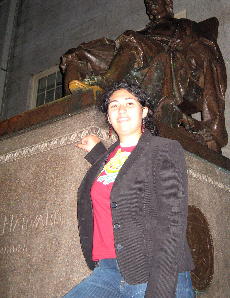
Freshman Mortazavi in Harvard yard
Two essays, short answer questions, an invasive personal profile, teacher references, a grueling interview, at least four different standardized tests, and a list of activities that strips the past four years of your life into a few sentences: and that's just to get in. There's a bigger pool of entrants (and those American students are much more familiar with a school's unwritten expectations than we are), wildly expensive fees, a plethora of immigration papers, and a national culture that is quickly diverging and growing more hostile to Canadian culture and values. So why would any Canadian ever think about applying to an American university?
Ironically, those obstacles are some of the reasons. Twenty thousand Canadians study in the US ever year, over half that number made up of undergraduate students. And I am one of them. This month, I started my freshman year in Cambridge, Massachusetts at Harvard University along with two dozen Canadian students.
Bookshops and bars
The quiet New England setting is the stereotype of university life: it has old colonial-style buildings steeped in tradition and history alongside commercial cornerstones like Starbucks and Dunkin Donuts, and the number of bookstores here is rivaled only by the number of bars. The vast majority of the students are American, with the odd Canadian and even rarer international student sprinkled into the mix.
So far (in my two weeks here), it seems that most of them, contrary to popular belief, are not the geeks who mastered 3-D chess and took Advanced Placement Physics in the ninth grade for fun, but laid-back, sociable artists, public speakers, mathematicians, and athletes with a thirst for knowledge that only a liberal arts college can fulfill. But all these students have one thing in common: out of over 20,000 applicants, these students were selected to attend Harvard University.
The road of paperwork
For all of us, the application process for American schools is long and tedious, consisting of many different portions, and most universities do not synchronize their applications (with the exception of the Common Application used by a handful of universities). When I was applying for acceptance to American universities last year, I had to drag myself out of bed at 6:00 am for four Saturdays and drive for an hour and a half to write my SATs along with almost a hundred other hopefuls and their parents. Most of my free time was spent filling out five different applications and supplementary questions ranging from my favorite magazine to the person who has inspired me the most. The time I spent at school was consumed with printing applications and hounding teachers to fill out their letters of reference on time. No one in my family could help, and while I had the support of my school, most people were as unfamiliar with the application process as I was.
Aside from the cumbersome application process, American schools are expensive. The average American university costs about $22,000 CDN per year for tuition alone, almost $50,000 CDN for big-name universities like Tufts, Princeton, and Harvard. And while the latter covers living expenses, it does not cover the cost of textbooks or supplies. Tuition is almost three times as high as the cost of attending the most prestigious schools in Canada, and almost one-half the income of the average Canadian family. And it does not look like it is getting any better: tuition and fees at U.S. universities are rising by 6-7% percent a year, a matter that is only aggravated by the absence of federal programs and funding.
So, why would I, or anyone in my position, subject themselves to a rigorous application process for the slight chance of paying an exorbitant sum of money to study in an unfamiliar nation?
'Grass is greener?'
Well, there are several reasons. First of all, there is the perception that American universities have a higher quality of education. This can be partially attributed to a pervasive grass-is-greener complex and good marketing; however, although the quality of education is subjective, the structure of many schools in the U.S.A. is quite different from Canadian ones. More liberal arts colleges are available in the States, and some students want the individual attention and academic flexibility that these schools offer. Harvard University, for example, offers seminar courses limited to 12 students, although the class will continue to meet even if these seminars are only half-filled.
Sure, an air of pretension hangs around most Ivy League schools that is further propagated by mass media; movies such as Stealing Harvard portray the college as "a place so unquestionably perfect that no one dares suggest that Lee's niece (who has gained acceptance) transfer to a cheaper state school" according to the Harvard Independent Weekly, despite the fact that her family can't afford it; instead her uncle, who has promised to fund her education, must do so through unscrupulous means. Stereotypes like these only serve to reinforce the perception that Ivy League schools are the pinnacle of accomplishment, and that entrance into these schools are worth any sacrifice as they permanently reflect on the merit of the individual students.
Having been at Harvard for several days now it's easy to see how students can get sucked into the brand name about as much as anyone else, but at the same time there is a definite air of indifference and normalcy here. Most students aren't fazed by the pressures of such an institution and are thus immune to the perceived pretension of this place. Most people who perceive students as arrogant or elitist are usually arrogant and elitist themselves; Ivy League schools try to promote their brand name as much as any other corporation would, and it is to their advantage that people perceive it as an exclusive institution for the privileged few. To some students, this is an attraction, not a deterrent.
Near and far
Secondly, most students want to "get away." With the sheer number of students that are accepted into Canadian schools, many students are wary of running into fellow high school classmates, old cousins twice-removed, and that quirky kid you knew in kindergarten that ate glue for fun.
With the transition from the subjugation of high school to the less-apparent subjugation of college most freshmen embrace the opportunity to reinvent themselves. There's the idea that the greater the distance the greater the difference: a university that is further away (or, at least, separated by five border patrol officers) will allow for greater personal autonomy and experimentation. It's not only an educational experience but a cultural adventure. That's the same reason American students, for example, apply to Canadian universities.
Third, most opportunistic over-achieving mini-Trump wannabes have set their sights on the States because working there will probably provide more opportunities and be more lucrative in the long run even if tuition and living costs are a little steep in the short run. The connections, opportunities, resources (both human and technological); gaining insight into American culture and way of life; and the added appeal of boasting an American university degree for a future resident and employee of American employers are all reason enough for someone to go south.
Alexander Rafael, a West Vancouver resident in his third year at Harvard University, started writing for The Crimson newspaper in his first year. He went on to be one of the founding editors of The Current, a nation-wide university magazine. Last summer, Newsweek approached him and offered him a paid internship in New York. Friends of his completed similarly high-profile internships. The chances that Newsweek would have sought him out had he been a student at UBC are about as likely as winning the lottery while simultaneously being struck by lightning, attacked by a shark, and voting for the Green party.
Difficult appeal
The fourth reason is my own reason for applying to the States. And it's probably the only area in which Canadian schools could change and therefore keep more Canadian students at home - if they're interested in doing that. Ironically, for me, the grueling admissions process was the big draw.
American universities check grades as far back as ninth grade; they assess students' community service, extracurricular activities, teacher references, class standing, and so on. The University of Toronto, on the other hand, does not look at any of those things; admission is determined by Grade 12 Provincial exams. Someone could work for four years establishing personal relationships with their teachers, working for the betterment of their community, devoting their time to a worthy cause, or discovering a new renewable energy source that will replace oil and revolutionize the world as we know it and if they come down with the flu when they are taking their provincial exams and do poorly, they could be rejected from the University of Toronto.
Or, if their achievements are recognized and they are accepted, they might rub shoulders with students who spent most of their high school careers mastering Halo and Doom and happened to make the cut-off because they got lucky on a few multiple choice questions. Of course, Canadian universities' application processes are partly due to the lack of funds and human resources. But whatever the cause, it still stands that the weak application process will yield weaker students (admittedly, interspersed with some exemplary ones) because their application process is too narrow to allow for students who have something better to offer the world than just an 85% class average.
That's why I think the application process is what Canadian schools should focus on if they're interested in keeping more students at home and if they're interested in improving the well-rounded, educational quality at high schools. Most students are looking to have their achievements recognized, and to be assessed holistically as a person and not just as a series of numbers and test results. I've made my choice. I'll let you know how it goes.
Sarah Mortazavi is the 2004 World Debate and Public Speaking Champion. She is from West Vancouver.
On Monday, a British Columbian student reports on her experiences at a Czech university. ![]()


51
Login or register to post comments
gaulois
6 years ago
Comments on "Southern Migration"
Allright Canadian universities need to further tighten up the admissions process. Do we need to carry guns and live in gated communities too? I think the university elites need to understand that the world has changed. Am not sure if you will learn that in an American University, or even a Canadian one.
tommymoore
6 years ago
50,000 tuition alone. Arrogant, elitist indeed. Hope you find whatever tf it is you need. Why does it not surprise me you are from West Vancouver? Hmm - wonder who ma and pa vote for? Not.
working slog
6 years ago
Why exactly is this article posted on the Tyee? To shove this West Vancouver [person's] exceptional previlege in our faces? I am a hard working white collar father of two, who admittedly would like to provide his daughters with the best of opportunities. But if the only way my daughter, an exceptional writer naturally, can access plum assigments at NewsWeek is that I mortage my soul in process, than I will be most pleased seeing her contribute to the Tyee. On subject matter far more worthy, real and thought-provolking than this diatribe from a boastful West Vancouver snob.
TYEE EDITOR: THIS POST WAS EDITED TO REMOVE UNWARRANTED INNUENDO ABOUT THE AUTHOR'S CHARACTER. IF THE POSTER PERSISTS IN SUCH, THOSE POSTS WILL SIMPLY BE DELETED.
mcfur
6 years ago
you ask why would anyone subject themselves to the difficult application process to allow themselves to pay huge tuition fees. subject who? the author or the parents? enlighten us.
Gursk
6 years ago
The class system is alive and well, and has been made stronger by the introduction of the brand. While living & working in the US, I noticed a strange pattern. Almost invariably, the first question asked by people I met, either in business or social settings, was "So where did you go to school?" My response, "I went to school in Canada." was my escape hatch from the inevitable judgments that would have resulted had I mentioned a US school. A fact known widely about the company I worked for, was that it was a Dartmouth enclave. The Dartmouth brand endorsed many of those at the company, endowing them with a value they did not actually possess. Mortazavi’s article is simply an endorsement of the Harvard brand, and the social/economic stratification it propagates. As Canadian school choice becomes more brand-driven, we invite the same “classâ€ification rampant in the US.
Steve P
6 years ago
After doing very well in his undergrad education at UBC, my buddy went to Harvard Law school. When he finished, he was astounded to find that his degree was not recognized by Canadian law societies, and that he would need to take at least a year of course work, in addition from the studies required to approach the bar. This policy certainly helps promote the "brain drain" because my buddy would love to come back to Canada to work.
Harvard sounds great, but be prepared to have to stay in the states to find the high-paying work to pay off the ginormous student loans!
jesterjogger
6 years ago
Yes, who are your parents my dear and how did they obtain the vast fortune they must have to finance your ivy-leaque adventure?
By the way were you one of the west-van kids with a 80000$ hopped up beemer I used to see racing down marine drive?
I'm afraid that your reality probably bears little resemblance to the average person in Canada. (the british properties excluded ofcourse)
allan
6 years ago
Why am I reading this tripe in Tyee from a privilaged child, regardless of her public speaking prowess, no doubt honed at the expense of her parents unlimited income.
I'm sure most of our children would be nice little keeners also if they were assured by mommy and daddy that they could have the education they wanted.
So the author got up early four Saturdays in a row for here Lsat.
Did she have to stoke the friggin' fires while stumbling around in the pre-light's chill too?
v-dog
6 years ago
The writer and others like her may be priviledged, but insulting her just because of her parents' (assumed) income is just as prejudiced as insulting any other group of people.
I also wanted to point out that admission to Harvard (and many other Ivy Leagues) is blind. That means the university doesn't know any of your financial details when you apply. When you get in, they review your ability to pay and the university gives you whatever sized grant you need in order to be able to afford the tuition. So some students go to Harvard and pay less than students pay to go to UBC.
Finally, 4 students were admitted to Harvard from BC this year. One from Port Alberni, one from Port Moody, another from Vancouver and only one from West Van. Admission didn't seem to favour the priviledged. What this writer would have had to do (along with the other 3) is work hard. I wish she'd chosen to stay in Canada. But is working hard really something we want to criticize her for? Would being less ambitious make her more acceptible?
The The
6 years ago
Anyone can study almost anywhere they want if they have the right stuff. In this case, the writer clearly has the smarts, but it's the way she rationalises her choice that causes me the greatest concern.
Basically, she says she avoided all Canadian schools because she thought she was too good for them. The applications and admissions process in Canadian schools doesn't take into account all the networking, schmoozing and all other sorts of hard work this writer did since the ninth grade. But why should the U of T or any other top-rate school in Canada care about those things? If that were the case, then I wouldn't have been accepted to my university. I was a shy high school student who went to class, got my grades and hung out with my friends. Clubs? Sports? Students' Council? It wasn't until university that I got myself involved. Some people blossom at different times. If a university frowns upon students who aren't "involved" in high school, than many smart people will be overlooked.
In my opinion, any school that checks to see if a student was on the Circle K club or the debating team is searching too far. Do the students have the smarts or not?
I read this article as the writer thumbing her nose at Canadian schools because they don't pander to her attitude. She also seems to believe it allows the lucky few who fluked on their grade 12 exams will get in and, god forbid!, rub shoulders with her during her elitist education experience. No, these exams aren't all multiple choice. If they have the smarts..
The argument that American schools bring more success is also subjective; the U of T, McGill, UBC, et al, are as prestigious as they come and have educated many future doctos, executives and millionaires.
Te Aro Arahina
6 years ago
Gee, why wouldn't an American-trained lawyer be accepted carte blanche in Canada?
Maybe because we have a different legal system?
gaulois
6 years ago
Let's not apply too much political correctness to Sarah's honest effort in writing down her thoughts. I am sure she gets plenty out there.
I think she is learning something on this from Canada and perhaps should be more grateful to her Land (and not that we become like them). If we were in an overly competitive society, we would tell her what exactly some people seem to be saying here. By being harsh on her, you are showing the pervert influence coming from south of the 49 that we wish to denounce. Perhaps her next attempt will be better inspired.
Steve P
6 years ago
Te:
Yes, we have a different legal system, but much legal education is very general and would have application in Canada, too. The important part is the bar exam, wherein the applicant learns the ins and outs of the specific provincial or state jurisdiction.
Ron Erwin
6 years ago
Good work Sarah, don't let the negative, jealous,statist comments posted here deter you from your goals. They are merley socialist pussies who hate anything American.
yarrow
6 years ago
I don't get the writer's logic and certainly do not value the same things in an education she does, but I am old fashioned believing a university education is about more than professional training or salaries. For most students Ivy League costs place attending outside the realm of possibility no matter what the hoops or dog tricks students must go through to get in.
Simon Pole
6 years ago
This is false:
If one of your parents or other ancestor went to Harvard, you have a 40% higher chance of getting accepted. These students are called "legacies" and they get preferential treatment because, as a private university, Harvard depends on donations from graduates for its endowment. Most graduates will only give (or give the huge amounts that are needed), if their children get a better chance of enjoying an elite education.
I went to Harvard for my undergraduate degree ('93). In many ways it was a mistake. Harvard socializes you to become part of the American elite. The American elite is very different from the Canadian elite, despite the recent embrace of neo-conservatism by our elite. At Harvard, you learn to take, and you also learn that most rules don't apply to you. This is the American system of course, where everything is okay if you can get away with it (Harvard's noises about noblesse oblige notwithstanding).
When I came back to Canada, I had to unlearn everything that I had been taught at Harvard. The way I lived became less about me, and more about the community.
Going to Harvard is great if you want to become a successful American in their system, but a mistake if you want to remain part of Canada. Canada is a complex country that requires years to understand and govern successfuly. The writer of this article will not be a future leader of Canada, though she will probably find her place in the American system.
Those who actually want to learn how to lead this country must remain in Canada for their undergraduate years. If not, you are digging yourself a hole you will not get out of. Post-graduate is the time to go abroad to seek comparisons -- after the fundamentals have been laid down.
Moat
6 years ago
Someone posted...
Woah!
People.... we don't need to be that critical here! She is giving a peek of life at Harvard, that's all. Do we not want Canadians at Harvard? I do! And I want her to come back to reside in Canada with that education.
Don't negatively judge her simply because she has to means to attend such as prestigious university. Instead, enjoy the sneak peak.
Is not the goal of the Tyee to have balance?!
Such a negative reaction from a population that can’t wait to watch a bunch of millionaires play hockey on October 5th.
James Burns
6 years ago
lol, v-dog there is a rather vast difference between getting admitted and getting a scholarship. No private American university simply provides grants or scholarships on the basis of acceptance for admission and ability to pay. Now those who apply for admission can also apply for financial aid. Scholarships are granted, but very rarely in relation to the number of students admitted. Loans are far more common for those in financial need. You should also point out that someone on full scholarship to Harvard will play the same tuition as a full scholarship student going to UBC, nothing.
As for the admissions process being blind, that's simply not true, particularly for the children of alumni, especially if those children come from wealthy powerful families. The current president of the US is a clear example of that kind of favoritism during his univeristy studies at Yale, and his MBA studies at Harvard.
Harvard, and similar private universities in the US, have always been a means to stratify US society primarily on the basis of wealth. Its brand is based on the exclusivity of wealth. These institutions, however, only provide a superior education, if public institutions are underfunded. Unfortunately underfunding of public education in the US is endemic. Private universities, aside from the occasional hurricane, are the clearest evidence of just how class based a society the US really is.
Davey-boy
6 years ago
Well this is certainly a refreshing change!
Usually, we have to put up with the rhetorically-bloated, information-bereft comments of Ron Erwin and others on the extreme right, while the lefties (for the most part) offer more thoughtful, articulate and substantiated assertions.
Not this time. While many posters critical of this article have made some valid comments, Ron's use of the term "jealous" aptly describes some of them.
V-dog is 100% correct when s/he asserts that tuition cost is not an obstacle in the Ivy Leagues. I should know. My cousin attended Yale, and paid tuition similar to the $50 000 per year that this author pays, and that tuition charge was based on his parents' above average income. His roomate in the dorm was the son of single woman who earned $8.00 an hour cleaning people's homes. His tuition was free.
If there is an archaic, elitist flaw in the Ivy League schools, it is this: they continue to enroll mediocre students who qualify only because their daddies went to that particular school. This type of student enrolls in what is officially known as the "legacy" category. And yes, folks, this type of thing is absolute bullshit, but the policy persists.
The most shameful example of this might be George W. Bush, who used this category to get into Yale when his C-average grades did not qualify him for entrance into the University of Texas.
It's sad really. The legacy policy seriously detracts from what would otherwise be a fairly progressive enrollment/tuition process at the so-called Ivy Leagues.
Simon Pole
6 years ago
This is not a flaw, this is the fundamental quality of the Ivy League system:
How else do you fund a private univeristy?
Cut out the favours for children of graduates, and what do you get? The Canadian system -- public funding.
v-dog
6 years ago
I was a high school teacher for several years in BC and was surprised to find that admission to an Ivy League American school is considered the highest "prize" for a grade 12 student.
Sure, people are pleased if a student gains acceptance to UBC, McGill, or UofT, but there's a different level of prestige associated with an American acceptance -- in both public and independent schools, and in both rural and urban.
Of course, much of this is due to branding and marketing. And some is due to the funding levels of these universities, meaning they can offer smaller classes, etc. I wouldn't want to see our universities putting their precious resources into marketing. But I'm wondering how we can raise the prestige of our universities, and convince our young people that attending them means as much?
Then when young people such as this writer choose to go, we know it's because they want an experience in another country, not because they feel they have to leave Canada to get the best.
moodyguy
6 years ago
I, quite frankly, am amazed by the comments on this thread. I take the author's comments to be a genuine reflection on a short period of time spent attending a very fine academic institution and I congratulate her on her choice. I think this choice must be tempered in the context Simon Pole's earlier comment. Yes, Harvard is an American institution in the American academic tradition which is different from Canadian and it is not public (it is not-for profit as are many ivy league schools). However, the author does generalize and make a huge leap implying in her piece that her decision to attend Harvard, an American school, can be extended to all American schools. This is a problem within the piece and constitutes a separate line of reasoning than just the decision to attend Harvard and initial reaction to the first few weeks.
moodyguy
6 years ago
I quit too soon. To imply, as the title does, that Harvard is a fair representation of American eduaction is similar to implying that Cambridge is representative of British education. Both countries have some excellent institutions, as does Canada, but unlike Canada, there are also some very poor quality institutions.
James Burns
6 years ago
How many merit based admissions are lost to the favoritism of mediocre elites?
This from Harvard's website:
As I pointed out scholarships or grants, are simply one part of financial aid. The legacy practice and the rarity of true low income students attending Harvard in comparison to the wealthy proves the wealth rule. Clever marketing doesn't change the reality.
Of course most low income American students are weeded out by the immense variation in the quality of public education in the US. That quality, or lack there of, correlates directly to income. The September 2005 issue of Harper's magazine offers an excellent article on the sorry state of public education in the US, particularly for poor urban overwhelmingly black children.
Mel from Calgary
6 years ago
I remember the follow up show after one of the Survivor TV shows ended. One of the contestants was going to Harvard law school. During the show he was talking about one of the other contestants and said (I am not sure of the other person's name)..."Betty and I conversatated a lot...)
I suprised they didn't kick him out.
Te Aro Arahina
6 years ago
moderate man, if your friend is capable of passing the bar examination without a Canadian legal education, then he should be able to practice law here. I know of American-trained lawyers who do.
Simon Pole
6 years ago
One other question that should be asked is this:
Could the writer of this article have gotten into Harvard if she had attended elementary school and highschool in the U.S.?
In my own case, I attended a pre-Mike Harris public school in Ontario that gave me the opportunity to put together the kind of transcript Harvard likes. My parents had modest means, though we did have a tradition of higher education in the family.
If I had grown up in a similar situation in the United States, I wonder if my local public school would there would have given me the same opportunity -- the good teachers, the resources, the extracurriculars -- to get into Harvard. I tend to think not.
I don't know what the writer's background is, if she attended a private or public highschool, or what her parents' socio-economic status is.
If she did go to a B.C. public school, then clearly the public nature of education in Canada -- where our overall resources are pooled for the benefit of middle class children -- gave her the opportunity to shine and get into Harvard.
By all means, individuals must go where life takes them. But they must also remember what set them on their way.
The The
6 years ago
I understand that many people in this thread think it is wrong to criticise the author for what she has written here, but I don't think anyone is attacking the fact that she is an excellent student who wanted a different experience. My reason for being critical is that she used so much space in her article to lambaste Canadian institutions and the way they select students.
She actually had the gall to suggest that those people who played video games in high school -- the same people who got scored high on their grade 12 exams -- would have to rub shoulders with her in a Canadian school. Perish the thought! Many of those long-haired acne-ridden doom players I knew in high school were brilliant and went on to perform much better than I did in university.
lynn
6 years ago
The author of this article can attend school wherever she wishes. Her choice completely.
But still I think The The gets it. This article drips with an elitism... the elitism of the conventional student, proud of her model student status, comparing herself to those "who got lucky on a few multiple course questions" and glad that american universities recognize the superiority of her position in her years of serving school and community:
The elitism of one who followed all the rules, pleased the teachers, played the game..."even as far back as ninth grade".
Now, I know I'm swimming against the current here but I don't find this particularly admirable or extraordinary...just conventional... as is the distaste the author conveys of those who did not follow suit:
QUOTE]they might rub shoulders with students who spent most of their high school careers mastering Halo and Doom and happened to make the cut-off because they got lucky on a few multiple choice questions.
In the end it is often the renegade that changes the world...whether they go to university or not... the one who thinks outside the box, questions, rebels, has no need to please, likes controversy and is willing to stand alone.
Education, sadly, is rarely willing to wrestle with real individuality, unconventionality. It is largely about the perpetuation of the status quo. Even more so now that business rules the world.
That is why the world is so slow to change... and why we still rely on oil, even though it is killing us.
tommymoore
6 years ago
Collingwood School, where Sarah was a student, demands $10,000 tuition per year. Boasting bright, airy classrooms, state of the art computers, etc, this institution is typical of what the wealthy few of our society get, while the rest of us have children in outdated classrooms of 40 kids using bedraggled 15 year old textbooks. With unhappy teachers. Snobbery, elitism, ostentatious wealth.. all exhalted on the pages of the Tyee. I'm sure this student's master debater status is admirable. I'm also sure her in-your-face socio-economic status is unmistakable. It's to puke.
Te Aro Arahina
6 years ago
I agree with you, lynn. Perhaps there is a bit of a Grand Narrative running through it, but the world changes when the people who lack inspiration, imagination, desire, initiative, resourcefulness, talent, persistance and the will to work for the larger community die, step aside or are forced aside by those who do. None of those attributes are necessarily connected to or attained by education as it is popularly understood, although one hears a lot about how the hoops through which students jump are like an obstacle course for such training. We hear far too much about it, in fact, since I don't know anyone with a postgraduate or undergraduate degree who doesn't recollect a great many hours spent on meaningless drivel necessary for the grade, or who doesn't realize what an obstacle for a healthy society those degrees, or the mind-sets that strive for them, can become.
It is natural for individuals to grow tired, disillusioned, bitter when all their glorious efforts appear to fall apart. Poverty continues. Diseases mutate. Communities, individuals and families, dissolve. We get retarded Wall Street Journal types calling them the 'underclass' afflicted with some mystical condition called 'self-destructive behaviour' as if the challenges of extreme poverty and illness weren't sufficient obstacles.
The efforts of those few exceptional people, the ones with the inspiration and other gifts, who apply themselves to service with all they give from the heart succeeds in healing, inspiring and relieving the burdens of a few others. They keep some communities together, keep some diseases at bay, bring some smiles and laughs to the angry or despairing. It's a steady ongoing process of renewal. As the tired and disillusioned drop away or are forced away, the new watch steps up.
Education used to be about supporting that renewal.
Now it's about jobs. And bloody mundane, banal, self-serving monkeyjobs at that.
scylla
6 years ago
Among the other perceptive things Gursk sai
The class system is alive and well, and has been made stronger by the introduction of the brand.
scylla
6 years ago
Sorry, GD dial-up, GD buttons which work one way on one site and differently on another, GD laptop with two rum & coke splattered keys which make me cut-and-paste, GD oldsheimered brain.....
Oh well, I'll try again.
Among the other perceptive things Gursk said 16 hrs ago was this:
Comment: Yup, when I think of the Harvard brand, I think Milton Friedman. 'Nuff said?
Te Aro Arahina
6 years ago
The brandname education can easily end up being an albatross around those students' necks. Consumers are not known for their steadfast natures.
Something like the brandname of newspapers who confuse advertorial with editorial ....
Tom Lal
6 years ago
I usually find the articles here to be intersting and relevant. I find myself wondering why why why this one is here..
Te Aro Arahina
6 years ago
The Campbell government has allocated $3M to education, $2M to be spent on a media campaign. Shades of the useless "No Child Left Behind" smokescreen.
Here's what the NYTimes reported on that today:
Buying of News by Bush's Aides Is Ruled Illegal
By ROBERT PEAR
Published: October 1, 2005
http://tinyurl.com/bfsny
To paraphrase: The program was a dismal failure and they never expected it to be a success anyway, so they had to spend a fortune on staged fake news reports telling everyone how great it was. Yesterday, the campaign was ruled a "covert dissemination of propaganda" and a violation of the law.
Well, these conservative governments have never let a little thing like the law stand in their way.
Bailey
6 years ago
Many Canadians recently seem to be embracing American values, if values is the right word.
An American education will make you into an American. This is not really a geographical distinction anymore, more like a religious one. The American Way brooks no diversity, to disagree is heretical, and severely punished. Even when overwhelming evidence is presented to change the status quo, that merely increases the severity of the punishment.
You must believe. Even if you must make yourself blind to obvious truth to do it, you must believe.
In my view, a Canadian education, even a poor one, is superiour to an American education, even a very elite one. Maybe especially an elite one.
Unless your goal is to become an American.
In the greatest days of the Roman Empire, many provincials would go to Rome, to improve their accent, and be where the money went, and a great thing at the time, to try to become a Roman Citizen. They did this even knowing what Rome was doing to their own home provinces.
nestingtree
6 years ago
I have attend and taught at Canadian universities and American universities (public and private). I believe the country differences noted here are greatly exaggerated. Schools may differ on particular dimensions, but to debate the pros and cons of "American" vs. "Canadian" university education makes no sense. For an undergrad at least, it's the same profs (trained at the same schools), same texts and readings, same pedagogy, same knowledge base.
skeptikool
6 years ago
Te Aro Arohina,
Re; http://tinyurl.com/bfsny
Thanks. An excellent article. Some would consider it a petty crime, given the record of this miscreant - and his appearance-to-come in the World Court.
Chalk up another one to the Bush crime family.
BC Mary
6 years ago
Good to see you again, Bailey. I've been "away" all summer, on the beach at Parksville. When I got back to my computer, I couldn't believe the changed, acerbic tone of the comments. Your summary is spot-on.
Nor could I understand the crankiness of so many British Columbians this year, until I got back to Toronto and a teacher said to me glumly, "Sounds just like Ontario during the Mike Harris years."
I hope B.C.T.F. and CBC (fundamental to the Canadian educational system) get through the next few weeks and emerge stronger.
dangrice.com
6 years ago
BCTF and CBC fundamental to to the education system. Damn, I swear it was those that made me miss the American application dates...
Anyways, there is a real point in this article, is in many ways you get what you pay for. While at UBC during the tuition freeze, labs were cut, library's purchased less books, and facilities were poorly kept. While Tuition made it accessible, neither the NDP nor the Liberals budgetted enough $$ to make the universities top of the line. To spend 4 years of your life in classes of 300 to 400 people and with profs who are judged on their ability to publish material rather than their ability to teach or instill knowledge, for some people doesn't make sense.
If you're ambitious, dream of earning 6 figure salaries, and making a name for yourself, education is not just a pat on the back. While not everyone can afford a top of the line education, and most really can't, those students who have worked their asses off throughout their whole life deserve the opportunities they've earnt.
Its true though that kids from impoverished families are less likely to have the same opportunities, but the bottom line isn't just the $$$. Growing up around achievers can instill a different set of values, and a child of a doctor may have different role models than others. And thisn't isn't a blanket statement, I've known people from low income families who worked at McDonalds for minimum wage, and who became valedictorians and beat the hell academically out of the rich kids.
Te Aro Arahina
6 years ago
Cheers, nestingtree.
Yes, but that's not what the discussion is centred around. For in those senses, except for pedagogy and numbers of professors exchanged, there is little difference between a "Canadian" vs. "British", "Australian" or "New Zealand" education either. Databases of university readings, similarities of speech and custom dissolve those restrictions.
The discussion is based upon cultural differences at a point when Canadians are acutely aware of how different from American society our inclinations are. The funny thing is, most of the Americans I know are not inclined to be lumped in with their compatriots either, so boundaries of space are---can't say illusory since they are real enough, but the boundaries of culture seem to be the most effective barrier at this time.
Christian
6 years ago
A Modest reply from a a Non-World Champion in
public speaking:
Dear Sarah,
I hope your experience will be a great one. I have had the opportunity and privilege to work with young people who have gone to Harvard.
They are some of the most humble and down-to-Earth Kids I remember working with.
You have raised many questions about what might make a good University. I had the fortune to support myself with part-time jobs to complete University(in Australia)--my family did not have the means to help here.
So my belief is that University education should be available to all who want that education and can meet that Universitiy's standards.
It is not about whther this leads to more material gain, job advancement such as a paid internship with Newsweek, or contacts that help further a carreer, but because the School offers the opportunity to reflect, think, empathize, synthesize, make friends, be a more gracious human being.
So Sarah beware of the airs and and snobbery that might lure.
I consider the education that I received to be excellent, challenging, engaging. The staff and faculty were supportive and helpful when I struggled, demanding at other times.
Is Harvard superior to the University of Western Australia. Who knows? Saying so smacks of arrogance and intellectual snobbery--presumably two characteristics Harvard would not encourage.
The fact that many apply and don't get in could be interpreted in a number of ways:
1. Only the best are selected ~ 1,000 plus students out of more than 10,000 applications.
2. There are not enough places at such an excellent school for the many excellent applicants and therefore they are denied the opportunity to access such education.
3. There are many schools who accept bright students who do very well--some may have applied to Havard and then decided to learn elsewhere but just as good.
4. As somebody working in marketing,the cost of product is often equated with excellence
Examples of this are: BMW cars, Breitling Watches, Ermenegildo Zegna clothing, some private schools.
This does not prove it is better than something just as well made,but less pricey.
Private schools cost more for a number of reasons:
-they have staff,who fundraise
-gardeners, who maintain and attractive campus
-more teachers with smaller classes
-librarians,who instil a love of books
-maintenance staff
-IT staff who maintain extensive school Networks
I digress!
Although the temptation to justify one's $50,000/year edcuation by saying just that is great; moreover it deflects a keen inquiry like: So what did you get for that$50,000?
A read of Tom Wolfe's "I am Charlotte Simmons"
may shock here.
Finally, as a Teacher who has judged debates/public speeches of students,I have seen and judged too many students
who have not debated the substance, but were excellent stylists when speaking
I urge you to use your skills to the betterment of our world not to highlight your own privileged position--lets talk again when you graduate.
In closing,
Sarah, the best gift a University Education can leave you with is a love for learning,the skills to express yourself well and succinctly,but more importantly a humility and grace that is conferred by the privilege of higher education, for people who are not well educated will look to you for leadership and wisdom
I wish you luck.
Christian
chevy
6 years ago
That was really nice Christian. If I had a better shot at studying, I would have liked to go to Harvard too. As for everyone else? I would mortgage everything I have plus work 6 jobs for my kid to go to Harvard. I think that education is superior to what we get here and this is coming from a guy who had to leave university because it was too expensive. I wish I did come from a more well-heeled family but I thank God that I can go back now. I thank God for education and the opportunity that it will bring me in the future.
Christian, that was a nice letter.
Sarah, make most of Harvard while you are there, you are getting an opportunity that most of us will never get so I salute you and wish you success and happiness.
For those of you who insulted her, it takes a tough person to talk tough behind a keyboard, and most times you are a puny person unhappy in life.
Avicenna
6 years ago
It would be nice to also read a "letter" of why international students choose Canada to come and attain their post-secondary education - and the numbers are certainly growing (as is UBC's coffers due to the exorbant cost of tuition from abroaders). It is interesting that the US has given itself the reputation of having "elite" universities when at the grade-school level - their educational standards lag behind other industrial countries as do their literacy rates. It is hard to judge quality just from the name of the school - didn't George Bush Junior and Senior attend Yale? If that is anything to go by... well, I shan't complete that shuddering thought - other than to say I would demand a refund. My personal ambitions as a left-wing Vancouverite in high-school only extended to the humble hope of pursuing a degree in literature and journalism at SFU. I quickly abandoned that noble frontier upon an enterance scholarship to UBC (I have no angst in admitting to be easily bought - as long as it is in Canadian sums) - and I ended up graduating with a free degree in science - which continued on to a free PhD in Experimental Medicine. Go figure... there is hope for the thrifty and the anti-globalization crew. Hail to the US - a land I can only admire from afar - and then only when the haze of hypocrisy has settled.
cheakamustom
6 years ago
The following excellent New Yorker article explains the true reason 'elite' American schools moved away from academic criteria and towards measures of 'character' and 'well-roundedness' in the early 20th c. Surprise! It's anti-semitism.
http://www.newyorker.com/critics/atlarge/articles/051010crat_atlarge
I can also clarify a couple practical points that have been raised in these comments. Admissions at Harvard is indeed 'need-blind': the admissions decision is made first, and then the list of accepted students is handed off to the financial aid office, which has the resources to make it financially possible for all admitted students to attend. As I understand it, this is unusual for American private universities. I paid about 25% of the total tuition and fees, which was not much more than I would have paid to go to school in eastern Canada once living expenses were included. As has been noted, however, this doesn't mean that class doesn't figure into who attends. Among Canadians I knew at Harvard, students from the Upper Canada Colleges and St George's and Collingwoods of the country were certainly over-represented.
I would like to second 'Simon Pole', who said that going to a Harvard (or probably any American Uni) is a good way to lose contact with one's Canadianness. I had a great time in undergrad, met many interesting people, and got a fine education, but I certainly also got Americanized (I may have Canadianized a few close friends some, but they probably had latent tendencies in that direction). I don't think I knew this would happen when I shipped off for my 'Freshman' year, but happen it did...
Jeeves
6 years ago
Congratulations Sarah!
You have rich parents who could afford to pay a quarter of a million dollars for an undergraduate degree.
I was accepted at Cornell but my folks just couldn't afford it. I was distraught at first but I wouldn't change my 4 years at McGill University for any Ivy League education.
Best time of my life.
Percy
6 years ago
I've been to 5 universities in Canada. They were all disproportionately staffed by Americans. I'm wondering whether one has a better chance of being taught by non-Americans in an American university....
NevinT
6 years ago
What an annoying article. First of all, there's no need to justify getting educated at Harvard.
Secondly, why write about it in the Tyee? The article wasn't particularly insightful or interesting.
The author does seem to be a promising writer, though.
jaspersky
6 years ago
Here are two excellent reasons to study at Harvard if given the chance:
1. The school's world-wide brand appeal will get you into almost any elite institution in the world post-graduation, and
2. You'll build a helluva contact list, which will benefit you for the rest of your life if you maintain it.
Sure that's elitist and not based on fundamental justice; it isn't even necessarily the case that Harvard is a better school than, say, McGill (I have no idea). None of that matters. The chick who wrote the article is just sensibly taking advantage of a golden opportunity. She didn't make up society's rules. She's just playing by them.
Christina
6 years ago
I recently completed six years of studying and teaching at a US institution very similar to Harvard. While I taught some brilliant students and some humble students, what struck me was the sense of entitlement exhibited by many of them. They had clearly been raised to think that they owned the world (and some did).