- Ms Kaye is a Tyee Builder. You can be, too.
- Mary Carlisle is a Tyee Builder. You can be, too.
- Prem Gill is a Tyee Builder. You can be, too.
- Nancy Flight is a Tyee Builder. You can be, too.
- Justin Everett is a Tyee Builder. You can be, too.
- John Westover is a Tyee Builder. You can be, too.
- Nora Etches is a Tyee Builder. You can be, too.
- Edward Henderson is a Tyee Builder. You can be, too.
- Bharadwaj Chandramouli is a Tyee Builder. You can be, too.
- Dean Chatterson is a Tyee Builder. You can be, too.
- Marius Scurtescu is a Tyee Builder. You can be, too.
- Robert Parkes is a Tyee Builder. You can be, too.
- James Murton is a Tyee Builder. You can be, too.
- Susan Doyle is a Tyee Builder. You can be, too.
- Vincent Strgar is a Tyee Builder. You can be, too.
- Helen Spiegelman is a Tyee Builder. You can be, too.
- Subir Guin is a Tyee Builder. You can be, too.
- Kimball Finigan is a Tyee Builder. You can be, too.
- Joanne Manley is a Tyee Builder. You can be, too.
- David Leach is a Tyee Builder. You can be, too.
Mair: Salmon a Huge Election Issue
Given dire findings, I asked Premier Campbell if he’d close fish farms. His emphatic answer: No!
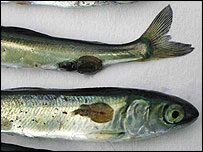
I’m often accused of beating the fish farm issue to death, but consider the evidence. In 2001, on air and in print, I warned the Campbell government that the fish farm story would come back to bite them in the ass if they didn’t do something. Well, we did have a catastrophe when, as scientist Alexandra Morton predicted, a Pink salmon run in the Broughton Archipelago collapsed due, she said, to sea lice.
The following year’s run, however, was pretty much as expected. Why? Because the fish farmers were forced to remove their lousy, literally, fish until the migrating smolts made it safely to sea. This past March fish farms cages were left full and Ms. Morton predicts another Pink salmon crash this fall. So do I.
You might well ask, how can the governments let this happen?
The answer is sickeningly simple – the federal Department of Fisheries and Oceans, given the statutory mandate to protect our salmon, has abandoned that obligation to the tender mercies of the provincial Ministry of Agriculture, Food and Fish, John Van Dongen, prop., and taken up promoting fish farms. The MAFF similarly has a primary mandate to promote aquaculture. Who then protects the salmon?
No one. Period.
Blaming everything but fish farms
Some readers may be new to the issue so here, in a nutshell, is what happens. Because they need good flushing, fish farms locate at the mouths of inlets. At the head of inlets are rivers. Because fish farms contain hundreds of thousands of salmon that are ready hosts for sea lice, the cages become huge sea lice colonies. When the tiny wild smolts migrate they must run the gauntlet of these nests of lice and they're slaughtered.
What ought to trouble all of us, left right and centre is how this issue has been handled. The fish farmers deny there’s a problem and blame everything from sun spots to el nino. The governments do the same. As the evidence mounts, the denials only become stronger. The Aquaculture Centre at UBC takes the side of the farmers.
Why? Could it be because the University of British Columbia doesn’t fund the center so has no power to force academic open mindedness?
Who, then, does fund it?
Here’s where you act surprised. It’s funded by DFO, MAFF and the Fish Farmers Association. The multi-national fish farmers, like green ooze, are into everything.
The recent study by the University of Alberta and the University of Victoria, published by the ultra-prestigious Royal Society in Britain, is devastating. Not only are the lice targeted as the problem, the scientists, all independent, actually trace the lice to specific farms thus killing the farmers absurd allegation that since the murderous sea lice can’t be directly traced to them, why, who could tell who dunnit? The sampling used by the study was huge and the findings so emphatic that the fish farmers and their government handmaidens are shorn of all defenses.
Candidates offer clear choice
What’s the position of the BC government bearing in mind that an election looms?
On March 1st I interviewed Premier Campbell him and put to him that, unless the Broughton Archipelago fish farms were fallowed, we would lose the 2005 Pink run about to migrate in March and scheduled to return in the Fall. (While I didn’t have the latest study I had spoken to Alexandra Morton and she told me that her findings, already published and peer reviewed, would shortly be confirmed by a huge study.) I told the Premier what the evidence was and asked, if only out of respect for the precautionary principle, would he order the fish farms fallowed?
He gave me an emphatic NO!
I then asked him if, when the Pink Salmon run fails in the Fall, he and his ministers would take responsibility and he again gave a firm NO!
Now, what the hell does a non-NDP voter do with that? Are we to be so afraid of Carole James that we will let this bunch back in?
I’m no NDPer. I ran against and beat them in two provincial elections and served in the so-called “right wing government” of Bill Bennett, in part as Environment Minister. (The Campbell government, upon taking office, tubed this ministry, founded by Bill Bennett in December 1975). Bennett would have fired my ass out the cabinet door if something like this Broughton series of catastrophes had happened on my watch. Environment ministries under Bennett were expected to act as policemen in the environment without any regard to who put money in our election coffers. (As a matter of interest it was the Bill Bennett government, when I was Environment minister, that bargained with Seattle Light and Power and saved the beautiful Skagit River from becoming a lake full of jet boats. But I digress.)
Vote the future
My question is simple – are we, the voters of this province, going to let the Campbell government off unscathed? Do we care so little about the out-of-doors, that we hold in trust for future generations, that we will reward with another term those who plunder it for campaign donations?
I fear the answer is that we will.
In which case we will give a mandate for more and more plunder of that out-of-doors and we’ll have no one to blame but ourselves.
Rafe Mair, a regular columnist for The Tyee, can be heard weekday mornings 8:30-10:30 on 600AM and writes a weekly article in Metro Valley community newspapers. His website is www.rafeonline.com ![]()


37
Login or register to post comments
Corvus
7 years ago
Comments on "Mair: Salmon a Huge Election Issue"
So long as these fish farms still exist off our coast, this issue has not been "beaten to death". I remember the fish farms mentioned by the large news media last year when there was the earlier wild salmon population collapse, but were then ignored as the media's 15-minute attention span was distracted by other issues.
Rafe, you have been the loudest voice keeping this important issue in front of the people and politicians. Do not let the Campbell Liberals sweep this one under the carpet, we need you.
BC Mary
7 years ago
Sometimes I think that CanWest is the biggest of our problems.
Democracy depends upon an informed population. With CanWest media as our primary source of local news, B.C. is not a democracy. We're a dumb-ocracy, in which the voters are pawns in an ugly power struggle.
Nobody could have described it better than Rafe Mair in this article. Thanks, Rafe.
Chris H
7 years ago
Rafe Mair summed it up best in an editorial he did awhile back on his radio program. The simple fact of the matter is that fish farms can bring in way more money than the wild fishery could ever hope to. If it was a purely economic matter, fish farms win every time.
In my opinion, is it any surprise that the BC Liberals refuse to stop the ecological damage that the BC fish farm industry is doing to the wild pacific fishery? The BC Liberals have proven over and over that they just don't care what happens to the environment. To them it's all about the mighty dollar.
KWD
7 years ago
Let me get this straight, we don’t let them go unscathed, we punish them by electing fewer in the next election, and somehow we will see less environmental rape and pillage? Hardly. This is not a right-wing, left-wing issue anymore than it’s an “ourselves†issue. Fish farms are a microcosm of an ever-growing global problem: Corporate corruption, a justice system that defends it and a misinformed public.
It should be abundantly clear to those following the federal debacle that the corporate world and its political lackeys view corruption as nothing more than the cost of doing business: At worst, a misdemeanor (Jean Brault and a handful of lackeys not withstanding). To pretend that this kind of corporate behaviour hasn’t slithered into provincial politics is naive. Have we already forgotten about the RCMP raid on the legislature, and “The Curious Case of Sam Nagraâ€, Tyee April 2005? The Liberals aren’t the ones doing the plundering. If you want to punish someone, follow the money.
dfp
7 years ago
One of the things I thought most interesting about this story was that Mr Mair asked, "if, when the Pink Salmon run fails in the Fall, he and his ministers would take responsibility".
I've been wondering why this question gets asked so infrequently.
And I wish Mr Mair asked "Why not?" as a follow-up. I'd really like to know why people feel free to make decisions without taking any responsibility.
anne cameron
7 years ago
We knew nothing of fish "farms". People came talking of "the Norwegian experience", telling us "farming" was going to relieve the pressure on the wild fish, was going to bring employment, was going to be a boon. We decided to let them give it a try. Only after the first "farms" were in place and selling shares on the NY stock exchange did we find out they had come here because Norway had brought in such strict regulations they couldn't do there what they did and are still doing here.
These feed lots have wrecked the coasts and the fisheries of Norway, Scotland , and Ireland and if we don't demand changes, they will wreck things here, too.
Period.
Now the same corporate mentality which refunded to the fish feed lots the fines imposed on them by the court when they were convicted of violation of the few regulations which exist, are paying attention to shellfish. We are told Europeans are lined up, money falling from their pockets, wanting to invest in oyster farming... which will be just fine IF we set our rules, regulations, and standards before they set up shop.
Do not let the ones whose waters are dying set the standards so that our waters, too, die.
Fish farms are a great way to launder money of dubious origin. There, dammit, I've said it! Those fish don't have numbers on their sides. Who can prove how many fish were sold? You could sell two of the mushy tasteless antibiotic laden things and then declare a one hundred thousand dollar profit. Who'd know? And with this pack of Phillistines at the wheel who'd care?
By all means put the moratorium in place, again. By all means, get the inspectors back on the job.
This government has cut the funding to the Conuma hatchery and now want to stop sports fishing off Farrier Point to protect, they say, the coho run. Farrier is a hot spot for sports fishing. People come from any place you'd care to name to fish the inlet. To cut back on funding to the hatchery is so stupid I can hardly believe anyone ever thought of it.
I'm not afraid of Carole James. I just wish she'd get off her ass and join the fray!
Good article, Rafe. Usually I disagree with your Socred approach and my opinion of the Bennett regime is about on a par with my opinion of this current pack of parasites, race horses notwithstanding. But this time I can agree and support you.
Bailey
7 years ago
Everyone seems to be assuming that the Liberals and the fish farmers, some of whom have been shown to be family members of Liberals, are just putting their own convenience above the safety of the natural run. That they're just doing things this way to save the cost of land based pens with septic systems to deal with the wastes.
What if it's more sinister than that? What if they've decided to wipe out wild salmon deliberately? Thereby gain a monopoly on BC salmon worldwide. They would then control supply and charge whatever they like.
They'd own all the life that used to be the gift of the creator.
It would be in line with other philosophical manipulations of the commons by these people who think it's a good idea to privatize absolutely everything from the genetic codes of all living things to the very air and rain that falls from the sky.
It sounds like only insane people could do such things, but the evidence is clear that it's exactly what they're doing. Repeatedly and consistently.
Can we dismiss as a motive that they're actually planning their actions to have the effect they're having?
Jeffrey J.
7 years ago
Great article. The ideology of "let the market forces decide" has trumped all notions of the "greater good". Thus, dominant control and ownership of our media is okay because "the market" let it happen. Fish farms can deny scientific proof, because they need only answer to "the market". And if "the market" (would that be the dominant media and dominant government?) doesn't object, ipso facto, it's okay! What a great system. I remain very, very troubled by the wholesale loss of BC's fabulous, world class assets and environment. I can only hope that there are more Rafe Mairs out there who can see beyond the right wing rhetoric and realize there are real consequences occuring from these current policies. The Tyee is a huge first step and it is crucial that we support it.
Budd Campbell
7 years ago
As one ages, one is supposed to become more conservative politically. Mair seems to be going in the opposite direction.
Here's the question I want Rafe to tackle. What is the reason for the declines in our wild salmon populations? Parliamentary Committees have weighed in on this question, and have tended to point the finger at Aboriginal "poaching" and general mismanagement by DFO.
Well, what do the more-or-less neutral academic experts say is the reason? Is it global warming, climate change and the like? Or is it pollution in the lakes and rivers caused either by logging and mining industries, or by urbaniztion? If all of these things are factors, what is the percent breakdown of liability, if I can use that term.
And what practically can we do about it?
If BC and Canada were to decide that the present aquaculture industry is a mistake, as Alaska has done by not getting into it in the first place, is there an alternative salmon farming technology that can be used safely and profitably?
KWD
7 years ago
A burgeoning global population needs (demands) protein (and energy) to survive. The corporate world’s survival, indeed its raison d’etre, depends on recognizing this and capitalizing on the supply. Investors see gold. The environment (which includes all human and non-human activity, as well as land, water and air) is never a controlling part of this relationship until it interferes with economic goals and life for the business community and its investors becomes too painful to ignore.
So, to answer your question Bud, unless the demand diminishes (through some form of population control, which is unlikely) or unless the public (investor) is willing to divest itself of any interest in the corporations that are pillaging the planet (which is possible but not probable), the destruction of all things wild, including salmon, will continue.
The best that can be hoped for is that there are enough concerned people around, who are willing to put their own well-being on the line, to slow the process.
Budd Campbell
7 years ago
Well KWD, I don't think you answered my question at all. You know, most people don't really care for ideology, they find it conceals more than it reveals.
interior_bob
7 years ago
Keep up your good work Raif. It is comforting to know that you remember some of the good things accomplished by the Socreds. You are absolutely correct about Bill Bennett and what he would have done to anyone who allowed what we are now seeing.
1.Can anyone provide some simple "economics" that demonstrates why fish farming is such a hot investment? I am not (but want to be) as well informed as I could be. I am looking here for information to help frame questions to put to candidates at public meetings.
2. What was the Alaska track that resulted in " no farming "?
Wild salmon/farmed salmon is an issue easily "stirred up". I suggest that the recent injunction success by the Hamolco Nation is a great starting point and perhaps focus for linking First Nation AND salmon election issues.
verso
7 years ago
I share the concerns of the posters above but I can't help think this will NOT be a major issue this election. It's just not "sexy" enough for Canwest and other mainstream media.
This morning on AM 600, Rafe himself said that any issues he has personally championed in the past are never covered in mainstream press. I worry that if it's not in the mainstream press, it's not registering with the majority of voters. Flip over to cknw and there is Bill Good extolling the virtues of an expanded highway and twined bridge. What has more appeal to the majority of voters, salmon runs or a quicker commute home? Here, we may believe the answer should be salmon runs but I doubt the general public feels the same.
Like it or not, the Liberals have been successful in framing the debate thus far. If it keeps up this way there isn't a hope in hell that they will be defeated.
pedroch
7 years ago
I hope that Rafe Mair's fear concerning the rest of the province continuing to support the Liberals on this issue turns out to be wrong. Up here on the North Coast, the Liberals have given a green light to the expansion of open-net salmon farms. For us, at least, it will be a major issue in the election and most of us here will support the local NDP candidate, Gary Coons, who is strongly opposed to the spread of open-cage finfish aquaculture.
With respect to Bud's question about an alternative . . . the obvious answer is a renewed and well-managed wild fishery.
Frank
7 years ago
The old saw about people becoming more conservative as they get older has nothing to do with left vs right politics. Its that they generally become less radical and somewhat nostalgic for things being the way they used to be. Hence they're "conservative".
Has nothing to do with economics or politics, certainly not in this day and age of the so-called neo-conservatives who are actually very radical.
JRG
7 years ago
Budd; I see you are attempting to confuse Broughton Archipelago fish farming issue with the Fraser River issues. Shame on you.
anne cameron
7 years ago
Yes, the burgeoning population needs protein but salmon, since the arrival of the Europeans and the installation of a commercial fishery has always been an expensive food available mostly to the well off. Fish feed lots will not ease the suffering of the starving!!
Fish can be reared in solid sided pens, on land, with sewage systems to take the waste from the water, sterilize it and sell it as fertilizer. But it is more expensive to start up, it's a totally different technology, and it actually "uses" more water (because the fish don't sit in water ripe with their own shit!). The technology is available, it is being done in some places, there is a ling cod experiment on Saltspring...
but why do that when your family members are in government and will allow you to do it the cheap and dirty way.
Of COURSE they want to get rid of those pesky wild fish and those damned commercial fishermen! When they have ruined the wild runs there will be no reason to object to the pens and the imported exotic fish.
It's all a question of mind over matter. They don't mind and they think we don't matter.
The governments have given permission for industry to remove metric tonnes of krill from the Georgia Strait...the result is a drop in herring return, the herring which did return were so small they could escape the nets...without krill the small feeders starve to death...and then larger fish, which would have fed on the smaller ones also starve and..eventually the entire Strait of Georgia will be bereft of all species and they can put their net feed lots , their lice, their bizarre mutant infections, their antibiotics, their growth hormones and steroid additives up and down the coast and only the curmudgeons will mutter about the good old days when the bounty of the sea was available to all.
bastards!
RickW
7 years ago
KWD:
A burgeoning global population needs (demands) protein (and energy) to survive.
In Gary Jennings' book "The Journeyer", in one scene set in south east Asia, Marco Polo remarked on the variety of caged animals he saw in a boat, slated to be taken upriver (Mekong?). The answer he received? "If it moves, we eat it."(not verbatim)
http://www.garyjennings.net/other_works.htm#journeyer
This describes the world as it soon will be, and nothing less than complete decimation of the world population will "help".
northernsky
7 years ago
from the 2001 Green Book:
>Rapidly phase out existing open ocean salmon fish farms and ban any new ones<<
nuff said
BC Mary
7 years ago
Not nuff said, northernsky. Whatcha talkin' 'bout?
Chris H
7 years ago
interior_bob: Fish farms sell approximately three times the fish, generate twice the revenue, and employ people year round. There is no comparison in an economic sense that would put wild salmon ahead of farmed salmon as an investment in the short or medium term. Of course, you might value catching a salmon with your grandchildren as something priceless, but that investment is something you can't put into the bank.
bc4me
7 years ago
Hey Raif ... as you well know, the Green Party has come out solidly against fish farming to protect diminishing wild salmon stocks - which has occured under successive NDP-Fiberal governments. The Greens are also advancing the most progresive plan to restore damaged salmon runs through wide-ranging remediation plans. So why the willful ignorance of this in your commentary? You voted Green in the last federal election ...
Jeffrey J.
7 years ago
thank you anne cameron for a perfect summary of the facts. i would like to add to that (in response to KWD's comments).
for every pound of salmon raised, the fish farming industry has to catch 2 or 3 pounds of other, smaller fish (i.e. protein) (mostly from south america) which is made into feed and then fed to salmon. if salmon don't eat other fish, they don't taste fishy (the reason why marsh ducks taste like fish).
if fish farms were interested in processing protein to feed the world, there are many ways to do so that would not involve salmon. salmon are sold to US restaurants who market it to well heeled north americans. it's a big money maker, and nothing to do with world hunger. were that it were so!
lastly, without virtually "free" waterfront real estate to subsidize the industry, they'd be long gone from BC. so much for free market capitalism.
Budd Campbell
7 years ago
pedroch: “With respect to Bud's question about an alternative . . . the obvious answer is a renewed and well-managed wild fishery.â€
Two things are not at all obvious, at least not to me. How does one renew that wild fishery, since no one can say authoritatively why the wild runs have declined so much since the early 1990s. Second, is there a method by which the wild fishery harvest and its economic return can be safely supplemented by a commercially viable farmed harvest?
JRG: “Budd; I see you are attempting to confuse Broughton Archipelago fish farming issue with the Fraser River issues. Shame on you.â€
I don’t have any use for arrogant insider talk, and neither do most Canadian voters, who soon tire of this kind of silly bugger behaviour, which is more often that not accompanied by an annoying colonial accent. I am not trying to confuse anything and JRG knows that. I am just asking for someone to tell me why the wild harvests have declined and whether or not there is potential for a safe and profitable salmon aquaculture using different techniques.
Jeffery J.:â€lastly, without virtually "free" waterfront real estate to subsidize the industry, they'd be long gone from BC.â€
Here’s a good point. How much do these foreshore properties cost the operators, and how should the price or rent on these lands, presumably mostly BC Crown lands, be established? Should these properties be auctioned periodically to the highest bidder, and does this not sound like another version of the same issue as how to price our public timber?
Anne
7 years ago
Thanks Rafe, you are an honest man. I must remind you, however, that salmon farming was first introduced in the late 80's, during the Socred era. Those of us who argued against it then were treated as nutty extremists. One of the issues was the loss of the use of the foreshore, of the public being fenced out of beaches and estuaries that we all own in common. The statistics from Norway were available then, too, but no one was listening.
KWD
7 years ago
Yes Anne Cameron and Jeffery J, I can see how my post would be interpreted as saying fish farms provide protein for the poor and the starving (my blunder, poorly worded). However, as you both acknowledge, the corporate world doesn’t give a rat’s rectum about the world’s poor and the starving. The business community has no intention of directing their attention to that portion of the population that can’t contribute to turning a profit. They aren’t in business to lose money. The poor and the starving aren’t part of the capitalist business equation because they aren’t considered part of the demand.
What I tried to convey, perhaps too over-generalized, was that (given our current neo-con economic structure and the continuing growth of human populations) corporate fish farms are simply taking advantage of the fact that the demand is real (someone is buying their product) and the demand is increasing. I assumed, perhaps mistakenly, that this would be obvious to most readers.
With respect to tackling issues like environmental destruction and species extinction: If we want answers that are meaningful, we have to start asking meaningful questions. And those questions must be directed at some basic underlying beliefs about how our capitalist society functions. Questions that expose the thinking and motivation and drives certain capitalist behaviours might be a better place to start than pointing fingers at Aboriginal poaching, fisheries mismanagement, logging, mining and urbanization, or rehashing “old†news about how many pounds of South American fish it takes to produce a pound of farmed fish. It solves nothing and won’t bring wild fish back to our rivers. They are symptoms, not underlying causes.
Budd Campbell
7 years ago
KWD would find a very compatible home at Audra Trouwer William's (aka Audra Estrones William's) political chat site, rabble.ca/babble.
islander
7 years ago
Good article and thank you.I
Jeffrey J.
7 years ago
KWD - I agree: an analysis of how monopoly capitalism doesn't work is in order. But what better way than reading columns like Rafe's. Bottom line: the fish farming industry is undermining protection of the public commons. That's exactly the problem when econominc interests start influencing public policy.
A case of the tail wagging the dog. So not only can we discuss in theory why monopoly capitalism is destructive, we need to see real live examples. And this is one of them.
JRG
7 years ago
Thanks for posting my comment again Budd.
KWD
7 years ago
Jeffrey J, I think we’re both on the same side of the fence when it comes to raising the dialogue and involvement on environmental issues. And I have no quarrel with the article. I’m not sure how you arrived at that conclusion. Rafe Mair has been, and continues to be, in the fore of many important issues, not just environmental concerns.
I’ve been fighting the war, along with many, many concerned folks - against fish farms, and their progenitors, fish hatcheries - for many decades. Round table discussions readily identify the culprits. Most need no introduction; they’ve been around a long time too.
Unfortunately the one topic that is consistently avoided and is conspicuous by its absence is topic of individual complicity. Bring that one up ‘round the campfire on your next fishing trip to Chile or the Dean River or the Miramichi or the Gold River and the response will be a lot of naval gazing and foot shuffling. And it is understandable; life style changes are painful.
So when you say the fish farming industry (or any primary resource extractor you care to name) is undermining protection of the commons, you are right; but I say it is far from the bottom line. And one more thing, changing personal lifestyle is not only a lot easier than changing the lifestyle of corporations, its cumulative effect has far reaching and immense impact.
Bailey
7 years ago
KWD, your post raises two questions for me.
-What is your objection to hatcheries? After protecting the fry through their vulnerable earliest stages, they are released into their natural wild life. No parasite problem, no waste disposal problem. I'm not sure why you object to increasing the successful restoration of overfished populations.
What lifestyle change are you talking about? How do you propose to change your behaviour to effect change in this toxic industry?
KWD
7 years ago
Bailey, I wish it were as simple as you say. I would question your statement that parasites and waste disposal aren’t problems facing hatcheries. In terms of ‘recovery plans’ for wild salmon, hatcheries have failed miserably. Despite a few recent outstanding returns of fish to American hatcheries, wild coho and chinook stocks aren’t recovering. And there is very little interest in significant habitat restoration. If it weren’t for the fact there is a whole bureaucracy and many government jobs that depend on the existence of hatcheries, government would be happy if wild fish disappeared altogether.
Unfortunately there is a litany of documentation on the negative impacts of hatcheries. Aside from the enormous subsidization required to keep the commercial fishing industry and hatcheries alive (SEP admin costs alone ran about $40 plus million per year making returning salmon a very expensive commodity,and with full cost accounting, the cost of each returning fish would be astronomical), there are also major concerns about the knowledge gaps around hatchery interference in population genetics (check out the miniature 3 lb coho returning to the Capilano), inter-specific competition problems and the negative effects caused by over-populating one species at the expense of others.
To mitigate the last effect, DFO spends millions annually to bolster steelhead runs that suffered devastation through over harvesting salmon. The full cost of each returning steelhead is scary.
However, the negative impact of hatchery acceptance on society’s concern for and stewardship of healthy fresh water and marine environments is by far the worst outcome. Plain and simple; hatcheries are an admission of the failure of government to challenge those forces destroying fish habitat: mining, logging, over-fishing and human encroachment. The public accepts destroying the environment for profit; it’s the cost of doing business. And our technology-solves-all mentality now overpowers what Aldo Leopold called our ‘land ethic’.
As far as lifestyle changes are concerned it is a matter of doing something about personal choices that impact the environment. It involves everything from reducing travel to being selective about food and clothing sources to making ethical investments.
anne cameron
7 years ago
KWD you make good points. Yes, the problems are many, varied, and challenging, and yes, we all need lifestyle changes, and yes, the hatcheries have been expensive, and...yes...to all of it. Yes.
I know I am a charter member of the society of conspiracy theorists but I really do wonder at the history of fish and the federal and provincial governments. Years of absolutely ignorant and stupid decisions wrecked the east coast cod fishery. Period. The fishers themselves were yelling for changes, many of which would have impacted them directly. Nothing was done and the cod crashed.
So here we are on the other side of a huge country and...steadily the encroachments have impacted and hurt the salmon returns. Some of the stupidest decisions since the ones made with regard to the cod have been made with regard to salmon and groundfish. Fumbling and idiocy seem to be commonplace.
Without fanfare the krill seiving has reduced the amount of food for sardines, herring, etc. On the east coast of the Island they first closed the salmon fishery, then they closed the groundfish. Now they're cutting back funding to the Conuma hatchery even though the coho returns are better than "good" they are wonderful. At the same time they cut the hatchery funding they say they are thinking of closing Farrier Point to sports fishing...to encourage the return of the coho.. Twenty-one species of groundfish have been reduced to dangerous levels...and it isn't JUST bad logging or poor sewage control or any one or two or three causes, it is the cumulative effect of all factors, and we have maybe ONE fisheries officer to patrol a large and very rugged coastline. Dumb. Stupid. And how can that kind of untrammelled bullshit continue without some kind of reason behind it? How can a person NOT think there is "something else going on"?
Time after time in the brief history of Vancouver Island the governments, provincial and federal, have forced people to leave the more remote hamlets. Repeatedly promises have been made and broken. First the mail boat stops coming..then the visiting nurse is no longer available...then...bit by bit by bit services are cut. After WW2 land was given to returning veterans. People came and hacked homesteads out of the rain forest, secure in the promises which had been made. Then the promises were broken. No way to get their harvest to market. Increasingly impossible to educate their kids by correspondence. And what do you do when your kid falls on a wet rock, slams her head on a boulder and lies unconscious? How long can you tough it out? So people move, the coast of the Island empties and guess what...the mining moves in, the logging moves in, and now the fish farms want to move in...and it is no accident, it is not co-inky-dinky, it is a long term plan.
When the Fiberals fire the bird at the judicial system and refund fines, something OTHER is going on. When fish farms are allowed to put buildings on land to which they do not have foreshore lease, something else is going on. When relatives of government officials are involved in the fish farm industry which is being pampered..something is going on. And the slimey link between federal and provincial Fiberal b.s. is being swept under the rug. Something is going on. I'm just not smart enough to know exactly what that something is. But just because I cannot identify the beast does not mean the bastard isn't kicking my home to smithereens. Is it an elephant, is it a crocogator or is it just one helluva big RAT?
Bailey
7 years ago
When the rats run the household you can expect only things rats would approve. In the absence of a healing vision, the hatcheries will at least stave off mass extinctions. And despair is not useful, only hope will inspire us to carry on in the face of such mindless malice. The hatcheries represent hope. It's possible the precipitous decline in stocks is caused by some key factor, Asian driftnet fishers for eexample. If so then something may change, and if it does, there will be fish left.
As to lifestyle changes, I'm sure someday soon we'll be offered grilled krill for dinner on a menu.
BrianWhite
7 years ago
I was told the real reason that the government is trying to wipe out wild salmon is to prepare the way for offshore oil.
You get rid of the salmon beforehand, and there is much less resistance to the oil. There will be no wild salmon left so less people caring about dirty seawater.
So, folks, they are doing it diliberately. If the sealice dont get them, the wild escapees will compete for their spawning grounds. My experience is of an inland fishfarm of rainbow trout in ireland on the slaney river. Pretty soon, the native brown trout disappeared and it was just rainbow in the river.
The little river lampreys disappeared (They arent the paracytic kind, they live in the muck), They couldnt swim over the 4 ft high dam in the river. And they were shooting the grey herons.
And all for 1 job, a guy who stayed in a caravan on the site.
So, the benifit to the local economy?
Nada. Fish farms are crap.
Bailey
7 years ago
Dear BrianWhite, Who told you that?
How did your informant know it?