Opinion

New Drunk Driving Law Oversold

Minister declares a crackdown, but 'musts' melt into 'maybes' when law is read closely.

By Barbara McLintock, 21 Oct 2004, TheTyee.ca

colemansm

TheTyee.ca

Just about everyone would agree that driving while impaired by alcohol is a very bad thing. Even those who get caught usually agree, at least in principle, that it's a very bad thing. In a manner not so different from that of Premier Gordon Campbell, they most often will be genuinely remorseful and will endeavour to point out that only on the rarest of occasions would they find themselves caught up in such an event.

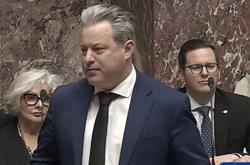
Hence, virtually no one is going to complain because Solicitor General Rich Coleman has introduced legislation that he says will amount to a crackdown on impaired drivers in the province. Everyone agrees that providing the police with new tools to make it easier for them to get impaired drivers off the road - and to send a strong message that drinking-and-driving won't be tolerated in the province - is the sort of legislation that ought to be encouraged.

The problem with the legislation introduced this week is that it just doesn't live up to the hype that Coleman is giving it. A detailed reading of the actual legislation shows that the changes are much more hedged around by ifs, buts, and maybes than the Solicitor General would like us to believe.

Rehab is not a must

Take, for instance, the idea of requiring impaired drivers to undertake some type of rehabilitation program before they can get their driver's licence back. It's an idea that will meet with widespread applause, especially in the case of repeat offenders who have shown they have such a serious alcohol abuse problem that they can't control their behaviour.

Here's what Coleman's news release says: "For the first time in British Columbia, drivers with a Criminal Code drinking-driving conviction, and other repeat offenders, will have to complete a rehabilitation program before they can drive again."

But here's what the actual legislation says: "This section (the one about completing a program) applies if a person has a driving record that, in the opinion of the Superintendent (of Motor Vehicles) is unsatisfactory or the Superintendent considers that, with respect to the person's driving skills, fitness or ability to drive and operate a motor vehicle, it is in the public interest for the person to attend or participate in" a program.

There's absolutely nothing in the legislation that makes the program mandatory for anyone who's been convicted of impaired driving under the Criminal Code. Only for those whom the Superintendent deems to require it.

And indeed, Coleman's ministry's own more detailed backgrounder states that completion of a program may  (emphasis mine) be a condition of retaining or recovering a driver's licence for those with convictions or with repeated 24-hour prohibitions (three in a five-year period is the example given). The backgrounder also points out that the program won't necessarily be a full program to deal with alcohol dependency. Although that could be involved for some drivers, for others it could involve only "an education program focusing on the harmful effects and consequences of drinking and driving." Another option would be "an intensive counseling program to change drinking and driving behaviour."

More maybes

Similar conditions hedge the use of an ignition interlock program for those who have been convicted of an impaired driving offence under the Criminal Code at least three times. The ministry's backgrounder says that when those individuals (who will have to complete a program, a clause that's in the legislation already) apply to get their licences back, the Superintendent "may require the use of an ignition interlock device, which requires a driver to submit a breath sample before the vehicle will start."

The minister and his staff have also been stressing the new provision which allows peace officers to immediately impound vehicles when the driver has been given a 24-hour driving suspension for borderline impaired driving, or when he or she has been served a notice of a driving prohibition. But again, the actual legislation specifies that the police officer is allowed to impound the vehicle only if he or she "believes that impoundment is necessary to prevent the driver from driving or operating the motor vehicle before the prohibition expires."

In some instances, in fact, the previous minimum penalties are actually being reduced under Coleman's new legislation. In particular, the legislation now requires a minimum jail term of seven days for someone who's convicted of driving while prohibited for doing so (most often because of convictions for impaired driving). But the new legislation abandons the idea of a required jail term for these drivers, although it does increase the minimum fine that someone caught in such circumstances must pay, up to $500 from $300.

Positive steps

To be sure, there are quite a number of elements of the new legislation that will increase flexibility for police officers and will increase some penalties for offences that often go hand in hand with drunk driving. A roadside screening device (essentially a type of handheld breathalyzer machine) will be able to be used in issuing roadside suspensions, rather than requiring a full breathalyzer test for any driver who doesn't go along with the 24-hour suspension. That will save officer time, and therefore be valuable to police forces.

The length of time for which vehicles can be impounded in prohibited driving cases is increased from 30 days to 60 for a first offence, and up to 90 for repeat offences.

And one of the most valuable changes may be the one that will allow ICBC to refuse to issue car insurance for those who owe fines, not just under the Motor Vehicle Act as is now the case, but also under provincial liquor legislation. Those are charges for offences such as drinking in a public place and, most importantly for young people, underage drinking. Currently fewer than half of these tickets are paid because it's become well-known on the street that the government has never had a system before by which to compel payment. In some high schools in British Columbia, charges of underage drinking have become such a joke that students thumb their noses at authority by papering their lockers with the paper tickets.

They might think twice if they realized it was going to make it that much more difficult for them to get a driver's licence or car insurance. And if they knew they had to pay the tickets, they might make an effort to avoid committing the offences in the first place.

In total, there's not a thing wrong with anything Coleman is doing in his new legislation. But no one should be lulled into thinking that he's invented anything that even vaguely resembles a cure for impaired driving on B.C. highways.

Barbara McLintock is the Victoria-based contributing editor for The Tyee.


   [Tyee]

13  Comments:

Login or register to post comments

  • MIA (not verified)

    7 years ago

    Is it true our premier just couldn't make it into the House that day to add his own sobering support to the former breathilizer jockey's enthusiastic bombast?

  • Bart Simpson (not verified)

    7 years ago

    As much as I dislike most of what Campbell's troops does, I really liked the idea of forcing the guilty to pay their fees on other offenses by linking the offense to their driver's license. I watched Question Period and was impressed by Coleman's responses.

  • CIA (not verified)

    7 years ago

    MIA No not true, but rumor is, There were no NDP ER'S in the house , I wonder if they all went to that seminar regarding THE EVILS OF SHOP LIFTING

  • DOA (not verified)

    7 years ago

    I still think the forfeit of the vehicle used during a drunk driving offense should be automatic. You can still drive with no license, harder to do with no vehicle. The money from the sale of these vehicles could be used for more education programs.

  • Bart Simpson (not verified)

    7 years ago

    Both NDP members were in the house and asking questions and they did not really disagree with the legislation as it was presented.

  • MIA (not verified)

    7 years ago

    Gee thanks CIA, but it seems you and Bart have a minor disagreement on where the NPD members were. So are you saying the premier was in attendance and, if so, did he impart any wisdom? or was he simply posing as the example of the problem our former speeding-ticket purveyor was promising to eliminate with his fine-tuning of sub-clauses?

  • CIA (not verified)

    7 years ago

    MIA-- could you run that by me one more time, but just a little slower, I missed some thing in the translation. Thank You

  • MIA (not verified)

    7 years ago

    CIA, ok real slow. . .You say the NDPers were absent from the leg. when Richie, the former cop, enlightened the world as to how he was clamping down on drunk drivers wih his proposed new legislation. Bart, (see above -it's ok, I'll wait until you return), says they were in the leg. You sort of imply (above again) that my initial statement, that the former drunk driver was absent, is wrong, but you weren't really too clear on it as you simply stated "no, not true." So my question to you, if the premier did stay did or make it to the leg. that day, did he have any words of wisdom to pass on regarding drunk drivers. Hey inhouse experience means we shouldn't have to get another politician to repeat a costly error.

  • curburtongue (not verified)

    7 years ago

    "....words of wisdom" Campbell? Surely you jest.

  • poiuy (not verified)

    7 years ago

    Oxymoron ,is it not to even suggest gordon c., has anything but a fine haberdasher.

  • bruce alm (not verified)

    7 years ago

    DWI, drunk driving, dui, and a license to drink. Madd, sadd, radd, A.A., and Alanon related. Copyright: 1987-2004 © Bruce Alm. Documentation is available. The answer to the problem of drunk driving, etc. could be this; a permit for the purchase and consumption of alcohol beverages. This would not only be a major assault on the problem of drunk driving, but would also have an effect on virtually all other crimes such as these; murder, rape, assault, burglary, robbery, suicide, vandalism, wife beating, child beating, child molestation, the spread of aids, college binge drinking, animal cruelty, etc., the list is endless. If this proposition was made law, there could be a major reduction in all these areas of concern, even though the emphasis concerning alcohol abuse seems to be drunk driving in particular. There could also be many other positive results; families healed, better work performance, booze money spent on products that would help the economy (we've all heard of the guy who spends half his check in the bar on payday,) would spare many health problems, etc. This new law could go something like this: Any person found guilty of any crime where drinking was a factor would lose the right to purchase and/or consume alcohol beverages. For a first misdemeanor, a three year revocation. a second misdemeanor, a ten year revocation. a third misdemeanor, a lifetime revocation. Any felony crime, an automatic lifetime revocation. Anyone caught drinking alcohol without a permit would receive a possible $1000 fine and/or jail sentence. those who would supply alcohol to people without a drinking permit (and possibly make money at it,) would also lose his/her right to purchase alcohol beverages. What wife or husband would buy an alcoholic spouse a bottle? What friend would give a problem drinker a drink at the possible cost of a thousand bucks and the loss of their own privilege? This could be a total discouragement to these would-be pushers. This permit doesn't seem as though it would be a problem to put into effect. It could simply be a large X, or whatever, on the back of any drivers license in any state, to show who has been revoked, and cannot purchase alcohol. Most people of drinking age have a driver's license, but one area that might be a problem could be New York City, where many people don't drive. This problem could be resolved, however, by a license-type I.D. specifically for the purchase of alcohol beverages. Most, if not all states have these already for the purpose of identification. This could be a small price to pay for the saved lives of thousands of Americans each and every year. After this, it would simply be a matter of drinking establishments checking I.D.s at the time of purchase. In the case of crowded bars, they could simply check I.D.s at the door, as they do now. Would this be a violation of rights? There can be no argument here since they already check I.D.s of people who look as though they may not be old enough to drink. This could be a good saying, "If a person who doesn't know how to drive shouldn't have a license to drive, a person who doesn't know how to drink shouldn't have a license to drink." Here are some other pluses to this idea: A good percentage of people in correctional institutions are there because of alcohol related offences . Because of this, court, penal, and law enforcement costs could drop dramatically. The need for A.A., ALANON, MADD, SADD, etc., could be greatly diminished as well. What the alcoholic fears most, is the temptation to have that first drink, usually a spur of the moment type thing. Without the ability to do this, he/she is fairly safe. To start drinking again would almost have to be planned in advance. and to maintain steady drinking would be extremely difficult, in most cases. Even though A.A. members as a group don't become involved in political movements, it seems as individuals, they would all be in favor of a situation like this. Any person who wants to quit drinking, even if never having been in trouble with the law, could simply turn in their license for the non-drinking type. A woman from MAAD, on the NBC TODAY show, said "One out of every ten Americans has a drinking problem, and that 10% consumes 60% of all alcohol beverages sold in the U.S.." If this is true, there could be financial problems for breweries, liquor stores, bars, rehab centers, etc., as well as lawyers, massive amounts of tax revenue 'down the drain,' and so on. But it doesn't seem as though anyone would have a valid argument against a proposal such as this for financial reasons. To do so would be morally wrong, and could be likened to a drug-pusher attitude. Even with the problems this new law could present, it still could, in one sense, be considered the simple solution to the number one drug problem in the U.S. and elsewhere. Alcoholism. P.S. What ever happened to the skid row drunk? http://members.aol.com/meroda3/romance/index.htm

  • drunk driving answers (not verified)

    7 years ago

  • tyad (not verified)

    7 years ago

    drink drivers are fags

    • No best comments selected by an editor for this story yet. To see all comments, click the All Comments tab, above.
    • The discussion for this story is closed. No more comments can be added.