

 SHARE:
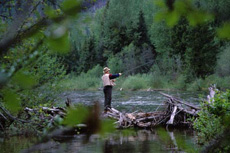
The second of a two-part series on the Kootenays, landlocked salmon, and nature's role in our sense of place, excerpted from Kokanee: The Redfish and Kootenay Bioregion.
In the Kootenays, I see the ideal location for a bioregional culture. Who are we Kootenaians? Well, we are a full day's drive from either Calgary or Vancouver. Although we do travel to those places on occasion, we are completely out of their orbit. Spokane or the Okanagan is half a day away, but other than for the rare weekend shopping trip, these locations might as well be on another planet.
The two local airports, Cranbrook and Castlegar, offer only expensive, unreliable connector flights into the main east-west routes. Castlegar airport's famous winter valley cloud and challenging approach have earned it the nickname "Cancelgar."
Like the kokanee, we are cut off. Those long drives and low winter cloud ceilings and mountain passes are our Bonnington Falls. Like the kokanee, we adjust to our isolation. Then, at a certain point, we look back and realize that relative isolation, and relative intimacy with the terms of our geography, have changed us, as they changed the kokanee, and we are pleased with our transformation. There is a bashful, self-deprecating, but persistent pride about living here, about being local.
People who lead tightly scheduled lives, who depend on cell phones and shuttle between commitments in major cities, simply cannot live in the Kootenays. The pace of life here is a little slower, a little more rooted. More than once I have had the experience of walking down Nelson's Baker Street, preoccupied with some nameless urgency, only to realize I was walking too fast and subtly disrupting the relaxed flow of pedestrians around me. In Nelson, walking at Vancouver speed is simply inappropriate.
One Kootenay, many Kootenays
As a bioregion, we must also deal with local complexity and local differences. Early on, "Kootenay" split into "the Kootenays," acknowledging two distinct cultures and ecologies. The Purcell Mountains divide our region into East Kootenay and West Kootenay.
The East Kootenays, basically the broad valley of the Rocky Mountain Trench, has a definite prairie energy, with a partly continental climate of warm summers and relatively dry, cold winters. Fifteen mountain passes through the Rockies have resulted in a strong prairie influence in the trench. The eastbound traveller on Highway 3 first sees the broad trench and the Rockies through a notch in the valley east of Moyie. Mount Fisher looms, its jagged shape chiselled across the sky, a classic Rockies mountain. In winter it often hosts its own lenticular cloud, curved over the summit.
Coming back to Nelson -- in the heart of the West Kootenays -- one returns to a totally different world of dense forest and dark rock. Rags of lingering cloud are caught and held on windless mountainsides. The West Kootenays are known ecologically as a "coastal refugium," where rain, heavy snowfall, and mild winters allow plants like salal, devil's club, and western red cedar to grow, hundreds of kilometres away from their centre of abundance on the coast.
There is even a disjunct pocket of yellow cedar thriving in the Slocan Valley, a species that belongs along the fogbound shores of the North Pacific. Botanists assume that these coastal species are a legacy of an earlier, more maritime climate that allowed them to spread right across the province, and the West Kootenays is the last remaining pocket of maritime-influenced Interior vegetation.
Mixed together with the coastal refugees, often on the same mountainside, are sentinels of the dry Interior -- ponderosa pine, rough fescue, and alligator lizards. The Kootenays are a complex ecological tangle, as well as a human one.
Hunting knives and hackeysacks
There is a fundamental social split between the East and West Kootenays. If I needed to buy a hunting knife, or hip-waders, I would certainly shop for them in Cranbrook. If a hackeysack or a handmade hat were on my list, I would look for them in Nelson. But the situation is actually much more complicated than that.
Communities of the Kootenays range from industrial to New Age and back again; downtown Trail is built around a massive lead-zinc smelter, while Rossland, ten kilometres away, is caught up with crystals, cappuccinos, and snowboards. New Denver celebrates environmentalism; adjacent Nakusp seems to be the last refuge of clearcut logging. Spread-out Castlegar welcomes strip malls and fast-food franchises; compact Nelson is a downtown-oriented, owner-operated kind of place.
Invermere is heavily influenced by Calgary; Cranbrook is nobody's suburb. Sparwood and the coal communities of the Elk Valley are another universe apart. Trail, Rossland, and Fernie all share a common heritage of radical labour movements, dormant now but perhaps someday to resurrect themselves in a new form.
Ethnic and lifestyle complexity further complicates the two Kootenays and binds them together. Swiss mountain guides, Quebecois treeplanters, German foresters, third-generation Italian immigrants, American draft-dodgers, nomadic skiers, dreadlocked hippies, suspendered loggers, Vancouver refugees, Ktunaxa, Shuswap, and Sinixt, descendants of Second World War Japanese internees, lesbian farmers, California telecommuters, nouveau Buddhists, and back-to-the-land dreamers from every jurisdiction help create the human fabric of the region.
Linkages bind disparities
East and West Kootenay engage radically different ecologies and sensibilities, yet I know of a hundred intimate linkages -- hydrographic, historic, jurisdictional, personal -- that bind them together. The kokanee forms one of those links.
The boundary between Pacific and Mountain Time Zones wanders down the spine of the Purcells, splitting the East and West Kootenays into two time zones, except for Creston, which marches to West Kootenay time in the summer and East Kootenay time in the winter. Missed appointments and meetings are common.
A Kootenay bioregionalism needs to be felt at gut level. The spawning habits of local fish, the feel of your own town on a Friday afternoon as people gear down for the weekend, the geological history of local landforms, all must be experienced and internalized. Some years ago the Whole Earth Review magazine proposed a now-famous bioregional quiz, which asked questions like "Name the waterbody that your domestic water comes from" and "Name two native bird species that nest in your area." The quiz seemed artificial, but it drove home the point that many of us didn't know that kind of basic information and had never even thought about it.
Kootenays blessed with many means
We definitely have the raw materials for a brash, earthy, and innovative Kootenay bioregional culture, plus the human energy and diversity to build it.
The Kootenay-Boundary Land Use Plan, an outgrowth of the provincial Commission on Resources and the Environment (CORE) process, released some of that energy and set the stage for an attempt at bioregionalism. The Land Use planning process brought together all the economic, environmental, and recreational sectors to work out zones of influence and reduce resource conflicts on Crown land, which makes up the vast majority of the Kootenay landbase.
The sectoral representation around the planning table was daunting. Foresters, miners, ranchers, and guide-outfitters worked out details with parks advocates, environmentalists, small business people, fishers, and trappers. Going well beyond the usual B.C. stalemate of loggers with their jobs versus environmentalists with their old growth, the process produced a number of minor revelations and unexpected points of agreement.
When they finished in 1998, the scarred veterans of the plan round-table had achieved a surprising degree of consensus and were prepared to soldier on with their innovative work. Officials were stunned by this unprecedented accord, so the Kootenay-Boundary Land Use Plan was hastily buttoned up and shuffled inside the safer confines of the government ministries.
Land measured without stories
As a minor participant in the Land Use Plan exercise, I marvelled at the process, the number of sectors represented, and the level of commitment, but I always left the meetings with a nagging feeling that something was missing. Finally, it dawned on me; there were no storytellers in attendance. No poets. No oral historians, no balladeers.
Storytelling and the oral tradition are crucial to the development and maintenance of a place mythology, but that tradition is weak in the settler cultures of western Canada, and what little tradition exists is continuously eroded by mass media culture. If we are to actually create a local narrative tradition, there are few precedents to build on. We are spoon-fed a mass culture that is suspicious of both narrative and of place, and we turn increasingly to that haven of atomistic, placeless particularity, the internet. It is no wonder that broad-based regional stories are few and far between.
As one small initiative in the development of bioregional and storytelling culture, I suggest the use of successional pathways and food chains. This information is not "owned" by any particular group, and it has good narrative and rhythmic potential. A written version of one branch of the kokanee food chain might go something like this:
dissolved phosphorous to floating diatom, harvester of Kootenay sunlight
from diatom to tiny invertebrate Daphnia
from Daphnia to silvery kokanee, molten essence of our landscape
from spawned-out fall kokanee to hibernation-minded black bear
phosphorous from bear scat captured by Douglas maple leaf
leaf falls, flows down steep and cedar-bounded creek to Kootenay Lake
elusive phosphorous captured again by diatom
This tale could be woven, expanded, and told in different ways, with different media. The fact that our knowledge of food chains is incomplete, and our knowledge of successional pathways even more so, would be a creative asset to this new phase of regional culture-building, encouraging us to speculate, research, and reinterpret.
I hope our kokanee prosper. As I glimpse the molten silver fry coming down the creeks on rainy and moonless spring nights, or marvel at the fiery red spawners returning on the quickening days of fall, I know these fish are a part of me, a clean and dignified and rooted part. I am glad that our futures are so entangled.
Don Gayton is an ecologist in Nelson, B.C., and the author of The Wheatgrass Mechanism and Landscapes of the Interior, which won the U.S. National Outdoor Book Award. This piece is excerpted from his Kokanee: The Redfish and Kootenay Bioregion, published by New Star Books in the Transmontanus series. Last spring, The Tyee also excerpted "Dad, Me and the Kokanee" from the book.
![[Tyee]](/design-article.thetyee.ca/ui/img/yellowblob.png)


Tyee Commenting Guidelines
Comments that violate guidelines risk being deleted, and violations may result in a temporary or permanent user ban. Maintain the spirit of good conversation to stay in the discussion.
*Please note The Tyee is not a forum for spreading misinformation about COVID-19, denying its existence or minimizing its risk to public health.
Do:
Do not: