- Ms Kaye is a Tyee Builder. You can be, too.
- Mary Carlisle is a Tyee Builder. You can be, too.
- Prem Gill is a Tyee Builder. You can be, too.
- Nancy Flight is a Tyee Builder. You can be, too.
- Justin Everett is a Tyee Builder. You can be, too.
- John Westover is a Tyee Builder. You can be, too.
- Nora Etches is a Tyee Builder. You can be, too.
- Edward Henderson is a Tyee Builder. You can be, too.
- Bharadwaj Chandramouli is a Tyee Builder. You can be, too.
- Dean Chatterson is a Tyee Builder. You can be, too.
- Marius Scurtescu is a Tyee Builder. You can be, too.
- Robert Parkes is a Tyee Builder. You can be, too.
- James Murton is a Tyee Builder. You can be, too.
- Susan Doyle is a Tyee Builder. You can be, too.
- Vincent Strgar is a Tyee Builder. You can be, too.
- Helen Spiegelman is a Tyee Builder. You can be, too.
- Subir Guin is a Tyee Builder. You can be, too.
- Kimball Finigan is a Tyee Builder. You can be, too.
- Joanne Manley is a Tyee Builder. You can be, too.
- David Leach is a Tyee Builder. You can be, too.
Uprooted after 30,000 Years
Robert Semeniuk documents the dislocation of the Kalahari Bushmen.
Gallery: The San »
The Kalahari Bushmen are one of the world’s oldest civilizations. For 30,000 years they have carved a life out the desert in what is now Botswana.
But for the last decade the Bushmen – or San, as they are also known – have been inexorably driven from their land in the Central Kalahari Game Reserve. In 1997 the government of Botswana began cutting off services and forcibly relocating them to camps and settlements outside the reserve.
The government, one of Africa’s wealthiest, says they can no longer afford to supply the services. But representatives for the Bushmen and from Survival International, an NGO that works for the rights of indigenous peoples, say the authorities are more interested in developing diamond mining in the park.
The government counters that, off the reserve and in towns and villages, the San have renewed access to hospitals and schools. But when Bowen Island photographer Robert Semeniuk visited the camps he was less than impressed. “This whole fucking village is drunk every day,” he told The Tyee, “this isn’t success.”
Removed from their traditional way of life the San scrape together an existence by working as hands on the local farms, or by relying on government aid. Alcoholism and AIDS are rampant.
“It’s like taking wild fish and sticking them in pens,” Semeniuk said, “they get sick. They get sick, they get drunk and they get miserable.”
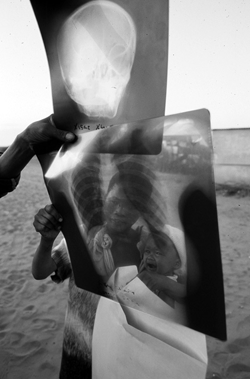
Because of the wealth that diamonds have brought to the country, access to AIDS fighting anti-retroviral drugs is better in Botswana than in most parts of Africa. But amongst the San, Semeniuk found that many patients aren’t getting the right testing done and, if they do, they rarely follow up.
On one trip, Semeniuk visited a family where the children were on the treatment. “They bring out a box of drugs,” he said “and there’s the mother, drunk, trying to sort out who takes what and the pills end up all covered in sand.”
For Semeniuk, the relationship between AIDS and the displacement of the San is clear. The photos that accompany this article are from his exhibition: The San: AIDS and Dislocation appearing at The Gallery on Bowen Island from July 20 to August 7.
“I’m convinced that if you don’t have a home you get sicker than if you had one,” he said. “And the first thing you want to do when you get sick is go home. So it’s a double whammy for people who are sick and don’t have a home.”
Richard Warnica is on staff of The Tyee. ![]()


4
Login or register to post comments
Bailey
6 years ago
Comments on "Uprooted after 30,000 Years"
These are beautiful, terrible images. Why do they look so familiar?
30,000 years doesn't establish their tenancy, doesn't make the land theirs, I guess, while there's a corrupt profit to be made by driving them to drink and death. We in Canada have some experience of that.
Corrupt profit. When will we ever establish an international law among nations, that can arrest corrupt officials, even heads of state, and bring them to trial. We make small gestures, now and then, but never seem to take a second step.
First world leaders have no appetite for it, because they fear their own actions would be judged fairly harshly. Third world leaders will never take the lead because, well, the diamonds or whatever will usually wind up in their own pockets. Their wives want more shoes, you see, thousands of pairs of shoes.
I don't think these constant slaughters will ever stop until there is a movement of ordinary people who all stand up and say stop. Arrest the criminals and make them stop. Ordinary people actually do have the authority and the power to do it.
Maybe the aboriginal people of the world, who have been showing signs of forming a common cause, might do something about this. If they could, it would be a moment of hope.
skeptikool
6 years ago
Genocide by degree. Others have used smallpox-infested blankets along with their rotten alcohol.
I recall a story of two Caucasian children, lost in Australia's Outback, befriended and saved by a young aboriginal boy. Fiction or not, Africa, Brazil or Australia, we have much to learn from their native peoples.
North of Hope
6 years ago
I believe the story skeptikool refers to is a movie called "Walkabout." It was a rite of passage for aboriginal boys to spend some time living on their own and while he was going through this process, came across the 2 Caucasian children. He fed them and kept them alive. Much more to the plot, but I will stop now. A great movie, but I do not know if it is now available.
allan
6 years ago
Bailey, Aboriginal people have been doing more than showing signs of forming a common cause for decades now, but whenever they start talking to each other they are suspected by "authorities" of being some kind of threat.
I'd recommend googling George Manuel, who in 1975 founded the World Council of Indigeonous People to pursue that very cause.
Manuel, a chief of the Shuswap nation's Neskonlith Indian Band located between Kamloops and Chase, brought peoples from around the world together, but his actions were always viewed with strong suspision, if not outright hostility by the larger non-aboriginal community.
Considered a world statesman by his compatriots around the globe, he was virtually ignored and barely understood by Canadian media.