

 SHARE:
The Tyee.ca
When officials of the world's nations convene this week in Nairobi, Kenya to renew efforts to eradicate land mines, Richard Fitoussi and Aki Ra will be there in spirit.
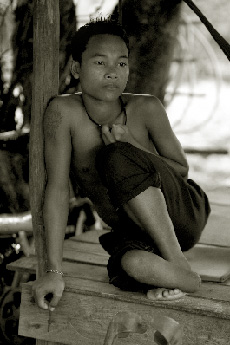
In Cambodia, Fitoussi, a young photographer from Toronto, and Ra, who once fought for the genocidal Khmer Rouge, have formed a two-man international alliance against the scourge of land mines.
Having sowed those mines for the Khmer Rouge, Ra went on to master the dangerous art of defusing them, and felt compelled to build a makeshift museum showcasing the weapons and the carnage they've created.
Fitoussi started out using his camera to document Ra's work, but now raises funds to support Ra's ambitious efforts.
Legacy of the Khmer Rouge
Since 1999, 37 million mines have been destroyed worldwide. But Angola, Afghanistan, and Cambodia remain the world's worst places for landmines.
Cambodia's 10 million land mines are remnants of decades of war in the region.
The North Vietnamese army laid the first landmines in Cambodia along supply routes in 1967 and continued to do so throughout the Vietnam War. The Khmer Rouge spread millions more along the Thai and Vietnamese borders during its reign.
Since 1979, the UN estimates more than 57,000 Cambodians have been mutilated by landmines – about one in every 240 Cambodians. Most of those injured are adults, but more than a third of them are children.
Under the Khmer Rogue's rule, between 1975 and 1980, it is believed that one in four Cambodians were murdered or died from starvation and disease. Cambodia still struggles with the memories of a genocide that claimed more than three million lives in the late 1970s.
Mine man
Four years ago Fitoussi, fresh out of Ryerson University's photography program, arrived in Cambodia to document the 25th anniversary of the Khmer Rouge's Killing Fields.
On his first visit, Fitoussi met Aki Ra, a former child soldier trained in landmine ordnance. Ra believes he is 31, but his only evidence is an old school teacher who thinks she remembers him in her class. Because he was enlisted as a child soldier after his parents were murdered by Khmer Rogue soldiers, he cannot remember himself with any certainty.
For 20 years Ra planted mines for the Khmer Rogue before switching his allegiance to the North Vietnamese and then again to the Cambodian National Army.
His education as a soldier was concentrated on mine ordnance, like most child soldiers. If orphans blew themselves up, no one cared, Fitoussi said. And their small hands were also perfect for setting booby-traps, he added.
But Ra has spent most of his adult life defusing the mines he was forced to bury as a child.
Memorial to mayhem
Ra founded his little landmine museum outside Siem Reap, near Angkor Watt. The museum consists of a shack, with Ra's crude paintings on the wall documenting his past, and a courtyard filled with more than 4,000 diffused weapons.
"Pretty stone-age. I'm talking bamboo and tin," is how Fitoussi describes the place. Large piles of mines, mortars, rockets, claymores, grenades, were piled in the yard, all of which Ra had defused.
More than 350,000 landmines were destroyed in Cambodia between 1992 and 2002, which has decreased the casualty rate from 360 per month in 1996 to an average of 60 casualties per month in 2002. Still, it is estimated that it will cost more than six times Cambodia's gross national product (more than $7 billion) to eliminate the mines.
The larger organizations receive most of the international funding for clearing mines, Fitoussi said. The money is often misspent due to poor organization and corruption, which raises the cost of clearing a single mine to $500 to $1,000.
Maverick defuser
Ra estimates he has defused more than 10,000 mines himself in the past four years. But he carries a reputation for being a bit of maverick without the backing of an international agency. Ra was supporting himself and his mine clearing efforts on backpackers' donations at the museum when he and Fitoussi first met.
Ra has been the topic of numerous documentary films, including Scared Sacred, shown at the Vancouver International Film Festival in September, which has not endeared him to the Cambodian government. Ra was accredited by the UN in 1993 to defuse landmines. The Cambodian government, however, revoked his credentials because of his efforts to document the genocide, Fitoussi said.
Ra's de-mining tools are a shovel, a hammer and a wrench. Peasants from villages all along the Thai border still come to him to ask him defuse mines whenever they are found.
"There are actually arguments against his safety, that he is dangerous, that he's a maverick and a cowboy. If you look at (the other agencies) and go onto their websites or annual reports, all of them will have accidents and injury reports. Aki Ra is still alive, so that's his safety record," Fitoussi said.
"I went back to Canada and thought, 'Well, I'm going to try and help this guy out.' I started using my images and picture to go to high schools to raise money and give lectures. I went to about 50 high schools across Ontario and raised about $15,000."
Fitoussi also hired a lawyer and registered the Cambodian Land Mine Museum Relief Fund as an NGO. Ra finally has his international backing.
"If we go in there and wave the Canadian flag and hold Aki's hand, then people will leave him alone and let him do his work. Suddenly we're an NGO and the (Cambodian) government has to watch what they do," Fitoussi said.
New museum slated
But it wasn't enough for Fitoussi to fund Ra's efforts; he also wanted to build him a real museum.
After first being snubbed by the University of Toronto and the Ontario College of Art and Design, Fitoussi partnered with Texas A and M to convert Ra's makeshift museum into the Cambodian Landmine Museum Prevention and Rehabilitation Centre.
The university's students donated the architectural design for a proper museum, a training centre, where Ra can teach people how to diffuse mines, and a rehabilitation centre, which will develop a sustainable plan for making prosthetic limbs for amputees maimed by land mines.
"This is a half million dollar project we're probably going to do for under $200,000 thanks to the efforts of volunteer expertise," Fitoussi said.
Even with the low price tag, however, funding is still an issue.
In 2003, Fitoussi's Cambodia exhibit was shown beside seven other war photographers, including James Nachtwey, at the Telluride Mountain Film Festival in Colorado. At the festival Fitoussi was approached by Tom Shadyac, director of Bruce Almighty, Ace Ventura, and Patch Adams. "Shadyac basically stuck out his hand and said, 'How can I give you some money?'" Shadyac donated $80,000 US to get the facility started and told Fitoussi to come back in a year with an update.
The land has since been bought and they are about to begin construction on the site. Last month, Shadyac donated another $25,000 to the cause and Fitoussi is currently in Cambodia overseeing the project.
Back to camera work
With the museum project in full swing, Fitoussi has finally had a chance to get back to building his portfolio as a war photographer.
Earlier this year he was embedded with the UN in Afghanistan and he is headed for Sudan with Medicin sans Frontiers (Doctors without Borders) in January. He then hopes to go to Iraq.
"Because of the four years I've dedicated to the project, I've put my journalism on hold. I'm just now trying to get some portfolio pieces together," he said.
Despite the delay to his career, he said he has no regrets. "If another situation arises and I can be of some use, I will. If I can use this model, then hopefully it can be transferred to all over the world and utilized everywhere."
Donations for the land mine museum project can be made to the Cambodian Land Mine Museum Relief Fund at www.cambodialandminemuseum.org/contact.htm.
Scott Deveau is a staff writer for The Tyee. ![[Tyee]](/design-article.thetyee.ca/ui/img/yellowblob.png)
Read more: Photo Essays




Tyee Commenting Guidelines
Comments that violate guidelines risk being deleted, and violations may result in a temporary or permanent user ban. Maintain the spirit of good conversation to stay in the discussion.
*Please note The Tyee is not a forum for spreading misinformation about COVID-19, denying its existence or minimizing its risk to public health.
Do:
Do not: