

 SHARE:
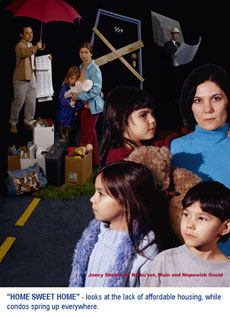
Tipping the Balance, an exhibition of art by and about people living in poverty, will open and close in Vancouver on a single night, Sunday, October 17 to commemorate the UN’s International Day for the Eradication of Poverty. Artists working mainly in photography record the stories of those living on the edge of the financial abyss, and although there are plenty of images of broken dreams, transcendent joy also finds a place in their works.
“The camera makes everyone a tourist in other people's reality, and eventually in one's own.” Susan Sontag
Elaine Brière is well known for her work as a photojournalist and documentary filmmaker who has chronicled human rights abuses East Timor. But in The Tipping Point, she turns her lens on people living on the margins of one of the richest countries in the world. And here she finds that “poverty hardens our hearts; it affects everybody,” she says.
Homeless Sleeping depicts the far reaches of destitution, where concrete pavement becomes a makeshift bed. Concealed by the shroud-like muddle of blankets that cloak him (or her?), this person’s identity has been erased by a society that would rather forget the poor. “It’s not a pretty reality,” Brière says. “Society treats them as disposable people.” In this photograph, Brière evokes not only the depersonalization of the poor, but also the precariousness of life on the streets: the soft curves of the blankets are juxtaposed with sharp angles that press in on this anonymous sleeper from every direction.
“A good photograph is one that communicate a fact, touches the heart, leaves the viewer a changed person for having seen it.” Irving Penn
This exhibition’s photographs force viewers to experience the poor as individuals, with dynamic emotional lives, tender friendships, and crushing defeats. In Friends at Four Corners Brière introduces us to a huddle of aboriginal men outside the Four Corners Community Savings, a bank that served the downtown eastside until it the province closed it last February. The joke these men share forces us to consider that despite their grinding poverty, they have not lost the capacity for relationships, emotion and community. “Most poor people exist by the charity of other poor people. Sharing among poor people is what keeps most of them going,” she says.
At the same time, however, Brière refuses to grant the spectator the luxury of pity or sentimentality. The authentic moments that Brière captures makes it impossible for viewers to see the poor as “the other,” a one-dimensional stereotype of poverty that dominates news hour tours of the downtown eastside. Brière’s photographs derive their aesthetic power from this authenticity, but they also pack a political punch. “Poverty is evidence of our kind of economic system,” she says. “Poverty is a huge social lever: poor people don’t vote, poor people provide cheap labour for all the dirty work. It’s very convenient and a very important part of free market capitalism.”
“Photography records the gamut of feelings written on the human face - and the wealth and confusion that man has created.” Edward Steichen
The intimacy of Brière’s luminous photographs are a foil for the six large-scale murals by Carole Condé and Karl Beveridge that are also on display in Tipping the Balance. These murals explore a range of poverty issues that were identified by community activists, such as affordable-housing shortages for the elderly or social service cuts to the disabled. Condé and Beveridge use the vivid colours and slick surfaces of advertising to document how Victoria’s cuts to social services has increased the suffering of the province’s most vulnerable citizens.
“Art is on the side of the oppressed.” Nadine Gordimer
Maria Ripley once took her middle-class lifestyle for granted, but after disabling disease destroyed her ability to work, she slid into poverty. “I thought that there was more of a safety net than there is,” she says. She discovered that a disability allowance—like the one she now subsists on--condemns its recipients to poverty. “You think that if you budget carefully you could survive, but you can’t--because you have to choose between bus fare and food,” she says.
Ripley’s piece, Free Fall, is a linocut print expressing what she describes as the power of community to sustain those in need. “I could have ended up on the street if I did not have some family and friends to help me out,” she says.
Tipping the Balance kicks off six months of art workshops sponsored by The Fulcrum Project, an organization dedicated to dismantling the public’s misconceptions about poverty. In these workshops, people living in poverty will have an opportunity to give voice to their experiences in writing and in the visual arts.
Anne Beesack, an artist, educator and art therapist, is one of the co-ordinators of the exhibition and workshops. She says participants’ stories “may be reflected in the art, but they may not. The point is you have people tell their stories.” By putting faces to poverty, and stories to images, the public will come to realize that “many people end up in poverty and it’s fluke, it’s circumstance, it’s bad luck; it’s not what they thought, it’s very easy for many people to fall into poverty.”
Tipping the Balance runs Sunday, October 17, from 7-10 p.m. at 3350 East Hastings. The exhibit is available to be booked by organizations that wish to focus on poverty issues in their communities. For more information, contact the BCGEU communications office at 604-291-9611.
Judith Ince is on staff at The Tyee.
![[Tyee]](/design-article.thetyee.ca/ui/img/yellowblob.png)
Read more: Photo Essays

Tyee Commenting Guidelines
Comments that violate guidelines risk being deleted, and violations may result in a temporary or permanent user ban. Maintain the spirit of good conversation to stay in the discussion.
*Please note The Tyee is not a forum for spreading misinformation about COVID-19, denying its existence or minimizing its risk to public health.
Do:
Do not: