We ARE Traffic!

That swarming Critical Mass flew by too fast you say? A second look offered here.

By Amy Walker, 30 Jun 2004, TheTyee.ca

1-255

TheTyee.ca

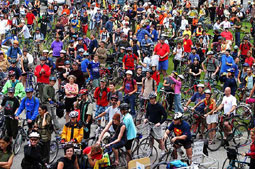
Vancouver celebrated Bike Month big, as some 800 riders, rollerbladers, scooters and skaters took part in the 2000 + 4 Wheels Ride on June 25th. The event invited cyclists to "take the lane" in support of clean air, safe, car-free transportation and for the pure joy of moving under one's own power.

While a Critical Mass Ride takes place on the last Friday of every month, this ride was about three to four times the size Vancouver usually sees as volunteers encouraged friends, neighbours, relatives and even (gasp!) total strangers to participate.

Pedal powered vibes

The ride made its way through the streets of Vancouver, crossing the Granville, Burrard and Cambie Bridges and delighting the denizens of restaurant patios, sidewalks and quite a few motorists along its route. Seasoned Critical Mass riders in the crowd called out slogans such as, "We're not blocking traffic. We are traffic!" and "If you love your car, set it free!"

Complete with a pedal-powered sound system courtesy of PedalPlay the ride rocked through Vancouver streets releasing into the atmosphere considerably fewer emissions and far more smiles than conventional motorized vehicles.

Click here for more photos of the ride by photographer David Grove. Here for photos by Ian Patterson. And here for more information about Critical Mass.

Amy Walker is at large editor for The Tyee's Fisheye galleries, and a Critical Mass rider.

 [Tyee]

6  Comments:

Login or register to post comments

  • Cycling Commuter (not verified)

    7 years ago

    Even though I don't like a lot of NDP policies and I voted Green, I do admire Layton's dedication to promoting cycling. Layton is pushing for a cabinet post. It'd be great if Paul Martin could give Layton such a post specifically for the purpose of distributing GST to cities dedicated to building safe, practical bike paths that are a reasonable distance away from cars. That way, the NDP and Liberals can steal a plank from the Green Party policy platform: preventive health care. Since China's economy started booming and the Chinese have started turning away from bikes toward cars and buses for commuting, their rate of coronary artery disease has started to rise dramatically. Building safe, practical bike commuting paths in cities can reduce the substantial portion of Canada's health care costs caused by inactivity and obesity; reduce health care costs related to air pollution; and reduce health care costs related to automobile collisions by encouraging high-risk teenage drivers to get out of cars and onto cycles using safe commuting cycle paths. It would be fair to use gas taxes to pay for safe cycle paths as a form of financial compensation for the health damage that internal combustion engines cause to non-motorists. Public transit is not as good an investment as safe bike paths and fuel-efficient hybrid cars or ultra-light commuting cars (including 1-person ultralights). Diesel exhaust from buses and trains contains microparticles that are extremely carcinogenic. Diesel exhaust does a lot more damage than exaust from gasoline-powered cars. Because of the inevitable stopping and starting to pick up and drop-off passengers as well as circuitous routes taken to destinations, public transit can force riders to sit longer and be even more inactive than riding in a car. The same shortcomings reduce overall fuel efficiency. With public transit, there's a large, constantly-rotating pool of strangers forced together into close proximity, breathing each-others' exhaled air. Buses and trains are the perfect transmission medium for SARS, tuberculosis, lethal forms of flu and many other airborne contagious diseases. Then there are the nutbars who like to release poison gases in buses and trains. Japan has been hit. Most recently, some crank released poison in a Vancouver bus. And hey, don't get me started on chili bean eaters! In addition to forcing a large and constantly rotating pool of strangers to breath each-other's foul air, public transit further increases the likelihood of disease transmission by forcing commuters to remain sedentary for long periods of time, weakening the body's immune system. Because buses are so heavy, they cause a massive amount of expensive damage to roads. Road damage starts when buses and other heavy vehicles over a certain weight threshold cause the roadbed to flex and crack. Water gets into small cracks, then freeze-thaw cycles accelerate the destruction. Bikes, ultralight cars and even some regular cars don't exceed this flex threshold. We also need pro-rated, by-the-kilometer auto insurance that encourages owners of large, heavy vehicles to use such vehicles only when absolutely necessary and use smaller vehicles (including single-passenger ultra-lights and bicycles) the rest of the time. For example, with pro-rated by-the-km insurance, a family van might be reserved for family outings to distant locations or during bad weather. A roofing contractor would only use his or her big truck on the job. Bikes would be used for shorter distance family outings, short-distance commutes to work and shopping during pleasant weather. Single-passenger ultralight vehicles could be used for commuting to work and grocery shopping in bad weather or over longer distances. The current flat-rate auto insurance system punishes those who use large vehicles only when necessary while rewarding those who use SUVs and monster trucks to drive to work or pick up a few groceries. The currently available slightly lower priced insurance for part-time work (2 days/wk) is useless for most people because real life doesnt fit into a neat little predictable pattern like that. When there's a lot of snow on the ground, you may drive a 4WD gas-guzzler every day for a few weeks, then cycle most of the rest of the year - using the 4WD only every third saturday for a family camping trip, to pick-up furniture etc. By-the-km insurance is the only practical way to go. Of course there will always be weasels who try to rip-off the system by attempting to disconnect the odometer. The same is true of electrical meters: those are sometimes bypassed. But nobody is suggesting that everyone should pay exactly the same amount for electricity regardless of how much they use. By-the-km insurance cheaters can be caught using anti-tamper technology and spot checks then fined enough to make it not worth their while. Repeat offenders can forfeit the right to by-the-km insurance and get stuck with flat rate insurance.

  • Brian Seidman (not verified)

    7 years ago

    Enjoyed the Photos really enjoyed the deep reds of the bikers clothing. Happy Canada Day

  • Tathra (not verified)

    7 years ago

    I'd like to contact Ian Patterson for permission to use some of his photos in a presentation on transportation solutions to climate change. His website has no contact information, can anyone help? please email me at

    Great to see so many inspiring images of human powered vehicles taking over the roads, more more more!!!!!!!

  • Marcel Larouche (not verified)

    7 years ago

    As a truck driver, I, every now and then, am victimized by a cyclist who wish to demonstrate how his environmental choices should inspire me! All I see is more polution coming out of my pipes because of this cyclist who forces me to loose my momentum and crawl up or down Knight steet corridor. Funny thing is, I support building more cyclists path all over the region I also support to outlaw cycling from truck route as some of your cyclist friends have detrimental environemental technics and are releasing more cancer generating polutants onto the streets and will sooner or later get someone kill and it wont be the truck driver although his carreer will likely be ruinned. I do what I can for the environment and I dont feel guilty about driving a big rig that is maintainned as good as it can be. The Knight street corridor needs to be dedicated as a truck coridor in order to accelarate passage through town and minimized damage to the city and the environment. Only Translink could do this as they should take over management of this strategically located truck route. This route could also be upgraded asa Vancouver By-pass to serve the tourist coming from Hwy 99 who currently must drive trough Vancouver gridlock in order to get to Whistler. It is my belief that environmental organisation should support a well engineered, cyclist free dedicated truck coridor on the Knight/ Clark streets From the Port of Vancouver to Richmond. as it truly would benefit all parties. Most commuter cars can be replaced by comuting bicycles but truck are supporting the nations economy and have no alternatives. All we need is to work together to minimize the damage. See you down the road!

  • Ron Yamauchi (not verified)

    7 years ago

    I feel very fortunately to be able to cycle to work. Kudos to the city and the bike culture here for the excellent and inspiring cooperation. The pleasures and benefits speak for themselves. Marcel, I will admire that there are a few cyclists who do not understand that there are such things as bike lanes (or helmets) and therefore screw up your route. All I can say is that Darwinism tends to equalize things sooner or later.

  • trew (not verified)

    7 years ago

    instead of gazillions to subsidize autos,whynot insist that every new bike sold must include a helmet,if you end up with two give one who is less wealthy a chance to buy a second hand one?

    • No best comments selected by an editor for this story yet. To see all comments, click the All Comments tab, above.
    • The discussion for this story is closed. No more comments can be added.