News

Do Car Shares Reduce a City's Footprint?

Fleets of Modo, Zipcar and Car2go reinvent the transport wheel in Vancouver streets.

By Adam Pez, 31 Jul 2012, TheTyee.ca

Car2Go

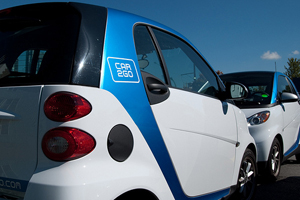
Car2go, one of Vancouver's car share companies. Photo by w.d.worden in Your BC: The Tyee's Photo Pool.

Related

A year back, Alexis Hinde decided to try an experiment: she ditched her private vehicle and switched to a car sharing group. Since then, she said she's sharply cut back the time she drives.

"It used to be if it was raining I would take my son eight blocks to daycare in the car, because it's easy to be lazy about that sort of thing. Whereas now if it means having to reserve a car and the expense of that and everything else, I'll just walk with [my son] to daycare or get on the bike and take him," she said.

It's a lifestyle switch that appears to be growing in popularity, as vehicles stenciled with car share company logos become a common sight on Vancouver's streets. Though each company is different, car shares offer a variety of rental vehicles, often by the hour, and they spare customers the expense of paying directly for maintenance and insurance. After use, share members can drop off vehicles curbside and just walk away. It's the convenience and potential savings that drew Hinde in.

Of the three car share groups in Metro Vancouver, Modo is now at 9,000 members, up from roughly 7,000 in 2010, and over the last five years, Zipcar has expanded "steadily" to more than 11,000 Vancouver members, according to Business In Vancouver. Car2go has experienced significant growth since setting up shop last year, reporting that 15,000 members have now signed up to drive the company's small fleet of Smart cars.

And now there's evidence that growth is starting to achieve what proponents claimed it would. Vancouverites are shedding their private vehicles, reducing their drive times, and lowering their impact on the environment.

Steering behaviour

Hinde, a West End Vancouver resident, works as a writer and part-time administrator for a software company. She has a small business designing, manufacturing and selling clothes for young boys.

Switching to a car share vehicle has definitely changed how she drives, she said. She still has her husband's car for weekend use. But after selling off her Toyota Echo hatchback and joining Zipcar, Hinde has reduced her weekday drive time from three or four days a week to "maybe three times in two months" -- mostly to do errands that require a vehicle, like taking her 87-year-old mother-in-law grocery shopping.

Lisa Corriveau agreed that joining a car share made her more cautious about the amount she drives. A Mount Pleasant writer and stilt performer, she's blogged positively on her car sharing experience.

Having to lug a car seat for her son three blocks each time she wants to use a vehicle has reduced the amount she uses a share. But she said she doesn't regret her choice to forgo buying a private car and instead sign up with Modo (then the Car Co-op) in 2003.

"I couldn't have gotten a nice car for $500," she said, noting both she and her husband work downtown. "Parking would have been $150 a month; it just would've been insane."

"I would rather invest that money or spend it on bikes instead," she said.

SHIFT TO A SHARE

Intrigued by the prospect of sharing a car, but want more details?

The Tyee recommends this fantastic service story by John Burns at Vancouver Magazine, published May 2012.

It has details on Modo, Zipcar and Car2go, including joining and per hour cost, potential "speed bumps," and other benefits.

Happy sharing.

— Robyn Smith

Because of car sharing, she's changed how she plans car trips. She now stacks up errands to minimize costs.

"I try to be very efficient when I use the car. I don't book it for longer than I need to. I combine a trip to somebody's house with an errand in that area," she said. "I definitely use cars less than if I had one sitting in front of my house. You know what it's going to cost per use instead of always paying that all the time."

Sharing results

"There could be one or two cities in North America where you have three [car shares] in operation and they're all doing well," said Bernice Paul, Modo's marketing director. Formerly known as the Car Co-op, the non-for-profit group pioneered car sharing in the city since it started about 15 years ago.

Paul said many Modo members were driven by green motivations to start car sharing. But often, she added, "people are joining for more the smart reason that they know they don't need to own a car. It's not necessarily the green choice; it's the economical choice."

Paul's noticed a shift in the business over the last couple years. Customers have become less concerned about securing transportation, and more interested in lifestyle and sharing resources.

"The last year and the half, 50 per cent of new members joining are between the age of 25 and 35. They're choosing to live around cities and city centres, and big transit hubs in Surrey and New Westminster -- that's where we've seen a lot of growth," she said.

Transport hubs are appealing for new members because they provide easy access to amenities and grocery shopping, she said, adding people can just step off the SkyTrain and hop directly into a Modo car share vehicle, which are stationed at several stops along the Expo Line.

Those sorts of city layouts make "it easy to get places -- to get to work or their friends' houses," she said. "You see similar setups now in municipalities all around Vancouver. They're really encouraging that lifestyle because it makes better use of the land and shared spaces."

And as a result of those policies, it's been easier for residents to give up their privately owned vehicles and use car shares to be part of a mixed urban lifestyle involving walking, cycling and using mass transit, she said.

From annual surveys, "we generally know about half of our members generally give up one vehicle when they join Modo," she said. "They scrap a car, don't join a lease, or they don't purchase a vehicle."

She said depending on the city you're talking about, a single car share vehicle can take between four and 30 private cars off the road. That reduces pollution, and ensures new cars -- and all the energy and steel used in their production -- don’t sit unused in garages or parking spaces for most of the day, according to a 2010 study sponsored by the U.S. federal and California State Departments of Transportation.

The study, which surveyed 6,281 respondents in the U.S. and Canada, found that car shares on the whole reduced a household's average greenhouse gas emissions by upwards of 0.84 tonnes per year. (By comparison, the average British Columbian emits 14 tonnes of carbon dioxide every year, according to 2007 Environment Canada statistics.)

The study also noted that dense cities with diverse transportation options were key to ensuring car shares remained profitable and retained a lower environmental impact.

Ahead of the pack

Vancouver, in that regard, could be a model for how to encourage successful car shares.

The City has been proactive in supporting shares, partnering with Modo as part of its 2009 plan to green staff commutes. The City has since managed to get 585 staff members signed up with Modo and has cut 20 passenger cars from its fleet of staff vehicles, said Alex Russell, a spokesperson for the City.

"There's quite a few things we try to do to support car shares because it's been so successful in the last few years," she said, adding that the City is considering making the inclusion of car shares mandatory for new transport hubs as part of Vancouver's 2040 Transportation Roadmap.

"Most cities are a little bit hesitant. But Vancouver is certainly at the forefront when it comes to this. I think Vancouver is a perfect example of a city that's done all the right things from the transit infrastructure perspective," said Mark Pribula, GM for Zipcar's Vancouver branch. The company has over 700,000 members worldwide, with cars in cities across North America and Europe.

City incentives for car share vehicles, like parking permit stickers and on-street parking opportunities, have helped a lot, giving car share members easy access to street-side parking in residential areas and providing his company more visibility, said Pribula.

"I look at the horizon and everything looks extremely positive," he said, noting the Vancouver market is still far from saturated.

"We're at such a low adoption overall -- still at such an infant stage. We see as a company urban centres where more than half of the people will be car sharers," he said.

The market share of car sharing organizations remains small in North America. Encompassing only 0.2 per cent of the United States' urban population, for example, the groups have a lot of room to grow, according to a 2010 DePaul University study.

Yet whether the business continues to expand and meet its environmental goals depends on sound city policy and planning, added Pribula.

"Obviously, people need to be able to take more transit. They need to be able to take their bikes a little more; they need to walk a little more. All those things have to work together for car sharing to be at its most effective," he said.

"We don't want people giving up their personally owned cars and driving car sharing vehicles five times a week, because that becomes a bit of a moot point."  [Tyee]

18  Comments:

Login or register to post comments

  • OhCanada

    46 weeks ago

    I could hardly call it footprint reducer ...

    So what if all these members of car-share groups want to get somewhere at the same time? Will they be driving? How is that going to reduce carbon footprint?

    How is ditching your personal vehicle will save the environment when all you do is to go and drive anyway but in this case will not be your car.

    The problem is not that people have cars. The problem is that there is no public transport system EFFICIENT enough for many people to make the switch from the car to a bus or metro.

    Adding to this is that many people are lazy and reach for their car keys first. Now the only difference is that they will be still reaching for a car key but this time they have to make a plan first.

    Don't get me wrong - it is a nice notion to share a car and all that. But...I wouldn't call this public transport or a system that moves mass amount of people efficiently with a minimal carbon footprint.

    It is funny how North Americans want the easy way out and try to avoid developing an efficient public transportation system which would be one of the best approaches to reduce our impact on the environment.

    Nothing is going to compare to a bus, a metro or a street car that can carry hundreds of people at once to a shared car that still carries only one or max 5 people at once.

    When someone living in Delta will get to downtown in 20 minutes on public transport then people will more likely switch. But I don't see how someone living in Delta for example will want to ditch his car if he works downtown. A shared-car isnt' going to be his solution. And when we talk about public transport it isn't about how I can get from Kitsilano to downtown but how I can get from Surrey, Abbotsford, Coquitlam or Delta to downtown efficiently and less than 30 minutes. (Entirely possible with a developed public transport system).

    All this shared car option has done is people living closer to downtown will use shared car. That I hardly call removing a footprint.

    The age group of 25-35 are the people who have debts from school and difficulties in today's time to find a decent paying job. They can't afford to own a car so they are forced to share if they want to stay mobile.

    I have a car. I bike or commute to work by bus. Walk or bike short distances and use my car when I have number of errands to do or want to take a weekend trip. My footrpint is minimal and I have the freedom to plan my time according to my schedule and not when a shared car is available.

    Call me ignorant but a car-share isn't going to do much other then retrain some people to become more aware of their car usage.

    Developing an efficient public transport system is what will really reduce our carbon footprint.

  • Bob Wiley

    46 weeks ago

    Embedded energy

    I agree with many of things Oh Canada says, especially about developing an efficient public transport system. But the point being missed is the one about the savings of the energy embedded into the materials and construction of all those vehicles being replaced by the car-share one. A huge proportion of the energy consumption of every vehicle's over its lifetime is already consumed before it leaves the sales lot. In addition, it takes energy to build roads for all those extra cars and places to put them.

  • BradT123

    46 weeks ago

    OhCanada - yes it does reduce

    OhCanada - yes it does reduce the carbon footprint. That's because carshare users do not jump in the car everytime we need a quart of milk. The inconvenience of car sharing means you plan more and drive less. You eliminate all those unecessary trips which are really a big percentage otf total driving. I used to drive about 3 trips a day with my own car, now it's about 3 trips a week.

    And by the way, if you are an average citizen of Canada, near the very top of the world economic heap, your carbon and ecological footprint is not "minimal". It's massive, and unsustainable. Don't forget the world economy is 1.4 times the carrying capacity of the earth already, with most of that economic activity coming from rich countries like Canada. If the whole planet gets cars (as they want to do) we are quite certainly doomed.

    If we in BC can't make little changes, like using a car share, how can we ever expect the human race to make the big changes and sacrifices needed to survive?

  • marine1941

    46 weeks ago

    Will a Car-Co-op save me money when the Viaducts are removed?.

    I looked to see if any of the car co-ops had vehicles parked close enough to my location in Strathcona, so they would be an option for getting into downtown Vancouver, since once the Viaducts are removed my taxi costs will go up from around $8 one way, to over $13 one way.(no tip) That was the effect of closing the Viaducts during the Olympics. Since there is no bus transportation that works during rush hour( no pickup on Hastings between 8.15AM and 8.45AM or later..buses too full to stop)I use a cab at least 2-3 days a week to get into downtown for meetings.And the ANSWER IS YES: So...if I join one of the Co-ops I will pay slightly less to use a co-op car than I will to take a cab...more than I pay for a cab now, but less than I paid during the Olympics for a cab that had to go south to Pacific Blvd, and then weave back north and west to get me to Hastings and Burrard on time for a 9AM meeting.

  • Piccolina Tremenda

    46 weeks ago

    Give up your car = drive less, period

    I gave up my car seven years ago, and it has been relatively painless overall. When I NEED to drive somewhere I rent a car or take a taxi.

    For day-to-day transportation I take transit and I have few complaints about Vancouvers transit system (with the exception of Translink executive's salaries and the organization constatly complaining it cannot make ends meet - but that's a rant for another article...).

    I do live in East Vancouver and work downtown, but even if I had a car I wouldn't dream of driving to work and paying $25/day to park...

    I know a few people who are carshare members and they very rarely use them but love the option when they need it. Carshare members aren't driving nearly as much as they would if they owned a car, so it follows that their carbon footprint is decreased.

  • alive

    46 weeks ago

    Vote FREE transit!

    If Harper would not buy those new jets, we could have free public transit forever!

    It is all a matter of what WE deem important!

    Remember that next election

  • OhCanada

    46 weeks ago

    The bottom line is

    ... still the same. Well-developed public system is what will really make a difference on our footprint.

    We need to look ahead 25-30 years not just a couple of years. Wasting time to develop a car-share program and telling people that this will help is just not the whole truth.

    We have destroyed so much already in the web of life that stuffing the wholes isn't enough anymore. We need more comprehensive and serious approaches. (3 possible outcomes: http://forestsofhope.wordpress.com/2010/06/03/three-possible-outcomes/)

    People in this part of the World are spoiled. Often 2 cars or changing a vehicle every 3 years is the norm and not thinking HOW to actually use a car efficiently.

    As I said earlier, this will make people think (something they haven't actually done before) twice if they want to drive. So in that sense, yes, it makes a difference - you won't be driving because you are forced to make a plan first.

    The car-share program still relies on oil. I know most things do but a well-developed public system will use that energy more efficiently and by moving a mass number of people.

    If the current government would have spent our tax money in the last 5 years on supporting public transportation system instead of building more roads, highways and etc. we might be ahead couple of years.

    In my opinion the car share program - regardless of some of the good things it may offer - is just a distraction from the real issue. Lack of efficient public transport system.

  • Hakuin

    46 weeks ago

    Street cars

    Light surface rail. Death penalty for humvee owners.

  • Doug Park

    46 weeks ago

    For what it's worth...

    ...the official name of what used to be the Car Co-Op (back when its demographic was us crunchy and communal types rather than hipsters) appears to be not "Modo" but "modo." with a lower case m and a period. Hmmm!

  • NickS

    46 weeks ago

    The price of gas has already reduced my driving

    but the carbon footprint doesn't matter much, since the latest news is that there has been little warming. It was exaggeration based on bad data.
    http://www.theregister.co.uk/2012/07/30/watts_et_al_temperature_bombshell/

  • peasant43

    46 weeks ago

    more car porn

    Co-op cars, green cars
    cars fueled by corn
    smart cars, zip cars
    it's all car porn

    We know in our bones
    that the cars day is done
    Lives built around cars
    are not fit for habitation

    http://kunstler.com/eyesore_201205.html

  • Fii

    46 weeks ago

    Bradt123...

    I'm with Oh Canada, I have always had the discipline to not drive my car unless I absolutley need to. In the 11 years I've lived in Vancouver I can count on one hand how many times I have driven to get groceries. It helps that I am an avid bicyclist and I like to exercise, but even in bad weather, I will take my dog for a walk to pick up "a quart of milk", etc. I find it interesting that the women in the article cannot get in the habit of walking instead of driving yet will go out of her way to book a car, pick it up, etc.
    This comment: "I couldn't have got a nice car for $500", reveals a lot. A nice car?? What is that all about? Too proud to drive a cheap, efficient, good-on-gas, beater? Maybe that's what helps me to make the decision to jump on my bike rather than drive short trips- I don't have an expensive, flashy car in the drive way to drive around showing off in!! haha

  • OhCanada

    46 weeks ago

    One more thought

    What is the single one activity that causes all the traffic jams and a heavy foot print on the planet?

    Commuting! You go to work and you go home.

    Will a care share program help you get to work fast and go home fast?

    I think not.

    Car-share is great for folks who live close to work, have no money for a car or don't want to own a car.

    Car-share isn't going to reduce traffic jams in the morning and in the afternoon when most of the driving occurs.

    Strong and efficient public transport will.

    The rest you can probably figure out.

  • snert

    46 weeks ago

    Where's the numbers?

    Nothing in the article actually answers the question posed by said article.

    There are two types of users of car share, those who can't afford a car and those that have given up driving their own vehicle. The mix is important in determining if there has been any actual overall reduction in carbon footprint per vehicle.

    Another thing that is not addressed in the article is the total vehicle miles being driven by all vehicles. Are they being driven 24/7?

    Because the vehicles being used are smaller and more fuel efficient they give the impression that they are generating a smaller carbon footprint.

    Is this actually the case since they are probably accumulating far more mileage than that of the vehicles they are actually replacing?

    Car share is an idea that works for some people and it works well. But, is it a panacea for reducing the overall carbon footprint of the city, I think not. This article just leaves a warm fuzzy feeling about something that could very well be more smoke and mirrors in that respect.

  • mjscox

    46 weeks ago

    a year's worth of experience

    After losing the use of our car due to its age and the cost of repairs to have it pass AirCare, we became Co-op/Modo members, and later joined Car2Go as well. Some thoughts:
    If you do not live where the majority of car share members live, you'll have fewer choices--or none at all--for vehicle access. For instance, there are dozens of Modo cars in the Mount Pleasant area, but only one within a kilometre of where we live (we sometimes have to take a bus or walk for 20 minutes to get a car if the one nearby has been booked). With Car2Go, when we joined you could only end your booking if you parked the car north of 41st Ave, but soon after joining they announced an extension of the boundary, to 49th Avenue.
    We can take our cat in a cat carrier in a Modo car, but pets are not allowed in a Car2Go car.
    When we use Car2Go we can just log out and walk away as long as it is within the boundaries of their log-out area, whereas the Modo cars must be returned to the place they are parked to log out, otherwise you're still on the clock. But Modo offers us the choice of vehicle types: a truck if we need it, a van, a hatchback, or a small sporty car for fun (haven't tried that yet). Car2Go is only the two-person Smart Car.
    Both services are really easy to use and both offer computer and smart phone reservation apps, as well as GPS enabled car searches.
    We don't miss our car, except for the longer trips, when we now have to rent one: it is less expensive to rent than to use a car share car. And Modo membership allows us to use Victoria's car share cars (as well as other cities); Car2Go membership is transferable to any city where they have the service (soon to be in Calgary).

    All in all we've reduced our reliance on an automobile and the slight inconvenience of the Modo and Car2Go vehicles (not having one in our parkade on a rainy day, for instance) is balanced by more walking and transit use, thus we're reducing our carbon footprint AND exercising more. Win-win, I'd say, after a year's use.

  • snert

    46 weeks ago

    mjscox

    Quote:
    thus we're reducing our carbon footprint AND exercising more. Win-win, I'd say, after a year's use.

    There's no doubt that individuals can reduce their carbon footprint when using car share. Where the doubt lies is whether or not the program reduces a city's carbon footprint. That is not the same and this article totally fails to answer that question.

  • danicaB

    46 weeks ago

    savings on cars

    That was interesting. The summer travel season is well upon us. With rising air fare and somewhat lower fuel prices, many are choosing to drive this year. Many of those drivers will also opt for a rental car in order to save wear on their personal vehicles. And while it is also the season to see increased rental car rates, there are many ways to minimize those costs. The Tips for summer savings on rental cars can help a lot. Rental rates spike during the peak season. You can also read more of footprint marks and rentals at websites like CarRentalExpress.com and CarRentals.com.

  • Hakuin

    45 weeks ago

    Most Vancouverites who live and work in the city

    could happily get by with electric golf carts. Ask the corrupt feds why there are a thousand barriers to that.

    • The discussion for this story is closed. No more comments can be added.