- Ms Kaye is a Tyee Builder. You can be, too.
- Mary Carlisle is a Tyee Builder. You can be, too.
- Prem Gill is a Tyee Builder. You can be, too.
- Nancy Flight is a Tyee Builder. You can be, too.
- Justin Everett is a Tyee Builder. You can be, too.
- John Westover is a Tyee Builder. You can be, too.
- Nora Etches is a Tyee Builder. You can be, too.
- Edward Henderson is a Tyee Builder. You can be, too.
- Bharadwaj Chandramouli is a Tyee Builder. You can be, too.
- Dean Chatterson is a Tyee Builder. You can be, too.
- Marius Scurtescu is a Tyee Builder. You can be, too.
- Robert Parkes is a Tyee Builder. You can be, too.
- James Murton is a Tyee Builder. You can be, too.
- Susan Doyle is a Tyee Builder. You can be, too.
- Vincent Strgar is a Tyee Builder. You can be, too.
- Helen Spiegelman is a Tyee Builder. You can be, too.
- Subir Guin is a Tyee Builder. You can be, too.
- Kimball Finigan is a Tyee Builder. You can be, too.
- Joanne Manley is a Tyee Builder. You can be, too.
- David Leach is a Tyee Builder. You can be, too.
Getting Kids out on the Land
Pulling them off the couch means a day's adventure in Gwaii Haanas. Or teaching, nationwide, a new generation how to camp.
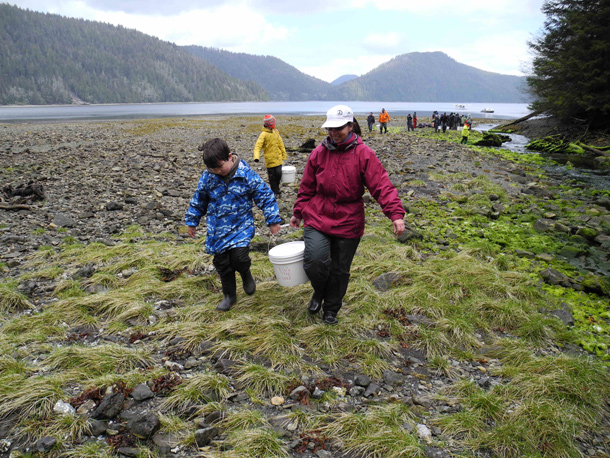
Grade 4 student Markus Carty and teacher Barbara Elduayen, both of Chief Matthews Elementary school in Old Massett, carrying a bucket of salmon fry to the pool where they will be released. Photo by Heather Ramsay.
Twenty-five years ago when the Haida blockaded logging operations on Lyell Island, young protesters took a stand to protect the land for their unborn grandchildren. The protest sparked elders to get involved and the international response led to the creation of Gwaii Haanas National Park Reserve and Haida Heritage Site, co-managed in a unique partnership between the Haida Nation and the Government of Canada. And those future grandchildren? Many are in school, but have never even seen the iconic place that rallied their grandparents.
So while Canada geared up to celebrate 100 years of National Parks, 15 students from schools all over the islands were invited on a day-long adventure into Gwaii Haanas, in the hopes that a new generation would become connected to this isolated part of the archipelago.
Gwaii Haanas is no easy place to get to, not even when you live on the islands. Some of the kids came from Masset at the northern end of Graham Island (one of two main islands in the chain), trudging onto a school bus at 6:30 a.m. in order to meet the others an hour and a half south at the ferry landing for the crossing to Moresby Island (the main southern island). A half-hour on the ferry and then an hour's bumpy ride on a logging road followed. At Gaawu Kuns (Moresby Camp), a wide estuary where Pallant Creek empties into the sea, the Zodiacs awaited.
Eight-year-old Markus Carty, the youngest in the group of Grade 4 to 11 students, bundled into thick rain gear and tumbled into the high-speed inflatable boat. Some of the teenagers refused to wear the wind and waterproof gear. With dark clouds looming out on the water, the adults shook their heads. Even Guujaaw, Haida president and one of the key players in the long ago blockades, tried to get his 15 year-old daughter to wear a slicker or an extra toque.
'Our people kind of got tamed'
An hour later when the boats got to the beach at Lyell Island, he noted a change in the generations that extends beyond teenage vanity. "Our people kind of got tamed. They want to sit around warm and watch television." But out on the land things are different. His gesture encompassed the 5,000 square kilometres of Gwaii Haanas -- both land and ocean protected from mountaintop to sea floor. "If someone wanted to turn off their iPod and live like an old Indian, they could still do it here," he said. "They could live off the land, hunt, fish and have adventures."
This is a key feature of the Haida/Government of Canada co-management relationship -- protecting Gwaii Haanas in the context of a living culture that continues to rely on area.
"That's the standard that we hold [the management of] this place to. As long as there are places for our people to enjoy the culture. And we have to make sure they can do that, whether it is now or in 100 years," said Guujaaw to the children.
With so much wilderness (more than 50 per cent of the islands are protected from resource extraction), one might think that Haida Gwaii students are always out on the land. But not every one has the means or the knowledge to take advantage of the bounty outside their doorstep. Stephanie Fung, education co-ordinator at Gwaii Haanas, said she could tell by the reluctance of some of the kids, whose names were chosen via a random draw at each school, that they weren't used to the idea of zooming across the ocean deep into vast wild spaces.
Across Canada, learning to camp
If Haida Gwaii youth are attracted to activities like computer games and television, imagine the rest of the country. It's this trend, away from outdoor pursuits, that is pushing Parks Canada to get youth enthused about the country's vast array of nationally protected areas. Grade 8 students across the country are offered free parks passes and an upcoming TV show will unplug eight young urban people from their techno-dependent lifestyles and thrust them into the national parks, heritage sites and marine conservation areas for the summer.
A nationwide "Learn to Camp" event aimed at teaching hundreds of participants to pitch a tent and cook over a fire will be held in Victoria, Vancouver, Calgary, Edmonton, Winnipeg, Toronto, Ottawa, Montréal, Québec and Halifax. And last year, 32 university students from across the nation were offered Canada's Greatest Summer Job, spending a season in a National Park and producing a video to document the experience. Sea to Peak by Joseph Crawford, the lucky Gwaii Haanas student intern, was chosen as a finalist in the Banff Mountain Film Festival in 2010.
But the trip to Lyell Island with local Haida Gwaii kids wasn't just aimed at showing off the natural wonders of Gwaii Haanas. The organizers want these future stewards to learn how they can make a difference in protecting or enhancing the area.
'Moving fish is stressful'
Lyell Island was heavily logged in the 1970s and '80s and the openings along creeks caused erosion and siltation, which destroyed salmon spawning habitat due. Parks Canada has been working since 2006 on stream restoration projects in the area and the students were tasked with releasing the first salmon fry into logging-damaged Beljay Creek in an effort to repopulate it.
The eggs were collected in the fall from a nearby creek with a healthy chum salmon population and mixed with milt from males at the local Pallant Creek Fish Hatchery. Meanwhile, the Hecate Strait Streamkeepers, a local stewardship group, sent their Fisheries and Oceans Canada-funded education co-ordinator Jason Shafto to set up tanks at islands schools and gave the first overview of the Stream to Sea salmon program. Later he delivered the fertilized eggs and the students watched the lifecycle of the salmon begin.
Back on Lyell at the mouth of the creek, the fish arrived by floatplane in a big cooler. A special tank injected oxygen into the water to keep the levels safe for the thousands of squirming creatures. "Fish need cool clear water with lots of oxygen," said Shafto to the crowd of eager youth. He'd been back to the schools to collect the fry and then carefully drove them down the island to the floatplane base. "Moving fish is stressful," he told them. He'd had to keep stopping at creeks along the way to freshen the water for them.
With that in mind, the children tried not to jostle their buckets filled with the inch-long fish as they made their way along slippery rocks to a quiet pool farther upstream.
Chum usually head straight for the ocean when they emerge from their eggs, Shafto said, as the buckets were tipped and the fish dashed into the moving water, aiming straight downstream.
Only .5 to three per cent of fry ever make it back to the creek they come from, the children were told, and that's when female fish are releasing hundreds of thousands of eggs into the river.
"We'll meet back here in four years for a barbeque," joked Ernie Gladstone, superintendent of Gwaii Haanas, who was also along on the trip.
He told the students about his memories of the Lyell Island protests. He was about 12 years old when he first came down and got attached to the area. All through his teenage years he continued visiting and he's still working here.
"We're trying to get people like you visiting these places, so that you learn about them and learn about why they are important. I'm hoping when you guys go back today you'll have some of those same kinds of memories that I had and you'll talk to your friends and your family about the experience you've had here and hopefully this will inspire you to do whatever you chose to do in your life."
'So many levels'
Soon it was time for the long journey home. The extra toques went on this time but back at Moresby Camp, the most common answer to what was your favourite part of the trip, was the Zodiac ride. Oh, and the salmon part too.
"Anything that gets them out of the classroom is a good thing," said Barb Elduayen, a teacher at Chief Matthews Elementary School in Old Massett, on the value of excursions like this. "It hits them on so many levels."
Children at this band-run school are lucky. They go on many field trips, sometimes to gather cedar bark for weaving, other times to dig razor clams off North Beach, but Elduayan says a trip like this one brings so many pieces about the history of this place into one. For kids to understand that many governments are working together in their homeland in a cooperative manner is a powerful thing.
According to Fung, Gwaii Haanas plans to offer this opportunity again, at least for the next three years, while funding for the project continues. And that's good news not only for students, but for those who worked so hard to ensure the logging stopped in the area.
One student, at least, felt the impact of Guujaaw's urging for kids to get out on the land. "When you get a chance to come down, come and learn things about the land and learn about who you are. Because it's the land that we come from," said Guujaaw while back on the beach near Beljay Creek.
Young Droughen Moseley, in Grade 7 at Sk'aadgaa Naay Elementary in Skidegate said he dreams of coming down again and camping for several days to see if he can survive. ![]()


14
Login or register to post comments
fish
1 year ago
that amazing world
Thanks, Heather, for a wonderful glimpse of that world. And let's hope the barbeque happens, with songs and dances...
cboo44
1 year ago
Don't forget the reality
That "hour's bumpy ride on a logging road" of access was there because of logging, paid for by logging, not by the taxpayer. In addition, the "successful blockade" of Frank Beban Logging on Lyle Island was a bit of a "set up". Frank was Haida, the logging was essentially coming to an end. The blockade "happened", the logging company was compensated by the taxpayers of this province and everyone lived happily ever after.
Fish-counter
1 year ago
Finally, a real topic for the Tyee, that is not about flowers
I just finished a series of 20 workshops in Bowen Park, Nanaimo, for elementary school children who have raised salmon fry in the classroom. They need to release them into the Millstone River, and we help them do it. Very few of them have even been into the park, even though they live within a few kilometres of it. Very few have ever been into any city park, even though Nanaimo has dozens of them scattered all over the city because Mom and Dad are hostage to Prime Time TV.
Getting back to the outdoors is the subject of Richard Louv's book, "Last Child in the Woods" and it has been the focus of my life for the last ten years.
Even with the best efforts of a few people, children are spending more time indoors, often in front of a screen of some kind.
Many city residents never explore their own home town. They never step outside a limited series of pathways, most often determined by the car they drive. If you put a GPS in you car and set it on 'tracking' for a month, you would be amazed how few places you go in that time. Your tracks will superimpose on themselves, and you will make very few deviations from your daily grind.
We need to get out more, and so do our kids. It is a full-blown crisis, no error. It is not so much a matter of choosing remote destinations such as Haida Gwai. Beautiful as they are, we need to walk through our own city parks more. There is as much wonder in the workings of a leaf as in the journeywork of the stars, and there is as much wonder in Bowen Park, Nanaimo as there is in Haida Gwai. You just have to put your car in "park" get out of the vehicle and WALK.
Thank you, that ends this morning's sermon and don't forget to put money in the collection box.
David Beers
1 year ago
Fish-counter
Why, in complementing the work of one writer because it corresponds with your interest, do you feel the need to denigrate another? I ask this because sometimes the negativity on Tyee threads seems instinctive and without a sense that real people are on the receiving end.
Wouldn't your comment have had a better effect if you refrained from the snide criticism that is off-topic?
For the record, we've run four stories about the fair trade flower industry -- reported straight from the faraway fields in South America, and will run one more reported from BC's own flower industry fields, as part of a series by a writer awarded a Tyee fellowship to write in depth about positive steps being made for protecting the environment and workers' rights. The Fellowships are adjudicated by an independent panel and I am pleased to be able to run the series.
cmac
1 year ago
Getting Kids Out On The Land
I'm sorry Mr. Beers, but I have to disagree with your comment. The stories about flowers in South America were interesting, and very hopeful, but had nothing to do with Canadian children learning about what life is like "on the land". I agreed with Fish Counter (in her actual comment) and what you were disagreeing with was the title. Hardly seems fair as the comment was true and important.
Fish-counter
1 year ago
I apologise Mr. Beers. The Tyee serves a diverse community.
I am all for worker's rights and the global flower industry is a spectacular example of the worst kind of employment conditions possible. We buy the flowers in Canada in all innocence and we do not see the harm they do elsewhere. Those articles are well written and they don't deserve to be denigrated. Please feel free to edit the title of earlier post in this thread to, "Let's get the kids out of the classroom"
That said, we urgently need to focus on the whole topic of the classrooms-without-walls, and getting kids back to nature. It is an urban problem. The school system is not really pulling its weight when they squabble over which schools should be closed, and end up caving in to parental pressures. The Work Experience Program in BC was a victim of such a squabble and its loss was an unmarked tragedy. I passionately believe that there is a need for an elective course in Natural History in the Grades 10-12. such a course would include:
BC Wildlife
Forest Ecology
Stream Ecology
Native vs. Invasive Plants
It would include mornings spent outdoors dealing with invasive plants, followed by an afternoon of classroom work. It will come as no surprise that I run just such a workshop over the school Spring Breaks. They are extremely well attended and they do an enormous amount of good work in our city parks.
We must get the kids back into the woods and creeks, recognising the wisdom of Richard Louv in his book "Last Child in the Woods", a must-read for every teacher and every parent alike.
RickW
1 year ago
Outdoor Classrooms Anyone?
http://news.bbc.co.uk/2/hi/uk_news/wales/8493984.stm
doggone
1 year ago
I too wonder, David.
As another Nanaimoite I did not pick up any negativity in FishCounter's comment but I have noticed that comments and blogs on many sites tend to be reactive rather than proactive. I am guilty of this behaviour.
When I agree with something posted - especially if is a reply to something I have put up - I do not see the point of posting a thank you note. But when an opposing view is posted I find myself inspired!
My theory is that we (certainly I) like to argue: "Never let reality spoil a good argument"
The (relative) anonymity of blogs and comments allows us to just Rant away.
I think this is as good as it get's just now.
OK, I should really read the articles about sources of flowers now.
rybarfoot
1 year ago
a resource
We offer credit based wilderness immersions for student at various age levels. Thanks for taking a look: www.outdoors.sd47.bc.ca
Fish-counter
1 year ago
The one and only drawback to outdoor learning is us.
Having just finished a program of 20 two-hour workshops, I have to say they are very draining on resources. It took two or three people to conduct the workshops, with teachers and parents on hand to keep the kids together.
Understandably, most teachers do not do any outdoor field projects with their kids. Aside from the manpower involved they have to get written permission from every parent to take the kid out of school. No signature on the permission form, no trip; end of story.
Then there is the funding. Just try finding THAT. You see, the three people conduction our workshops are not teachers. Two are students. They have tuition fess in the order of $5,000.00 per year. I am a self-employed fisheries biologist. My vehicle runs on gas, not wishful thinking. We charge a very small fee for our services, which just covers the transportation costs. Try writing 15 invoices for $50.00 each, to be split between three people for a two-hour workshop. It comes down to about $5.00 per hour per person. If professional teachers had conducted the tour at union rates, it would have cost $500.00, not $50.00.
I am sorry to be so down-to-earth, but in the end, it all comes down to the money, you see. A trip to Canada's north is well beyond the reach of all but the most affluent, and it would be better and more appropriate to focus on our immediate surroundings, if only for reasons of accessibility.
In truth, keeping kids in contact with nature is the parent's job. It should not fall on the shoulders of the schools, but in reality, it does because parents are not doing its and we are asking the schools to raise the kids.
If you want to feel first hand the man-made impediments to progress, try applying to a funding agency for support. I am currently working on an other project in the same park. In order to proceed I had to ask the City Parks Department to write a letter of permission from them, to the funding agency, so they themselves can work in one of their City own parks. Read that again, it isn't a typo.
BC is a great place to live, except for the people who live here, and the institutions they have built around themselves to complicate the lives of others.
RickW
1 year ago
And herein lays the major deficiency of our education system:
the real ODB
1 year ago
a beautiful place
I have had the absolutely amazingly good fortune to have spent 10 days sailing around Gwaii Hanaas. Have visited many of the Haida villages and talked with the "Watchmen". Anchored in secluded bays and hiked thru moss covered forests. It truly is a remarkable place. More areas of this Province should be designated with the same protection afforded Gwaii Hanaas. Instead, our always caring, families first, call the Interior the "Hinterlands", business friendly BC LIEberal govt. is taking 10.5 hectares out of another Park for a power line to feed robber baron scumbag mining interests. Good thing BC has the "toughest" mining regulations in the world and that "Industrialists" care. No, they really do! And if you believe that I have some pristine wilderness I'll sell you cheap. Oops, better not let that get out, this is BC after all!
Fish-counter
1 year ago
We have some amazing natural beauty much closer to home too.
I was in Victoria this weekend, for example. We went to Mount Douglas Park. I remember three things:
1. A bag of garbage dumped at the entrance
2. A large pile of lawn clippings about ten feet away.
3. A great big Giant hogweed plant about 50 feet further in.
So Nanaimo is not the only place where the locals dump garbage, then. I thought the people of Victoria were a little more enlightened. Someone should take out the hogweed though before it burns some poor sod.
Other than that, we had fun.
Fish-counter
1 year ago
Aside for the politics we have a huge responsibility to conserve
British Columbia is one of the most beautiful places on Earth. We are SO lucky to live here and we have a responsibility to the rest of ther world to keep it alive.
Anyone who has lived in an industrialised landscape will tell you this. We need to discuss it, to argue for it and to fight to retain as much wilderness and as much wild urban space as we possibly can.
Seeing garbage dumped in Mount Douglas Park is very, very sad. We can do much better than this.
We need to instill the thought that the wilderness and the magic begin at our doorsteps, not hundreds of kilometres away.