- Ms Kaye is a Tyee Builder. You can be, too.
- Mary Carlisle is a Tyee Builder. You can be, too.
- Prem Gill is a Tyee Builder. You can be, too.
- Nancy Flight is a Tyee Builder. You can be, too.
- Justin Everett is a Tyee Builder. You can be, too.
- John Westover is a Tyee Builder. You can be, too.
- Nora Etches is a Tyee Builder. You can be, too.
- Edward Henderson is a Tyee Builder. You can be, too.
- Bharadwaj Chandramouli is a Tyee Builder. You can be, too.
- Dean Chatterson is a Tyee Builder. You can be, too.
- Marius Scurtescu is a Tyee Builder. You can be, too.
- Robert Parkes is a Tyee Builder. You can be, too.
- James Murton is a Tyee Builder. You can be, too.
- Susan Doyle is a Tyee Builder. You can be, too.
- Vincent Strgar is a Tyee Builder. You can be, too.
- Helen Spiegelman is a Tyee Builder. You can be, too.
- Subir Guin is a Tyee Builder. You can be, too.
- Kimball Finigan is a Tyee Builder. You can be, too.
- Joanne Manley is a Tyee Builder. You can be, too.
- David Leach is a Tyee Builder. You can be, too.
Towers on Cambie: Vancouver's Top Planner Explains
Brent Toderian on the city's mid-rise future, thinking in corridors, Goldilocks, and more.
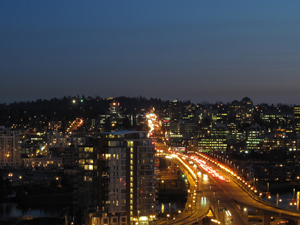
A view of the Cambie Corridor, from downtown Vancouver. Photo by tuchodi, via Creative Commons.
Vancouver is well-known for its approach to urbanism, and using densification towards creating a more liveable city. In reality, however, this popularity is focused on the relatively small area of Vancouver's downtown core and the neighbourhoods immediately surrounding it. Moreover, emphasis is often placed on the city's podium-towers as the future of sustainable urbanism.
The vote Tuesday by city council to approve the Cambie Corridor Plan, allowing mid-rise towers of up to 12 stories along that key artery -- and taller towers at Marine Drive and Oakridge intersections -- shows a different version of what the future may hold. More recent developments in Vancouver outside the downtown core, such as Olympic Village, have successfully deployed a mid-rise urbanism, and the Cambie Corridor Plan builds off many of the lessons learned from such projects, instead of the renowned downtown peninsula.
Recently, I conversed with Vancouver's director of planning, Brent Toderian, about the Cambie Corridor Plan, and what it means for the future of Vancouver and the City's approach to urban planning. Here is a condensed version of that discussion (with a longer version found here.)
Erik Villagomez: This is the first time since 1928 that a large area of the city, spanning multiple neighbourhoods, is attempting to be planned comprehensively. Can you talk about how it differs from past approaches that focus more on developing small pockets of the city individually?
Brent Toderian: "It's true, the Cambie Corridor work represents the largest and most complex area planning exercise -- crossing several neighbourhoods and involving a significant intended transformation over time -- that we've ever undertaken outside of the central area. I've also suggested that the corridor will eventually become the third most significant area of complex urbanism in the city, after the downtown and the Broadway Corridor.
"Originally, the planning department had conceived the work program along Cambie Street as a series of station area plans, and that would have taken a long time -- six to eight years in total -- to do one at a time. Not only was that approach lengthy and time consuming, it also, to my mind, thought about the street and transit line in the wrong way. It didn't think about the corridor as a corridor, but saw the corridor as a series of individual areas. And it didn't necessarily think about change along the corridor in the areas in between the stations. From my perspective, you don't have to choose one or the other, you can do a corridor approach that recognizes the transit-related commonalities and consistent principles along its length, but also recognizes the unique identity of the station areas.
"And that's what we've done -- a corridor approach that also breaks the corridor into distinct neighbourhood areas, each with their unique identity."
Do you see this type of large-scale approach to city planning that you took to Cambie Street as something that will be happening more frequently in the future?
"Well, absolutely. We're seeing the corridor work as a way of significantly educating ourselves around transit-oriented planning, in general, across the city. A way of moving from 'being a bit behind' in this key aspect of city-building, to being right on the cutting edge, a new North-American 'best practice'.
"And as we conceptualize this corridor, we're thinking ahead about how it relates to the entire corridor structure of the city. That's going to serve us well once we move into doing a new physical plan for Vancouver -- something that's been called for over the last few years, and I'm very keen to initiate. So, the corridor program is a bridge, if you will... This plan signifies for us a new definition for success -- the robust integration of land use, transportation and energy.
"Further beyond that, our corridor thinking worked very hard to integrate a number of factors -- from affordable housing aspirations, social diversity, jobs and community amenities to public realm design, economic analysis and infrastructure. There were a number of interests and disciplines that we fully integrated in this process into a holistic urbanism. That's where we want to be."
In a city known for its podium-towers, can you speak to how and why, in the plan, the dominantly mid-rise built form was decided upon as being the "right" choice for the corridor?
"Vancouver has gotten a great deal of attention for its podium-point tower building type, but in truth we've been doing mid-rise forms very well for years along our corridors, like Broadway. I tend to think of specific projects like The Rize and Crossroads, at the corner of Cambie and Broadway. We have as much innovation in our mid-rise form as in our high-rise form, and possibly even more, but the podium-point tower tends to get all the attention.
"What we've done in the Cambie Corridor program is build on the success of those mid-rise prototypes: particularly, building on the urban form success of Athletes Village -- the Olympic Village -- and we're translating that into a predominant urban form for the city. Vancouverism 2.0, really.
"What we're talking about is a clarity that the majority of the transformation of the city in the future, outside of the central area, will be in low- to mid-rise forms. That the tower form will be the exception, not the rule. It will be strategically used in places, like right at key station areas and on special sites within neighbourhood centres.
"So even in our neighbourhood centres, the dominant forms will be low to mid-rise with towers being the exception.
"The point is, the majority of the pattern of change will be in the low- to mid-rise. Low-rise densification in the context of the single family blocks -- what I call 'gentle density', in the form of rowhouses, laneway houses, etc. Along the primary corridors, mid-rise of various scales, anything from four stories up to 10 stories depending on the character of the corridor. So we're still talking about very ambitious density, but avoiding that automatic assumption that density will be in the form of slim towers on a podium everywhere.
"That's a transition for us because our development industry, and even the marketplace, has come to expect that densification will mean towers with views. I often hear that's what sells in Vancouver, that's what the market expects. On the other hand, our mid-rise projects do very well in the city. They can be more sustainable. They can even be more affordable, and they are more acceptable to the public, who tends to be more negative to height than they are to density. So if we can provide clarity on where towers will be, and by definition where they won't be, that helps with our entire discourse on densification in the city.
"So (along Cambie), we're making the point that the majority of the built form is mid-rise. Only at Marine and Cambie, and at Oakridge are tower forms contemplated. The rest is four- to six- to eight- to 10-stories."
What were the pressures to take other approaches, and can you discuss the motivations behind these different approaches?
"Well, there have been times through this process where I've joked that we feel like Goldilocks and the three bears: where some people are saying the porridge is too hot, and some people are saying the porridge is too cold. Some of the public is saying that the densities and heights are too high, particularly around some key locations where they'd prefer that the area around transit stations remain relatively unchanged -- remaining as dominantly single detached housing. And then others have asked, 'Why aren't there more towers? Towers are the assumed built form, so why are we going against that assumption? We should just have a corridor of towers, or at least have more towers at stations, because that's what the market knows how to build and that's what the market expects.' So, you see what I mean... the porridge is too hot, or too cold.
"But increasingly, I think, as we've had this discourse with the public and shown the urban design performance, the sustainability performance, the affordability performance, etc., we're getting more and more people saying the porridge might be just right... And that form is not a false choice between single family houses and podium-point towers. It can be in many other forms that provide us the density we need -- to lower our carbon footprint, to enhance our affordability and sustainability, etc., -- without the polarizing effect of the fear of tall towers everywhere within the neighbourhoods."
Do you mind elaborating on what you see as the future of Vancouver's urban form?
"I think Vancouverism 2.0 is going to be a range of housing types for a range of different challenges and contexts. We have challenges of artful densification in single family neighbourhoods. We have both a local and regional market that appreciates ground-oriented units, and so ground-oriented densification has to be part of our strategy. Not everyone wants to live in a high-rise or even a mid-rise, so for ground-oriented forms I've created terms like "gentle", "hidden" and "invisible" density, in the past -- secondary suites, laneway houses, rowhouses, duplexes, etc. With these forms, we can double or triple the population density within single-family neighbourhoods, while still keeping a compatible urban form with the single-family housing.
"You know, the truth is that 'single-family lots' are no longer single-family lots. That isn't really accurate anymore, because many of those single-detached lots have a secondary suite in them, and now a laneway house. So, there could be three families living on that lot, even if you don't factor in the cultural family structure nuances. So, you can triple the density on the single detached lot in terms of population. Or not... you might just return the population density to what used to be there, because we know there are fewer people living on single-detached lots these days, with fewer people per household.
"So, whereas a single detached lot may have had a family of five in the past, perhaps it went down to a household of two. But then the secondary suite brought someone else back and the laneway house may now has a couple living in it. So now maybe you're back to five. Maybe you haven't densified beyond what it used to be, but perhaps have returned the density to what it was originally. Hopefully, there are kids present in at least one of the units so that the local school stays open.
"So, we've looked a strategic densification in different places and come up with different strategies, and the key message is that it's not a one-size-fits-all."
Can you tell us what is going to happen after the Cambie Corridor?
"We do have standing council direction to develop a city-wide plan, a "Plan Vancouver" if you will, and it essentially starts with -- and respects -- the results of CityPlan and the various Community Visions and area plans. It would also seek to address both our city-wide needs and regional issues, not the least of which are the pressures of sprawl on agricultural and industrial lands. But it would not do all this at the expense of the "city-of-neighbourhoods" concept that is so important to us. It would provide greater clarity around what physical change can and should look like across the city, because the more clarity we can provide in the context of a shared vision, the less we'll have debates on a project-by-project, proposal-by-proposal basis, when everybody is concerned about a project setting a precedent.
"But as you can imagine, you don't do that exercise unless you are able to do it properly and successfully. It will take the right resources, it will take the proper mandate, and I'm hoping to see that materialize in the next few years."
The Cambie Corridor Plan can be downloaded at the City of Vancouver website. ![]()


24
Login or register to post comments
snert
1 year ago
Let's get this straight.
Densification does not produce a "more liveable city". Population control might.
Grumpy
1 year ago
The Canada Line..................
........is the fulfillment of giving developers a $2.5 billion subsidy to build high rise condos and apartments.
The rail for the valley folks have another take on Vancouver's densification policy.
http://www.railforthevalley.com/latest-news/the-sunday-supplement-essay/
http://www.railforthevalley.com/latest-news/zweisystem/vancouver-considers-higher-density-housing-plans-for-cambie-street-corridor-have-we-given-land-developers-a-2-5-billion-subsidy/
With much cheaper light rail, one doesn't need to densify a transit route, yet light rail still retains the ability to carry large volumes of customers.
Our SkyTrain/light-metro obsession is really a land development obsession, with metro the excuse for massive land redevelopment.
It seems our UBC/SFU trained planners can not do anything else but, which is a very sad comment on the state of the planning faculties of both universities.
freebear
1 year ago
What are the limits to Vancouver's growth?
Will anyone acknowledge any limit?
Water?
Food?
Affordable?
The best thing that could happen (unfortunate the loss of human life and suffering) to Vancouver is an earthquake.
So it can be re-designed and rebuilt; it is not sustainable in it's current form and planned future!
Macb423
1 year ago
disagree
"Densification does not produce a "more liveable city". Population control might."
I must disagree with this. I live in the "densified" West End. I have also lived in Boston, Philadelphia, Seattle, Santa Cruz, Tokyo and Bangkok. The West End is the most liveable of all of these, BY FAR.
This is a good plan and is of course a work in progress over the next 20 years. It deserves our support.
pwlg
1 year ago
Cambie Corridor
It should come as no surprise that the Cambie Corridor was due for higher density redevelopment.
The 1991 study looking at providing an urban rail system to Richmond examined all southern corridors and found Cambie the best bet for redevelopment purposes. Note that transit wasn't the primary reason for Cambie's selection as an urban rail corridor to the south.
This was reinforced almost a decade later when the creme de la creme from Arbutus, the NPA financial backers, shut the door on developing the CP Arbutus Corridor for an at grade urban rail line.
In fact, early in the 1990's a Vancouver Magazine produce an article with colour drawings showing high rises and a downtown feel to Cambie.
It is interesting to note that during the early days of finding private funding for the RAV (Canada) Line, SNC Lavalin found two "private" partners to assist in the private funding of the line. Both of these private funders were actually public investment companies, trustees, investing public sector pension funds. One of these funders just happens to own Oakridge and Richmond Centre shopping centres. They will not only receive a premium for their capital investment for the Line but will also gain by government assisted planning that adds value to their land.
Booker
1 year ago
Planning
I do hope that they don't back down on having housing in the Cambie corridor for lower income Vancouverites. We need more rental housing in the core of the city.
It's unfortunate that the suburbs continue to sprawl in mostly low density developments that make mass transit impossible. When it starts costing $150 to fill your gas tank we are going to have a lot of stranded communities in the Lower Mainland and Fraser Valley and their property values are going to plunge.
Crass
1 year ago
I could never understand why
I could never understand why Vancouver's planners were so obsessed with building 'podium towers' in Vancouver. Of all places, do you really want to be living on the 20th floor of a tall skinny building that will sway violently back and forth for 3-5 minutes when the BIG earthquake hits. Do you really want to be the guinea pig who's family is going to demand an inquiry as to why so many podium towers fell when the BIG ONE hits (and it WILL HIT).
Fish-counter
1 year ago
Bring on the podium towers! Bring on The Big One!
I want to see them fall! Bring on the liquefaction in Richmond and Delta! The simulations I have seen were awesome, with power poles and homes sinking into the mud. Personally, I can't wait to see the video. If we survive, that is.
snert
1 year ago
Macb423
Sorry but a front and back yard will beat the west end any day of the week. You can keep telling yourself that they don't but that won't make the west end any more liveable.
zalm
1 year ago
booker
"I do hope that they don't back down on having housing in the Cambie corridor for lower income Vancouverites. We need more rental housing in the core of the city."
Unfortunately, all the low income housing on Cambie already exists - all those pre- and post-war apartments, nice spacious suites with postage-stamp kitchens, most of them upgraded with insulation and double-glazing now, all rented (prior to 2005 when the Big Dig decision was made) for as low as $475 a month for a bachelor and $750/month for a 1 bedroom.
As I watched the rental real estate market at that time (having at that time envisioned myself a landlord), I saw the price of older apartment suites like this in the Cambie corridor which formerly (2004) ranged from $105-130,000 per suite double in less than 18 months to $220-245,000 per suite. Higher, even than the Granville and W. Boulevard corridors! All because "the train" was coming. Never mind that the current rents made any kind of debt service on the buildings totally unsustainable at those prices, they sold like hotcakes!
Some traded hands back again when a few "business" people found out that you simply can't raise rents beyond all reason for modest old places - nobody will move in.
Rents are less affordable now - the 1-bedrooms are over $1100. The Knight-Clark corridor is now the new "affordable" for "low income". Just don't count on any services or good schools in the nieghbourhood.
the real ODB
1 year ago
what the ????
Low to mid rise has been the norm in Europe and GB for decades. Nothing new there. And after it's said and done, how are these new residences going to get around? The Canada Line? What a joke! It's already packed to the rafters. Thanks to the Public Pirate Project, the Pirate, in cahoots with the LIEberals decided to eliminate stations and shorten the stations in order to bring it online "on budget and ahead of schedule". What a joke. Unfortunately, it's a bad one and it's on us. A 2 car train is not a train. It's an elongated bus on tracks.
DTUC
1 year ago
Olympian success?
Both Toderian and Villagomez consider the Olympic Village (now imaginatively renamed "The Village" for marketing purposes) a success? In what way is "The Village" a success?
Toderian also mentions "signifying a new definition of success" and a "holistic urban plan".
Will this plan include solutions to the housing affordability and stability crisis?
Can we consider mid-rise apartments that will be built and then bought and then speculated on -- but not lived in -- part of our density plan?
"What we've done in the Cambie Corridor program is build on the success of those mid-rise prototypes: particularly, building on the urban form success of Athletes Village -- the Olympic Village -- and we're translating that into a predominant urban form for the city. Vancouverism 2.0, really."
aranhil
1 year ago
A front and backyard = livability?
I still don't see why everyone seems to be saying no to density. I hear way too often that people think high rises and the West End are not livable options. Why do you prefer a front and back yard? I grew up in the densest part of Kitsilano and never lived in a detached house for all my life. I simply cannot understand why you'd think it's livable to have to start your SUV just to go get groceries or a cup of coffee. Density means walkability; it means having work, school, shopping and entertainment within easy reach. It also means more efficient sewage, water, electricity, and heat. A family living in a single detached house requires the city to spend more money on building water and electricity infrastructures than a family living in an apartment. If they were taxed in perfect proportions to the maintenance they require, many families would have to move out. It's a simple reason why detached housing is not affordable; it is not sustainable. We have new immigrant families moving into brand new detached houses in Coquitlam and Surrey on a daily basis, at the cost of using our precious land in a low-efficiency manner. If ten of them lived on top of each other rather than behind each other, how much space would we be saving? How much of that land could have been used for food production and restoring nature?
Then why not just control population, you ask. That is not an option for this world we live in. If Canada, one of the most sparsely populated countries in the world, puts a cap on population growth, the rest of the world might just as well perish. Population control is an issue for the whole world; closing the gates to our city is not going to help.
So to all of you, whose definition of livability only includes your own yard to play catch, I urge you to think again. High density can be livable.
John Greg
1 year ago
the real ODB
said:
"The Canada Line? What a joke! It's already packed to the rafters.... A 2 car train is not a train. It's an elongated bus on tracks."
I know it is slightly off-topic, but I am amazed, gobsmacked, and speechless that this has gotten so little attention. A rapid transit line with absolutely no space for train/car expansion?!? Unbelievabley stupid; simply unbelievable.
Tornto's subway, built in the 40s, still had room for train/car expansion in the 90s, 50 years after the initial build. The Canada line? Overloaded from the very first day it ran. Un-friggin-believable stupidity.
snert
1 year ago
aranhil
But density does not mean liveability. Maybe if you had lived in a detached home with a front and back yard you might understand. I have lived in high density dwellings and feel qualified to make the the judgment call.
And they pay way more for the privilege of using those services than a renter.
Sorry, but if you think high density housing is sustainable then I feel for you. There are limits to everything and all high density housing does is prolong the inevitable.
I'd venture to guess that a goodly number of them have had lots of experience with high density housing in the past. You might want to ask them why they are not living the sustainable life, now, if it's so desirable?
Remember what I said about prolonging the inevitable. We are under far less pressure in Canada. Let's not over think ourselves into emulating the rest of the world just because of the twisted notion of "sustainability" which has rapidly become the most over used buzz word of the 21st century.
zalm
1 year ago
The Canada line did its job
The only purpose of the RAV line was to promote real estate development along its corridor. Its purpose is not to move large numbers of people, nor to reduce the amount of traffic coming into town on a daily basis.
Wot?
Yes, this has to be repeated again and again until everyone gets it. Rapid transit in Vancouver is only a driver of real estate development toward higher density. Each line takes more than 5 years to plan and build, during which more than 30,000 cars are added to the roads. Each of the Millennium and RAV lines took approximately 18,000 cars off the road. Net cost: $4 billion plus unnamed future operating costs. Net result - an increase in traffic of 24,000 cars over the ten year PDB (plan-design-build) period, and no room for future expansion.
There are lots of better ways to move people, but none of them make real estate so valuable to existing landholders on the corridors as fancy technology does. It's not surprising governments fall for this old trick every time. Merely another reason to rethink taxation of capital gains on land ownership and development. Heavily.
Fiat lux
1 year ago
It will be interesting to
It will be interesting to see how that multitude will be fed in the case of any emergency in a landlocked city with no way in or out?
We've lived in Vancouver from 1955 to 79, when it was still a very pleasant place, but my wife hasn't been back since 1980 and I since 1988, when I had to deliver something.
We're horrified when we see that dump of humanity, surviving in pigeon holes, in the news and have no intention ever to set foot into it again.
Ed Deak.
Bobby Peru
1 year ago
Missing the Point
All of these densification plans are just estranging many of us from the Vancouver we once knew as kids, the small city or big small town. Vancouver will never be the same again because of these planning bureaucrats who think dense condos are the answer to the future. I get the feeling that most of them are environmental activists, anti-capitalists, granola crunching, painfully thin vegan bureaucrats who want to eco-inconvenience all of us into abandoning our cars and living their dream of cloned lifestyles.
No wonder so many flocked to the Herzog exhibition of classic Vancouver images. Many of us miss the past when this great city wasn't inflicted with environmental zealots in power.
Vancouver and the Lower Mainland simply don't have enough money to build enough public transport- especially light rail and subways to make it convenient enough for people to get around to most places. They think by not building more highways and roads they can coax the rest of us to stop driving. They don't realize that many of us need our cars and trucks given the poor rainy weather most of the year.
Instead we just keep hearing about more condo zoning in a Vancouver which is losing many businesses to the suburbs. So many people living in Vancouver are commuting outwards. Most of us in management jobs can't afford to show up wet and sweaty after riding a bike or walking out of the subway. Have any of these planners actually tried to make some of the Skytrain and bus connections?
Grumpy
1 year ago
Thank you Zalm...............
...........could not have said it better myself.
Except, there is no evidence that the Canada line has taken many cars off the road!
As the cars have infra-red passenger counters (10% to 20% error margin), TransLink roughly knows boardings numbers. but take this into account.
35,000 former bus riders (401-2-3-4+B-Line; 601-2-3-4-20 South Delta buses; 301-11-51-52-54; South Surrey @ Cambie St.)
This number adds up to about 70,000 boardings (in and out)
10,000+ YVR employees who drive to work and ride the Canada line for free on Sea Island from employee parking lots to work.
This number adds up to over 20,000 boardings.
Multiple trips on Sea island (free) and U-Pass students - up to 5,000.
This accounts for 10,000 boardings.
We are now at 100,000 boardings with the rest made up of new riders to the Canada Line, approximately 4,000 people, with about half one way traffic to YVR.
Joseph Jones
1 year ago
"Character of the Corridor" Means – Trash East Vancouver
Director of Planning Brent Toderian says: "Anything from four stories up to 10 stories depending on the character of the corridor."
Enamoured of the corridor concept, Toderian could not allow Norquay in the heart of East Vancouver to have the neighbourhood centre that was being "planned" – or at least, was in the works before he came along to trash CityPlan. As of last November, Norquay gets a neighbourhood strip instead. And planners have the gall to call what they have done up a "village"!
Policy has already judged the character of our Kingsway corridor to call for imposition of the maximum 10 stories. (The first new development application now proposes 12 storeys.) Thus will our neighbourhood get bisected along an entire mile by merciless height.
In other words, take an area that has already done far more than its share in accommodating density, treat it like crap, and proclaim "revitalization."
The term corridor has lovely military connotations – and so suits a planning agenda that favours the automobile over anything else, including people.
formula80
1 year ago
No respect for current Official Community Plans
I am not against an increase in density, just against certain types of higher density forms that don’t fit with the existing neighbourhood, don’t respect the current Community Plans and don’t achieve the more sociable, walkable, complete neighbourhood goals the city SAYS it is trying to accomplish.
Townhouses, Rowhouses and Laneway houses fit the neighbourhood, a more sensible approach to achieving higher density instead of a wall of 4-12 storey apartments on a few prime EAST-WEST blocks near the RAV station. It makes NO sense to have a 4 storey apartment building on King Edward street 2 or 3 blocks away from the RAV station, but limit 24th Ave (starting right across the lane from the RAV station) to small, 2 suite, 2 ½ storey duplexes.
Increasing density in a circular footprint and spreading it out over the entire 500 meter “walking zone” around a station, with a tiered concept in mind that would NOT situate single family homes and 4-12 storey apartment buildings back to back, but still get the same density increase, should have been the goal, but instead, they used a finger or “t” approach on just a few blocks.
It’s not just about density, it’s that the city wants to achieve it by building towers and large scale complexes favoured by large development companies and generate CACs for city coffers. This is not good urban design.
There is NOT a lot of support for this plan. According to raw data taken from the latest open houses the city held regarding the Cambie Corridor plan, 75% of respondants supported only 3 storey townhouses or lower.
The Cambie Corridor density plan was rammed though, ripping up and throwing out the RPSC Community Vision Plan in the process. This Official Community Vision Plan was not old (adopted by city council in 2005) and was not outdated because it had already considered the RAV line. 4-6 storey apartment buildings were NOT SUPPORTED and WOULD NOT BE BROUGHT FORWARD FOR CONSIDERATION. Official community plans are supposed to provide certainty to residents and the city planning department as to how the area will be developed and are supposed to last 20-30 years.
Community Vision Plans now have NO worth... after millions spent on these exhaustive public processes, they aren't even worth the paper they are printed on. This message should be heard loud and clear by the West Point Grey, ARKS and Mt. Pleasant neighbourhoods that all have had their Community Visions recently adopted by city council.
My wife and I read the RPSC Community Vision from cover to cover before we started our renovation and thought we could rely on it as we made a major monetary and life decision. We will shortly be across the lane from a 6 storey apartment building.
This was a developer driven plan to capitalize on prime west-side property right from the start. It was a sham of a planning process, with only a guise of public consultation. Vote against Vision Vancouver in November.
aranhil
1 year ago
NAYSAYERS OF DENSITY
snert:
It seems that this comes down to an issue of value and preference. You prefer the backyard, while I value the high density convenience. You don't believe we can achieve sustainability, I do. It's obvious on this thread that I am the minority here.
Snert, I think you could say many people didn't choose sustainability, but chose affordability. Prices in the city today are no where near affordable. Leaving Cambie the way it is will not solve that problem. I agree with formula80 in that high density developments that "don't achieve the more sociable, walkable, complete neighbourhood goals" would end up disastrous. That's why we need to strive for better urban planning.
But most people here are naysayers of density. I understand now that the simple reason for that lies in the difference in our ideals. (I realise, after reading Bobby Peru's ramblings above on densification as a tool for bureaucrats to estrange old-timers, that these differences are in fact huge.) Reading these comments, I have learned that the core of zoning controversies is really about backyard vs. common garden, driving vs. transit, suburbia vs. the inner-city. Here rapid transit is perceived as real estate promotion, while UBC students perceive it as the future promise of getting to class on-time (and they are bullied by the NIMBYism of 2-million dollar homeowners on the west side). Fine. It's perfectly fine that we have our differences. But I'd like all of you to know that there exists a population like me; there are people in their twenties, who grew up in a more recent Vancouver, one of global urbanism, of high-rise dominated residences, of schools staffed by hippie environmentalist teachers, of multicultural transit-users. Of course, we know that Vancouver used to be a quiet small town, we know our history. But we are the post-Expo inner-city kids. Tall buildings make up the hometown we knew, monster homes are what estrange us. That's why this is a fight between suburbia and the inner-city. We might be out-numbered, but we will never back down.
gfhjkjfhgj
1 year ago
good
Wonderful.
Share a website with you ,
==== http://mcaf.ee/6e4ac =====
Believe you will love it.
wuwu22336
1 year ago
bdsg
===== http://www.fashionclothe.com ====
Air jordan(1-24)shoes $30
Handbags(Coach l v f e n d i d&g) $30
Tshirts (Polo ,ed hardy,lacoste) $15
Jean(True Religion,ed hardy,coogi) $30
Sunglasses(Oakey,coach,gucci,A r m a i n i) $15
New era cap $12
Bikini (Ed hardy,polo) $20
===== http://www.fashionclothe.com ====