
When Convention Centre Opened, Inspector Had Safety Concerns
Reports reveal worries about fire preparedness as premier ushered in the public.
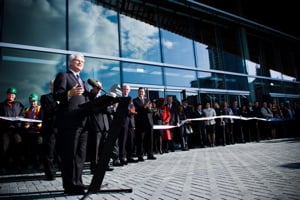
Premier Campbell at April 3 ribbon cutting.
On April 3, Premier Gordon Campbell cut the ribbon at the expanded Vancouver Convention Centre, calling the building a "spectacular facility that will drive economic activity for years into the future."
For two days following the opening, the convention centre remained open to the public for tours, with 26,000 reportedly visiting on the Saturday alone. Reports quoted visitors saying they were impressed with the building and believed it money well spent, despite being far over budget.
Now, documents obtained from the City of Vancouver show the building was far from ready for permanent occupancy and inspectors were worried about fire preparedness. The Tyee received the documents through a freedom of information request.
Certain conditions needed to be met before opening the centre, wrote Kevin To, an official with GHL Consultants Ltd. The company had a co-ordinating role to make sure the appropriate professionals looked at different aspects of the project.
"We note that this conditional use described above will only take place from April 3 - 5, 2009 and is not considered a permanent occupancy," said To in the March 30 e-mail. "The subject floor spaces are still considered construction zones with no construction activity while opened for the proposed uses. Remaining work will resume after April 5, 2009."
That conditional approval allowed Campbell, along with federal cabinet minister Stockwell Day, to open the convention centre five weeks before the May 12 provincial election and just 11 days before he visited lieutenant-governor Steven Point to call that election and officially launch the campaign.
B.C. Pavillion Corp. president and CEO Warren Buckley, however, said the city of Vancouver had issued a partial occupancy permit 17 days earlier on March 13. "You're run through the fine tooth comb of compliance by the time you get your occupancy permit," he said. "You're safe when they issue the occupancy permit."
Fire worries
To's March 30, 2009 email to convention centre and government officials noted managers proposed opening the harbour concourse to the public and the service corridor to centre staff between April 3 and 5. "GHL will only support this request if the following is achieved prior to the opening event on April 3, 2009," he wrote.
To wanted temporary fences, or hoarding, to block any construction areas still being worked on, and signs and hoarding anywhere there was access to terraces where the guardrails failed to meet the building code.
There was also a need for "acceptable trained operators at the main fire command room," he said, and whenever there were more than 800 people in the centre there would have to be an "acceptable trained operator of the firepump. . . present at the firepump."
To also wanted the managers of Canada Place to make sure there was "an acceptable fire watch plan" prepared for the event, that the sprinkler system for the area that would be used would be "fully operational and monitored" and the smoke control systems would be working and able to be controlled manually.
And he wanted the managers to put emergency lighting in any areas without windows, noting the proposal and the approval were only for using the building during daylight hours.
Kevin To no longer works for GHL and could not be reached by posting time.
Inadequate protection
To had reason to be concerned about fires. "The Fire Department responded to an alarm on Monday, March 23, 2009," said an April 13 report prepared by GHL's Joseph Krevs based on site visits made on March 26 and April 2. "Security personnel had a difficult time operating the fire alarm system and locating the area of the alarm."
Present for the visits were city building inspector Art Burch, Tim Atkinson from VCCEP, architect Jacques Beaudreault, Danny Zima from PCL Constructors Westcoast Ltd., and Teddy Lai from GHL, the report said. After GHL raised the issue about the alarm, convention centre management made a plan to train the security workers how to use the fire alarm system, it said.
The eight-page April 13 report lists at least three dozen areas that still required action, plus others that had recently been completed.
The report listed several places that required fire stopping that would prevent the spread of flames if a fire broke out. Places where wires, cables and pipes came through walls needed particular attention, it said. "Penetrations shall be firestopped," it said. "Penetrations . . . should contain one large fire stopping system. The concern is the small pieces of gypsum that are inserted to fill the gaps between the services will not provide adequate protection."
The contractor had used the same incorrect system repeatedly, the report found. "It is noted that this occurs in other locations throughout the project. All are to be corrected."
'No one . . . present at the pump'
Similarly, fire spray, which slows or prevents materials from burning, needed to be re-done in some places. In others, covering flammable materials needed to be completed. For example, "Foam insulation in the south wall where the ducts penetrate the floor slab is exposed. All foam insulation should be covered with drywall, or acceptable fireproofing is required."
In some areas there were concerns about what would happen if there was a fire. In one of the restaurants, the report said, "Sprinklers . . . are very close to the structural steel." That would have to be fixed, it said, so the water could cover the area. "Sprinklers will be required to be relocated so that there are no obstructions."
There was also concern about having enough space to attach fire hoses. There might not be space to get a wrench in, the report said. The contractor agreed to add adapters to provide more space.
Other concerns included a threshold that was too high that "may be a trip hazard", an incorrectly placed exit sign, an opening in an exterior wall and a place where "there is a large space between the escalator and the window." The gap should be no larger than four inches, the report said.
An April 20 report, based on an April 15 site visit, said: "A person is required to be stationed at the backup fire pump when the occupant load is greater than 800 until the [Pressure Reducing Back Flow Preventer] is installed, verified and is satisfactory to the CoV Plumbing Inspector."
That wasn't happening, however, the report found: "Today's occupant load is greater than 800; however, no one was present at the pump."
Within weeks of the opening, a six-inch pipe burst, flooding some 8,000 square metres of the centre.
A May 27 report noted there was at least one other place where plumbing might be a problem. "Large pipes in east serivice corridor . . . is not in contact with the supports," it said. "It also appears that the pipes have shifted and are not in line with the supports. Adjustments are required."
Even two months after Campbell opened the convention centre there was still much work to be done. At least two dozen items required action by either building contractors or convention centre staff.
A June 8 report, based on a June 3 site visit, said the building needed an updated fire alarm verification report, a building code requirement to ensure the alarm system is working and audible. In one place, the report noted, the fire alarm speaker had been taped over. The tape was subsequently removed, it said.
Various places required firespray to be replaced, fire stop still needed to be redone in places where pipes and cables penetrated walls and there were concerns that builders had attached drywall to wood in some areas, a fact discovered after the water damage. "Combustible material shall not be used in fire rated separations," the report said. "All drywall shall be supported by steel studs."
The centre's calendar lists five meetings that used the facility in April, the first starting on April 7, five that used it in May and five more in June.
Safe to occupy
Much work remained to be done as of the opening, said PavCo's Buckley. Some door locks were being replaced, work was being done on escalators and there were some chipped paving stones, he said. But all the major work had been dealt with and none of what remained would have affected safety, he said.
"You're safe when they issue the occupancy permit," he said.
Asked about the reports detailing the need for things like fixing fire stopping and attaching drywall to steel supports, he said, "They were highlighted to us and we were given a conditional permit to occupy the building."
Knowing the people who issue the permits, he said, if there was any danger, "They wouldn't have issued the permit."
Art Burch, the Vancouver building inspector responsible for that area of the city, said most large buildings open with a list of things that require work. "Any large building isn't going to be 100 percent complete," he said. "An occupany [permit] isn't the city saying the building is 100 percent complete or the permit is full. It's saying it's safe to occupy."
Fire spray and fire stopping tend to get damaged during construction, he said, and can be fixed. "Those are relatively minor items." The backup fire pump now has an enclosure that meets the building code, he said.
Work on the convention centre will likely slow or stop during the Olympics, he said. "The finalization of the project is, guessing, a year and a half or two years off," he said. "It's another project still in progress."
Campbell: 'It's breathtaking'
If Campbell knew at the time of the opening about To's safety concerns or the work to be done, you would not know it from his April 3 Facebook entry about the opening.
"Without any exaggeration, this is a truly an iconic building for British Columbia," he said. "I hope everyone comes down during the open house to see this . . . Pictures don't do it justice; it's breathtaking."
The original $495-million budget for the project ballooned to $883 million by the time the expanded convention centre opened. The federal contribution was capped, leaving the province to pick up the nearly $400 million overrun.
A 2007 Auditor General's report suggested last-minute building changes and a rush to meet a tight Winter Games deadline helped costs balloon, the Tyee reported.
The project, which broke ground in 2004, added 111,500 square metres to the centre's capacity, the province's press release said. It added a large exhibit hall, a ballroom, 52 meeting rooms and a "living roof" with a bee colony.
The convention centre will be used as the media and broadcast centre for the 2010 Winter Olympics. ![]()


23
Login or register to post comments
jrb
2 years ago
well ...
... it looks pretty nice from the outside.
Gary
2 years ago
Life and Limb
So let's get this straight. This SOB in Victoria, along with a raft of inspectors, allowed the general public into an area of great danger for a political, pre election photo op.
Anyone knowing that these concerns were there, including the contractors and inspectors had a duty to shut down this political photo op. Why didn't they?
alive
2 years ago
put the blame where it belongs!
As with most buildings each contractor has only a specific job to be concerned about.
When given the opportunity he will do his job in what appears the most effecient way, and perhaps make the job for the next contractor more difficult.
All because there never is an overall detailed plan!
Architects get away with simplistic plans that never directs how or where any trade must do their job.
Hence it is often a race to get in first on a new project so you can find the easiest way to get your specific task done, and to heck with the other trades!
I have had the opportunity to closely follow the building of several similar houses in a new development, and one would think they are identical, but in fact they differ in substantial ways because of the lack of a proper plan and schedule.
I feel that Architects are paid to create designs that are fully functional, meaning that every wire, pipe or duct must have a designed route that takes everything else into consideration.
In our society Architects have become fashion conscious, and concentrate on creating "stunning visual designs" but completely ignore how they can be build in actual fact.
Our cities are full of examples of structures that need rebuilding within a few years for various reasons.
David Beers
2 years ago
Gary
Our story doesn't say there was 'great danger' at the convention centre. It does point to a report where an inspector had raised concerns and asked for special measures to be in place during the days it was opened to the public, and then further fixes.
Van Isle
2 years ago
Gee, hope nothing goes wrong
Gee, hope nothing goes wrong when the olympics is on. Think of all the negetive reporting when you have a building full of foreign press, (as if our mass-media will say anything).
Kam Lee
2 years ago
gordo photo ops
Safety will never stop this madman. There are so many other "re-dos" all over the lowermainland. The new skytrain to Richmond has some of its concrete redone because of below standard concrete. Workers were scared for the many people that would travel on the then dangerous lines. The answer was to rejig it, at a great cost. Lets see if the MSM can find it in the budgets. Won't happen, cause gordo is in charge. campbell is a scoundrel, get him and his yes men out!
realisticman
2 years ago
A Sienfeldian Tale
This is not really a story. Just listen to the Vancouver Inspector.
"Art Burch, the Vancouver building inspector responsible for that area of the city, said most large buildings open with a list of things that require work. "Any large building isn't going to be 100 percent complete," he said. "An occupany (sic) [permit] isn't the city saying the building is 100 percent complete or the permit is full. It's saying it's safe to occupy.""
GreenEngineer
2 years ago
To Alive
While you may think that Architects "have a duty" to produce fully detailed and coordinated documents for a building, the reality is they don't. They can only provide documentation to a level that the Client is willing to pay for. The building design industry is based on obtaining fixed fees for design work - so fixed fees = fixed scope of work, if the business has any hope of continuing. Thus, over the last few decades of this (most of this lean and mean mentality started after the big recession in the arly '80's), the building design industry became more and more about getting documentation "just good enough" to meet minimum Code and Building Permit requirements, and off you go.
While the layman may think that a building "built to Code" is of good quality, this is far from the truth. "Built to Code" means the design and the building meet MINIMUM standards for health and life safety. There is little in the Building Code that requires "quality". And given the fixed fees, and lowest price Tendering/Bidding practice we use to procure contractors, guess what happens....just as Alive has stated - a race to the bottom.
G West
2 years ago
Green Engineer
Excellent point...and the reason why some of us just don't bother working professionally in the field in which we were trained any longer.
I've seen more design colleagues 'fail' than succeed and end up in bankruptcy - often more than once - when they take their 'responsibilities' too seriously.
Isaac
2 years ago
realistic man is correct
...this is NOT a story. I am no fan of Gordon Campbell and his bulls**t, and race to squander our money on his pet projects, but this is a cheap shot. The implication of this piece, presented in a sensationalist way, is of some kind of impropriety in allowing an "unsafe " building to be occupied, and that the public is put at risk. The fact is that every large and complex building will have a long list of deficiencies that will be documented (usually by all of the many, many professional consultants) and eventually addressed in one way or another by the general contractor and many sub-contractors. The city inspectors are generally fully aware of what the issues are, and they, along with the life safety consultants, use their professional judgement when allowing conditional occupancy - it happens all the time, and is standard in the construction industry. I see in today's news that the roof leaked after yesterday's heavy rains - too bad, but lets not start any conspiracy theories over that either...
G West
2 years ago
Fire safety issues
Fire safety issues are not 'trivial'...perhaps the quibblers above haven't READ the story.
This, for example:
Furthermore, the 'point' of the article is also directed to the reality that the re-election agenda of the Premier appears to have TRUMPED THOSE SAFETY CONCERNS.
I think that's a damn fine reason for the article...and those who disagree appear to like the push-me pull-you kind of place British Columbia is turning into...
That, I'd suggest in the most respectful way, is the real issue here...and it's neither nit-picking nor trivial to have pointed it out...
This was not a question of moving occupancy ahead for a GOOD reason - but advancing it for a purely selfish and POLITICAL one.
Get the point now?
Well done Tyee!
GreenEngineer
2 years ago
What Isaac said
There are a lot of buildings around town that still don't have a "final" occupancy permit, and are still deemed safe enough to occupy and be open to the Public. Any large building will have a lot of clean-up deficiencies to deal with, and it's a matter of how much effort the design team puts into policing up the Contractors.
One thing to note in the current Construction Game is that we see a lot of "construction managers" running projects these days, and so there is no "one" General Contractor running the show as a single point of responsiblity any more. The CM takes on that role for a fee, and attempts to corral the hundreds of sub-trades on a jobsite to try to get a building built. There are no more "master builders" left, they've all retired.
Remember - every building is "Model #1, Serial #1", so this isn't the production of widgets. The complex design and coordination required even for a fairly simple commercial building is multiplied by a factor of 10-100 as the building project grows larger and more complex.
alive
2 years ago
someone HAS to be responsible
sorry green engineer, if there are no Master builders around, then perhaps new ones are overdue?
We see examples of oversights all the time, and since noone is responsible for the overall construction and design, then it is another blame-game that gets whitewahed away and insurance companies pay for.
If million and billlion dollar projects cannot afford to pay for proper supervision to ensure that the final products is acceptable, then why bother in the first place?
Why pretend that we get value for our monies, if it all is about getting away with minimum or less?
Perhaps it all started when out esteeemed premier was major of Vancouver?
dave49
2 years ago
I had a tour
I toured the building in May. Nice building, but worth nearly a billion dollar? No is the answer.
Will we ever get answers as to the outrageous cost over-runs. Very doubtful.
By the way, how much did that extra-clear low-iron glass cost, anyway?
GreenEngineer
2 years ago
For Dave49
You might also want to ask about the expensive water treatment plant they have there to get a couple of the Canadian Green Building Council LEED Credits. It is supposed to take a lot of the sewage water waste and treat it to re-use it for toilet and urinal flushing. I understand it was started and commissioned, but now sits idle due to the cost of operating it, as well as some of the technical challenges it presents to the building operators.
I learned a long time ago that sustainable buildings adhere to the K.I.S.S. principle, and avoid techno-solutions where possible.
Low Iron clear glass is great for visible light performance (good clear views), but glass is a poor insulator, and it takes a whole lotta heating and cooling to maintain any kind of comfort inside the building next to all that glass.....a whole lotta heating and cooling = a whole lotta energy being used, no matter how efficient the heating and cooling plant may be. All that efficient heating/cooling plant represents is a more efficient pump to keep the water out of that screen door on the submarine.
The Blackbird
2 years ago
It's all good!
If a fire had started before the required work was complete, Premier Campbell had a perfectly good plan in place. (Sorry, I looked for a Tyee link to this story, but came up empty.)
http://network.nationalpost.com/np/blogs/posted/archive/2009/04/27/vancouver-s-900m-convention-facility-evacuated-after-leak-causes-flooding.aspx
Bob Watts
2 years ago
Who Knew!
My smarter brother (The Engineer) years ago pointed out that whenever a public project is being built it has cost overruns. During Expo 67 in Montreal they poured the foundations for the Habitat buildings without putting in the pipes, costing millions in cost overruns. Anyway in the private sector buildings are built for the contracted price, if not the contractor is out of business. Ever seen a government worker being paid minimum wage???
Van Isle
2 years ago
Seems that not too many
Seems that not too many people remember 'Cave-on-Foods', ooops sorry, Save-on-Foods collapse and the aftermath. It was the high minded and brilliant engineers who orchestrated that fiasco. Who did they blame? At 1st some tried to blame the tradespeople then finally a minor engineer at the bottom end of the food chain.
Lifeguard
2 years ago
PavCo Safety
Crown Corporations are above the law. BC Place allowed ice to accumulate on the Teflon fibreglass membrane for 15 years. This was contrary to established Birdair safe work procedures to ensure zero accumulation of ice on the roof. These safety concerns were ignored and covered up, and resulted in the 2007 collapse of the roof.
Was the BC Roof ever certified by an Engineer?
NicS
2 years ago
@ Green Engineer & Green Building Council LEED Credits
It is telling how anything with "Green" attached to it costs more, but that doesn't always mean better or more energy efficient. The good honest public believe that the powers that be must be doing the right thing with all this green being splashed about. But hey, if you get the grants for greened toilet water and you don't install the system, who gets to keep the grant $'s?
A recent article in the NYTimes,
"Some Buildings Not Living Up to Green Label" certainly says something about how the building industry has managed to greenwash themselves without actually doing anything. Whether anything will be done to correct this problem remains to be seen. "Will You Lose LEED Certification for Poor Energy Performance?"
mary jane
2 years ago
deaf and ?
Is this another case of idiots at work? gordo and his gang don't care about anyones safety. Drunks don't care about their own so why give a darn about anyone elses. Cut backs in seniors care, welfare, which equals food for kids, health care, education, build repairs to schools, homelessness, rail gate, romper rooms for gov employees, so why care about a showy building to impress the world?? But those of us who live in BC aren't impressed are we?? He insults us every day and he is still there. He is not even smart enough to know he isn.t wanted
RickW
2 years ago
A Trend?
http://www.cbc.ca/fifth/2009-2010/riding_on_risk/
zalm
2 years ago
You think this is a problem....
...you should see what doesn't work or is badly built in our new hospitals.