News

The Meltdown, Seen from Below

What union leaders, labour experts and anti-poverty activists say needs to be done.

By Tom Sandborn, 3 Nov 2008, TheTyee.ca

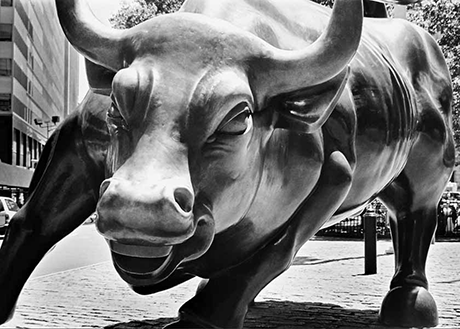
Bull statue on Wall Street.

Now that bullish turned out to be bull...

As the global financial meltdown spreads to threaten General Motors and even the Euro, financial experts in well-tailored suits vie in the news media to frame how we arrived here and what should be done.

Their debate tends to be about just how many billion of dollars need to be delivered to banks and other financial institutions to keep the good ship globalization afloat. From quarters such as the conservative Fraser Institute, we hear that government is to blame for intruding into the market, and so less regulation is the cure.

Here at The Tyee, we noticed that most of the commentary on our Titanic dilemma seems to be coming from the passengers in first class and the government navigators who helped create the crisis. We were curious about how it looks to the crew and the passengers in third class, so we made some calls to union leaders, anti-poverty activists, and various economists and historians who make it their business to study big business without being part of the action.

We heard voices saying that Canada and the world economy need increased social services, expanded public infrastructure investments and restored regimes of strict regulation for banks and investment houses. And we heard much skepticism towards bailout programs perceived to have so far rewarded the folks who created the crisis.

"The bankers seem to have forgotten one of the most serious commandments, 'Thou shalt not steal,'" said Sister Elizabeth Kelliher, a Franciscan nun on Vancouver's gritty Downtown Eastside.

"We need government action to set and enforce a living wage," she told The Tyee. "The government should immediately fund new social housing."

'A great unwinding'

Kelliher, who operates a soup kitchen that feeds between 300 and 500 of the city's most poverty stricken each day, says she is already seeing the results of the financial crisis as desperately needed donations to sustain the feeding program are beginning to dry up. So while the crisis may mean diminished RRSPs and pension funds for many of us, it could already be generating thinner soup and smaller sandwiches for the city's hungriest citizens

Andrew Jackson, director of social and economic policy for the Canadian Labour Congress, agrees with Elizabeth Kelliher that the Canadian government should be making massive new investments in social housing, as well as many other areas of infrastructure.

"What we're seeing here is a great unwinding of the current system," he said. "We are headed into a major downturn, and Canada should be putting at least $10 billion into infrastructure projects right away. We need to get out of the casino and into the real economy that channels savings into new production."

The CLC has just issued a paper on its response to the current crisis titled "Global Capitalism: On the edge of the abyss." The paper says the global economy is now "almost certainly headed for a deep and prolonged recession," and notes that global markets have already fallen as far as they did in the Great Crash of 1929.

The labour group blames deregulated global finance for the crisis, pointing to what it calls "the unregulated shadow banking system of investment banks, hedge funds and private equity funds," and decrying the creation of "fiendishly complex and sometimes outright fraudulent products." The face value of these highly abstract and uncertain financial instruments, the paper notes, was recently estimated at over $50 trillion.

The CLC paper quotes Nouriel Roubini, professor of economics and international business at the Stern School of Business at New York University: "The crisis was caused by the largest leveraged asset bubble and credit bubble in the history of humanity.... a housing bubble, a mortgage bubble, an equity bubble, a bond bubble, a credit bubble, a commodity bubble, a private equity bubble, a hedge funds bubble are all now bursting at once in he biggest real sector and financial sector deleveraging since the Great Depression."

The CLC paper calls on Canada to play a role in creating a co-ordinated international response to the crisis that features re-regulation of both local and cross-border transactions and the imposition of a small transaction tax on all securities trading, including commodity futures. This Tobin Tax, named for the Nobel Prize winner who first suggested it, is designed to discourage short term speculation and to raise the government revenues that will be necessary to fund appropriate investments in social services and infrastructure repair.

Bail out tied to regulation

While many critics of the official response so far are asking why so much money is going into the banks and finance houses that created the crisis, the CLC endorses some bail-out activity as necessary to avert a systemic collapse. The bail out money must come, it cautions, tied to effective regulatory rules.

The CLC wants Canada Mortgage and Housing to re-finance distressed Canadian home mortgages at lower rates, dismissing the view that Canada is not experiencing a housing bubble as a myth. The $10 billion a year in new infrastructure investment the CLC calls for, says the paper, would create 200,000 new Canadian jobs rebuilding roads and bridges, mass transit projects, water works and the like as well as replenishing the country's diminished stock of social housing. A public letter recently signed by 80 prominent Canadian economists has echoed this call for an active and interventionist response by government to the economic crisis.

Further corporate tax cuts should be cancelled, the paper argues, in favor of direct government support for new investments in machinery and equipment, research, development and training.

Even if all these reforms are put into place, says the CLC paper, Canada may well experience serious increases in unemployment, which will expose weaknesses of the Employment Insurance program. Far fewer workers are eligible for EI as it now exists than was true in years past, and maximum rates and time allowed for coverage are both inadequate, according to the paper, which calls for broadened eligibility, higher maximum payouts and longer terms of coverage for the unemployed. The EI system currently has a surplus of over $50 billion.

Call for new pension protection

The CLC paper predicts the current financial crisis will create a severe pensions crisis, and a follow-up paper issued on Oct. 29 calls for the creation of a new pension benefit insurance scheme (financed by the proposed tax on financial transactions) to insure annual pension and RRSP benefits for individual Canadians up to $60,000 a year.

Pensions are a concern for Bill Saunders, too. Saunders, the president of the Vancouver and District Labour Council, says that Canadian workers and their pensions are more exposed to risk during market trouble because of the successful campaign over the past decades to move from defined benefit pensions, which guarantee a certain monthly amount when you retire, to defined contribution plans, promoted by market enthusiasts.

Contribution plans shovel a defined amount every month into mutual funds and other stocks, creating pension payouts that can vary widely depending upon the health of the market, as many Canadians are discovering this year as their RRSP holdings have shrunk dramatically.

"Twenty years ago," said Saunders, "60 per cent of Canadian private pension plans were defined benefit. Now that share has been cut in half. Defined contribution plans just don't deliver the goods for workers the way defined benefit plans do, and the current crisis illustrates that."

Deficits and ideology

Marc Lee, economist at the Canadian Centre for Policy Alternatives, a progressive Vancouver think tank, says that government action on the reforms suggested by labour will be hampered by ideological objections to running deficits in bad times.

"In Canada, we're haunted by the deficits of the '90s. However, in times of recession, you want government to run a deficit. If you try to avert deficits in times like these, you get pressures to cut services, which would only make the problem worse.

B.C. Finance Minister Colin Hansen has predicted the global meltdown will strip billions from provincial government revenues. Lee says that's no reason to punish the poor, in fact, it's bad economics.

"We need to use income transfers like EI and social assistance to channel money to people who will put it back immediately into the economy. We should increase welfare rates by 50 to 100 per cent and increase EI replacement rates to 75 per cent. We should also be gearing up public infrastructure projects, especially ones like mass transit that advance other important agendas like reducing green house gas emissions," says Lee.

'Job creation is vital'

The union and anti-poverty activists who spoke to The Tyee for this article were unanimous in echoing calls from the CLC and the CCPA's Lee for increased infrastructure and social spending in Canada. Jean Swanson, a veteran of decades of anti-poverty work in Vancouver, noted that the only up side she could see to the crisis is that it might possibly slow down the "luxury condo hurricane" she has seen crowd out needed new social housing in the Downtown Eastside. Swanson backed the calls heard from others for increases in welfare and EI rates, and expressed hope that some of the bail out money could go to creating new housing and infrastructure.

Gary Kroeker, president of the BC and Yukon Building Trades Council and business manager of Operating Engineers Local 115, says his members are already seeing big construction projects cancelled and postponed. Like Wayne Peppard, the council executive director, Kroeker told The Tyee that part of the solution to the current crisis lies in robust new investment in public infrastructure.

"Job creation is vital," said Kroeker. "We can't let the economy go to hell in a handbasket.

"We have to make Keynesian investments in the future," said Peppard.

Barry O'Neill, president of CUPE BC, wants to see some of those Keynesian investments made at the local level. He told The Tyee that local governments are currently the most progressive in Canada, and the ones closest to their citizens and taxpayers. O'Neill advocates robust infrastructure investments, and he would like to see more tax money controlled locally to focus on local needs and job creation.

"We should be doing more on import substitution and local production, and on investments that will keep money in the local economy," he said.

Kids, women to bear brunt?

Darryl Walker, president of the BCGEU, says his members are worried and want more money to go into public projects and smaller communities. They are confused and angry about the economic crisis, he said.

"Somebody has squandered and wasted billions of dollars," he said, "and Campbell is throwing darts at the wrong dartboard."

Irene Lanzinger, president of the BC Teachers Federation, echoed the call for public investments and stricter regulation of banks, and added particular concerns about schools, women and students.

"B.C. has the highest levels of child poverty in the country," she noted. "Why can we find millions for tax cuts and bank bail outs and not enough for kids?"

She said that increases in poverty always had serious impacts on B.C. students, and on women, who continue to make lower average wages than male workers.

"Downturns always hit women harder," she said. "We haven't yet made the progress we need."

Judy Darcy is another union leader who serves a primarily female membership, and they are telling her they are very worried about the future.

"We're not seeing job losses yet, but there is a lot of generalized angst among members," the secretary treasurer/business manager of the province's Hospital Employees Union told The Tyee. "We'd like to see all health care facilities pay their workers a living wage, and we'd like to see the current mantra that all new infrastructure be build with public private partnerships revisited. We've argued for a long time that these privatizing deals don't make sense, and now, with the credit crunch, P3s are a ticking time bomb and a threat to public infrastructure."

Marjorie Griffin Cohen, who teaches political science and women's studies at Simon Fraser, says that the economic crisis will have serious impacts on women.

"The private sector will be a bloodbath for women and, if the crisis is prolonged, the pressure for service and staffing cuts in the public sector, where women have some significant union protection, will grow. At my university, we've already had announcements that 30 faculty and 50 support staff will be cut, and these are likely to be mainly women."

Like many of the other union leaders we consulted, Darcy says that her union will continue to organize aggressively during hard times, noting that the HEU has successfully signed up workers at most of the health facilities where the Campbell government has contracted out support services.

Re-training a high priority

Saunders and BC Fed president Jim Sinclair both pointed to the need for more worker education as one component of organizing drives in hard times.

"The challenge for our movement is to establish a new alternative vision, and to protect workers," said Sinclair. "We want to see programs that educate and re-train workers and more support for apprenticeship."

The Vancouver District Labour Council is sponsoring a local public appearance by Canadian Auto Worker economist Jim Stanford in January, Saunders said, and an ongoing study group based on Stanford's new book, Economics for Everyone.

Stanford told The Tyee that one of his policy priorities would be more emergency aid for the real economy of production, as opposed to banking and finance.

"Do you let North American auto companies go down? I don't think so. We need a return to a Canadian industrial policy. The past three years have been terrible across manufacturing. Things could get much worse if manufacturing crashes altogether. And when we put public money into companies, we should demand a quid pro quo, make it an investment, not a bail out."

Militancy reborn?

In the last Great Depression, one of the responses to a worldwide collapse of capitalism was the emergence of new and more militant unions. The Tyee asked the folks contacted for this article what the prospects were for another such upwelling of popular resistance.

Jim Stanford says the crisis may well be an opportunity for labour.

"There are huge risks here," he said, "and huge opportunities for a fight back. We could see dramatic changes like the 1930s. We'd need to see ambitious, militant organizing to lead to such a renewal, but it could happen."

"When times are bad, movements get re-born," Griffin Cohen observed. "I don't see any new militancy emerging, at least not in B.C., but big cuts may lead to resistance."

Mark Leier teaches labour studies at SFU and has a special interest in the Wobblies, or IWW, a hardcore militant union active at the beginning of the last century. He agrees that the current crisis represents an enormous challenge and opportunity for organized labour.

"Nothing happens automatically, though," he cautions. "It all depends on labour's openness to new ideas and strategies. The crucial message of unionism is that we need to help each other."

Guest workers take a hit

Leier says it would be a mistake for unions to wait for the laws to change. Militant struggle is what leads to more pro-labour legal changes.

"We would have to combine the rebel energies of anger, discontent and joy with the institutions that are already in place in the movement," he told The Tyee. "You can't rule out any tactics out of hand, for example, a general strike. We just don't know now what would work. We have to continue to push for legal changes such as sectoral bargaining and at the same time stay active in the streets."

Another way that the current crisis hurts those at the bottom of the economic ladder was revealed in a conversation with Lucy Luna, a United Food and Commercial Workers union organizer among immigrant farm workers in the Fraser Valley, who notes that the reduced value of the Canadian dollar means that the remittances sent home to Mexico by the "guest workers" shipped to Canada under a federal temporary work permit program are now nearly cut in half in value by the time they reach Mexico, where the economy is geared to the U.S. dollar.

Luna also predicted that farm owners will continue to lobby to expand the guest worker program, citing economic pressures to justify access to even more cheap labour from abroad.

SFU's Leier mused that the fast-shifting landscape may change the way people think about their own identities, and their relationship to the people running the economy.

"The idea of class has been kicked out of people's heads," he said. "Maybe one result of the meltdown will be that we re-discover class."

Related Tyee stories:

 [Tyee]

42  Comments:

  • ME2

    02-11-2008

    No revolution, not yet.

    But are we revisiting "Class Struggle"? Sure, though it never really went away. It's just been cleverly papered over with consumerism, while our ruling elites busied themselves figuring out ways to neuter those pesky Socialistic ideas which are fostered by Democracy.

    Unable to control their greed, they blew it, and now they're trying to figure out how to get us spending again without having to give back what they stole, or it costing them any money.

  • Frank

    03-11-2008

    Good article

    Thank you for this, nice to hear from those with interesting opinions instead of the usual right-wing nonsense of how the poor have too much money and the rich not enough.

    By next May even people like Carole James might be looking too right-wing.

  • PatrickMcEvoyHalston

    03-11-2008

    But what nastiness does our collective unconscious want?

    There are those who believe that if there is a depression and it most adversely affects the weak (i.e. women and children), that it would be doing exactly what the broad population (unconsciously) wants it to.

    Right now I'm thinking specifically of Lloyd DeMause's psychoanalytic explorations of what societies tend to do after periods of economic growth, and of his general belief that most of us (having been the recipients of too much maternal miscare) are under the rule of "internal persecutory alters" that drive us collectively into trance states where we seek out/create those who could able serve as "poison containers" for our own unwanted feelings of helplessness and abandonment. These alters seek out children specifically, because children can easily be made to represent our internal striving selves. They seek out women, because women can represent the Mothers who hurt and abandoned us.

    Crazy? The left used to be all into psychoanalytic thought, and looked at the broad populace, not so much as misinformed, but as quite foul and crazy.

    What to do? Maybe less rather than more attention to how recessions affect women and children. Our collective unconscious might be salivating . . .

  • Fiat lux

    03-11-2008

    Rupert Murdoch's

    Rupert Murdoch's speech.......

    Getting the public ready for microchip implants ?

    Interesting that the world's governments have just bailed out, or at least are attempting to, the bankrupt "free market" system, to the tune of some 5 trillion, that would have put food on the table of all the starving for years to come, but their propagandists are still demanding less and smaller governments.

    And, of course, our politicians are jumping to their demands.

    Ed Deak.

    http://www.news.com.au/heraldsun/story/0,21985,24590176-662,00.html
    ======================================

    To: sunrise
    Subject: Goldman Sachs at work

    Forwarded without comment,

    Ed,
    ===============================================================

    http://www.dailymail.co.uk

    Goldman Sachs is on course to pay its top City bankers multimillion-pound bonuses - despite asking the U.S. government for an emergency bail-out.

    The struggling Wall Street bank has set aside £7billion [approximately $14 billion] for salaries and 2008 year-end bonuses, it emerged yesterday.

    Each of the firm's 443 partners is on course to pocket an average Christmas bonus of more than £3million [$6 million].

    The size of that pay pool comfortably dwarfs the £6.1billion [$12 billion] lifeline which the U.S. government is throwing to Goldman as part of its £430 billion bail-out.

    As Washington pours money into the bank, that cash will immediately be channelled to Goldman's already well-heeled employees.

    END EXCERPT

    Yes, you read that right. Four hundred and forty three top executives in a firm that is receiving 6.1 billion dollars in emergency aid from American taxpayers are EACH being rewarded with THREE MILLION DOLLAR Christmas bonuses!

  • HawkEyes

    03-11-2008

    Locally, some were wondering

    ...why 300 million Americans weren't simply given a million dollars each?

  • Wilfred Laurier

    03-11-2008

    A larger approach

    This kind of "report" is nothing new. It has been going on for as long as I can remember but there are a few things to consider.

    1. Guaranteed Annual Income. This was first proposed by Robert Stanfield. It is still a good idea. I would peg it at $1000 a month, taxable, for all people earning less than $50,000 a year. It has been partially stared with the CCTB but it needs to expanded to be universal

    2. Real supports for homeless. This is a rub and a difficult issue for the left. A significant portion of homeless are severely mentally ill and require institutional care. For lower income families, now is the time to build low income units as property prices tank.

    3. Economics. Left wing think tanks have all the solutions to everything. Said tanks are invariably staffed by well to do grad students or wealthy socialists like the Klein family. Let business do business. They are good at it.

    4. Understanding one thing doesn't fix all. To make this kind of programme work, all levels of government must cooperate. The Guaranteed Annual Income has to be federal and uniform across the country to discourage migration.

    5. Drug education. There has to be more everywhere. On billboards, on TV, in magazines, in schools. Again, the Feds have to take the lead.

    Well, there is my dream list. With Harper in Ottawa, little will change in my opinion.

  • jnewcomb

    03-11-2008

    NO!....to environmentally-damaging infrastructure!

    All this talk of building yet more concrete-and-steel infrastructure, whether as P3 or public, is going to be another way of destroying the environment. In Victoria, the Chamber of Commerce is positively giddy over the thought of seeing a $1.2 billions mega-sewage scheme in the city (with the inflow of $800 millions of fed and provincial support). However all this additional new infrastructure is not going to make any positive difference to the marine environment, but will be paving over more of our urban community. So, no environmental benefits, but huge environmental costs. Sounds like some weird Keynesian nightmare. UGHHH!!.....

  • biscotti

    03-11-2008

    Seen from Below?

    "Here at The Tyee, we noticed that most of the commentary on our Titanic dilemma seems to be coming from the passengers in first class and the government navigators who helped create the crisis. We were curious about how it looks to the crew and the passengers in third class, so we made some calls to union leaders, anti-poverty activists, and various economists and historians who make it their business to study big business without being part of the action."

    Sorry to quibble, but with the exception of Sister Elizabeth Kelliher, I don't think most of the people quoted in this article are travelling 3rd class. Union leaders may not be steering the Titanic, but their income levels put them a few decks above a lot of people.

  • Luke Skywalker

    03-11-2008

    Labour Militancy?

    Quote:
    Militancy reborn?

    Quote:
    In the last Great Depression, one of the responses to a worldwide collapse of capitalism was the emergence of new and more militant unions. Jim Stanford says the crisis may well be an opportunity for labour.

    Quote:
    "There are huge risks here," he said, "and huge opportunities for a fight back. We could see dramatic changes like the 1930s. We'd need to see ambitious, militant organizing to lead to such a renewal, but it could happen."

    Quote:
    "When times are bad, movements get re-born," Griffin Cohen observed. "I don't see any new militancy emerging, at least not in B.C., but big cuts may lead to resistance."

    One should learn from more recent history:

    BC - 1982/1983... double-digit unemployment, high interest rates, government revenues falling over a cliff... BC literally in a mini-depression.

    Post-May, 1983, BC government imposes some severe cutbacks with its restraint program.

    Operation Solidarity/Solidarity Coalition is born... huge protests ...50,000 show up at Empire Stadium...

    But by the fall, 1983 a frontpage Vancouver Sun public opinion poll showed public support for Operation Solidarity at just 19%.

    That same public opinion poll showed the NDP in last place at just 23% and the NDP were worried that they were being usurped by an extra-parliamentary opposition movement.

    Premier Bennett hints at a snap election call... and then...

    Quote:
    The whole thing ended in a whimper with the so-called Kelowna Accord, agreed to in mid-November, 1983 by Bennett and then-forestry union chief Jack Munro. Labour got what it wanted, but the community activists were shut out, thus sowing seeds of disunity on the left.

  • CH

    03-11-2008

    BS

    I call B.S. on

    "... and notes that global markets have already fallen as far as they did in the Great Crash of 1929."

    Nice fear mongering!

  • G West

    03-11-2008

    CH

    Depends upon your measuring stick.October 1929 saw a fall in the DJA of about 35%...In one week this October the Dow Jones industrial average fell over 1,874 points, or 18%, in its worst weekly decline ever on both a point and percentage basis.

    If you take the DJA at the end of 2007 and compare it with the closing at the end of that week, the decline certainly qualifies as being worse than 1929...but, viewed from a different perspective, the Depression was much worse and the DJA didn't actually hit bottom until July of 1932 and when it did, the total loss of value was in the neighbourhood of 89%.

    So, it all depends upon what you're talking about - restricted to the 1929 example, I'd hardly say the contention was BS.

    As to where we're going....time will tell.

  • Fii

    03-11-2008

    Don't even get me started on this topic

    Women have to stand up for themselves more. Part of the reason we make less is because we give in more easily and don't demand what we are worth. Not sure why that is, but at the same time, if women manage their money well, how much you gross isn't as relevant as what you do with that money.

    Education is key. Round up every 8 yr old girl (and boy) in this country and start drilling into them the importance of saving and investing (sound too young? My dad was lecturing me on the topic when I was about that age~ often zoned out of course, but at some point in my mid 20s it sunk in). Once you make little girls undertand that it makes more sense for them to buy an Economist magazine in their teens, rather than spending their part-time job money on Vogue and cosmetics, and over-priced clothing and bags, I'm guessing there will be a lot fewer women out there "very worried about the future".

  • CH

    03-11-2008

    G West

    Fair enough. I agree from a time perspective the declines are similar but it just seems like a bold statement to throw out there.

  • Neighbour

    03-11-2008

    Wouldn't look to unions for answers

    "Sorry to quibble, but with the exception of Sister Elizabeth Kelliher, I don't think most of the people quoted in this article are travelling 3rd class. Union leaders may not be steering the Titanic, but their income levels put them a few decks above a lot of people."

    Thank's for this biscotti. I was thinking the very same thing myself, so it's worth repeating. I don't believe the unions are blameless in the crash of the manufacturing industry either. There's greed on every side of that issue.

    Does anyone remember how to make stone soup?

  • biscotti

    03-11-2008

    Where militancy will come from, or not...

    --most welcome, Neighbour ;-)

    I don't know of any union leaders these days who'd be willing to risk jail to take direct action in the hope of bettering conditions for their members, let alone for the general public.

    On the other hand, anti-poverty activists and advocates for the homeless are much more prepared to take risks. Not always effectively, perhaps, but very active nonetheless.

    Yes, lots of rocks available where I live. Dead pines, too! Could be a new recipe and story...

  • Palharry

    03-11-2008

    Try This

    Where is all the bailout money going?

    -- against this backdrop, little relief is being proposed; where it's most needed; so beleaguered homeowners can keep their properties; to struggling households to stimulate demand; not for toxic assets or to fund giant bank acquisitions; what Alan Nasser reported in his article titled "The Bailout Lie Exposed;" that big banks won't lend out their windfall; that New York Times economics reporter Joe Nocera confirmed from an employee-only recording of a JP Morgan Chase conference he secured; that the bank will use bailout funds for acquisitions; leveraged buyouts; with public money; for assets at fire sale prices; courtesy of US taxpayers; for further consolidation; a multi-generational tradition; to crush competition and grow monopolies; with both presidential candidates on board; assuring reduced social spending and no return to enlightened New Deal policies when they're most needed.

    No I'm not an avatar of Fiat Lux

  • David Lewis

    03-11-2008

    labour hasn't one clue

    I don't see anyone in the group of crew and passengers on third class you consulted who mentioned anything about any worry they had that a planet near by might be in an advanced stage of being killed, except for Marc Lee from the Canadian Centre for Policy Alternatives.

    Food for thought: The Titanic sunk. It wouldn't have helped the ram the iceberg at full speed situation if steerage passengers and crew got more food and more comfortable beds in the days before the ship hit the iceberg.

  • anne cameron

    03-11-2008

    hang onto your hats

    It isn't going to matter one little bit whether the third class passengers get garlic bread with their soup.

    It's the fourth and fifth class passengers will suffer the most.

    And it doesn't matter what the captain says or the crew does, the good ship Capitalism is on the rocks. They'll try to raise her and refloat her with a few more invasions, a few more bombs dropped, a few more rockets launched, more blood in the streets, more children maimed and killed...and it isn't going to solve a thing.

    Remember Monty Python..this bird is dead. dead dead dead!!

  • DPL

    03-11-2008

    http://www.raesidecartoon.com

    http://www.raesidecartoon.com/today/

    Nobody was in charge then and nobody is in charge now.

    Depends upon your measuring stick.October 1929 saw a fall in the DJA of about 35%...In one week this October the Dow Jones industrial average fell over 1,874 points, or 18%, in its worst weekly decline ever on both a point and percentage basis.

  • zalm

    03-11-2008

    Un-ion or un-informed?

    Boy, there's a whole lotta noise about what unions are or are not doing. Yet, every time unions try to do something for those who aren't their members, like fight for more accessible university tuition, spend money inside the country on infrastructure, health care or education, level the playing field for those of different races or orientations, then they're accused of meddling and told to butt out and go take care of their members.

    It doesn't stop them - most unions I know devote from 2-10% of their budgets to organizing the unorganized and another 5% or so to social justice issues. Most unions I know ensure that their members who want to run for political office have a job to come back to when they've done their job in the Legislature or Parliament; when the work week is set back to 40 hours from 70 or 100, when overtime is no longer free for the employer, when medical care is accessible to all, even if it isn't quite as well funded as one might hope, and when the statutory and summer holidays that even die-hard capitalists all seem to take are enshrined in law, for ALL people to enjoy, not just union people.

    So you think, don't many union working people have it pretty good now? Haven't companies and governments have learned that it's pretty difficult to push around an organized group of people, so they don't much try any more? Sure, some do - they're pragmatic about sharing the facts of business, to see how both can work to make it better, and share the wealth. But it isn't always a successful process, though it's a helluva lot fairer than it was a hundred years ago. But you never hear about the little stories, how some unionized workers are still suffering discriminatory treatment and substandard wages or find their pension plan has been all used up by the company's operating budget instead of providing for retirements.

    But you can't fix Rome in a day - the Libertarian barbarians have been pounding the capital with their economic cannon for more than 70 years now so it's not surprise there are still a few gaps in the system. Destructive lot, them Ayn Rand types...

    At least Canada's not like Iran, Columbia, China, Chad, or any of a hundred other places in the world where union leaders regularly go to jail, are killed or are disappeared for standing up for not only their members' rights, but the rights of all people. Including you.

    Thank goodness for that. Eh?

  • AMP

    04-11-2008

    don't comment, get out and protest

    use this time to write letters and call the government. we need all hands on deck.

  • murdock

    04-11-2008

    Amen Fii

    Education is key. Round up every 8 yr old girl (and boy) in this country and start drilling into them the importance of saving and investing (sound too young? My dad was lecturing me on the topic when I was about that age~ often zoned out of course, but at some point in my mid 20s it sunk in). Once you make little girls undertand that it makes more sense for them to buy an Economist magazine in their teens, rather than spending their part-time job money on Vogue and cosmetics, and over-priced clothing and bags, I'm guessing there will be a lot fewer women out there "very worried about the future".

    AND KEEP DOING IT!

    http://www.secretsofthemillionairemind.com/a/?wid=668544

  • ME2

    04-11-2008

    Zalm

    Thanks for that excellent post, Zalm.

  • James Burns

    04-11-2008

    Garbage

    Round up every 8 yr old girl (and boy) in this country and start drilling into them the importance of saving and investing (sound too young?

    That sounds like indoctrination into a religion.

    But investing in what? The stock market? Mortgage derivatives? Wage slave factories in China?

    The link you provided Murdock is selling pure bullsh*t. It's even marketing a conference called "Never Work Again". What utter garbage. The only people making money are the website owners, by selling "the emperor's new clothes" - a whole lotta nothin'. To a "T" that mind set is exactly what has caused the problems the world economy now faces.

  • biscotti

    04-11-2008

    Class and militancy

    For sure many unions do lots of effective work and there are many fine people in their ranks and leadership. No argument about that. But let's not delude ourselves about who might spark a rebirth of militancy, and let's not pretend union leaders are on the bottom deck.

    It's unfortunate that Tom Sandborn suggests that all of his sources (below) are in the same 3rd class on the Titanic, then frames his article as "the view from below". So much for the rediscovery of class that Mark Leir says might happen as a result of the meltdown. As Anne Cameron points out, there are 4th and 5th class passengers below most of Tom's sources who will suffer more.

    What I see is that highly-paid union leaders often seem to want to protect their own class privileges more than they want to generate militancy, especially if they can't control it. Their policies and actions tend to reflect their own class positions, which are a few levels above the bottom deck.

    I'm not suggesting that their rank and file members send them off to the rice paddies (or the cut blocks of BC ;-) for re-education from the masses. However, which people from the list below would you look to for new inspiration and leadership? How many really have their fingers on the pulse of those suffering most from globalisation and neo-con policies? Who would you want to be on a lifeboat with when the Titanic goes down?

    (Personally, I'd rather paddle with Lucy Luna, Sister Elizabeth and Jean Swanson, though I think Marc Lee would be fun to have on board, and Mark Leir could probably sing Wobbly songs from the IWW Little Red Song Book to set our pace ;-)

    In his reflections at the end of "A Hard Man To Beat", Bill White laments the way winning the dues checkoff – at the time an important gain – ended up robbing unions of solid contact with the shop floor. If unions are going to rediscover class and militancy, they need to find new ways to connect with their rank and file members, let alone the growing number of people in our province who are on the bottom deck, or already overboard.

    Sister Elizabeth Kelliher
    Andrew Jackson, CLC
    Nouriel Roubini, Prof., NYU
    Bill Saunders, Pres. Van. & Dist. Labour Council
    Marc Lee, CCPA economist
    Jean Swanson, long time anti-poverty activist
    Gary Kroeker, Pres. BC & Yukon Bldg Trades Council; Bus. Mngr Op. Engineers Local 115
    Barry O'Neill, Pres. CUPE BC
    Darryl Walker, Pres. BCGEU
    Irene Lanzinger, Pres. BCTF
    Judy Darcy, Sec'y Treas/Business Mngr HEU
    Prof. Marjorie Griffin Cohen, SFU
    BC Fed Pres. Jim Sinclair
    CAW economist Jim Stanford
    Mark Leier, SFU
    Lucy Luna, UFCW organizer

  • The discussion for this story is closed. No more comments can be added.