

 SHARE:
"If my grandchildren had diabetes or cancer, or a condition that put them in wheelchairs, there would be no question about Canada providing them with the treatments they needed. Because autism is less visible and less understood, the government can get away with partially funding its treatment and a shameful patchwork of different programs across the country."
-- Donna Celle, grandmother of two autistic children in Vancouver.
A long-simmering fight between parents of autistic children and Canadian governments over funding for their children's therapy may boil over into this fall's expected federal election. Medicare for Autism Now, a recently formed activist group, means to mount a campaign it calls "The Two Percent Solution" in 14 swing ridings across the country.
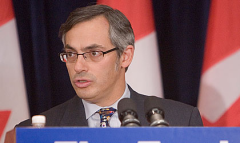
In the Maritimes, Ontario and five B.C. ridings, targeting federal Minister of Health Tony Clement and other incumbents who won last time by less than two per cent, the group will press candidates with demands that they support Canada Health Act coverage for autism treatment and full funding for an intensive one-to-one therapy approach.
Clement, who some wags have dubbed "Landslide" Tony, took the Parry Sound-Muskoka riding by a razor-thin .06064 per cent margin in the last election.
Meanwhile, some B.C. families with autistic children are drowning in debt as they struggle to provide their children with therapies they believe will provide important help, therapies that are only partially funded by the provincial government.
Who is Medicare for Autism Now?
Minister Clement was not available for a requested interview over several days of Tyee phone contact with his office as this story was prepared. For at least part of that time, according to press reports, Clement was in Denver attending the Democratic Party convention. However, The Tyee did receive an e-mail from a Health Canada on August 27 that read, in part:
"The responsibility for delivering health services in Canada rests with the provinces and territories and it is at that level that the issue must be addressed. The Canada Health Act (CHA) requires provinces and territories to provide coverage for medically necessary hospital and physician services. The Act does not deal with individual medical conditions. Services provided outside of hospitals, or by health professionals other than physicians, are not insured health services under the CHA. Canada's Government has already begun to address the issues that individuals with ASD and their families are facing."
Medicare for Autism Now, a group that is campaigning to change this federal position, is led by Jean Lewis, a North Shore parent and businesswoman. The group is advised pro bono by David Marley, a gregarious local political consultant. Marley is a former staff member for the federal Progressive Conservative and B.C. Social Credit parties. Lewis's son, Aaron, 14, has been diagnosed on the autism spectrum. Marley has no direct family ties to the issue, but says he first became interested in the 1970s, when a then girl friend's parents adopted an autistic son.
The two say they are determined to change the face of Canadian medicare and rescue a generation of autism-diagnosed kids.
"As a veteran American senator once observed," says Marley, "politicians see the light when they feel the heat. We launched the Two Percent Solution in five ridings in the last elections, and I believe we had some impact on the outcome in two of them. We punched above our weight the first time, and I think this time out the campaign has real potential for democratic renewal. This isn't a partisan effort. It's an attempt to reverse a stupid policy.
'Orphans of the system'
"Putting autism under medicare could be a national issue this time," Marley continued. "The current policy is just wrong. For one thing, it costs a fortune in costs when kids aren't helped and have to be warehoused later in life. The status quo is shameful, especially when Canada considers itself a compassionate country. These children are the orphans of the health care system and we want medicare coverage to cover the costs of an effective scientific cure for autism."
Marley says he predicts the next election will result in another Conservative minority government, but hopes that Medicare for Autism Now's targeted campaign will have enough impact to promote reform.
"We want to hang a few candidates in the window this time," he says.
Marley told The Tyee that most Canadians support his group's demand. He says that an Ipsos-Reid poll taken in 2004 showed that 89 per cent of Canadians support medicare coverage for autism treatment.
But this isn't just about election tactics and backroom strategies. It's also a story about the Celle brothers and their beleaguered family.
In a bright, cheerfully cluttered old house on Vancouver's east side, Dominic bounces down the stairs with a Lego airplane he's just built and engages a visiting Tyee reporter in chatter about the toy. Dominic Celle, 8, and his six-year-old brother, Gabe, have both been diagnosed with Canadian children's most common neurological disorder, autism. Both brothers make direct eye and verbal contact with a visiting stranger, unlike the deeply damaged kids The Tyee reporter remembers from work in a camp for special needs kids in the 1970s. During the afternoon, the brothers work with their therapists, chat happily with their mother and grandmother and play raucously with a gang of friends over for a play date.
The Celle family gives the credit for their boys' improved social and cognitive skills to an intensive program of one-on-one therapy administered by a team of therapists from B.C.'s Early Autism Project, a private sector firm that delivers the detailed therapeutic approach pioneered by California physician researcher Ivar Lovaas.
Deep into debt
Like many of the over 5,000 families in B.C. with children diagnosed on the autism spectrum, the Celles have had to go deeply into debt to pay most of the costs of this expensive approach. Bobbie Celle, the boys' mother, told The Tyee on a summer afternoon recently that the Lovaas-based Applied Behaviour Analysis (ABA) has made an immense difference in her children's development. She wonders why the B.C. government will only cover part of the nearly $100,000 dollars a year it costs her family to provide life-transforming therapy and day-to-day care for Dominic and Gabe.
In the wake of a series of court cases brought by parents of autistic kids since 2000, the province will provide families with funding for autism treatment of up to $20,000 a year until the child is six. After that age, the money available for private therapy falls dramatically to a maximum payment of $6,000. Autism treatment funding varies widely across Canada, with Alberta and Newfoundland paying $40,000 a year, or more, per child, Saskatchewan $25,000, Manitoba only $6,000, while New Brunswick, like B.C., pays up to $20,000 a year for treatment.
ABA therapy involves as much as 35 hours a week of intensive one-on-one therapy for each child administered by a team of five therapists. In the Celle household, much of the work goes on in a room on the living room fitted out as a purpose-built classroom full of toys, books and the massive binders full of detailed behaviour modification programs designed to isolate small elements of behaviour and positively reinforce each successful accomplishment, with meticulous records kept for each behaviour change. The therapists are typically university students, like Angie Ho, who was working with Gabe when The Tyee came to visit, led and supervised by a qualified behavioural consultant.
The process requires extensive involvement by supportive family members like Donna Celle, the boys' grandmother, and their father, Peter. At one point, the Celles calculated that 22 different people were actively involved in Gabe and Dominic's treatment and care each month.
All this work and expense has paid off, they say. For example, Gabe, diagnosed at two, had no language facility at all. After only nine and a half months of therapy, his recognition vocabulary was in the low normal range.
"This change is an indicator of the kind of progress the boys can have with help. We don't know what they'll be like as adults, but we can be sure they'll be more capable than without the program," says their grandmother.
Provincial funding to support this therapy program, partial at best even before age six, plummets to only $6,000 a year to families for each child when they are old enough for school.
Schools picking up the burden: Christensen
The rationale for the reduction in provincial support for ABA therapy when Dominic and Gabe reach school age, B.C.'s Minister of Children and Family Development Tom Christensen told The Tyee, is that the province's schools receive an extra $16,000 per year for each student diagnosed on the autism spectrum.
Christensen says that his government's investment in autism services has increased 12-fold since 2000, from $3.4 million to $43 million, even without including the increased spending in schools. He refused to comment on the question of whether he would support Canada Health Act coverage for autism therapy, and defended the decision taken by the Campbell Liberals to fight and finally defeat the demands of parents of autistic children for full treatment funding in a court battle that went to the Canadian Supreme Court in 2004.
This court battle, an appeal initiated by the previous NDP government, ensued despite Liberal expressions of support for parents while in Opposition, including this from Colin Hansen, now B.C.'s Minister of Finance:
"It is time for the government to stop hiding behind the courts. Let's get on with providing treatment to children as the courts have ordered."
Rich Coleman, now Minister of Housing and Social Development, told the Langley Advance News, "This (appeal) disgusts me completely. I'm so mad. The Government should make the decision to fund."
During this period of great expectations, Gordon Campbell told a concerned parent, according to Families for Early Autism Treatment BC: "The NDP decision to appeal the recent ruling of Madam Justice Allan reflects a government that has consistently failed to act in the best interests of children."
"The medicare question hasn't been given any substantial thought," Christensen told The Tyee. "We are working with the federal government on initiatives to help, including a new research chair at SFU. On the question of going forward with the Supreme Court case, I wasn't in Opposition when the statements you mention were made, so I can't comment. However, once you get into government you have to listen to the best legal advice and that's what we did."
Christensen did tell The Tyee, however, that B.C. government policy reflects agreement that ABA is an effective approach.
"It's the most supportable treatment now, I think," he said. However, Christensen said that he had not met recently with Families for Early Autism Treatment, the province's most vocal advocate for ABA autism treatment.
Parent group not persuaded
Christensen said his staff had told him that the $20,000 annual cap on payments to parents to fund autism treatment was often not fully expended by families qualifying for the money. He pointed out that the number of families receiving therapy support for their autistic children had gone up from less than 500 to over 5,500 since 2002.
Jean Lewis of Medicare for Autism Now is unpersuaded. She says if families are not expending the $20,000 a year, it is because they are having trouble finding qualified therapists in the province.
A note of clarification received by The Tyee from Minister Christensen's press aide seems to support Ms. Lewis's read on the question of parents under-spending the money provided by the province for autism treatment. Kelly Gleeson forwarded the following e-mail on Aug. 28:
"The ministry's program area conducted a three-month sample of autism funding (under six agreements), which ended in January, February or March of 2008: 82 of 122 families (67 per cent) utilized all of their funding.
"Program does suggest, however, that particularly in rural and remote areas, this result is impacted by challenges that families face in locating qualified service providers."
"We have an under-capacity problem at the consultant level," Lewis says. As for the proposed SFU research chair, she says it isn't what's needed most.
"The chair is political, something to put in the window as an election nears. We know the chair should be putting out qualified consultant-level professionals, not doing more research comparing therapies. The research has been done for 40 years and the best available is Applied Behaviour Analysis. Parents of newly diagnosed children often can't get a consultant or have been misdirected into speech therapy, which is not useful until ABA has helped a kid get speech."
Clair Schuman, who heads up Autism Community Training, a not-for-profit province-wide information and referral service created to support families of children with Autism Spectrum Disorders, says she would like to see government funding increased to reflect the real costs of autism treatment.
"We need a system across Canada so all children are entitled to the treatment they need." When asked about the Medicare for Autism Now demand for coverage under the Canada Health Act, Schuman told The Tyee:
"This is a necessary treatment. I don't care what body provides it. Adequate treatment is what's important."
'Nonsensical' cutoff
Schuman, a trained social worker with an autistic son of her own, is sharply critical of B.C.'s current policy of reducing available treatment funding for families when their autism spectrum children reach school age. She says that the government's rationale, that school activity can substitute for one-on-one therapy at home, "just doesn't happen. That money is necessary. The birthday cut-off is nonsensical." She said that a strong body of evidence exists that ABA treatment is the most effective for autism, and more effective when treatment starts early.
In contrast with government documents that claim there is no wait for treatment once an autistic child is diagnosed, Schuman says that there are long wait lists for therapy in the Fraser Health Region.
"This is a real stress for families, children and the whole system," she says.
Andrea Finch is a Vancouver lawyer who has a seven-year-old son who was diagnosed on the autism spectrum when he was two and a half. She says one of the worst stressors for her is uncertainty about the future of the ABA program funding her family receives to help defray treatment costs.
"What strikes fear into me is the prospect of a letter from the government announcing changes that won't respect the individualized nature of this therapy," she told The Tyee. "Of course treatment should be covered under the Canada Health Act. Society is going to pay one way or the other. If these kids aren't helped now, we'll have to deal with them when they are full grown and non-coping adults, and parents can no longer care for them."
Related Tyee stories:
- A Sun Columnist's Change of Heart
The Vancouver Sun's Don Cayo's first heart attack was treated in Florida and he trashed the care he might have received here. Now he's changed his tune. - BC Health Pays to Restore Man's Foreskin
Landmark patient calls circumcision 'human rights abuse.' - Canada's Health Care 'Crisis'
How valid is the alarm behind Campbell's Euro tour?
![[Tyee]](/design-article.thetyee.ca/ui/img/yellowblob.png)





Tyee Commenting Guidelines
Comments that violate guidelines risk being deleted, and violations may result in a temporary or permanent user ban. Maintain the spirit of good conversation to stay in the discussion.
*Please note The Tyee is not a forum for spreading misinformation about COVID-19, denying its existence or minimizing its risk to public health.
Do:
Do not: