
'BC's Hinterlands Are Opened Up for Business'
River power projects bring roads, people, wildlife threats.
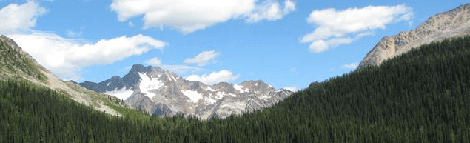
'Pristine' Edouard Pass in the Purcells. Photo Gregory Byrne.
When a team of conservationists and guides set out to explore Edouard Pass in B.C.'s central Purcell Mountains they intended to document the landscape and wildlife as it exists today.
Gary Diers rhymes off a list of animals they spotted: "golden eagle, mountain goats, caribou, small mammals, lots of birds ... we just shook our heads when we got there, it's a completely pristine area."
He and other members of the Wilderness Committee, which funded the expedition, fear it might not remain so pristine for long.
A 125 megawatt run-of-river hydro project in the area is currently in the environmental assessment process. The proponent, Purcell Green Power Inc., intends to build two facilities that would divert water from Glacier and Howser creeks, approximately 50 kilometres south-west of Invermere.
A 90-kilometer-long transmission line would cross the Purcell Mountains and connect at the Invermere sub-station.
"From the south end of Purcell wilderness conservatory, all the way to the TransCanada Highway, there is no industrial development," says Diers. "With a transmission line like this and assisting roads, no longer will it be a pristine corridor."
66 run-of-river projects in the works
Although the provincial government is promoting run-of-river as a clean, green source of power, critics say the speedy development of this industry, coupled with weak wildlife legislation, is destroying the landscape of B.C.'s back country and endangering wildlife there.
The Glacier-Howser project is just one of many run-of-river projects in some stage of development in the province. According to a recent report by Watershed Watch Salmon Society, some 25 such projects were approved before 2006, 41 have since received initial approval from BC Hydro and hundreds more water license claims have been made on rivers across the province.
The impact of a single project, let alone all of them together, reaches far beyond rivers, tributaries and the fish species in those waterways.
Part and parcel with hydro development, particularly in remote areas of the province, are transmission line corridors and access roads, sometimes totalling hundreds of kilometres in length.
"Just the existence of transmission lines themselves can sometimes interfere with the movements of wildlife, particularly animals that like to stick to dense cover," says biologist and environmental consultant Lee Harding. He says for grizzly bears, this development represents a loss of habitat because they might not cross such open corridors.
Importing human beings
Harding adds that other species, like caribou and moose, "can live quite happily with transmission lines in their area," but that doesn't mean those species are safe from what access roads and transmission lines bring in -- humans.
"The worst thing ... is generally the access that they give to hunters and recreationists who use powered vehicles. That's the worst impact," says Harding.
This is the kind of impact that worries Elaine Golds, conservation chair of the Burke Mountain Naturalists, a group that has taken up the fight against Run of River Power Inc.'s Upper Pitt River development.
It includes seven interconnected hydro projects on eight of the river's tributaries as well as two transmission line options, each between 42 and 53 kilometres in length and each bisecting part of Pinecone Burke Provincial Park.
"We campaigned mightily to get Pinecone Burke protected in 1995," says Golds.
"We think it's an absolutely spectacular wilderness ... it's amazing that we have an area like this so close and it's because you can't drive there, you can only get in by boat."
"This is a new intrusion into a remote wilderness area," Golds says.
'Hinterlands open for business'
Mark Haddock, a lawyer who received funding from West Coast Environmental Law to work with the Burke Mountain Naturalists, said most wildlife habitat protection measures were enacted with the forestry industry in mind. Now, IPPs are going where logging companies can't (mostly because the areas aren't profitable to log) and the same rules don't apply to them.
"B.C.'s hinterlands are opened up for business," says Haddock. "And there's a huge impact on the environment and wildlife that's not getting properly assessed."
For example, when a proponent applies for a water license, it must assess present fish populations, and how the project could affect those populations. Under the fish protection act, there are rules that set out the parameters for those assessments.
No such guidelines exist for other mammal, bird, insect or amphibian species.
"We have guidelines that we wish proponents to follow when they do an assessment of potential impacts to fisheries, but we don't have any guidelines at this time for proponents when assessing impacts to wildlife or any other non-fish species," says Ross Neuman, head of the ecosystems section of the Ministry of Environment's environmental stewardship division.
Neuman says the lack of ministry guidelines for non-fish species has been identified as a gap, but adds that such guidelines are not currently in production and are not being addressed in the ministry's current revision of the B.C. Wildlife Act (to be released early in 2008).
Still 'building the policy'
Steward Guy, manager of the ministry's conservation planning sector in Victoria, says the ministry is in policy discussion right now.
He says independent power production "is raising a whole new way for us to consider how we place environmental protection. We're building the policy with how we deal with new initiatives around the British Columbia."
"There are two aspects of most environmental legislation; the rules and procedures about how to undertake approvals, and the substance of protection for the environment," says Haddock.
Wildlife is addressed procedurally in other approvals, he says, but there is no strong legislation to make sure proponents effectively measure potential impacts and mitigate them.
Gap in wildlife assessments
When an IPP wants to develop a new hydro project, it must obtain licenses under the B.C. water act and land act, and comply with legislation under both provincial and federal fish protection acts and environmental assessment acts, among others.
These are legally binding, and these agency offices get to make the decision about whether or not to issue the license or environmental assessment certificate.
Environmental stewardship is the agency charged with protecting wildlife and wildlife habitat, but its role in the approval process is simply to guide other decision-makers.
Proponents are not required to give environmental stewardship officers requested studies, and this "gap" in wildlife assessment guidelines means the scope and depth of any proponent study can vary widely from project to project.
"If the level of work that's done does not provide us with adequate information to enable us to advise the decision maker as to the potential impacts and risks ... it's up to the decision maker to get back to the proponent and say, well you have to do more work, or to make a decision without the benefit of our advice," says Neuman.
"But we have no authority to insist either that they even use the guidelines, or that they do a piece of work that we find satisfactory."
Self-policing process
Haddock says that even with the conditions and regulations currently in place, there is another gap in making sure proponents are carrying them out as required.
He says, that in his own discussions with government officials, he's detected "a broad acknowledgement of a lack of follow-up," when it comes to monitoring the conditions placed on approvals.
For example, a proponent might be issued an environmental assessment certificate on the conditions they monitor grizzly bear activity in the transmission line area. Haddock says this kind of information is too reliant on experts who are on the payroll of the proponent.
"There's been so many cuts to the ministry of environment that there's very little ability to do any field review," he says. "It's all highly reliant on the proponent's own experts."
Neuman says he is one of 11 people in the ministry's Lower Mainland office who provide input for environment assessments. He says this represents "quite a significant workload," but it's just one small piece of what they do.
"All of these people do lots of other things at the same time. We don't have anybody where 'your job is to deal with IPPs and nothing else,'" he says. "Resources is always a challenge."
Related Tyee stories:
- A 'Green' Threat to B.C.'s Rivers?
Touted by BCHydro as renewable electricity, the rush to install privatized 'micro-hydro' schemes may change the flow of 76 B.C. rivers. - BC Hydro's Amazingly Bad Deal for Ratepayers
We give big firms $15 billion. We get higher prices, no assets, no guarantee of supply. - BC's Billion-Dollar Wind Power Giveaway
We're heavily subsidizing private power developers. Will Californians profit big?


Fiat lux
17-10-2007
When it was announced that
When it was announced that Al Gore was receiving the Nobel Peace prize, the media of the corporate mafia in the USA went crazy, denouncing him and anybody who even dares to mention climate change and global warming.
Which is an excellent proof, along with thousands of others, that "wealth can not be created, only taken from other sectors, the environment and the future"
If wealth could be created, big business wouldn't have to oppose environmental protection, but they, and their political pimps, know very well where wealth must be taken from and how it is taken.
On the subject of privatized power generation, the claim that it, and many other privatized projects, somehow "save the taxpayers' money" is a fraud, because all the investments, the carrying and service charges, and then the profits must come out of the taxpayers' pockets, therefore there are no savings, but extra expenses over and above what publicly owned facilities would cost.
In short, our whole present economic system is built on fraud, lies, extortion, forced collectivization, the expropriation of human and environmental properties and rights, promoted by fools and crooks.
Yet, the public laps it up ????
I can well remember when Hitler's Germany was the envy of Europe and can see the similarities with today's wealth creating gangs.
All in the name of "freedom" and now "democracy", of course. Especially with imported carpetbaggers stealing us blind.
Ed Deak, Big Lake.
gkam
17-10-2007
it's money!!
"Conservatives" don't seem to understand, despite their moniker, that the environment is our life-support system. The environment is not just the backdrop for our pictures, it is the the group of interacting systems that make and clean our air and water, and provide our food.
If we were on a spaceship, would they let one passenger disassemble the air purifying system in it and sell the parts to gain relative advantage over the other occupants?
So why are we letting the greedheads do it?
Come on, capitalists, tell us why it's more important for you to count your money than for the rest of us to see our kids grow up in a fine world?
Working Memory
17-10-2007
Solutions?
What's the solution?
Coal? Nuclear?
Sounds to me like some of you are advocating that BC should ignore the problem and continue to sequester itself.
Unfortunately, ignoring the power problem won't work. BC has done that for way too long and look where it go us.
It's time to manage it.
No matter how much you wish it, time and progress won't stand still.
You can't complain that BC isn't respected by the rest of Canada, and also complain that you don't want to do anything to improve the situation.
How would you make it work?
Education would be a start. Don't wait for your boss or neighbor to run with it. Email someone today in another part of the world and tell them what an IMPORTANT natural place BC is respective of their survival. Do that once a week. And tell whomever you email to tell someone else.
Ahh sorry . . . you can't do that because then they'd want to live here. Foiled again. Your greed trumps their greed by virtue of occupancy. I get it, and I'm with ya - to a point.
Instead, maybe you can tell them to put increased pressure on industry to conserve power. And while you're at it, remind them to turn out the lights when they leave the room because that would help too, but not nearly as much as it would if you went to your boss and told him or her that the company that pays your salary is wasting so much power that you could probably turn out all the household lights in the province for a year and still not make up for the power your company wastes in a day.
The Tyee is a perfect opportunity for you to share your solution with the world.
Please don't squander it.
jrc
17-10-2007
BC's Hinterlands are Open for Business
I was pleased to see this article and to note that the Tyee is continuing to report on this important issue. The BC Government's Energy Plan is responsible for the damage now being done by private power producers on pristine streams across the province. Through BC Hydro energy purchase agreements, the public is providing the revenue stream that provides developers with the capital needed to build their hydro projects. And, through limiting the alternatives for acquiring new energy or promoting conservation, the government is forcing BC Hydro to source its future energy requirements from these same developers at prices that are unbelievably high. At the same time, by selling water licenses at a tiny fraction of the value of the water resource, the government is effectively transferring billions of dollars in asset value to private interests with no benefit to the public. Yet despite all the public money that will be channelled to these developers through their lucrative energy purchase agreements with BC Hydro, citizens will get no assets, no protection from price hikes down the road and no guarantee that the energy will be used to meet the needs of the people of BC. It is a horrible scam.
At the risk of being self-serving, I should note that I have just published a book analysing the government's energy privatization policies entitled Liquid Gold: Energy Privatization in BC. Others have been campaigning as well against the government's policies, including Citizens for Public Power which was founded to preserve public ownership and control over our electricity system. There are also a number of key environmental groups such as the Western Canada Wilderness Committee that have joined in the fight to stop the government's private power agenda. And as the article notes, community groups are sprouting up all over the province in response to suddenly discovering that a private energy developer is going to build a project in their area.
As more and more of our rivers are threatened by the government's policies, I believe will see a much stronger reaction from communities and environmentalists across the province to the government's privatization agenda. Our challenge now is to bring together these various organizations into a co-ordinated provincial campaign.
- John Calvert
monty
17-10-2007
BC Citizens for Public Power
claim that there are close to 500 current water licenses and applications by private power producers across BC (see www.citizensforpublicpower.ca) Is BCHYDRO
still making a fortune selling power to the US? Just what power shortage are we talking about? Is this a pseudo-alarmist situation created by this gov't to benefit more of their friends? Does anyone know?
Fiat lux
17-10-2007
One of the main causes and
One of the main causes and problems is the overcapitalization of industry, where the 1/2 hp of a worker is often replaced with 20 or 100, or more hp. of energy, either electrical, or Diesel etc. because all forms of competition demand ever increasing energy inputs and raise real, physical costs that ultimately appear as monetary costs.
This is why we have 1000% inflation of the cost of living, with stagnating wages, since the neoclassical market economy theory was forced on humanity 30 off years ago.
This waste of energy is called "savings" by the industry, because they can invest in the automated machinery with imaginary capital created by banks, then pass all the costs onto the public in the form of taxcuts and higher prices.
The forest industry was employing twice the number of people 25-30 years ago, all making good wages and the companies good profits. But now we're "globally competitive", which means our costs and prices are going up every week, but so are the profits of the corporate mafia, thanks to their right to waste energy. And this is called "the competitive equilibrium of the global marketplace" where human blood is the the prime "commodity."
Ed Deak.
monty
17-10-2007
Powerex.com
This is the name of the company through which BC HYDRO is selling power to the US.
It's bothered me all day so I had to search and answer my own question.
If anyone is still reading this site, it's worth taking a look at Powerex. Site has not been updated but this firm clearly makes a lot of $$$ for the gov't.
Makes me certain this "shortage" is a sham.
skeptikool
18-10-2007
We share that umbrella
The economics, horse trading or whatever, aside, this planet's protective envelope does not recognize borders.
If our selling "green/er" electricity to the U.S. means less is produced using fossil fuels, it must be seen as a step toward producing a cleaner environment.
Two recent news items give cause for hope. One concerns a Wavebob device, about to be tested off the Irish coast. It's hoped that, at full scale, each device will be adequate to provide electricity for 1,000 homes.
The other item concerns a project that has been mulled over for a century. It involves building a tidal trap across the Bristol Channel's Severn estuary - noted for its tidal bore. The controlled release of trapped water as the tides recede will power electrical generators.
This coastal waters of both Canada and the U.S. have vast potential which, if exploited, could provide the power needs for all. A great pity this potential seem to remain largely ignored.
DPL
18-10-2007
Gordo has waited for years
Gordo has waited for years to be able to wheel and deal with the province's resources. Lots of friends are made by allowing companies to do just about anything they want in this province. Brings in big dollars toward the next election. and when the place is sold down the river, heck he will find a nice place to retire somehwere else
lemonheart
19-10-2007
More river projects......
.....will virtually guarantee the extinction of wild salmon in BC.
Salmon don't spawn on dammed rivers. The cause of depleted fish stock is never attributed to over fishing or too many damns. Its something like "unusally warm waters". Ban fishing for a few years and tell everyone to lump it. No one wants to grasp: Some fish or no fish at all? take your pick.
As said above, a lot of people don't seem to make the connection between life support and cash cow. We will go down in history as the Infinitetly Stupid for standing by and watching it happen while we bitched about it on websites like this just to make ourselves feel better without actually having to forfit conveniences.
Of course I'm speaking generally.....as I'm generally p*ssed off about it all.
actio,action,action,action,action,action,action,action,action.
The Question: Why can we not act?