

 SHARE:
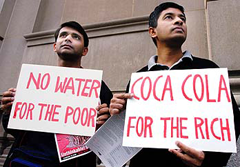
When governments cut postsecondary funding in previous decades, cash-strapped universities quickly learned that exclusivity contracts with beverage companies could be a lucrative way to stay out of the red.
At the University of British Columbia, for example, a secret deal signed between Coca-Cola and the university's administration in 1995 meant students were expected to quaff 36 million cans of Coke or Coke-owned brands over eight years, during which time no other company could set up on campus. When that proved too tall a task, the $8.5 million contract was extended for two years -- at no extra cost to the beverage giant -- while students tried to drink up the administration's end of the bargain.
But over the past half decade, a pattern has been emerging at postsecondary schools across North America. Student societies, upset about Coke's alleged human rights and environmental abuses in developing countries, have started taking matters into their own hands to cripple the deals. The result is one of the world's largest activist movements since the anti-Nike effort of the '90s, and it's costing the company millions.
'Conscience of society'
Over the past two years, Canadian student unions at McMaster University and the University of Guelph voted to sever or not to renew Coke contracts on their student premises. They join a total of 33 postsecondary schools in North America to have made some kind of motion to drop or hinder contracts.
According to a report by the Polaris Institute, an Ottawa based think-tank, 13 of the 48 post-secondary institutions with exclusivity deals with Coca-Cola are Canadian.
There is a tacit consensus that the ethics allegations against Coke are just too hard to ignore, says Becky Wallace, University of Guelph student executive, who cites the labour abuse allegations in Colombia and murder of unionized bottle workers as the principle reason for the student union's decision to abolish their Coke contract.
Wallace is referring to the accusations that paramilitary groups have been complicit in the kidnappings, murders and threatening of workers and union leaders for the past 15 years at Coca-Cola's bottling company in Panamco.
In India, it is also been alleged on several occasions that farmers have lost their livelihoods when wells near Coca-Cola factories dried up. The most recent incident was the ordered shutdown of a Coke bottling plant in Kerala in 2004, after numerous reports from local farmers and villagers claimed their water supply was being polluted and was slowly disappearing.
Coke scored a victory when the ban was overturned by the high court in Kerala in September 2006.
Wallace, however, said her student union was not satisfied with these and other rulings in favour of Coke. They opted for pulling the plug based on principle. "Universities are supposed to be the moral and social conscience of society."
McMasters University's student union also recently voted not to renew a contract with Coke but will have to wait until the end of 2007 before they can open up for other brands on their premises, says student union president John Popham.
And in a watershed moment in December 2005, the administration at New York University (NYU), the largest private university in the United States with 15 campuses and over 40,000 students, issued a ban of Coca-Cola products on their premises.
NYU's senate passed a resolution calling for an "independent investigation into allegations of the Coca-Cola Company's complicity in human rights violations" in Colombia.
"We're having a say in how the global economy and global politics enact themselves," says Crystal Yakacki, a former NYU student involved in the fight to kick Coke off campus.
Get in the zone
At most campuses, however, it's immensely difficult to convince under-funded university administrations not to sign exclusivity contracts. But student unions have begun passing motions of their own to render the deals null and void on the parts of campus where they are the authority, such as graduate and undergraduate student union buildings.
The result is that when a given administration wants to sign a deal with Coca-Cola or any other cold-beverage provider, the contract has to be zoned to factor out the parts of campus where student societies have jurisdiction. This stipulation severely devalues contracts, which fetch millions less than what a university could get if they had campus-wide exclusivity. It also makes it a hassle to develop a contract in the first place.
UBC's undergrad and graduate student society, the Alma Mater Society (AMS) and Graduate Student Society (GSS), for example, passed a motion in October 2006 that would not allow for any further exclusivity contracts with cold-beverage providers when UBC's $8.5 million 10-year deal with Coke ends this year.
If the university -- slated to make a decision over the next couple of months -- were to re-sign the contract, the campus would have to be zoned. Since the undergrad and graduate student societies run the areas delivering food and other service-related business -- and thus arguably the highest volume of people -- access to that product will be sharply curtailed compared to what it was.
"There may be some areas that have more choices [in the new contract]," says Brian Sullivan, a vice-president for the administration at UBC. "More zones may be part of the agreement; the more zones like that, the less valuable the agreement is."
'Ebb and flow of business'
The University of Alberta's student union may follow UBC's lead.
Under contract with Coca-Cola until 2008, the University of Alberta's student union president, Samantha Power, believes that student council, still bitter about having to tack on two extra years to their contract at no extra charge when students didn't consume enough Coke, is leaning towards a similar decision.
"We have control over our building and that's pretty advantageous in that regard," says Power.
Nevertheless, Power figures that the university, regardless of the student union's input, would go ahead and sign a zoned-type contract with Coca-Cola in 2008.
Diane Garza, a spokesperson for Coca-Cola, disagrees with the idea that students can curtail sales and product exposure by cutting them out of certain areas of campus. She says that people tend to forget that there are many more channels through which Coke markets its product. Zoning contracts, she continues, is completely up to the school.
"You're presuming that channel is the only channel to the consumer," she says. "We're multitasking. It's the ebb and flow of doing business."
The company can make up for lost sales through advertising or off-campus sales, she said.
Guilty until proven innocent
Garza admits that something did go on in Colombia, but denies that Coke had any involvement with it.
"We don't say there's nothing going on," says Garza. "But you have two independent court cases have investigating and have found that there's no truth to this whatsoever. Coke and its bottlers had nothing to do with the violence."
The most recent court decision, made on Oct. 3, 2006, by a Florida Supreme Court, dismissed the lawsuit the Sinaltrainal union filed against Coca-Cola because the court lacked jurisdiction. A similar charge was dismissed in 2003.
Sinaltrainal is the national food and beverage workers' union in Colombia, and the principle instigator of the lawsuits against Coca-Cola. The union intends to appeal the 2006 decision.
Garza said people tend to gravitate towards headlines that paint things in a bad light.
"[It's] not surprising given the world we live in," says Garaza. "How sexy is it to write a story about what a terrible company Coca-Cola is? Isn't that more sexy, than to say, 'they're doing a really good job?'"
"At the end of the day, it isn't in our best interest as a company to operate in a manner that is perceived to be unethical or perceived to be unfair," says Garza.
"It's so easy to point a finger at the Coca-Cola company and make it the target of all of society's ills," she says.
Colombia's 'bad situation'
Leslie Gill, a professor at American University in Washington, has been going to Colombia for the past three years to investigate the matter herself. She says what she's found has been appalling.
Paramilitary leaders continue to intimidate those who attempt to unionize, she says. Union leaders, she claimed, fear for their lives, and have to be escorted around in some areas in armoured cars with body guards.
"Last summer in August a member of Sinaltrainal was murdered. He wasn't a Coke worker but he was in a union and he had recently come to a protest against Coke and was active," she recalls.
Coke employees, Gill says, have provided her with eyewitness accounts about paramilitary coming into plants and talking to plant managers.
"It's a very bad situation," she says. "It's a very undemocratic company, to put it mildly."
Coke, however, continues to deny any culpability, referring repeatedly to the two dismissed court cases in the U.S.
Ray Rogers, a 62-year-old activist from Massachusetts and the director of the global anti-Coke campaign, sees otherwise.
He feels that the devalued contracts and the banishment of Coke from campuses are forcing the company to change its tactics, demonstrated earlier this year by Coca-Cola's national open letter ad campaign addressing the alleged human rights and environmental abuses in Colombia and India.
While Rogers thinks the ads have evidently done little to lift the company out of the fog of suspicion that surrounds them in students' minds, he says the company's motive is clear.
"One of the most important markets is the student market because Coke says, 'If we get a student hooked on Coke or the brand name, we've got a customer for the next 50 to 60 years,'" says Rogers.
Truth, unbottled
Despite Coke's denial, skepticism still runs rampant. With so many accusations, it's hard not to think that these claims about Coke bear some truth, says Power.
"I can't understand how those allegations haven't been proven, but when you have a number of allegations from different organizations, then you have to start questioning if they're true," said Power. "You have to at least look at them."
Mirroring Power's opinions, Wallace questioned why thousands of people in India would go on marches if the claims didn't have some merit to it. "I don't believe that people would go on hunger strikes for these fictitious claims when their rights or livelihood are taken away from them," said Wallace.
"They wouldn't do this for no reason," she said.
With so many contradicting stories, it's hard to tell where the truth lies. One certainty, however, is that until students are satisfied with Coca-Cola's attempts to reconcile these alleged abuses, they will continue to find ways to make it more and more difficult for the company to get exclusivity deals on their campuses.
The University of Western Ontario and the University of Alberta have campaigns underway, says Rogers. Major U.S. universities like UCLA and the University of Connecticut are moving in the same direction, he added.
"The ultimate goal is not to have Coca-Cola banned from campuses," says Yakacki. "The goal is to force Coca-Cola to recognize basic human rights worldwide, not just in Colombia and India, but all over the world."
Related Tyee stories:
![[Tyee]](/design-article.thetyee.ca/ui/img/yellowblob.png)








Tyee Commenting Guidelines
Comments that violate guidelines risk being deleted, and violations may result in a temporary or permanent user ban. Maintain the spirit of good conversation to stay in the discussion.
*Please note The Tyee is not a forum for spreading misinformation about COVID-19, denying its existence or minimizing its risk to public health.
Do:
Do not: