News

Plug-In Car to the Rescue?

Driving toward energy independence.

By David Morris, 27 Apr 2006, AlterNet.org

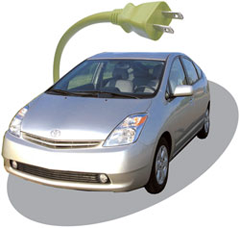
plugcar

I imagine driving a car without consuming petroleum, or generating pollution, or making noise. Imagine getting the equivalent of 100 to 150 miles per gallon. Imagine that every time you drove, you pumped money into the local economy, rather than sending it to distant shores. Imagine that this car was not only ideal personal transportation but also a driving force, quite literally, for transforming both agriculture and electric-power generation in ways that benefited farmers and urban dwellers alike.

Farfetched dreams? Not at all. All of the necessary technologies have been developed and road-tested in the battery-powered car, the hybrid gas-electric car the flexible-fuel car. All that's needed is to combine these approaches in a single vehicle that merges their advantages and eliminates their shortcomings.

The hybrid car, introduced in the United States only in 2000, is already a bestseller. More than 200,000 hybrid cars ply U.S. roads. But they suffer one major limitation: they can't go more than a mile or two on electricity alone. (Indeed, GM and Honda hybrids can't go anywhere without the gasoline engine running.) This makes them glorified gasoline-powered vehicles, with an electric motor assist. But a Toyota Prius or a Ford Escape can be fitted with an expanded battery pack, rechargeable from a household outlet, that would let it travel 20 to 50 miles between chargings. That is farther than many Americans drive every day.

Driving on electric power has many benefits. Electric vehicles, or EVs, are quiet and nonpolluting. Even taking into account increased power plant emissions, EVs still produce less pollution than gasoline-powered vehicles. And EVs are remarkably efficient; achieving the equivalent of over 100 miles per gallon -- twice the mileage of the best existing hybrid.

Expanding the range

Of course, the Achilles heel of the EV has been the cost and performance limitations of its batteries; sooner or later, most motorists want to go more than 50 miles without stopping to recharge.

A plug-in hybrid overcomes that limitation by having a backup engine -- but instead of the gasoline engines used today, it could easily be a flexible-fuel engine of the type now powering more than 4 million vehicles on U.S. roads. These engines operate on any combination of ethanol and gasoline, and the additional cost to manufacture one has fallen to about $100.

But ethanol derived from corn or other biomass also has its Achilles heel. Current U.S. gasoline and diesel consumption is far too high to replace with plant-derived fuels. Planting all available agricultural acres in the country with fast-growing trees or switchgrass could generate only enough fuel to displace about 25 percent of current vehicle consumption.

Plug-in hybrids, however, overcome this biomass limitation by using electric power to reduce fuel consumption by as much as 85 percent. This lets biofuels become primary fuels rather than minor additives.

Rewired power grid

With the introduction of plug-ins, the transportation and electricity sectors begin to merge. Utilities would probably offer EV owners the option of recharging their batteries at a lower cost at night, when demand is low. No new power plants would be needed.

Indeed, widespread use of plug-in hybrids could address the principal disadvantage of wind turbines to generate electricity -- the absence, so far, of an efficient way to store the power until it is needed. Wind is an intermittent power source, making voltage only when the turbines are spinning. But utilities need to dispatch electricity when their customers demand it.

The batteries in thousands of plug-in hybrids, connected to the grid through two-way household outlets, could bridge this gap between generation and delivery. Indeed, some studies estimate utilities might pay EV owners $1,000 to $2,000 a year for using their batteries to help balance and stabilize the grid. (That's in addition to saving perhaps $600 a year at the gas pump.)

One can even imagine tens of thousands of very small wind turbines sprouting up at homes across the country, built primarily to fuel vehicles. Consider the arithmetic: today, owners of large wind turbines get paid about 4 cents per kilowatt-hour (kWh) when they send the electricity over the grid to distant buyers. A farmer making wind power for his own use displaces retail electricity priced at 5 to 8 cents per kWh. But if that electricity is used in a plug-in hybrid, displacing gasoline, it is worth about 32 cents per kWh.

Politicians catching on

How futuristic are plug-in, flexible-fuel vehicles? Ford has introduced the first flex-fuel hybrid. Daimler Chrysler has about 100 plug-in vehicles on the road. Most interesting, perhaps, is the recent announcement by several companies of a plug-in conversion kit for Prius and Escape owners. One Canadian company has informed me that an order of 1,000 kits would cut the price in half (to between $4,000 and $5,000). At such a price, payback could come in less than seven years. And the costs will undoubtedly continue to decline.

The state of Minnesota, to use one example, has several advantages that could make it a leader in advancing these vehicles: an established ethanol industry, abundant wind power, plenty of gas stations selling E85 (half the national total, in fact), a top-notch automotive engineering program at Minnesota State University, Mankato. Not to mention the Ford Motor Co.'s St. Paul plant, now facing an uncertain future; it once made an all-electric pickup truck, as well as a flex-fuel pickup. In the future, it could make plug-in, flex-fuel hybrids on assembly lines powered by its own hydroelectric turbines.

A bill that begins to put in place a plug-in, flexible-fuel strategy is on the floor of the Minnesota State Senate and is wending its way through the Minnesota House. In five committees there has not been a single negative vote in either the Republican-controlled House or the Democrat-controlled Senate. Perhaps such unanimity sends American car companies a message.

David Morris is co-founder and vice president of the Institute for Local Self Reliance in Minneapolis, Minn., and director of its New Rules project. He is the author of the report, A Better Way To Get There From Here (PDF).  [Tyee]

50  Comments:

Login or register to post comments

  • Colin

    5 years ago

    Comments on "Plug-In Car to the Rescue?"

    I like the idea of a Flex-fuel and a mix of different types of vehicles propulsion systems.

    Rural Canada should be encouraged to go with diesel-electric vehicles because they need the range and independence the other vehicle don’t get. They would also adapt well to home generated energy and biomass fuels.

    The problem with Hydrogen is that it is an expensive fuel to make. Iceland has gone big down this road as they have abundant Geo-thermal energy to produce it and the cost of shipping in fuel is high.

    The problem with batteries, is that the only have a life of 5 years or so. If you are going to be using lots of them, you will want to make sure that you have an efficient recycling system in place.

    Another problem that is cropping up is that many places just don’t have anymore capacity in their electrically systems, or they are transferring it to high demand areas from low demand areas. These areas (Ontario) will not look forward to a large numbers of electric cars sucking up juice.

    We need more incentives to buy into renewable energy devices to upgrade existing homes and to design new ones. I looked into putting a solar water heater at our house, but the payback is a long time.

  • Peter Dimitrov

    5 years ago

    really - -and the electric power for all those 'pluggable cars' is going to come from where? ---another Columbia River treaty ...building the Peace River dam (which is likely going to occur anyways), diverting the Kootenay River - another hair-brained scheme ---more power from private power-corporate producers who are modifying many river systems in BC to accomodate their projects and who will charge an exhorbitant price to cover their higher (then BC Hydro) borrowing costs. - or maybe it will be 'wind-power & solar power", or nuclear power? Lets factor in the social & environmental costs associated with producing electric power in the equation too. I'd like to see cleaner fuel cars...but having living outside of the lower mainland for most of my life - especially in the Kootenays - I have witnessed first hand the destruction that goes with 'dam building'. But certainly, we must end our personal and economic addiction to oil - and as prices increases surely that 'weaning' process will accelerate.
    By the way, does anyone have a list of locations where 'batteries' can be re-cycled in the Greater Vancouver area? - including old car batteries, cell & computer phone batteries, and the smaller AA, AAA, C, batteries...where does it all go? Are their any stats being kept on how many are sold in the lower mainland --and how many are recycled - the difference being the number that are dumped in the 'garbage' or low-land fill sites- only to leach their deadly heavy metal toxins into the ground-water supply.

  • Yammer

    5 years ago

    Hm...reuse/recycle battery technology that obviates the environmental downside to the diesel-electric solution...sounds like a shrewd business opportunity to me. Anyone got a few million dollars sitting around?

    What about fusion, is that completely dead technology? Or heat gradient transfer and wave-motion generation? There has to be some solution. And, thanks to nutty gas prices, there will be incentive at last.

    In the meantime, in these last-gasp days of petroleum-as-fuel, is anyone planning what to with the money when Canada becomes the new Saudi Arabia?

  • Ruben

    5 years ago

    Let's go a little deeper into the possibilities, instead of just adding a big battery pack onto hybrid cars.

    Most urban dwellers could accomplish, say, 95% of their trips with a straight electric car with a 55-80 km. range. These cars exist and are affordable. You can even retrofit some existing cars with off-the-shelf kits.

    This means that 95% of the time the gas engine is dead weight. Big, heavy, expensive, highly refined, dead weight.

    So add-on the gas engine! Want to drive 200km? You drive your electric car to the gas station and pick up a generator. Imagine a generator, of the sort you would buy at a hardware store to power your next bush party. Now slick-ify that unit with a smooth housing and a nice paint job, optimize the size of the engine to the generator, and add a clip so it attaches to the bumper. Plug the two big cables into your electric car and Voila, gas-electric hybrid! I bet we could eliminate 75% of the gas engines in the world.

  • akk

    5 years ago

    I have to agree with Colin and Peter...I would like to see these changes as much as the next guy or gal, but if it were really that easy, it would already have happened!

    "Utilities would probably offer EV owners the option of recharging their batteries at a lower cost at night, when demand is low. No new power plants would be needed."

    HA! That'd be the day! Not to mention the issues of battery disposal, availability of electricity, etc.

    And I am truly disappointed in how much the issue of pollution created from extra energy production has been downplayed in this article. It is all nice in theory, but it seems this article was sorely under-researched.

  • Jack's

    5 years ago

    I'm all for new technology that is environment friendly but wasn't gas saving inventions stifled by the big oil companies in the past?

    Aside from that, there is one area of development which has not progressed nearly as fast as needed.

    That is batteries.

    To replace batteries for hybrid vehicles is damned expensive....

  • Stump

    5 years ago

    It's not what the vehicles use for power. It's the number of vehicles. Fossil fuel consumption is just one of the problems with automobiles. Better to cut the number of vehicles we use than try and find another band-aid for a fatally flawed solution to most transportation requirements.

  • darcy.mcgee

    5 years ago

    Quote:
    Plug-In Car to the Rescue?
    Driving toward energy independence.

    This is not driving towards energy independence; it's driving towards a different kind of dependence. (Recognizing the fact that I'm not the first to point this out.)

    Quote:
    It's not what the vehicles use for power. It's the number of vehicles. Fossil fuel consumption is just one of the problems with automobiles. Better to cut the number of vehicles

    Certainly one viable strategy. Or the number of trips. I drive about 3 times a week -- basically on the weekend, when I need to go places to have fun -- and once...maybe twice during the week.

    Outside of that, cycling, transit and my feet get me around.

    There are choices we make -- people need to start making these choices with an eye towards less use of a car.

  • Yammer

    5 years ago

    Stump and Darcy - I'm a bike commuter so I see your point. But we can fix two things at one time. There was no need to wait for seatbelt laws to implement drunk driving legislation, for a car-related analogy.

  • skeptikool

    5 years ago

    The N. American auto industry has been dragged kicking and screaming to do what little it has in response to the public's concerns regarding vehicle pollution.

    There are probably fewer areas where we are such victims of deliberately withheld technology.

    Naysayers have long talked about a significant increase in the use of electric/battery-driven vehicles causing grid burnout. If I had such a vehicle I would certainly maintain a photovoltaic array charging a switchable battery pack.

    Even with the dirtiest method of electricity production, barring nuclear, the pollution produced would be much less than all the fuel that would have been burned by those vehicles that had been replaced by electric vehicles.
    on charge.

  • jwstewart

    5 years ago

    I see this as a new way to waste a different form of energy and remain an eternal consumer.

    What exactly is the difference in wasted energy between a 2000-6000 pound gasoline powered vehicle with a single occupant and a 2000-6000 pound electric vehicle with a single occupant ?

    The ratio of vehicle mass to cargo mass is clearly the problem.

    As you are driving home today, imagine all of the single occupant vehicles were Yamaha Vino 50cc scooters which get 100mpg.

    Then imagine all the Yamaha gas scooter drivers get sick of breathing each others hydrocarbon sludge, and they order a Vectrix electic scooter.

    Problem phugging solved. No need for a plug in car when you can get a plug in motorcycle.

    And no need to litter the planet with nuclear generators, since the bike uses far smaller batteries.

    http://www.vectrixusa.com/index3.html

    Oh, and while were at it, why don't we call the local HVAC dealer and replace our furnace and airconditioner with a zero emission unit.

    http://waterfurnace.know-where.com/waterfurnace/cgi/index?mapid=CA&design=default&lang=en

    You are now able to eliminate the emissions from your transportation and home heating, which account for most greenhouse polution.

    Stop waiting, stop pretending to be environmentalists, stop being eternal consumers, and stop poluting.

    Or at least make a plan do do so, and stick to it.

  • YlaReina

    5 years ago

    Quote:
    No new power plants would be needed.

    This depends on the current state of the power grid in any one location, and the number of these vehicles drawing power off the system.

    There's no way we're going to take a huge leap forward in efficiency all at once. The main feature of this is "clean" as long as the electricity generated is not by fossil fuel. I'm all for taking baby steps to a cleaner future, not dirtier.

  • Birch

    5 years ago

    Our author may be a bit optimistic, and certainly the timelines of the changes he envisages are longer term rather than shorter. Still, I like the optimistic tone, and the vision of the proposals, particularly the notion of people generating their own power in distributed but linked, small-scale ways.

    We may be 40 years late (too late?) to stop global warming, but perhaps we can take a dent out of it.

    Comments re. too many vehicles and our hyper-consumptive lifestyle are useful observations worth attending to.

  • stan

    5 years ago

    The simplest way to lower the fuel consumption (and greenhouse gas production) of private automobiles is to start taxing engine displacement, horsepower and weight. Gradually phase in these taxes and make them high enough to disuade people from buying 3 ton, 300 hp SUVs for puttering around town.

  • minnow

    5 years ago

    Some great comments so far!

    Yes, weight of vehicles is an important factor in the whole problem. Basically, people are hooked on huge all purpose vehicles. It makes sense in a way: if you have to buy a car and insure it, you want a car that meets all your needs.

    One part of the problem is that there is a big disincentive to have several different vehicles for different needs. The insurance costs alone eat up the savings of having a fuel efficient car for those one person trips. (NO, motorcycles or scooters just won't do for most people. It has to be dry, warm and comfortable.)

    If you could get a break on a second or third (think families with multiple drivers) vehicle, you could justify having appropriate vehicles for commuting plus another for the family camping trip. Of course, the problem is that there is no way to ensure that the second vehicle isn't being driven at the same time as the first, by the spouse or child. You could make the licence plate transferrable: You have one license for two or more vehicles, and can only drive one at a time.

    Or, how about this: you pay your insurance at the pump. Put on a fuel tax and rebate the revenue to the insurers. If the fuel tax was high enough to pay the basic insurance costs of a vehicle, it would be a significant incentive to have more than one vehicle and drive the appropriate on for each trip. Plus, the higher cost of fuel would really put the heat on people who drive gas guzzlers unnecessarily, such as for long commutes alone.

    A fuel tax for insurance also means that you pay for insurance according to how much you drive. That strikes me as quite fair: the more you drive, the more likely you are to get in an accident, the more you pay. Conversely, if you use transit and other alternatives as much as possible, and cut down the driving, you really save big. You can still have a car sitting in the driveway, for those rare occasions when you need to drive, but the fixed cost of having it sit there is minimal.

    Or, perhaps we could give some real cash to vehicle share programs, so that there would be lots of SuV's and specialty vehicles available to people who normally drive teeny tiny cars but occasionally need something bigger.

    Or maybe put all of these ideas together: make the license transferrable, drive up gas prices with the "insurance tax", and give some real incentive for people to rent the gas guzzler for the occasions you need them.

    One final point about electric vehicles. If they were to catch on, it would only be a matter of time before the government needed a way to tax them to replace the fuel taxes collected on gasoline. You can't fairly compare fuel prices between heavily taxed gasoline and untaxed electricity. Somebody has to pay for the roads.

  • doggone

    5 years ago

    Followed links to the battery powered scooter and I like it a lot.

    However: Having given up riding on two wheels in rural canada (let alone urban) due to learned distrust of the four wheel drivers out there it occurs to me that driving habits and laws need to be changed to make the smaller vehicle safer.

    In South east Asia (I have riden bicycles, scooters and scramblers in Cambodia and Lao P.D.R.) there is a very simple rule: the heavier vehicle is at fault.

    If you ride down a pedestrian with your bicycle you are at fault. If your Lexus is crushed by a gravel truck you are not. It is quite simple and I finally got used to the blaring horns (and the lack of rearview mirrors) and rode there confidently.

    I do not ride on two wheels in western canada because I do not trust the canadian driver to pay attention. Incedently I am liscenced to ride a motorcycle and have passed motorcycle safety training.

    Once the larger vehicles become less numerous (and aggressive) it may be time to get a sensible set of wheels but for now I'm filling up the tank on a Ford F150 and jousting with the rest.

    I have to admit that I too have crowded motorcycles - "Asleep at the Wheel" - maybe it's cultural or maybe it's design of roads (or speed limits) but canadians seem to me to be the worst drivers in the world.

  • Cycling Commuter

    5 years ago

    Plug-in hybrid bikes, cars, trucks, buses, trains and even short-run ferries such as the Sea Bus can all make a positive contribution to cleaner transportation. Hybrids can boost reliability because engines that run at a fixed speed with a moderate load last a lot longer than engines that are subject to high RPMs and widely varying loads.

    Hybrids are far quieter than diesels. This is an important factor. A recent peer-reviewed study published in a respected medical journal found that frequent exposure to intense noise in an urban environment quadruples the rate of heart disease in women - probably by making them tense. Exposure to urban noise also increases the rate of heart disease in men, but by something like 50%-100%, not 400%.

    My neighbor's diesel pickup truck is one of the worst sources of noise on our street. Damn but that thing is loud and irritating. Because there are no sidewalks in this area of town, my neighbor uses his noisy, smelly diesel truck to drive his kids to school three blocks away. He also uses his stinky noise machine it to pick up groceries from 10 blocks away.

  • willy

    5 years ago

    eh eh I can see it now windmills all over the west end and the north shore, ya right!

  • Yammer

    5 years ago

    Thanks for the Vectrex link. I have been hot for one for more than a year. They are so cool. They really break the stigma against electric bikes IMO. I haven't seen any in the shops however. Not that I need one, I bike commute, but it would be fun to wheel around on and take on longer trips.

  • ModernSerf

    5 years ago

    Hi folks,

    I just wanted to provide some addtional detail. To darcy's point, "driving toward a different type of dependence" you are right. However this new dependence can be as high as 99% efficient versus the efficiency of IC engines at 35-45%.

    I think Ruben is right in that marginal steps forward are nice, but we are due for a big leap. Toshiba has a rapid recharge battery so if you want to drive long distances just pull over to the coffee shop and recharge. Recharging like this could become as ubiquitous as hot-spots are now.

    http://www.worldchanging.com/archives/002435.html

  • Stump

    5 years ago

    "One part of the problem is that there is a big disincentive to have several different vehicles for different needs. The insurance costs alone eat up the savings of having a fuel efficient car for those one person trips. (NO, motorcycles or scooters just won't do for most people. It has to be dry, warm and comfortable.)"

    I'll leave aside the comfort factor (give me convenience or give me death as Jello Biafra sez) and say that this is where private ownership of vehicles falls down. Far better a co-operative or communal pool of vehicles that lets me choose the vehicle I need depending on my destination and task. Unfortunately, cars have morphed into status symbols and penis/boob enhancers! Thank you advertising industry for yet another manufactured desire!

  • Yammer

    5 years ago

    It's not a manufactured desire, it's a manufactured expression of desire. Did the settlers share their horses and wagons in a communal pool? No. What you're proposing is reasonable, but it is novel.

  • Stump

    5 years ago

    I don't really see it as novel. I don't own an airplane or a cruise ship. I don't own a motorhome or a train. I just 'rent' them as necessary. Since I don't need a Hemi Charger to remind me I'm a virile man I'm not locked into having a vehicle to promote my masculinity.

    I don't think the early settlers is a great comparison. Often those people lived in relative isolation and you couldn't efficiently share those kinds of resources.

  • starchild

    5 years ago

    Well I guess this just goes to prove the power of propaganda and disinformation. Sounds like the classic not-in-my-backyard approach... ship the pollution somewhere else and bring home only the nice "clean" power. This is really ostrich thinking.

    Better I think to go after the energy monopolies and press them really hard about why they have so rudely suppressed alternative energy inventions since Tesla started the ball rolling over a hundred years ago.

    Zero-point energy inventions (so-called "free energy") have been around in many forms over the years, but they and/or their inventors are always eliminated before they can get to market.

    Zero-point is cool. It is neither difficult nor expensive technology for your average inventor - you just have to see the physical world somewhat differently to get your mind around it. There is no practical reason other than the sad state of society why every little gadget could not have its own built-in power source. Everything.

    The big boys use 'from the vacuum' energy to power their energy-guzzling geotoys (starwars and stuff), but officially it still doesn't exist.

    Batteries, on the other hand, are the same old recycled manure to keep the people in their places on the grid and continuing to pay for something that should be as free as the air.

  • starchild

    5 years ago

    Oh, and while I am ranting about hybrid electric vehicles... why does no one talk about how human bodies react to being surrounded by the electric field of a motor big enough to power a car, and probably sitting very close to them.

    I guess these will be the same people who think microwave ovens are harmless to health and environment. Or that wireless is somehow benign technology when it is actually just about the worst kind of pollution out there these days.

    Maybe all these 'homeless' people who move around so much because they don't have a home life and think home is boring - maybe they should all get a life instead of spending so much time consuming energy to satisfy their restlessness.

    Maybe the solution to energy pollution is for people to put a little more attention toward making a nest they can enjoy, and feeding the spirit of community so community will be there when they need it.

    I rant, I rant.

  • Stump

    5 years ago

    No one could suppress "free energy" forever. If it really exists why didn't Soviet Russia (w/ little reason to care what happens to markets) bring them on-line when they could have?

    If it sounds too good to be true....

    Although I do agree that the long-term effects of EMF are yet to be fully understood.

  • Cor_van_de_Water

    5 years ago

    Since January this year I am driving my EV to work, 23 miles roundtrip.
    So I can say a few things from own experience
    and from researching the information.
    For one - since I started driving the EV, this has immediately become my primary vehicle. Only 2 or 3 times a month do I need the gas-car (Prius) for a longer trip.
    Max range is 60 miles and that is almost always sufficient.
    NOTE that most of the US could start using an EV or plug-in Hybrid for their shorter trips without building a single new power plant, since all these cars would mainly be charged at night.
    You are right saying that there are power shortages sometimes, but that is in the afternoon, not at night.
    Power companies actually love you when you plug in at night, so they can make money instead of having that plant running without
    the electricity being consumed.
    That is why you get a free TOU meter installed
    (Time Of Use) by a lot of power companies when you tell them you are charging your EV at home and they are happy to give you a 5c per kWh rate during the night.
    All you need to invest is a timer to switch the power outlet for your car's charger on at midnight and off at 7 AM.
    My car gets 3 to 4 miles per kWh so driving it
    takes less than 2c per mile. Charging from my
    23 miles commute needs to replace about 6kWh plus charger inefficiency, say a total of 10 kWh. This costs me 50c.
    If I used most of the battery capacity I may need to get 20 kWh butthat still is about $1 and for that I covered more than 50 miles.
    Try that with a gas car! at $3/gal you need better than 150 MPG to do this!

    When I brake, my car uses its engine to put electricity back in the batteries.
    Have you ever seen your gas tank being filled up while you were braking?

    Oh and the batteries - yes, these are being recycled. You always turn the old 'cores' in when purchasing new batteries, so all lead and
    other materials can be recycled.

    If you want to know where to recycle, then call your city or your waste management company (the ones that pick up your trash).
    Car batteries can always be dropped off at
    your local garage or car parts store.

    As a closing remark, I'd really like to see plug-in Hybrids, my next car will certainly be another car that uses electricity as propulsion and having the Hybrid assistance to achieve larger range will allow me to replace the two cars with one, combining the strenghts of each in one.

  • Jack's

    5 years ago

    Cor_van_de_Water

    Before your final comment about the economy of your vehicle you should inquire about the cost of replacing the batteries - which I understand are comparatively short-lived.

  • Stump

    5 years ago

    And who pays the cost for rendering used batteries harmless to the evnironment? I'll eat my bike helmet if it's the manufacturer or the owner.

    /Actually, I won't but, I'm still interested to know the answer.

  • G West

    5 years ago

    Stump
    Dunno about elsewhere, or whether this is still happening or not, but there used to be a little back alley industry which existed in conjunction with dive shops and fishing equipment suppliers who would melt down car battery lead plates with primitive equipment consisting of propane tiger torches and small ceramic retorts. This molten lead was then cast into dive weights and, for the fishing industry, line weights of various types and sizes.

    This often took place in the back alley behind the shop and no consideration was ever given, in the operations I observed, to the environmental or health impact of the vapourized lead the process created. I often wondered if WCB had any data to indicate that the personnel who worked in such places ever showed up with identifiable illnesses related to the practice.

    Nowadays I think pretty much all worn-out automotive and industrial lead/acid batteries are turned in and recycled through a consumer charge levied whenever one purchases a new replacement battery. I assume this process is done profitably and carefully but I'd be surprised if a kind of black market wasn't still in operation for the back alley casting operations.

    Clearly, if lead/acid batteries for EV cars come into wider use, there will have to be more consideration given to the problem. I also learned some years ago when I was looking into the question, that many candles have a small lead core in their wick which also vapourizes and can be inhaled when the candle burns.

  • darcy.mcgee

    5 years ago

    Minnow:

    The idea of linking insurance rates directly to the amount driven is a great one, and I'm surprised that ICBC hasn't thought of doing it.

    I insure a car that gets driven rarely. If I were to have the same vehicle and drive every day, I'd pay the same.

    This makes no sense: if I'm driving every day, the likelihood of being involved in an accident is significantly higher. It's just a numbers game.

    This could be done at the fuel pump, or it could be done with an annual mileage check. Basically, when you renew your car insurance you pay for next year based on last year's consumption of mileage (or an averaged time period perhaps.)

    Another good strategy to work towards minimizing the number of trips.

    It's not viable to eliminate cars from our lives in North America; focusing on reduction and have vehicles pay their own way is a viable strategy.

  • rotlin

    5 years ago

    Interesting ideas Minnow.

    One thing about owning multiple vehicles though is multiplying your depreciation. Sharing of vehicles on an as needed basis can help make things more economical for drivers depending on their driving pattern.

    Vancouver has a Cooperative Auto Network organization which can make a variety of vehicles available for use when needed. Their website is at:

    http://www.cooperativeauto.net/

  • kootowl

    5 years ago

    Would a railway revival, for longer distances, help anything? BC has a number of rail lines that are used strictly for cargo. What would it take to make rail travel economically and environmentally viable for regular folks who live out in the boonies?

    Not that I'm keen to have the CN derailment contingent running the show...surely there could be a way to make those ribbons of steel work for Canadians in the 21st century.

  • G West

    5 years ago

    darcy.mcgee
    Not quite true - at least for ICBC insurance. Pleasure rates are less than for vehicles driven to and from work or school more than 6 times each month if I remember the details.

  • Stump

    5 years ago

    ICBC knows very well the details of 'distance-based' insurance. My understanding is that it's not as profitable as blanket coverage.

    A railway revival is exactly what we need. But, if we couldn't get from Vancouver to Toronto in less than a day civilization would crumble. Or would it?

    G West.

    battery recycling may be profitable, but I'm wondering who actually pays the piper.

  • freebear

    5 years ago

    So how will this work if our "system" is supposed to grow and continue growing? 10 electric vehicles sold this month; 20 next month and so on!

    How are these "new cars" made? How much energy is used to make these "non polluting" vehicles?

    Funny how there is no discussion about how we design and plan the places we live in! Why do we create places that people want to escape from every weekend!!!!!?????

    Ultimately, we have to do with less, consume less, throw away less; live within our and the planet's means.

  • Stump

    5 years ago

    Stop making sense. You'll scare people into not buying more useless crap and then the economy will crumble and Satan will walk the earth plucking hearts from the unrighteous to feed his unholy hunger. Or something like that, right Capitalist? :-)

  • Colin

    5 years ago

    Some good comments and thanks to cor_van_de_water for posting their experience with hybrid and electrical.

    Right now you do pay an eco-fee when buying a car batteries and most seem to be recycled, how efficient this process is and can it handle the influx are good questions.

    Cyclying C
    I was standing beside a VW Jetta turbo-diesel that was running and I didn’t even know it was running till the car moved off and only then could I hear it (barely) the US pickup diesels are mostly old technology and can be done better. Diesels are not the best choice for congested areas with confined air masses, but for rural areas, they are great. I put a turbo-diesel in my Landrover and cut my fuel bill in half. Turbo’s also help ensure a better fuel burn. Also many people drive a diesel like a gas vehicle and that leads to inefficient use.

    I also like the idea of the insurance being tied to the person and not the vehicle, that will give people more options. Our friends use the Co-op auto network, they like it, but you have to be able to plan ahead to use it.

  • darcy.mcgee

    5 years ago

    A valid point on pleasure vs. work use for insurance. There is that one distinction, and I apologize for not acknowledging it.

    As for 'distance based insurance not being as profitable' that's why such an initiative must come from ICBC. It could be MADE profitable by charging an appropriate rate. Add to this that ICBC is a government agency which implies that it has a social mission in addition to any profit mission, and it could (and arguably should) happen.

    US pickup trucks sound the way they do because US pickup truck drivers want to drive big, diesel powered pickups. At least in part.

    In any case, Diesel is not the future -- it's just an alternative present.

  • Colin

    5 years ago

    A bit on bio-diesel from Malaysia

    The Government had stated that all diesels sold at petrol stations must contain 5% palm oil from next year. This move would enable Malaysia to save up to 500,000 tonnes of diesel imports, or about 10,000 barrels per day.
    http://biz.thestar.com.my/news/story.asp?file=/2006/5/1/business/14074510&sec=business

    Darcy Not everyone buys a diesel powered truck because it’s a big truck. They buy to carry out tasks that they need to do, diesels are excellent for towing and give longer range for the same size fuel tanks. Pickups are common because people use them for multiple reasons. There is a reason for the saying: “If you don’t think you have friends, buy a pickup and wait for the end of the month”

  • G West

    5 years ago

    What about ethanol?
    In Brazil ethanol accounts for 40% of all automobile fuel and 80% of new Brazilian cars are flexible-fuel models that can run on either gas or ethanol.

    Why not follow Brazil's lead? The answer is partly Big Oil — Oil companies have fought the introduction of ethanol, even as a fuel additive — but Agriculture is a big problem too. There are huge tariffs imposed on imports of Brazilian-produced ethanol by both the U.S. and the European Union as a way to protect northern farmers.

  • freebear

    5 years ago

    So how will this work if our "system" is supposed to grow and continue growing? 10 electric vehicles sold this month; 20 next month and so on!

    How are these "new cars" made? How much energy is used to make these "non polluting" vehicles?

    Funny how there is no discussion about how we design and plan the places we live in! Why do we create places that people want to escape from every weekend!!!!!?????

    Ultimately, we have to do with less, consume less, throw away less; live within our and the planet's means

    VERY FEW ANSWER MY QUESTIONS?

  • darcy.mcgee

    5 years ago

    Trust me Colin. I know all about the borrowing of pickup trucks: I've got a close friend who has one, and I've borrowed it many times.

    My point isn't that pickups are common, it's that there's a certain...aesthetic that comes with the purchase of a diesel pickup for city use.

    Couldn't agree more that they provide better range -- extremely relevant for those who live in rural areas. Less relevant for me, who has 3 gas stations walking distance from...almost anywhere I happen to be.

    I still stand by the basic premise though: Diesel is NOT the future, it's simply an alternative present.

    Personally, if I lived in San Francisco I wouldn't even bother with a car -- I'd just own a motorcycle. Addresses congestion, fuel consumption and environmental pollution all in one fell swoop. Sucks when it rains like it did on Saturday though, and for about 4 months of the year in Vancouver 'cause it's just plain too cold.

  • darcy.mcgee

    5 years ago

    One point on pleasure rates vs. work: I can call my call pleasure and still drive it every day.

    ICBC distinguishes the destination to which I am driving, not the amount that I am driving.

    So if I drive to the grocery store every day, I'm still killing trees, children, using the infrastructure and at greater risk of an accident than someone (such as I, for example) who typically drives no more than 3 times in a week and cycles or walks the rest of the time.

  • G West

    5 years ago

    darcy
    No question. I'm sure the distinction in rates between pleasure and work has nothing to do with the objective of reducing miles driven; it is simply the actuarial result of accident statistics.

    Probably a better way to get people out of their cars is what London Council introduced a couple of years ago - a generated charge every time one drives an auto into the city via some technical tracking gizmo or camera. This has, from what I read, led to a marked reduction in cars driving daily into central London. Given what must be myraid ways into the city the tchnical tricks must be quite complex.

  • Stump

    5 years ago

    "What about ethanol?"

    Ethanol, like propane and some of the other alternative fuels being touted as the answer isn't as energy-dense as gasoline as far as I understand. The beauty of gasoline is just how much energy is packed into every drop. It's so darn useful and efficient you'd think we'd husband the resource a little more carefully but addicts rarely put aside some of their drug for a rainy day.

  • G West

    5 years ago

    Stump
    I agree completely with your points about gasoline's advantages. But, even so, why make it more difficult to substitute ethanol which seems to be working in a place like Brazil?
    Even American high tariffs contra sugar from Cuba tend to work against the production of ethanol as a substitute fuel. Bush seems to prefer switch grass apparently.

    It's all just so ignorant. The only hope for real change is to keep gas prices over $5/ gallon. But the problem with that is it will just encourage the oil industry to do more, not less, exploration for new sources of oil like the Arctic and off BC's coast. Without $50/bbl oil there would be less demand for the kind of environmental nighmare that the Oil Sands is creating too. In many ways, given the current market system, you're damned if you do and damned if you don't. With high priced oil, it's just a matter of time before the govt steps up with more, not less, subsidies for farmers in North America.

  • freebear

    5 years ago

    The planet is phuqded!!!!

    It may be too late already (cascadeing impacts)!

  • darcy.mcgee

    5 years ago

    Love the idea of a downtown toll. It's great.

    Vancouver, though, has an...interesting downtown. The 'peninsula' (how I describe it to our visitors) isn't even our busiest zone, but it's the obvious dividing line.

    Ideas on how to delineate? I'd think you'd have to keep south granville...

    It's a great idea, but with weak, milquetoast civic politicians I suspect it won't happen here. We don't elect leaders, we elect bureaucrats. Such a profound move needs to come with leadership attached.

  • G West

    5 years ago

    darcy
    One thing about Vancouver, the choke points are easy to demark: Granville Bridge, Burrard Bridge, Lions Gate, Second Narrows, and Cambie. THe only problem would be the sector from east of Cambie to Hastings Street...we certainly don't have any Ken Livingstons in the current council do we? It does seem to be working well in London - guess they don't call him Red Ken for nothing.

    • No best comments selected by an editor for this story yet. To see all comments, click the All Comments tab, above.
    • The discussion for this story is closed. No more comments can be added.