- Ms Kaye is a Tyee Builder. You can be, too.
- Mary Carlisle is a Tyee Builder. You can be, too.
- Prem Gill is a Tyee Builder. You can be, too.
- Nancy Flight is a Tyee Builder. You can be, too.
- Justin Everett is a Tyee Builder. You can be, too.
- John Westover is a Tyee Builder. You can be, too.
- Nora Etches is a Tyee Builder. You can be, too.
- Edward Henderson is a Tyee Builder. You can be, too.
- Bharadwaj Chandramouli is a Tyee Builder. You can be, too.
- Dean Chatterson is a Tyee Builder. You can be, too.
- Marius Scurtescu is a Tyee Builder. You can be, too.
- Robert Parkes is a Tyee Builder. You can be, too.
- James Murton is a Tyee Builder. You can be, too.
- Susan Doyle is a Tyee Builder. You can be, too.
- Vincent Strgar is a Tyee Builder. You can be, too.
- Helen Spiegelman is a Tyee Builder. You can be, too.
- Subir Guin is a Tyee Builder. You can be, too.
- Kimball Finigan is a Tyee Builder. You can be, too.
- Joanne Manley is a Tyee Builder. You can be, too.
- David Leach is a Tyee Builder. You can be, too.
Landmark Great Bear Agreement Is Down to the Wire
Hopes, doubts rise as Premier faces signing deadline. A Tyee Special Report.
There is frustration and urgency in Art Sterritt's voice as he talks on his cell phone while rushing down the highway to catch a boat in Kitimat. As the executive director of Turning Point, a coalition of coast First Nations, he is on his way to meet with log buyers and funders from the United States. They want to know why nothing has changed in the way business is done in the Great Bear Rainforest.
Other business people are asking similar questions. Klaus Peter Petschat is one. He represents a consortium of the German paper industry. After first visiting the Great Bear Rainforest in 1999, he and a group Europeans have come back to see whether protesters are still chained to the forest products coming out of the Great Bear Rainforest.
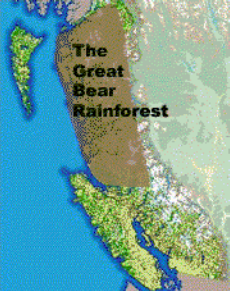
They, along with other players in this long unfolding coastal card game, hope the government will soon play their hand and sign off on an agreement dictating the future of roughly 8.5 million hectares of ancient cedar, salmon, wolf and bear habitat in British Columbia's globally significant temperate rainforest.
It is a high stakes game. Between the German paper industry, Home Depot and Lowe's, a billion dollars in wood and wood products are purchased from coastal British Columbia, says Merran Smith, director of the BC Coastal Program of ForestEthics, one of the environmental groups involved in negotiating a complicated land use agreement. Also at stake is $200 million in financing for conservation-based economic initiatives on the coast.
A lack of government action could mean the unraveling of ten years of transformation in the way environmentalists, industry and First Nations work at land and resource management in British Columbia, she says.
The environmental sector has worked long and hard with other stakeholders to move away from conflict toward developing a solution for the coast. That's why there are no protesters chained to trees in the woods at the moment. But Smith foresees trouble if the government continues to delay.
"The whole solution will start to erode and this will take people back to marketplace campaigns and conflict," she warns.
Premier holds cards
The cards are in Premier Gordon Campbell's hand, says Smith. In December 2003, a multi-stakeholder consensus agreement was reached at planning tables on the coast. From there, First Nation governments in the area and the provincial government have been behind closed doors hammering out the final details. The deadline for these negotiations was December 2004, then spring 2005 and now the leaves are starting to turn.
Premier Campbell promised coastal First Nations government to government negotiations would be signed off by the end of summer. Those close to the Great Bear Rainforest campaign are generously interpreting this as September 30. A government spokesperson would give no exact definition but said discussions and meetings continue and they are on track to deliver on the Premier's commitment.
"We've been muzzled a bit too long," says Sterritt. He wonders if the premier's office is feeling a false sense of security about its relations with First Nations, since the release of its New Relationship document.
"If the deal fails at this time, if we can't make this work, then denying our communities an opportunity to make an economy on the coast will never be forgotten," he says.
"All hell will break loose," he adds.
What's at stake
One of Sterrit's biggest concerns is the potential for $200 million in pledged conservation financing to fall apart, leaving a myriad of First Nations and coastal community projects, like shellfish aquaculture, tourism, non-timber forest products and sustainable logging to fail.
Smith says the money, raised from private industry, government and foundations, became an important piece of the complicated Great Bear Rainforest Agreement, because communities demanded it.
Environmental groups helped to secure $110 million dollars intended to help First Nations implement the land-use plans in their territories, Smith says. Some of the money will become seed capital for business ventures and some will be set aside to help First Nations go about the physical task of managing and monitoring the streams, forest and ocean. She sees it as one way to help First Nations build capacity and control in their territories.
An additional $80 million in socially responsible investment dollars may be available to larger communities like Prince Rupert for sound business projects.
Sterritt says if the land-use plans are not enacted by November most of the funders will pull out. If that happens, he's not sure what will happen to the rest of the package.
The plan, as negotiated by parties such as logging and mining spokespeople, tourism operators and the general public, at the Land and Resource Management tables will preserve one third of the land base from logging.
The five companies operating on the coast have also committed to significant changes in how logging is carried out in the unprotected areas by turning to full implementation of eco-system based management (EBM) by March 2009.
Forest firms push for action
Bill Bourgeois, spokesperson for the Coast Forest Conservation Initiative, a coalition of Canadian Forest Products, Western Forest Products, International Forest Products, Weyerhaeuser and Norske Canada, says government must act, not only to ensure certainty for the forest companies, but in order for them to fully implement this new way of doing forestry on the ground.
"Work has already begun, but [foresters] need further clarification on how to implement EBM," he says.
The companies have agreed to interim measures and have begun training staff in the EBM principles agreed to by an independent science panel, but Bourgeois says it may take another year before change will be noticed in the woods. They also need to see the new rules enacted into law.
"It's one thing to have it written down on paper and another when you are standing on the edge of a creek deciding which to cut and not cut and why," he says.
Bourgeois who spent the last ten years working with an interior forest company as vice-president of environment and government affairs looks forward to seeing this new approach take hold.
Even over the last six months, he has noticed employees of the CFCI companies starting to embrace the ecosystem based management concepts more whole-heartedly. He thinks innovations will really start rolling when the parties have truly begun working collectively and collaboratively.
How the truce was won
Throughout the 1990s, tension over the rate of clear cutting BC's ancient rainforests was building. Massive arrests of otherwise law-abiding citizens at Clayoquot Sound on Vancouver Island heightened public awareness of the raging conflict between conservationists and corporate interest.
At the same time, resource communities in rural BC faced high unemployment due to increased mechanization and over cutting in the forest sector.
The government's very own projections confirmed that regional rates of logging far exceeded long-term sustainable levels, and significant declines in the yearly amount harvested, otherwise known as the falldown effect, were inevitable throughout the region.
Into this milieu, protesters opposed to clear cutting and seeking more protected areas were labeled "cappuccino-sucking urban environmentalists" by resource town mayors. First Nations leaders also disdained many enviros, and coastal communities like Bella Coola were torn apart by conflicting interests.
At the height of the tension, Premier Glen Clark fed the flames by labeling environmental activists the "enemies of BC."
Out of this evolved a new approach to activism, says Darcy Riddell, who worked on the Great Bear campaign from 1998 until 2004. Some environmentalists, frustrated by the traditional "valley-by-valley" confrontational style of activism dominating the coastal BC scene made a conscious effort to change their tactics.
Campaigners recognized the need to move away from angry and adversarial positions to being open to the possibilities of negotiation.
A model of the possible
Riddell thinks the agreement is unique partly because it is a consensus reached between such divergent interests. But the process of finding agreement between environmental, economic, social and First Nations interests was not only difficult and painful, it was transformative, she says.
Riddell now works for the Hollyhock Leadership Initiative which provides training and strategic support to people working for environmental and social change. She thinks the Great Bear Rainforest agreement sits on the emerging edge of social change.
"It is a model of the possible. It represents the next steps in resolving land management issues," she says.
She says the methods used are known as the integral approach after philosopher and psychologist Ken Wilber's Integral Theory. The approach seeks input from disciplines such as natural sciences, economics, politics, culture, psychology and spirituality on an individual and the collective levels, including the interior and exterior of each of these.
"[The strategy] comes from a place of understanding power," she says, adding that people had to be ready to take responsibility for their own issues while seeking innovative solutions.
In the beginning of the campaign, someone took the time to figure out the mindset of the adversary, rather than demonize them, she says. This led the activists from groups like the Sierra Club of BC, Greenpeace, Rainforest Action Network to become involved in what is now called the Rainforest Solutions Project. They then started using a particularly potent tool - the markets campaign.
In 1999, at the height of the conflict over the rainforest, major companies including building suppliers Lowe's and Home Depot cancelled millions of dollars in contracts. They told the BC government they wanted the dispute in the Great Bear Rainforest solved in a way that respected the global significance of this temperate rainforest.
"That was the turning point," says Smith. The markets campaign was essential in bringing all sides to the table.
But according Riddell's theory, the next phase had to be negotiation and mutual understanding.
'Solution builders'
Circumstances swirled around the campaigners to help facilitate the transformation. Riddell remembers the companies on the coast were losing money, and the communities and First Nations were disempowered due to lack of economic opportunity and control of resources.
The integral approach addresses all of these problems and everyone can win, she says. She calls it a more optimistic framework that tends toward solutions.
Riddell knows that some in the environmental movement feel the Rainforest Solutions Project has sold out. But she says there is too much at stake to exclude the people who hold the power from the dialogue.
"Where the most power and control of resources lies is where there is the most opportunity for transformation. We have to engage with corporations and government because they are the ones who make the decisions."
She has noticed more and more new activists tending toward this style of work.
"They see the path towards environmental health and sustainability has to be holistic. Young activists see themselves as community builders and solution builders," says Riddell.
Too much or too little?
But there are those who suggest the compromise approach of the Great Bear Rainforest Agreement amounts to nothing more than large environmental groups giving away too much of a globally-significant ecosystem.
According to George Hoberg, professor in the department of forest resource management at the University of British Columbia, the process by which the Great Bear Rainforest agreement was brokered may be groundbreaking, but the details are not.
Although 33 percent protection triples the amount of protected areas in the region, it still falls short of protected areas in similar regions Hoberg writes in a March 2004 paper entitled "The Great Bear Rainforest: Peace in the Woods?"
The Tongass National Forest in Alaska, which occupies 6.9 million hectares in the Alaskan Panhandle (the region just north of the Great Bear Rainforest), is topographically and ecologically very similar to the GBR, he states. A 1999 decision by the United States Forest Service provided for the protection of approximately 80 percent of the Tongass National Forest.
Chris Genovali, executive director of the Raincoast Conservation Society, also thinks the agreement doesn't go far enough to protect wildlife. He says the Great Bear Agreement doesn't even protect the creatures it is named for.
According to a study commissioned by Raincoast, bear biologists Dr. Brian Horejsi and Dr. Barrie Gilbert show that 80 percent of grizzly bear habitat will remain unprotected in the land-use plan awaiting Premier Campbell's signature. Genovali is also concerned that trophy hunting wasn't addressed in the plan and will be allowed to continue in the region.
Genovali says the Liberal government's rhetoric maintains they will make decisions on the best available science. But not so in the Great Bear Rainforest.
He points to the Coast Information team, a panel set up to provide the best science to negotiators of the deal. They concluded that protecting 44 percent of the Great Bear Rainforest was the minimum amount necessary to create a high risk solution for maintaining biodiversity. The agreement as it stands falls short and will threaten wolf, salmon and bear habitat.
"Millions of dollars were spent by government, industry and non-governmental organizations on a science panel, but their recommendations are being tossed aside," he says, demanding Premier Campbell increase the size of the protected areas.
Others on environmental listserves have cried foul, as well.
Some question how much of the proposed protected areas cover forests and how much is "rock and ice" while others suggest negotiating and acquiescing to corporate interests indicates a much deeper problem in the environmental movement.
"That Rainforest Solutions Project view actually represents the [public relations] perspective of the forest industry rather than the informed analysis of less credulous environmentalists and ecologists.," writes Michael Major, who is not a spokesperson for any environmental group, but he is an active member of BC Envirowatch listserve.
Aiming for balance
The frustration in Sterrit's voice rises up again as he ponders those in the environmental world who are fighting the deal he and others have poured blood, sweat and tears into. He is angry and it shows in his comments.
"There are environs who would love to see us [First Nations] living like in a zoo with no economy but an ancient one, exchanging trinkets," he says.
"Our communities need a little bit more than that."
Bourgeois has heard the complaints too. He knows there are some who think there is too much conserved and others who think it is not enough.
"There will be some on both ends of the spectrum, but we can't manage for those," he says.
In the end he believes balance between human well-being and the environment will be achieved.
"It is an exciting initiative. By March 2009 we will have made a significant contribution to forestry in BC and around the world.
Would he apply the same approach everywhere? No. But if other areas of global significance in the world follow this process of collaboration we will have exported a very valuable product, he says.
"But there will be some agony getting there."
Heather Ramsay is a contributing editor of The Tyee, based in Queen Charlotte City. ![]()


30
Login or register to post comments
herbie
6 years ago
Comments on "Landmark Great Bear Agreement Is Down to the W
Where is the Great Bear Rainforest? Is it in South America somewhere? Your map seems to think it's a chunk of BC. Someone didn't just make the term up out of thin air to try to impress people and piss off the people who live there did they?
nemesis
6 years ago
You're pretty close Herbie. The 'conservationists', for lack of a better term, made this one up all on their lonesome. Of course they have a right to do that because they're cause is worthy, at least as far as they're concerned, and that's all that really matters to them anyway.
cosmo
6 years ago
Herbie and Nemesis,
Go there why don't you. Find out who lives there. From Phillips Arm to Kingcome Inlet up to Kemano you will find a First Nations majority, along with a bunch of fly-in logging camps. And big trees. And tons and tons of bears.
Unlike the Kootenays - for example - Grizzly bears are all over the place right down to sea level, all interspersed with the black bears. I can honestlly say I have seen an average of 2 bears a day, whichever logging camp I was working out of.
Yes, while I seem to recall a recipe for Spotted Owl soup posted on the mess hall in Phillips Arm, I also recall loggers lamenting the building of a bridge during the spawning season. 'How stupid can people be?' they asked.
The loggers tend to live in Campbell River or Port Hardy (or Vancouver) and fly in for 14 days on, 14 days off. If you are wondering, it is mostly the bears that live there.
Again, I challenge you to actually go explore that coast boys. You'll be amazed how far it is from the South End of Vancouver. Then look at the clearcuts, explore the logging roads, consider the price of lumber, and meditate on where the money that built up Vancouver came from. Guess what? It never came from tax cuts to the rich.
freebear
6 years ago
Why is'nt ecosystem based management applied throughout BC?
Also the conservation intitiative dollars have strings attached, but no mention of that in the article.
Also you can not "preserve" and ecosystem. You can help maintain and sustain an ecosystem by not damaging/removing components beyond resiliency thresholds. In other words you can "protect" an ecosystem, without prohibiting loggging, mining, tourism, etc. as long as the activities do not breach thresholds. These thresholds exist at various scales, including the stand level.
One thing that is worrisome to me is that in the plan, old growth forest is categorized as trees 250 years lod and above.
My concern is that the forest will be logged at that age, and few if any trees will be free to grow to ages of 600-800-1000 years old.
In fact forest companies (as they often do on private land on Vancouver Island) would harvest trees that are 80-100 years old!
Take a look at maps that show the age of trees on the coast. Very little old growth is left, despite the fact that the Ministry of Forests and forest companies have said that they are managing the forest sustainably!
sumit
6 years ago
First let me start by saying I live in Kitimat, I wonder how many other posters to this item can say they live in the region.
I pay attention to what Art Sterritt has to say about the proposed agreement, he also lives in the region.
The "Great Bear Rainforest" name was developed by a Vancouver enviromaniac not by anyone living in the region.
I suspect that the majority of those quoted in the article and in the posts above also live in a city somewhere outside the region and are much more concerned with preserving an area far away from themselves than with cleaning up their own back yards.
When 11% of greater Vancouver or Victoria is protected in parks come back and tell those of us living beyond Hope that we need to start doing more. Until then clean up your own backyards and stay out of mine.
Many of us who choose to live outside the urban messes which constitute only the very small southwestern corner of our province are here because of the clean environment. We live in and love the area. We work and play in the truly great outdoors, we raise our children in safe communities.
We pay for these priviliges. For many of us transit is not an option, we have no choice but to drive, medical services are often many hours away, most of our children must leave our communities for post secondary education services, food costs are higher, the quality and choice are often limited.
We are more than happy to pay these extra costs and face these additional challenges.
What we absolutely hate though are the "cappucino-sucking, urban environmaniacs" who are trying to tell us how to live.
cherise
6 years ago
The most up to date scientific study on Canada’s coastal rainforest (including the area known as the‘Great Bear Rainforest’ and Haida Gwaii) can be found at canadianrainforests.org. It is a comprehensive study by the David Suzuki Foundation that examines all of the current and proposed logging for the region and also analyzes how well the proposed protection package in the great bear deal protects biodiversity.
Key findings include:
1. Clearcutting continues in Canada’s
rainforests: 74% of logging in Canada’s rainforest is still conducted by clearcut logging
2. Salmon streams remain under threat:
46% of logging in Canada’s rainforests is
taking place in the most productive salmon
watersheds.
3. Logging of old-growth continues:
78% of logging in Canada’s rainforests has
been in old-growth forests – home to majestic
old-growth cedar and sitka spruce.
4. Species at risk. Proposed protection for the Great Bear Rainforest leaves 80% of white “spirit†bear habitat at risk to logging.
See for yourself. Go to canadianrainforests.org
rikia
6 years ago
This is a balanced and well researched article. I'm impressed that ANY consensus has been reached by this varied group of stakeholders, and I urge the governement to respect the process.
When I think of decimated rainforests, I think of poverty-stricken second-world countries like Brazil. Surely Canadians are prosperous and ingenious enough to be successful without destroying entire ancient forests and ecosystems. Can everyone stop for a moment to remember where oxygen comes from?
This isn't about telling anyone how to live. We get so excited about our entrenched positions- business vs. environmentalists, urban vs. rurual, left vs. right- that no one stops to think about what is good for us all.
We need to breathe. We need to eat. We need to leave something for the next generation. Simple stuff people.
Morg
6 years ago
Seventeen scientists under the Coast Information Team appointed jointly by government,industry and environmental groups concluded after threee years of study that a minimum of 44-50% protection is required in their study area in order to guarantee species survival.This is in order to ensure that at least 30% of the habitat of all focal species and other ecosystem values will be protected.In the Central Coast LRMP region 21% will be fully protected and an additional 11% will be protected from logging but not mining far below the minimum target.Almost 70% will not be protected which will leave species vulnerable.
60% of prime grizzly habitat is unprotected
Morg
6 years ago
Sorry for a second post but I need to finish what will not be protected.
60% of prime girzzly habitat is unprotected
83% of the best nesting areas for the threatened Northen Goshawk are unprotected
74% of the nesting habitat for the threatened Marbled Murrelet are unprotected
73% of mountain goat winter range is unprotected
66% of key salmon habitat is unprotected
BAD DEAL! Tell Clearcut Campbell this is not enough protection.
nemesis
6 years ago
Deep/Sleepswithangels; Certainly sounds like you should have learned more respect. You insult people so much I suspect that you must also hate yourself. As for this thread; great to see some of the residents of these areas speaking out against the city slickers and yuppies who extoll the virtues of 'conservationism' in other's back yards.
freebear
6 years ago
Hey Nemesis:
Would you have the same opinion about First Nations speaking out against city slickers and yuppies, and the corporations and the Province?
cosmo
6 years ago
Sumit and Nemesis
That expressed by sumit is the common lament of many people who live in resource-based communities. However, it also reflects a lack of understanding of economics.
All recent analysis shows that the more a town or rural area is dependent on a single resource, the less stable it is. Expressions of opinion such as Sumit's are common, as such people from resource dependant communities have been long-time victims of the on-again off-again nature of big timber business. And they care about their families.
It is a mistake, though, to take the side of the big forest company lobby if you are interested in the future of your economy. First, it is ILLEGAL for any of the directors to give a flying rat's *ss about Kitimat or any other town. I repeat - it is illegal. If the business interest of the company is in shutting down a mill for a couple of years, they are legally obligated to do so.
Taking a finance perspective, the anology would be to invest in one asset. This is foolish. Diversification of any portfolio is a must. [The 'portfolio' in my analogy is the town of Kitimat]. Indeed, taking the analogy further - financial theory makes clear that a large percentage of variance (risk) on returns can be statistically controlled. It cannot however, be controlled if you only own asset.
I am not from a big city. I am from a rural area, and recally very clearly the early 80's when they cut the green chain resulting in my home town having no open gas station, no hotel, no motel; and just one store still open.
Since then, the percentage of forestry workers at the mill has steadily declined.
However, all the cappucino-sucking environmentalists turned out to be right, and the economy is rapidly diversifying, and people are moving back. There is an open hotel, a motel, a store, a gas station, saveral resorts and a good 50+ businesses in the area catering to the rapidly developing tourist industry. People come from all over the world to go there, some paying as much as $1000 a day for the pleasure.
My one lament is that my area is not quite as beautiful as the area South of Kitimat. The potential for diversifiaction is incredible and by any reaonsble economic analysis - crucial.
And finally, as mentioned in my previous post, most of those employed in the 'Great Bear Rainforest-proper' do not live in Kitimat. They fly-in and fly-out. I have done that myself a number of times to make money.
So I do not blame sumit for his/her opinion, as it is a common one. However, history has shown that rather than blame the 'cappucino-sucking' environmentalits, you will be better off to invite them up to your favourite spots, and charge the $150 for the pleasure. They do pay. You are sitting on a most wonderful group of asset. Don't sell them out.
And as for nemesis...no comment.
scylla
6 years ago
S'funny, despite Cherise and Morg's comments, noone has wondered howcome FN's support a Grizzly bear hunt and enviro's support variable retention, all in the "pristine" GBR.
Could it have anything to do with a $200Mil carrot dangled before their eyes?
Mel from Calgary
6 years ago
Why does a tree have no value unless it is cut down?
Tourism is the second largest business in the world but do tourists want to see a clear cut forest? Tourists can be hard on nature but not as much as the forest industry.
scylla
6 years ago
Mel, the only kind of tourism that pays well enough, and employs many people on the Coast is fish guiding and bear hunting.
That is, beyond grants of various kinds.
Moat
6 years ago
Sumit cranked out...
The trees are not yours. They belong to ALL British Columbians. And to future generations.
Yeah, yeah, yeah. Vancouverites can get out into the "great outdoors" just as easily as you can. As a matter of fact, we can take a bus to the base of several mountains. And in two hour hike, a Vancouverite can have the same wilderness experience you have.
Logging roads? They are there too!
Fishing, but of course.... lots of it (except wild salmon)
In fact, we have bear and cougar problems in North Vancouver - just like in your community!
You don't own the trees, or a "wilderness lifestyle.
We share it.
jamez
6 years ago
Moat; Well put... I was raised in Vancouver and have sinced lived in a few rural communities. It has amazed me how ignorant small town people are when it come to Vancouver's wildlife situation.
Were I grew up we used to have bears in the backyard at night, and cougars were always a threat.
I spent my childhood running through trees and fishing in the ocean...
Yup, plenty of woodlands around Vancouver, in fact I've only seen one bear since I moved here...
Not all cities are like New York, or London.. they HAVE forrests
scylla
6 years ago
Tell me, Moat, who do the Grizzly bear belong to?
Do you agree with the rest of those on this site who apparently think a hunt for this animal is OK??
Moat
6 years ago
scylla,
Well, it is always odd to claim “ownership†of any living being, however, I guess maybe we can define it as “responsibilityâ€.
If we as a society believe that grizzly bears are important, then we have a collective responsibility to protect the grizzly bear. However, this means that it needs to be done properly, or then why bother. We can estimate the habitat requirements as well as what needs to be done to protect the genetic diversity of the species.
But what is the point if the grizzly bear is just slowly marching towards extinction? Are the conservation measures we are taking now effective?
As for your question regarding hunting this animal, I believe that “trophy hunting†is a wasteful activity. However, I have no issue with those who hunt moose, elk, and deer according to regulations. The meat is great eating and the activity does generate money for the local economy.
Fishing and hunting guides are great, but their income depends on the health of the animals that their clients are hunting for. The animals do not “belong†to the guides and neither should the responsibility of managing the resources.
But then I ask you the same question… who do you feel the grizzly bear belong to?
scylla
6 years ago
Thank you, Moat, for a reasoned response, with which I agree almost 100%.
I believe, as you do, that all resources - which includes "game" - belong to us all, and whether we like it or not, "management" is forced on us.
I profess to be an environmentalist, and am a wannabe Deep Ecologist to boot, living with all the inconsistencies today's lifestyle imposes.
Unlike you, I fully opose trophy hunting, since management of this type of hunting is perverted by "Wise Use", money-oriented reasoning. I would ban it.
If you had followed the Grizzly bear controversy a couple of years back, you will know what I mean by that.
I support hunting for the prey species you mentioned only because we create habitat for them, and because they can become pests if their numbers get out of hand. I think, however, that saying "hunting is OK if you eat the meat" is just another Wise Use pile of....
That kind of rationale then goes on to justify the killing of wolves since they compete with us for meat and guiding revenue.
The key point of my previous messages however, was why, if environmentalists oppose the Grizzly bear hunt - knowing the Species is rapidly becoming at risk because of disappearing undisturbed habitat (not just hunting) - why do they support First Nations in their assertions they're going to do guide hunting and logging in that habitat any way??
Who "owns" the Grizzly bear, Moat?
Colin
6 years ago
Well if the Grizzly’s continue to extend their range like they are doing in the Pemberton valley, in another decade you might get to enjoy them going through our garbage in N. Vancouver. I get bears, cougars, coyotes in my yard and now they have spotted a Wolverine in N. Van. I have to watch for bears every time I step out of the door in the morning.
The “Great Bear Rainforest†is a marketing gimmick designed to create support for a particular viewpoint. From a marketing perspective it is a great idea and pulls at the heart strings of people who do not live in the area and unfamiliar with the issues.
Hunting is a natural activity and is part of an ecosystem. Humans have been in competition with other predators since the beginning of our species and our ancestors went to great lengths to reduce Bears and wolves in order to protect themselves and their food sources/ livelihoods. It was hunters and other people who work/live in the bush who realized that the Westcoast Grizzly needed protection in order to sustain their population. Conservationists predate environmentalist movements by at least a century in North America.
I have no particular desire to hunt for trophies and dislike leg hold traps. But I also realize that many people make their living through guiding and trapping. I will support sustainable guiding and want to see a alternative to the leghold trap.
I used to support David Suzuki, but have lost any faith in him now. Radical environmentalist played a part in the formation of new attitudes, but they are more of a hindrance now than a help. It is important that for environmental protection to succeed in any area that you get buy in from the local communities as they will be the eyes and ears that will ensure the proper measures are taken. I think that people who think that the First Nations are going to play along with the environmentalists are going to be in for a shock. Most of them are setting up development corporations in order to increase their involvement in regional industries and won’t look kindly on outsiders interfering with their revenue flow.
There are a lot of people who don’t buy into the decreasing bear population theories presently being expressed. I meet lots of people across this province who feel that bear populations are quite healthy. To be fair to both sides, there is not a lot of good data to go on. Grizzly bear studies are sporadic and generally associated with project approvals. I am hoping that a data bank will be set up so that hair samples taken in hair snags can be used to start building a genealogy data bank which will be a good tool for understanding their health and numbers.
Who owns the bears? The dominant bear in the area does…and if you doubt it, just walk up to the carcass it’s guarding.
cosmo
6 years ago
Some good comments Colin.
But I disagree a number of fronts. Yes there are a lot of black bears. Yes there are a lot of Grizzlies on the Coast. This is good.
In other areas there is a valid argument that the Grizzly populations are under threat. I have not seen a grizzly below 4500 feet in the Kootenays. All the lower valleys have highways and populations. And there is a lot of development pressure. No need to mention Jumbo. The most recent example is a plan to put a lodge in Wee Sandy Lakes in Valhalla Park.
I agree that First Nations will not agree with all radical environmentalists. However, there has been a historic partnership and compromise between some of the leading environmental organizations. From South Morseby to the Kitlope. Many of the historic pushes for preservation have been subject to land claims settlement. I think the belief in local control has always been part of the environmental ethic.
scylla
6 years ago
Black bears are opportunists, Colin, and can coexist with humans. They are on an upswing.
Grizzly bear are a different ball of wax, requiring huge territories, relative isolation, and have a low reproduction rate.
And yes, long-term studies need to be done, but are not likely to happen - too expensive.
"Radical" environmentalists began losing it when back in the early 80's they decided, quite wrongly, that all our various environmental ills were not the result of actions by all humanity, but rather just the "greedy, white, Christian, European invaders".
Reason is slowly entering the picture, but there's still the many minefields of political correctness, cultural relativism, historical revisionism, guilt-tripping, etc., to navigate first, just as needs doing by the Left before it can once again become an effective force.
You're right, the bears own themselves. That's why the Animal Rights movement is so important, since until their rights are enshrined in Law, we'll keep fighting among ourselves over whether we "manage" animals solely in our interest, or their interest as well.
x4estworker
6 years ago
The Midcoast land use agreement (there is no such thing as a Great Bear forest) is a shameful example of how public policy should not be made. After a long propaganda campaign in Europe in which the "big lie technique" was used to reasonably good effect, Greenpeace in particular, and other deep ecology groups began a browbeating campaign against European customers of our forest products.
Any pressure on B.C. forest companies and the B.C. government came from this source and not from the general public in Europe.
That led to an economic blackmail campaign in which the threat of market boycotts was used to force this deal. While the forest companies and multinational environmental groups worked out a backroom deal, the general public were left out in the cold.
This is particularly true about the residents of the area whose livelihoods depend on midcoast forests, from Northern Vancouver Island to Prince Rupert. They may have been given a token opportunity for input, but the real deal was cut behind their backs.
One of the prime behind the scenes players in this sham is the so-called ForestEthics group. What a misnomer. The way this deal came about was anything but ethical or honest.
scylla
6 years ago
X4estworker, while I share your concerns re "backroom deals" and non-involvement of the public, and recognise your concern over job-losses, I find your posting full of misconceptions, most being left-overs from the "War in the Woods" of 25 years back.
First off, not Greenpeace nor any other group in BC promotes Deep Ecology. In fact, I doubt if you could find 1 in 5 of "environmentalists" who knows what that is all about, and even fewer loggers like yourself.
A friend of mine researched environmental groups a couple of years back, and he found that in Europe the Animal Rights movement counted more numbers than all the churches and political parties combined, with environmental groups running second. So the politicians and businesses are responding to political realities.
Ad hominum attacks on outspoken environmentalists and boycotts on their businesses were common back in the days of the SHARE groups, and though economic blackmail was threatened by the forest companies, loss of profits held them back. So what's new in this game?
Forest jobs were lost through cutbacks in AAC, but large-scale cutbacks actually began in the early eighties, before AAC withdrawals, when "downsizing" became the "in thing" for Corporations, and continues today.
In my view, a major reason for the reason for the secrecy in the GBR Settlement was FN participation and its bearing on future claims negotiations. FNs also have huge support in Europe.
Theoretically, a major item in environmental groups reasoning is forest sustainability, but all that's been left to Suzuki's "Wisdom of the Elders". If all of today's enviros haven't gone to grant heaven by then, those left will wake up to find they've got a politically awkward fight with a new group of "Wise Users".
In my view, the forest worker and the true environmentalist are natural allies, for resource use (jobs) and sustainability is quite possible in the forest. However, the damage done by the IWA lingers on, and the enviros gave up a long time ago.
But still, don't be fooled by the Rape 'n Run Corporations or Campbell's chimera, "Results Based Forestry"
Hope you find work.
Colin
6 years ago
Scylla
I think we finally agree on something. I also think the “result based forestry†is a turd. I have worked with some good companies, but they will lose the bids to the companies that cut the corners and soon they will be all the same, regardless of how the people feel.
The government has also cut back the enforcement staff, so it is unlikely that anyone will be caught, much less fined.
scylla
6 years ago
Colin, you might be surprised to find there's lots of things we agree on.
The trick used by leadership in both tree-hugger and redneck organisations in order to maintain solidarity is to refute every statement and every member of the other's organisation, no matter how reasonable.
But all of us seek the same basic things, most of which ultimately depend upon sustainable production - jobs.
Our common enemy, found among rich and poor alike, are those who want their goodies "right now - today - who gives a damn about the future anyway?"
x4estworker
6 years ago
Scylla:
Let's talk some more about misconceptions.
First of all, there is mountains of good solid evidence that every major environmantal group in B.C. is led by people who are very committed deep ecologists. Not that they would want to admit it, because , as you point out, many of their supporters don't know what it is and would find the concept foreign if they did understand.
Secondly, the old SHARE groups and forest companies NEVER had any kind of organized boycott campaign. There may have been some small local efforts, but nothing like the sleazy propaganda campaigns carried out by Greenpeace and the Western Canada Wilderness Committee, among others, over the years. That is a very old and worn out enviro tactic to try and turn the argument by pointing to those "big, evil companies and those SHARE groups". They haven't even existed for at least 10 years.
Third, while reductions in AAC caused some job losses, there have been large local reductions in jobs because of eviro campaigns. Remember South Moresby. The same will happen on the midcoast and will adversely affect all coastal communities. And don't believe the nonsense about the magical effects of tourism. Again look at South Moresby.
Lastly, what makes you think I am an unemployed logger?
scylla
6 years ago
OK, X4est,
First of all, if any among the leadership of BC environmental groups were Deep Ecologists, they would recognise that our environmental problems are not racially attributable, nor solvable by any existing racial or cultural special solutions such as Suzuki's "Wisdom of the Elders".
That point has been made abundantly clear in Ronald Wright's A Short History of Progress, among others. The problem is that throughout time humans have been unable to choose long-term sustainability when short-term gain is instead offered. If you are unable to apply that info to the evidence which surrounds you, nothing I can write here will change your mind.
We are told that FNs had managed the Salmon sustainably, and yes, that is true. But when new technology (which had formerly been unavailable) appeared, they behaved just the same as anyone else. They reacted, and react the same today, with many other resources as well - and just the same as us.
That uncomfortable fact is deliberately hidden behind the more obvious rapacity of today's resource capitalism, where sustainability is paid lip service to, but largely ignored.
In the days of BC's SHARE groups, boycotts etc were indeed uncommon, but then such was also the same with the Enviros. The European boycotts are a modern phenomenon, but if "sleaze" is the issue, compare that with Corporate influence in BC's rapacious (that word again) forest policy today.
And just for interest, Ron Arnold's "Wise Use" philosophy (see "wise use, Wikipedia), which was adopted by the COFI/Share coalition, is alive and well in the US today, still fighting the Environmental Movement.
Yes, South Moresby did cause people to lose jobs. And yes, those jobs were not replaced by tourism. However, the same obvious charges were laid against the establishment of the huge US National Parks at their inception. Fifty years later, they have overcrowding problems, while returning far more revenue than resource rent could possibly do - and will on thru the generations.
Lastly, it was just a guess, and I'll try another - A retired Motel owner?
Moat
6 years ago
Scylla offered
That's bang on! However, it is nearly impossible to convince people to put aside any short term gains for future generations.
I don't have a link to the article, but Peter McMartin of the Vancouver Sun wrote a few months ago something to the effect that an area such as the Spatsizi wilderness is comparable to a wasteland. He feels that an area empty of human presence is wasted, as 99% of British Columbians will not access the area.
I believe he wrote that "parks are for people, not eco-elites". What he is really trying to say, is that he does not like his tax dollars supporting something that he will not likely personally benefiet from.
Too bad he forgot about the eco-system.