- Ms Kaye is a Tyee Builder. You can be, too.
- Mary Carlisle is a Tyee Builder. You can be, too.
- Prem Gill is a Tyee Builder. You can be, too.
- Nancy Flight is a Tyee Builder. You can be, too.
- Justin Everett is a Tyee Builder. You can be, too.
- John Westover is a Tyee Builder. You can be, too.
- Nora Etches is a Tyee Builder. You can be, too.
- Edward Henderson is a Tyee Builder. You can be, too.
- Bharadwaj Chandramouli is a Tyee Builder. You can be, too.
- Dean Chatterson is a Tyee Builder. You can be, too.
- Marius Scurtescu is a Tyee Builder. You can be, too.
- Robert Parkes is a Tyee Builder. You can be, too.
- James Murton is a Tyee Builder. You can be, too.
- Susan Doyle is a Tyee Builder. You can be, too.
- Vincent Strgar is a Tyee Builder. You can be, too.
- Helen Spiegelman is a Tyee Builder. You can be, too.
- Subir Guin is a Tyee Builder. You can be, too.
- Kimball Finigan is a Tyee Builder. You can be, too.
- Joanne Manley is a Tyee Builder. You can be, too.
- David Leach is a Tyee Builder. You can be, too.
Budget Plans Spell End to B.C. Libs’ Spending Binge
Steep declines in spending after election, government documents reveal.
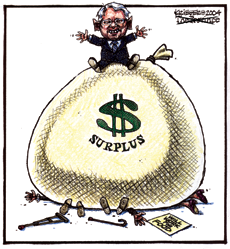
The official election campaign is about to start, and Premier Gordon Campbell and his ministers are giving out money like there is no tomorrow. There’s money for sports stadiums, and money for parks, and money for new housing projects for seniors, and new health research projects that, it is to be hoped, eventually benefit everyone. It would seem that before we voters actually go to the polls on May 17, there won’t be a community left in British Columbia that hasn’t benefited somehow from this tidal wave of newfound money.
This, as Premier Campbell keeps telling us, is the beginning of “the golden decade,” something that all of us in British Columbia have earned by going through the pains of the past three years to get to that balanced budget. (Just ignore for the moment the debate as to whether in fact all British Columbians have in fact gone through Campbell-caused pain, or whether that pain was disproportionately tilted towards the poor, the ill, women and seniors. It doesn’t matter for purposes of this analysis.) Because in any case, it’s over now, and everyone will be marching into a much brighter future. Or so Premier Campbell would have us believe.
To be sure, he’s careful never to say the words. But there’s no question that he and the Liberals would like us all to think that the incredible largesse we’ve witnessed in the past 90 days will continue, just so long as the Liberals are re-elected.
The only problem is: the Liberals’ own budget documents tell a different story. According to the detailed ministry plans as laid out for the next three years, many British Columbians are going to feel the pain again, before the next three years are up. The struggle to find and maintain a reasonable level of service will resume once again.
What the ‘resource summaries’ say
The numbers are contained in documents known as “resource summaries” for each ministry. As part of the government’s financial planning, each ministry as part of the budget provides a look-ahead to how things might look two and three years down the road.
One must start, of course, with the disappearance of the so-called “slush fund” that was included in February’s budget for, it might be argued, the sole purpose of doling out election goodies to communities around B.C. Under the heading “Enhancing Economic Development Throughout British Columbia,” Small Business Minister John Les has been given for the current fiscal year a fund of more than $235 million to distribute. That’s 13 times as much as was in that same fund one year ago. It won’t go back down to its previous base level of $18 million next year, but more than 80 per cent of it will have vanished again. The fund will stand at about $43 million for 2006-07, and then drop even further back to $28 million the next year. There’ll be a lot less money around for all those community projects that have enjoyed the capital grants in the months leading up to the vote. The money earmarked for “capital projects” in most ministries will drop significantly as well.
Of greater concern, however, is the question of whether key government functions will have the staff and money to provide the services British Columbians would like to see. On this question, the budget documents offer a mixed bag of responses.
Some ministries, such as Advanced Education, appear to be launching out on a plan which will indeed see continued growth and development. B.C.’s post-secondary institutions are predicted to see a small but steady growth in revenue from government over the next three years. The money available for student loans is predicted to increase as well.
But other ministries – and their clients – are not so fortunate. In the Ministry of Water, Land and Air Protection, for example, spending in many areas has reached as high as the Liberals plan for it to get during the current fiscal year. Spending on “environmental protection” will decline slightly again next year and the year after that. So will spending on parks and recreation. Spending on “environmental stewardship” will stay exactly the same for the next three years. The only increases in money and staffing will be found in the “enforcement and compliance” areas.
Fall-off for schools, health sector
School trustees might also be a little nervous if they looked at the predictions for their funding for the next three years. The increases that have had school boards breathing a sigh of relief this year amounted to about $139 million across the board. That, boards said, was enough to allow them to maintain services, to add back some of the services that had been lost, such as special needs counselors and teacher-librarians, and not to have to consider distressing options likely closing more schools and laying off more staff.
But the numbers show that next year, the plan is to increase the total budgets for public schools by only $60 million – less than half this year’s increase. And by the year 2007-08, the increase will be a measly $17 million (on a total budget for more than $4 billion). Just dealing with the normal costs of inflation, let alone any wage increases or paying for the skyrocketing fuel prices, will more than eat up that sum.
Even the health care sector will have new concerns as the next years unfold. The money allotted to the regional health authorities – the money that pays for the hospitals, the long-term care facilities, home-care for the elderly, mental health services, and public health – went up this year by about $475 million. It’s been enough to allow the authorities to balance their budgets without cutting services further, although still not enough to make a big dent in the surgical waiting times or clear up the horrendous backlogs that often plague our emergency wards. But the increase for next year is going to be only a little more than half that – about $260 million. And for the year after that, it’ll be down to $162 million. It’s difficult envisioning those increases being enough to prevent the system from spiraling further into crisis.
Even more worrisome is the money being allotted to B.C.’s doctors. The total being spent on Medicare payments this year is budgeted to be more than $100 million more than it was last year. But in 2006-07, the increase is expected to be only about $15 million – and for 2007-08, it’s not expected to rise by a single dime. Doctors, in other words, are being expected to hold the line on payments – not just how much they get paid to do any given procedure, but how much they will make in total, no matter how many more patients they must cope with. Given the strong stand the B.C. Medical Association has recently been taking in negotiations, this could be little more than wishful thinking.
Too many cuts in service within a year or two after the election, and the B.C. electorate could be forgiven for thinking that the golden decade had turned into fool’s gold.
Barbara McLintock is the Victoria-based contributing editor to The Tyee. ![]()


24
Login or register to post comments
dearpremier.ca
7 years ago
Comments on "Budget Plans Spell End to B.C. Libs’ Sp
Jean Binette writes: Thanks for the interesting jumble of numbers Barbara. Did you get them from Mr. Shreck?
Dan
7 years ago
That's democracy. As much as I don't like it, everyone I discuss this 90 day pre-election spending spree with says "That's what any party would do" or "That's what I would do if I was in power". And they're right. It's our duty as the voting public to see through that, and have at least a 4 year memory (I know that's hard for some, but let's try) when going to the ballot box.
dearpremier.ca
7 years ago
Jean Binette writes: I fully agree Dan, but voters should stretch back at least 12 year's worth of memory in order to make an informed decision.
BC Mary
7 years ago
There's $6,000,000,000.00 in cash wafting around British Columbia each year, the proceeds of organized crime.
Of course, we know that illicit cash would never find its way into unmarked envelopes. It would never pay campaign expenses. And even if those unthinkable things did happen, organized crime would never ask for favours in return. No, no. They'd be donating for the good of the country.
The punisher
7 years ago
Thank you for your most informative post ever BC Mary. That's one hell of a grow-op for sure.
Sincerely
The Punisher
Budd Campbell
7 years ago
Here's a question I would like answered by someone who understands the basic policies underlying fiscal federalism. How is it possible for BC to be collecting federal equalization payments at the same time that it is running a $2 billion surplus? At what point in time do the net payer provinces, Alberta and Ontario, stand up and demand that the process be halted?
dearpremier.ca
7 years ago
Excellent question Budd - I don't have the definitive answer for sure. But I think Ontario and Alberta are already complaining loudly, and I am left wondering if we will be faced with massive cutbacks in federal transfers next year, leading to yet another health care crises.
JIm
7 years ago
Budd, I'm not too sure, but I believe that the equalization we are getting now stem from 2+ years ago. I have read there is a 30 month lag time between the completion of the fiscal period and the payment of the funds. Still, that's my translation so I’m not too sure how it really works.
This is puzzling to me as well, I have tried to find a straight forward explanation of equalization payments, but I don't think there is anything straight forward about them. You need a PhD in Canadian bureaucracy to figure it out.
Your question budd is one I’ve been trying to figure out for awhile with not much luck. Please post any definitive answers you can find. But my basic answer, guess, for you would be that equalization payments are a snapshot of what the province just went through, not what it's going through.
mbraun
7 years ago
JIm the information really isn't that hard to find! Even if the equalization payments stem from over 2 years ago (which they do not) the liberals would be responsible for the payments we in BC have been receiving for the last 2 years. Have a look at this link - scroll down to a nice little chart showing the equalization payments since 93-94.
http://www.fin.gc.ca/FEDPROV/eqpe.html
Now it's not too difficult to see where you were going with your post considering you are one of the lemmings out there who still goes on ad-nauseam about the “financial mess†that was the 90's BC NDP. That being the case, JIm, note the NDP years! It’ll be interesting to see if we qualify again next year. I say this because the purpose of equalization payments is to ensure that every Canadian has access to adequate social services – it is NOT a transfer from the “rich†provinces to the “poor†provinces. With the gutting the social services courtesy of gordo et al., does that mean we will continue to be eligible until a socially responsible government is reinstated?
I know poor Jim, this will be hard to swallow; what with your suffering from the “ostrich†syndrome (i.e. head in the sand – if I can’t see it, it doesn’t exist).
JIm
7 years ago
So mbraun, are you saying that equalization payments are immediate? Since this is so easy and I’m a little stuck on it.
When we receive equalization payments this year what fiscal year is that calculation from?
"I say this because the purpose of equalization payments is to ensure that every Canadian has access to adequate social services – it is NOT a transfer from the “rich†provinces to the “poor†provinces. With the gutting the social services courtesy of gordo et al., does that mean we will continue to be eligible until a socially responsible government is reinstated?"
It's weird, NDP governments in other provinces aren't providing adequate social services, yet Alberta is. That flies in the face of your logic that left leaning governments are better for social programs after all Alberta obviously is the best and they have a conservative government. I guess I learned something new today, vote NDP for reduced social services.
Yammer
7 years ago
Liberals running out of money? Can't they just, I dunno, sponsor something?
Budd Campbell
7 years ago
If you go to the site referenced by mbraun you will get some figures for BC:
1999-00 125
2000-01 0
2001-12 240
2002-03 71
2003-04 320
2004-05 682
2005-06 590
Even if there is a two year lag, the latest payments, for 2005-06, would be in consderation of 2003-04. The payments seem to be increasing, though the latest figure is down somewhat from last year's. Still, it does represent about one third of the surplus of $1.9 billion ($220 million official surplus plus debt payment of $1.7 billion as in Fin Min Colin Hansen's press release of Feb 15 [[url]http://www2.news.gov.bc.ca/nrm_news_releases/2005FIN0004-000139.htm][/url])
Chuck
7 years ago
JIm, yet again you're posting a lot of BS. "It's weird, NDP governments in other provinces aren't providing adequate social services, yet Alberta is. That flies in the face of your logic that left leaning governments are better for social programs after all Alberta obviously is the best and they have a conservative government. I guess I learned something new today, vote NDP for reduced social services."
While it is true Alberta is the richest province in the country, Alberta is also the perfect example why your right wing philosophy doesn't work.
Health care, education and social services in Alberta are as bad as BC's, if not worse. Although the Alberta government is rolling money it is not investing the money in health care or education. Speak to any working class person in Alberta and they have any many horror stories to tell as we have.
The conservative mantra; reduce taxes for business and they'll all become profitable and we'll all benefit with good jobs is simply a load of BS. The rich get richer and take their money out of the country to invest overseas where they can really exploit the people, more bang for their buck.
The Liberals have shown, without shame, they are ready,willing and able to cut social services with passion.
jesterjogger
7 years ago
Good point Chuck.
Guess where the wealthy of bc spent their gordo reaganomic gift of 2 billion in 2001. In bc? Not a f'n chance and these swine knew it too. why invest your ill-gooten booty in a place that still has some environmental standards, work-pace regulations and social safety net when your capital can seek out the sources of greatest exploitation, i mean profit. In the race to the bottom gordo and his hidden majority might save themselves a little while longer than the rest but they better have diamond coated bio-spheres. Gated communities with lard-ass private security rent-a-cops cruising around in smart cars is'nt gonna cut it when the bottom falls out.
p.s.-try not to give these guys anymore ideas ok Margaret!
mbjc88
7 years ago
(Just ignore for the moment the debate as to whether in fact all British Columbians have in fact gone through Campbell-caused pain, or whether that pain was disproportionately tilted towards the poor, the ill, women and seniors. It doesn’t matter for purposes of this analysis.)
If we are supposed to ignore it and it doesn't matter, then what is it doing in the article?
crh
7 years ago
If anyone can't figure out Gordo's style after four years, they don't deserve to vote. This Liberal party is so obvious that some of their members are embarrassed to be tied to them. Sheila Orr in her recent campaigning, doesn't even put the fact that she is a Liberal in any of her advertisements. Guess she knows that is her only chance of being re-elected.
Let us not forget, that Gordon Campbell has been a lousy Premier. He is not a leader of all people, but simply a man with a corporate agenda.
Why settle for second best?
Budd Campbell
7 years ago
I for one find it a bit curious that Vaughn Palmer hasn't found one of his experts to comment on this fiscal conundrum.
We hear ads extolling the great revival of BC's economy, some coming from the BC Liberals and many more coming from a variety of other sources, some identified, some not. Then at other times we hear that in "these tough economic times" there is no room for spending on certain public services, or raising public sector wages. Which is it? Good times or tough?
And then you turn to the budget and you see that it's time for a $1.7 billion paydown of the accumulated provincial debt, but it's also time to ask the rest of Canada to send us the domestic equivalent of foreign aid in an amount exceeding half a billion dollars. Again, which page are we on here?
jesterjogger
7 years ago
Welcome to the GOLDEN DECADE!!!!
Not only do the liberals vastly UNDERFUND our health care system but now they are THREATENING the doctors who have spoken out against their brutal cuts which ENDANGER us all. Welcome to the most OPEN AND ACCOUNTABLE government in B.C. history!!(Gee I wonder if all of this systemic underfunding has something to do with complete privatization of our health care system. Guess what sick poor or middle class person - YOU DIE!)
What hypocrisy, what true evil. The liberals say they dont want "negative press" so close to an election!! Yeah I guess it's better that the vast majority of us find out that we're
fu$&ed after they buy the election with a bunch of promises that they KNOW THEY WILL BREAK! The evil master rove has taught them well.
I, with great pain and utter disgust, forced myself to watch a liberal cheer-leading session on lap-dog canwest last night.
I'm never seen such a critical mass of sleaze, self-interest, greed and outright moral bankruptcy.
Don't forget that the doctors who have spoken out against the liberals dismantling of our PUBLIC HEALTH CARE SYSTEM have all taken the sacred hypocratic oath: "..I will prescribe regimen for the good of my patients ...and never do harm to anyone..".
Too bad for us that the provincial liberals never had to take the same oath.
lynn
7 years ago
Well said, jesterjogger. This government has been jingling fool's gold around in their pockets for some time now... their agenda continually fed by one tawdry deception after another. My Dad would have called them swindlers. The lot of them. Whether or not we get a Fool's Gold Decade will depend on whether the electorate is foolish enough to believe them once again.
jesterjogger
7 years ago
I apologize for my earlier, innacurate statement, re the source of the so-called threatening memo which I was told originated from the provincial government. I have since learned this was not the case.
Frank
7 years ago
On equalization, it doesn't matter if you're in surplus for 10 years straight, you can still get equalization. Its not based on your provincial budget.
Shreck has a good basic explanation : "The basic idea behind equalization payments is to pretend there is a standard tax system and then to apply that tax system to each province. Those provinces which fall below a comparison standard of revenue per person from the standard tax system become eligible for federal payments to make up the difference. Over the years the standard tax system and the average used for comparison have changed.
Until 1962 the standard tax system used personal income tax, corporate income tax and succession duties. Half of natural resource revenues were added to the formula in 1962. At the same time the standard for comparison was changed from the average yield of the standard tax system from the two wealthiest provinces to the national average.
Since 1982 the standard for comparison is the average of the five middle income provinces - Quebec, Ontario, Manitoba, Saskatchewan and British Columbia. The hypothetical common tax system is applied to the fiscal capacity of each province, and then compared to the five province average. The common tax system, fiscal capacity, is based on 33 separate provincial revenues sources. Personal income tax remains the most important. The Campbell government's cuts to personal income tax do not affect the equalization formula because they are based on a representative tax system for the entire country rather than on the actual tax system of any one province."
gsb
7 years ago
Yes, this is what needs to be looked at and I applaud you for writing this article.My interest is MCFD which is looking at 5% cuts over and above.It is stark now and we are on to a cowardly new world under the Fibs who are going to continue with their right wing agenda of changing the social fabric and greasing the skids for their selected corporate friends.Wake up British Columbians before our waitlists grow longer, the homeless population explodes, and they keep on telling us how the serices are better and the sun is shining on this beautiful day.Do not sell B.C.
Budd Campbell
7 years ago
Frank has given us some useful details, presumably from David Schreck.
Without disputing what Frank has said, it seems to me that major changes to BC's tax rates would have at least some effect on the equalization formula as described, since it would affect the hypothetical "national average tax rate".
Isn't it rather odd that no one can provide a link to the federal or provincial finance departments that would give a complete explanation of equalization and how it is calculated? I am told informally that, at least for the federal Finance Dept, it's a bit of a state secret, and if so I think it's really strange that no one has challenged that under Access to Info.
Also, why would other provinces be content to pay equalization to a province that is running a surplus and paying down its debt? Whatever the calculation details, the basic purpose of equalization is to allow all provinces to provide a kind of standard level of provincial and local public goods and services (highways, education, health, welfare) to their populations whether or not that province has a strong economy producing lots of revenues. IOWs, it was intended to equalize the ability of provincial governments to spend on services, not to finance lower tax rates in conjunction with atrophied service levels.
sonic931
7 years ago
The numbers are contained in documents known as “resource summaries†for each ministry. As part of the government’s financial planning, each ministry as part of the budget provides a look-ahead to how things might look two and three years down the road.
Jean Binette,your sarcasm would pack much more punch if you actually took the time to read the articles you choose to mock...