News

Olympic Village Neighbourhood Green Enough?

Leading green builder says Vancouver's Southeast False Creek plan falls short of world-class.

By Scott Deveau, 4 Mar 2005, TheTyee.ca

sefc2

The Tyee.ca

When Vancouver's city council approved plans for Southeast False Creek Tuesday, it waved off critics who said the project spent too much in service of green ideals. But now the city's sustainable Shangri-la has a critic from the sustainable building community.

A leading green builder in B.C. says the project risks not being green enough. If the project is to be a successful model of innovation, argues Joe Van Bellegham, a Victoria-based green builder, the Vancouver council will need to rethink how it parcels out the land and specifies technology. There's no doubt the project will be much greener than your average neighbourhood.  The measure of such things, recognized worldwide, is the LEED rating, which stands for Leader in Energy and Environmental Design. It's a point system grading how efficiently builders use energy and water. Southeast False Creek's development plan will also require all municipal buildings and the Olympics Athletes' village to be built to a LEED gold rating, and all other buildings are required to meet a LEED silver rating.

No other municipality in North America requires such high LEED standards.

Aim higher says developer

Van Bellegham, developer of the Dockside lands in Victoria, says his project is poised to become the first platinum LEED community in North America, and he doesn't understand why Southeast False Creek can't do the same.

Some have argued the Vancouver project had to be made a bit less green in order to cut costs and create a prototype that commercial developers could replicate in other settings while turning a profit.

And some have gone further, arguing that Southeast False Creek, as planned, is already economically out of whack.

In the Feb. 18th Vancouver Sun, columnist Bob Ransford's raised concerns that the $85 million from the city's Property Endowment Fund used in the project will not be returned and that the anticipated $68 million profit from the Southeast False Creek development will also not be reinvested into the fund, but will rather redirected into the community's services.

Ransford said in his column the city's plan to invest in social housing, child care centres, and community gardens is "gutting" the city's $1.2 billion Property Endowment Fund and would "rival the fast ferries as one of the costliest failed attempts at using public dollars to build something that has never been built before."

Ransford's concerns were echoed in Tuesday's council meeting by both NPA councilors Sam Sullivan and Peter Ladner.

Triple bottom line

Mayor Larry Campbell said the purpose of the Property Endowment Fund is to invest in the community, not the bank. The city has adopted a triple bottom line approach to building Southeast False Creek, attempting to balance social, economic, and environmental concerns in its development. 

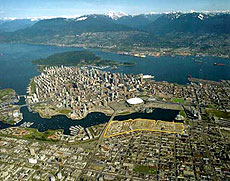
Vancouver's COPE dominated council won't to turn a profit on developing 12 hectares of waterfront property. Council has defended the economics of its plan highlighting that one third of the development's residential units will be allocated to affordable housing with subsidized land values; another third will be allocated for social housing.  About 10,000 people are expected to live in the community.

Joe Van Bellegham, who has no qualms about admitting he has an interest in developing part of Southeast False Creek, says the project should not only offer that level of social housing, but push harder at the edge of green sustainable construction.  Van Bellegham admits he was a "shitty" builder in the past, but has adopted a new philosophy around green building.

"I'm a chartered accountant.  I went to business school.  What do they teach you there about the environment? It's a cost of business or, you know, do the minimal amount possible to avoid prosecution," he said.

The Dockside plan

The Dockside project will be built on five hectares on the east side of Victoria's inner harbour that is contaminated by industrial waste. Van Bellegham's Windmill Developments won the contract to develop the site and remediate the land.

The sustainable community features on-site septic treatment, a bio-diesel factory that will provide fuel for the project's construction vehicles, car share program, and mini transit. There will also be a facility that will reach "super-platinum" LEED rating and will house a group of NGO's like the Sierra Club.  The facility will also act as an education centre for sustainable building, Van Bellegham said.

"What stopped a lot of municipalities from using the triple bottom line is that they were afraid they weren't going to get fair value.  What Victoria has done is shown leadership.  They are getting a fair value for the land, but they're getting much more than they could ever have imagined," Van Bellegham said.

He said he has some concerns about the way the Vancouver is parceling up the Southeast False Creek project's land and placing technological restrictions on developers.

The Southeast False Creek development plan outlines specific green building strategies it wants builders to adhere to; from green roofs and bio-swales to retain rain water to building orientation to reduce heat demands. But the development plan is also specific about what methods developers use.

Heat sources are to use methods like geo-thermal ground loops or sewer-pipe heat recovery. Van Bellegham warns that if the city gets too restrictive on how it wants the community built, it may well cut into the innovation that green builders could bring to the table.

'Don't try to figure out too much'

"The danger is too to try to figure out too much.  A lot of proposals I've seen elsewhere get really constrictive and say, 'You shall use this fixture. You shall use this glass.' Personally, I think that's a mistake. That should be where the developers distinguish themselves," Van Bellegham said.

His other concern is the city's intent to put individual parcels up for development instead of larger sections of the community going to one developer.

 "Vancouver, in my opinion, is really on the brink of something.  Victoria for instance is attracting attention from around the world and really capturing people's imaginations.

"If they had have taken the triple bottom line to Dockside and parceled it up like Vancouver is planning, there is no way they would have gotten what they got, because you need the economics for a lot of these systems to be spread out.  I'm not saying that all of False Creek would have to be parceled as one sale.  But you need some meaningful pieces put out," Van Bellegham said.

Van Bellegham said high rating LEED buildings use so few resources, building something like on-site sewage treatment for one building would be unfeasible.

City Hall satisfied

The City of Vancouver's green building planner Dale Mikkelsen said he is not concerned that the city's plan is placing too many constraints on builders. 

He said forcing the developers to conform to communal systems actually helps them build to a LEEDs silver standard because by virtue of tapping into the communal systems, they up their LEED rating on each building. 

Likewise, Mikkelsen said he is not concerned the dividing the land up into smaller parcels will impede upon innovation. 

Mikkelsen said the five current platinum ranked buildings in North America were all developed as single buildings.

The overriding goal to developing Southeast False Creek to a LEEDs standard is to "show developers building green is the way to go."

By developing such a large area divided into small parcels there will be more builders involved and it will create a larger demand for sustainable products to be built in B.C., Mikkelsen said. 

"This will create a competitive market and the builders will be forced to try to achieve a higher LEEDS rating to distinguish themselves," Mikkelsen said.

Changes can be made

The city's green strategy is independent of the development plan for Southeast False Creek and can be amended by council at anytime, Mikkelsen said. The standards are currently set at silver for all other buildings than the municipal ones and the Olympic village, which must be built to a gold standard.  There is nothing preventing council from upping the ante over the 15 year plan to develop the area (nor is there anything preventing it from reducing those standards).

The LEED rating system is what Mikkelsen refers to as a "market transformation tool" that is itself malleable.  The standards for LEED are upgraded every three years to reflect the standards buildings are adhering to. In three years, the gold level municipal buildings are being built at, will in fact be held to a much higher standard, Mikkelsen said.

Scott Deveau is on staff of The Tyee.  [Tyee]

10  Comments:

Login or register to post comments

  • rob_ (not verified)

    7 years ago

    from: Rob's
    Ramblings Blog (
    http://rbaxter.blogspot.com/ )/FONT>

    Here are my comments for a public hearing at Vancouer City Hall:

    We who live in Vancouver often like to consider ourselves world leaders when it comes to environmental sustainability. Will the new South East False Creek development be a world leader in environmental sustainability?

    There is no doubt that the planners and others that worked on this project have put a lot of hard work into it. It will undoubtedly be one of the most sustainable neighborhoods in the Lower Mainland and British Columbia. But will it be the a world leader? I have concerns that it may not be.

    An example of a world class environmentally sustainable community being planned is Mata de Sesimbra in Portugal. It is part of the One World Living project.

    There are two areas that I would like to emphasize when looking at the sustainability of SE False Creek.

    The first is transportation. I think a large portion (if not all) of the community should be car-free. I know this sounds like a radical idea but in actual fact it is not. Many cities around the world have car free areas. The planned community in Portugal has a goal of zero automobile use in its urban areas. Even Toronto has a community of over 300 people where private cars are not allowed. Do we really want to be behind Toronto when it comes to sustainability?

    The second issue I would like to address is renewable energy. I realize that there has been some discussion of renewable energy in SE False Creek. But I am afraid that this will become a suggestion that is not widely implemented. The community in Portugal has a goal of 100% renewable energy use.

    Ground source heat pumps should be used in as much of the area as is physically possible. Solar hot water systems should be required on all buildings with good southern exposure. Both of these are cost effective technologies that are already in use in Vancouver. Photovoltaics are less cost effective but should be incorporated where it is feasible.

    And what about a wind turbine? Normally the urban environment would not be suitable for traditional wind turbines. But the open spaces along the edge of false creek might be a good spot for a mid-sized turbine. Toronto has a large wind turbine on the edge of its downtown core. Again why are we behind Toronto?

    I think Vancouver deserves the best. I hope that we will work to create an example of sustainability that really is one of the best in the world.

  • Sue Clark (not verified)

    7 years ago

    World class? Are Vancouver builders capable of doing such work? This article makes me think about the leaky condo travesty and the builders who would just change their company name each year to avoid prosecution. I also think about the poor building codes in BC and the previous NPA government in Vancouver passing a bylaw that they cannot be sued for their poor building codes. I see outrageously high prices on new complexes being built and wonder what surprises the purchasers have in store for them.

    Vancouver builders have a reputation for piss-poor construction, why all of this fuss over green initiatives when they cannot build a decent home of any kind?

  • billy pilgrim (not verified)

    7 years ago

    i hate the olypmics and anything that is connected to them. the corruption in the olypmics make martin and his sponsorship scandal look like pikers. all the construction leading up to the games will put pressure on prices and make already sky high housing prices even more unaffordable to the average working stiff. gordo and his pals in the property development game will be lighting their cigars with $100 dollar bills. all this reminds me of an old adbuster line - growth for the sake of growth is the ideology of a cancer cell.

  • trew to a fault (not verified)

    7 years ago

    The tax stewards no doubt will be the Campbelltards,at the time of this construction gambit sees the light of day,which it will, i do suggest that the housing for the affordable level will not include lowest income persons[to whom it will be unaffordable].
    The priority is to fleece the general tax revenue pile and shift as much as possible to reward developers for favours to be rec'd,that's the way of the world.Pricey condos will occupy their rightful place,profit will flow ,th big O is all about profit ,why would any other sane person start lusting after a 5 year away ,two week event?
    Sorry to say but the system of government in B.C. is way into cronyism ,qid pro quo,and assorted creative activities .The group in power can do almost anything it wants with its majority mandate.Tread carefully though lokk what happened to their predecessors even after some heating help cheques were cut,remember those? Will new cheques be cut ,as we get closer to the election?
    Someone's gone get cheques,who will it be?

  • Fi (not verified)

    7 years ago

    vancouver isn't even close to being environmentally sustainable- on a very basic level. Two paper cups every time you buy a coffee??... so you don't burn your wee hands (I take them home, rinse them out and re-use them and get weird looks everytime). I've lived in some pretty trashy places on this planet and this city is starting to resemble them. Perhaps the Westender rant page is the better place for this comment, but give me a break- until people in this city clean up their "litter act" and lose the obsession with take-out cups... argh!!!!! What a joke...

  • cab (not verified)

    7 years ago

    I'd agree with rob and the Carfree idea. If you look at the existing transportation plan they have really forced into the area a large amount of auto infrastructure. A green building is fine and dandy, but without addressing in an equal sustainable manner you really not getting anything new or ground breaking. What is shown here at http://www.carfree.com would have been a much better model to follow then this standard North American urban development.

  • Super.. (not verified)

    7 years ago

    Social housing that has been promised to follow past Olympic Games has never materalized. Another myth that haunts the Games. Sault Lake City for one that is nearby.

  • Kit (not verified)

    7 years ago

    "South East False Creek" was part of Mount Pleasant - and at the stroke of an NPA pen in the 80's, became what it's called to day. Prior to that, it had clearly been intended to be used as a park, to address the greenspace inequities (14 to 1 differential by some park metrics, that had been argued at City Council) of West side to East side park space.

    South East False Creek is a yuppie community, with an intended park for it's own developmental constituency - not for the whole of the Mount Pleasant Neighbourhood. "World class" is development-speak spin that's invariably used when "developers" want to build (read - extract) something out of the ground.

    "South East False Creek" arrived as an NPA initiated plan, as a contruction project. The question, as framed was: "How can we best develop the site" Surprise..

    It didn't arrive via asking: "What's the best use of the last piece of public waterfront in Vancouver?"
    Picture Jericho. Picture Stanley Park. Notice any houses, apartments?
    Jericho could've been - easy as pie. Never happend.
    Huge West side support for a living green space. Dear me - the lost "World Class development" opportunity. How un-sustainable. A park instead -

    As stated, South East False Creek was an NPA intended construction project. And everyone went chasing the bit thereafter. Once the question of that land use was set into motion - it was near impossible to turn back, and ask the question: "What the best use of that last piece of City waterfront property?" - because every interest had gotten its fingers into it by then.

    Intially, after initial proposals all the park space was to be 8 hectares, then after huge Mount Pleasant Community outrage at this neighbourhood rip-off - it was revised to 26.4 hectares. (A professional poll had been commissioned in Mount pleasant of 1000 polled people, and the vast majority of those polled had wanted the land as park, as initially intended). The initial 26.4 hectare park was really only agreed too because it is too toxic - and too thus expensive to remediate, and then built on.

    When the COPE adminstration took office, the SEFC land use was re-debated - but under the same NPA frame of the land use question. In the end the park land was hacked down to two hectares less - thanks to NPA / COPE lite support (one vote difference), including "40 watt incandescent bulb" positions like COPE really-lite Raymond Louie's, who stated in council during the vote on the final proposal, that his child didn't like "do-nothing parks", and so he voted against the COPE councillors who wanted to actually respect the initial NPA agreement of 26.4 hectacres of park. Stanley Park, and Jericho must be totally insufferable.

  • jasondoubleyou (not verified)

    7 years ago

    does anybody know the amount of people that are expected to reside in the areas between the cambie bridge, city gate south to first ave? almost 20k!

    i like the comment about world class design and construction. (in the land of leaky condos...) is there a level beyond leed: locally ubc has taken the leed 'challenge'. by completion of sefc, would the leed standard be outdated anyway.

    npa, cope. who cares where the idea came from to develope prime waterfront realestate. better suited than post industrial city works yard.... why does this have be so proprietary?

    end.

  • RickW (not verified)

    7 years ago

    Vancouver idea of being world class is to finally be able to say that apartment rents here are the same as those in Manhattan........

    • No best comments selected by an editor for this story yet. To see all comments, click the All Comments tab, above.
    • The discussion for this story is closed. No more comments can be added.