- Ms Kaye is a Tyee Builder. You can be, too.
- Mary Carlisle is a Tyee Builder. You can be, too.
- Prem Gill is a Tyee Builder. You can be, too.
- Nancy Flight is a Tyee Builder. You can be, too.
- Justin Everett is a Tyee Builder. You can be, too.
- John Westover is a Tyee Builder. You can be, too.
- Nora Etches is a Tyee Builder. You can be, too.
- Edward Henderson is a Tyee Builder. You can be, too.
- Bharadwaj Chandramouli is a Tyee Builder. You can be, too.
- Dean Chatterson is a Tyee Builder. You can be, too.
- Marius Scurtescu is a Tyee Builder. You can be, too.
- Robert Parkes is a Tyee Builder. You can be, too.
- James Murton is a Tyee Builder. You can be, too.
- Susan Doyle is a Tyee Builder. You can be, too.
- Vincent Strgar is a Tyee Builder. You can be, too.
- Helen Spiegelman is a Tyee Builder. You can be, too.
- Subir Guin is a Tyee Builder. You can be, too.
- Kimball Finigan is a Tyee Builder. You can be, too.
- Joanne Manley is a Tyee Builder. You can be, too.
- David Leach is a Tyee Builder. You can be, too.
Coast Guard Cuts Fog Horn Wires
Boaters must "share the responsibility" as navigational warning tools are shut down.
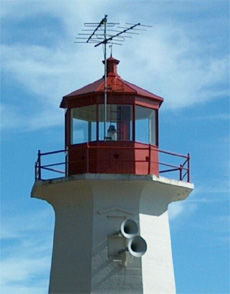
The Canadian Coast Guard's Pacific Region management this week shut down another part of the West Coast's marine safety network. Just four years after installing a new generation of electrical fog horns -- less powerful devices which replaced the coast's much-beloved but high-maintenance air-compressor horns -- the coast guard's regional superintendent of marine navigation services told three Inside Passage light keepers near Campbell River that their stations' fog-horn warning devices would be immediately taken out of service.
The three sites are the Cape Mudge Light at the southern tip of Quadra Island, Vancouver Island's Chatham Point Light near the northern end of Quadra Island, and the Pulteney Point Light on the west end of Malcolm Island.
The lightstations maintain watch over a comparatively narrow passageway up the east coast of Vancouver Island, which is extensively used by a wide variety of large and small vessel: kayaks, sports and commercial fishing boats, freighters, container barges and tugboats, and giant cruise ships.
Rick Nordstrom, president of the Gulf Trollers Association, which uses the area extensively, noted that the passage regularly has problems with fog in summer, and said the cruise ships frequently use their own fog horns to try to warn other marine traffic of their location and approach.
The disconnections were quickly condemned by members of the commercial fishing fleet and municipalities along the route. Federal Fisheries Minister Geoff Regan is due to meet a regional district government official to discuss the issue next week.
"There's a real risk that there could be an accident, with potential loss of life." said Garth Mirau, vice-president for the United Fishermen and Allied Workers Union. He added that an accident on water is very different from on land, because help can be "very hard to get and very expensive."
Cuts are "false economy"
Mirau compared the disconnections to the coast guard's previous, largely unsuccessful efforts to destaff of lightstations, efforts he said degraded the safety service based on "a false economy." Mirau said lightkeepers are afraid of speaking out against the ongoing reduction of coast guard services because they fear being reprimanded, and claims lightkeepers have even been disciplined for taking part in rescues.
At first, the recent disconnections were blamed on Ottawa, but Victoria coast guard superintendent Terry Weber confirmed this week that he made the decision a month or two ago, following a review of services at the stations. He notified the three lightkeepers by telephone early this week, informing them that a helicopter-carried crew would arrive at the stations -- all accessible by road -- within a few days, to disconnect the fog horns.
Weber told The Tyee he expects the remaining four fog horns left at B.C. lightstations also to be taken out of operation in the next year or two.
Weber said that with most marine traffic now equipped with charts, radar and extremely accurate electronic global positioning systems, the fog horns are no longer seen as needed. "Very, very few mariners rely on fog horns for navigation," he said, adding that the devices are now regarded internationally as "very imprecise" guides for navigation and warning.
Renewed onus on boaters
Asked about the numerous pleasure craft and small recreational fishing boats which operate in the area, often without global positioning systems, Weber said the coast guard will be placing renewed onus on all vessel operators to ensure they are suitably equipped for safe navigation along the coastline, in fog or not. "We deal with many different kinds of mariners, including the small boat, and they're expected to share the responsibility and be equipped to travel accordingly," he said.
Memories of the Cap Rouge incident -- when a coast guard dive team was initially refused permission to rescue hoped-for survivors from the overturned seiner -- are still vivid, exacerbating the reaction of lightkeepers and maritime observers.
All three lightkeepers said the current generation of fog horns, which use solar power, are extremely reliable, require virtually no maintenance, and cost almost nothing to run.
Nordstrom said some members of the small-boat trolling fleet have not installed GPS systems, and added that electronic systems have a nasty habit of breaking down. "Things always go wrong," he said, "it's Murphy's Law. And when do things go wrong with your electronics? In the fog, of course."
Nordstrom and Mirau both said they intend to fight the disconnections as an unjustified increase in risk to mariners.
Further cuts feared
During the recent federal election, concerns arose that the plan to destaff the Cape Mudge Light was about to be revived. Neither the North Island Liberal candidate nor Island MP David Anderson -- who promised several years ago that the light destaffing program would not be reinstated while the Liberals were in power -- was able offer any reassurances on the issue. Anderson, once B.C.'s top MP and the federal fisheries minister responsible for the coast guard, is no longer in cabinet.
Weber said this week that if there is any renewed plan to destaff the Mudge Light -- seen by some as one of the most crucial on the B.C. coast -- it is news to him.
Quentin Dodd is a journalist based in Campbell River. ![]()


12
Login or register to post comments
Nelson (not verified)
7 years ago
Weber is right. Most vessels on this coast have pretty sophisticated Electronics. However: Every time I power up my old Lowance it tells me not to rely on it as my only source of navigation. I beleive that. I have used light stations in the past for navigation (and been very greatful for the reassurance) There was something very comforting about the diphone (is it still operating?) at Pt Atkinson. At Alert Bay there are quite a variety of horns and I would truely miss them. Fog is so disorienting that any signal that one can trust is beyond essential. The point is: Any large commercial vessel will likely have very good equipment and layers of backup systems (these are not invulnerable either) and most pleasure craft have good electronics though there are Skippers out there who do not know how to use them. In the worst case: Your electrical system simply crashes and you are fogbound. (Do not dismiss this as somewhat less likely than winning the lottary) You have been running on GPS linked to your monitor that simply blinks off. WHERE ARE YOU? Assuming you took the above warning seriously you know exactly where you are. That's pretty good! But you are now (assuming you still have propulsion) blind And you are moving and you need to quickly pay attention to your COMPASS. That would imply that you remembered the desired bearing and knew that your binacle was reliable. I have never been in this situation although I have been involved in a total system crash - all GPS goes blank - no radar - no VHF. The good news was that we could still see the surrounding land forms. I have also run over my own wake in fog and thought there must be another boat near. Until I can go to the local ship chandlerer and buy a machine that sees through fog I vote that every light house maintains a fog horn.
larry (not verified)
7 years ago
More government imbicility! Isn't it time that the people who actually use, or work in a facility be the ones to make these kinds of decisions? Surely it ought to be up to the boat owners to say whether they need fog horns or not and not a bunch of bureaucrats who don't give a damn about anything but their tax-payer funded overpaid salaries! If anyone dies because of this, those responsible ought to be charged with first degree murder.
John (not verified)
7 years ago
In this day and age there is little to justify maintence of fog horns on our coast & in reality much the same applies to lighthouses. Electronics backed by the old fashioned paper charts are all a compentent skipper needs. Nostalgia is hard to shake but this is the 21st century & its time for those who sail to mature & stop whining about change.I wonder if 'boat owners' are prepared to pay licence fees to offset some of the cost of perpetuating obsolete navigation methodologies.
Heidi (not verified)
7 years ago
I live in the town of Sointula...within ear-reach of the Pulteney Point Light Station. There has not been a fog horn at Pulteney Point for years............
Mimi (not verified)
7 years ago
I'm not clear on why shutting down a few fog horns that cost "almost nothing to run" is even occupying Mr. Weber's time. This makes no sense, given the other seemingly more pressing issues the department has to deal with. Why the fog horns and why now?
Margo Hannah (not verified)
7 years ago
Just an exercise in petty management?
Not a boater (not verified)
7 years ago
I am not a boater but I really disagree with Webber's decision. Electronic global positioning equipment relies on sattelites does it not? If so, this time is not good for sattelites because of the behaviour of our sun. Huge solar flares of a size never seen before are happening all the time now. Some sattelites have been knocked out. The increase in solar flares happens in an 11 year cycle and reoccurs like clock work. The back up system which presently exists should remain longterm. Webber is dead wrong. It doesn't matter if one of the TV sattelites gets knocked out. That will not affect lives. But if the sattelites shipping and boaters rely on crashes that could cost lives. The odds have greatly increased on this occurring.
Been there Done that (not verified)
7 years ago
I have been in pea soup thick fog both with and with out a GPS and radar. Navigating by foghorn is a very tricky business even in a small open skiff where you can easily hear a fog horn. Yes a fog horn will give some reference but when you cannot see the shoreline until you are about to ground yourself fog horns are pretty much useless. I can see no way that a vessel of any size could have any use for foghorns as a navigational aid. A GPS and/or radar is the only real tool that should be used to navigate in the fog. If these instruments go down your best bet is to wait it out, yes that may be a few hours, but at least you will not end up driving on to a rock. The thing that is missing from the various articles about inactivating the fog horns is that they are useless except for that little bit of area around where they are situated. Probably 99% of the coast never had any fog horns for navigation. Most areas where I have been in fog are far from fog horns or lighthouses. To me they are an anachronism that are essentially useless on this coast, however people will now turn this into a political football complete with dire warnings of catastrophe. Ah life in BC never dull.
jeff (not verified)
7 years ago
Just face the facts. They aren't really needed. When's the last time you used a electric typewriter?
Nelson (not verified)
7 years ago
You got me! I have never found fog horns really useful - I just like the sound of them when I'm snug in an anchorage. In fact when I run in fog (as least often as possible) I have yet to sound the required signals. I avoid travel or hope that the other vessel sounds. By the way: Do you know what a Kayak or canoe looks like on radar? Nothing
Tim (not verified)
7 years ago
I've been commercial fishing for 24 years and frequently operate in fog. I only paid attention to a foghorn once and it messed me up so bad I think they should be illegal. If you can't navigate, stay at home.
Andrew (not verified)
7 years ago
Well if you arent gonna use the horns anymore...atleast give'em to me so I can put'em on my truck