News

How Did Premier Lose Public on Strike?

And more questions as dust settles on HEU dispute, with more labour fights looming.

By Barbara McLintock, 10 May 2004, TheTyee.ca

rally4

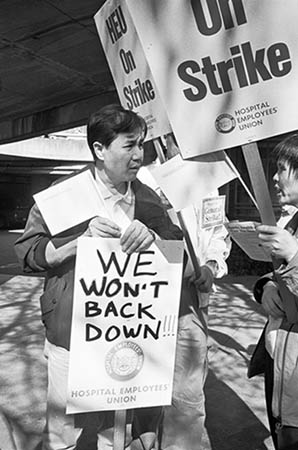
The furor over the Hospital Employees Union job action and the almost-general strike appears finally to be dying down. At least for a while.One might well suspect that the "truce" reached between Labour Minister Graham Bruce and B.C. Federation of Labour head Jim Sinclair should be compared not to the ending of a war, but to a brief ceasefire in which both sides can, without losing face, retreat, regroup and treat their wounded.Labour battles before electionAt least two more big battles are brewing on the labour front - and both must be fought before the fixed date of the next election in May 2005. One group involved is the teachers, the other the nurses.Last time around the nurses became known for throwing shoes during a demonstration in front of the legislature.The teachers have never managed to achieve a negotiated settlement since the current bargaining structure was first set up in 1996.None of this bodes well for labour relations involving the Campbell government during the next several months.All of which makes it worthwhile to look at some of the underlying factors involved in the HEU action in the hopes that British Columbians can learn from it some lessons that could reduce future levels of confrontation. For the Campbell government, that may mean looking beyond common assumptions about the strike, and grappling with some challenging answers to questions still lingering in a lot of people's minds. For example:Did the government really win this one?Most revealing is a McIntyre & Mustel poll that was taken only a few days after the truce was brokered. It is a given in political science in B.C. - and in most other places as well - that governments virtually always win public sector strikes, especially once the courts have ruled those strikes to be illegal. The public sees the union members on the picket lines, preventing them from getting access to health, education or other services they need. Independent courts have ruled the picket lines are illegal. In the court of public opinion, this is a battle that it should be nearly impossible for a government to lose.But the McIntyre & Mustel poll (which was conducted for Global TV, not for any union-related party) showed clearly that Gordon Campbell had managed to lose it. The general view of the populace was "a pox on both your houses." But when push came to shove, just 51 per cent of those surveyed said they disapproved of the HEU's strategy an tactics, compared to 65 per cent who disapproved of how Campbell and his cabinet had acted. Asked about how they viewed Campbell's personal performance, a full 47 per cent said it had made them think worse of him as premier. Only six per cent said it had improved their view of him.Apparently, a large majority of British Columbians weren't impressed by the oversimplified union-bashing spin that Campbell was attempting to put on the issue. They realized that it was a much more complex event than the government was making it out to be. Even after the poll was released, Campbell and his ministers continued to put 100 per cent of the blame on the HEU for everything that happened.Was this really about overpaid "hotel services"?The fact is that an HEU dispute can rarely, if ever, be a simple dispute, because the HEU is not a simple union. It is not like, say, the B.C. Nurses Union or B.C. Teachers Federation, where all members perform essentially the same job. The government would have liked us to believe that all members of the HEU were performing what Health Services Minister Colin Hansen describes as "hotel services" - housekeeping, food preparation, and laundry. Those are the services that the health authorities, with the government's encouragement, have begun to contract out to private companies, which are planning to pay $10 an hour or less for front line workers.Ironically, managers in the various health regions who took over some of those jobs during the HEU picketing were paid $50 an hour and more for the overtime they worked. Some of those managers also quickly realized that Hansen's description of them as "hotel services" was more than a bit of a misnomer. To be sure, hotel guests also need clean floors, clean sheets and towels, and healthful food. But those doing laundry for a hotel, for example, are rarely faced with sheets covered with blood and bodily fluids or bed linen that has been used by incontinent patients. But that's a regular occurrence in the hospital laundries.Even leaving those working conditions aside, however, that group of workers is far from a majority of HEU employees. Hansen talked about the HEU as members who don't perform bedside services for patients - but in fact, thousands of them do. They are, for instance, pharmacy technicians, licensed practical nurses and mental health counselors - all of whom require special training and skills to do their jobs. It is this large number of subsectors within the union that makes HEU negotiations so complicated.Why did HEU members reject earlier deal with government?It might well be argued that HEU's stratified membership is also why the union members didn't vote in support of a compromise deal reached between the union executive and the government almost exactly one year ago. At that point, the HEU brass saw the writing on the wall - thousands of jobs being privatized, maybe as many as 20,000 among their members. The executive reached a tentative agreement with the government which would have limited the number of jobs to be privatized in return for a pay cut of one dollar an hour for those in the "hotel services" branches and 35 cents an hour for the rest of the membership. As well, the work week would have increased to 37.5 hours from 36, everyone would have received five days less vacation per year, and overtime rates would have been lower on statutory holidays.Looking at it now, most HEU members probably think it wouldn't have been such a bad deal. Nearly every HEU member is now going to take a bigger hit from their pay-benefits package under the government's legislated settlement. For some, the difference will be significant. A skilled worker making, say, $22 per hour, is going to lose at least $3 of that in some combination of direct wage rollbacks and benefit cuts. That's at least four or five times as much as they'd have lost under the deal they rejected.But at the time, most of the non-"hotel services" workers didn't see that they had anything to gain by accepting the deal. Because of their specific skills, they weren't in the line to see their jobs contracted out. And none of them appear to have anticipated that the Liberals would force larger rollbacks on the entire union.What are real costs to taxpayers of layoffs, jobs with poverty pay?Meantime, over the past year, the Health Authorities have continue their privatization of food and housekeeping services. On Vancouver Island alone, close to 1,000 members will be out of a job come September or October. In many cases, the government isn't in reality going to save all the money that was being paid to them in salary. Instead, they'll be receiving employment insurance or even welfare payments - just from a different pocket of the taxpayer. Meantime, they're expected to go back to work for four months or so, take the wage rollback - and still not have a job at the end.The workers who come in to take the $10 an hour jobs will nearly all be living under the Low Income Cut-off line (poverty line, as we used to call it) as established by Statistics Canada.This was a battle that no one won. And everyone in B.C. knows that it isn't going to get any better as the next skirmishes develop on the battle lines.Barbara McLintock is the Victoria based contributing editor for The Tyee.  [Tyee]

7  Comments:

Login or register to post comments

  • Bailey (not verified)

    7 years ago

    The Liberal hatred of unions in general, and those unions standing in the way of their privatisation plans is not so much a political outlook as a religious one. Faith based rather than evidence based. Faith used to mean trustworthiness; A faithful person was one who kept to his word and duties. Now it seems to mean the willingness to absolutely believe things you know for certain aren't true.

    Campbell&co. can't accept that the "enemies of Capitalism" are as important to the function of society as the Capitalists themselves. To admit that would shake his ability to insist on the insanely narrow world view he has hitched his soul to.

    The Communist experiment in Europe failed miserably, I think because it represented only one kind of human longing, the prosperity of the group. The Capitalist experiment is failing miserably for the exact same reason. It ignores all human traits except those it represents. Most things people do can be described by a bell curve. In any system, Capital, Commun, or any other ism, some few people will do very well, some few very poorly, the rest will fall in the middle of the hump. It's because of our basic nature that this is so. We have different talents, different interests, different destinies. If you decree that one type will have all, the rest be blamed for the troubles of the world, it's no different from Nazis blaming Jews for their own economic and political mistakes. It can only end in tears.

    Room must exist in the world for all it's people, of all kinds. Inventors have to invent, farmers farm, bankers must be allowed to bank, social activists must design social structures, businessmen must do good business. All these talents exist in humans, and society needs them all, whatever the dogma according to (insert ism here) would have you believe.

  • Ryan Blogg (not verified)

    7 years ago

    Take this job and shove it. That's the general sentiment among many of the skilled trades people working in the hospitals, now for even less money than their counterparts in construction and other sectors. (Most tradespeople were already working at a discount compared to wages through their trade unions BEFORE the Campbell government legislated its wage rollback.) I for one -- a journeyman plumber at St. Paul's Hospital -- was not about to sit around and take a fat pay cut when construction is already booming, and will only get better. I'm one of the lucky ones in this fiasco -- I walked out of St. Paul's a couple of weeks ago, straight into a new job through Local 170 of the Plumbers' & Pipefitters' Union. With $5 more per hour in pay, similar benefits, and less risk of contracting serious illness. The other plumber at St. Paul's quit the same week as me, and also went straight to another union job. Unfortunately, I know the impacts of the layoffs and rollbacks have been devastating for thousands of my fellow hospital workers. I quit St. Paul's the day the kitchen staff were replaced by contracted food services from Sedexho. These people worked hard for what they earned. And from what I saw of the contracted-out cleaning services in practice (Aramark was operating in St. Paul's for about six months before the strike), this business of laying off trained and experienced staff as a cost-cutting exercise can only lead to trouble. How thoroughly would you clean a bloody operating room for $10/hour? Within the skilled trades sector, it is hard to see how hospitals will keep their plumbers, carpenters, electricians and others, let alone attract young new tradespeople to replace the many who are close to retiring. Good luck Gordo. St. Paul's -- which is falling apart due to inadequate staffing and a bare minimum of preventative maintenance -- needs six plumbers, not the current 0.

  • C. Parkhurst (not verified)

    7 years ago

    People need money in their jeans in order to participate in the economy and society that they live in. People that work in hospitals are no different, yet Campbell and his cronies have seen fit to slash many jobs to a low wage that has dropped their standard of living drastically, all the while proclaiming that there are far more $16 per hour jobs than ever before. My wife is an LPN who has taken a wage cut, and I`ve watched firsthand how this government has demoralized her and her co-workers. And yes, the public did watch the way these people were treated, and I suspect that many had their eyes opened.

  • RLM (not verified)

    7 years ago

    How can the HEU have any bargaining power at all when the leadership of the IWA undermines the process by brokering private deals with the employer? The 'divide and conquer' strategy adopted by Gordon Campbell, et.al. appears to be working, thanks to the efforts of a few well-placed individuals. Some insight can be found by visiting the Elections BC website and examining the financial contributions of the corporations that made it possible for the current provincial regime to take power. The Columbia Encyclopedia states, "Capitalism is grounded in the concept of free enterprise, which argues that government intervention in the economy should be restricted and that a free market, based on supply and demand, will ultimately maximize consumer welfare." Since it is impossible for a monopoly to even exist in a true 'free market' environment, our current economic system can hardly be called 'capitalism'. Some things should not be controlled by entities that measure success by profit alone. Quality health care is much more important to civil society than the short term profits gained by a corporate body within a flawed economic system. We need leadership with policies that balance social, environmental, AND economic concerns. For that, we have to stick together.

  • allan (not verified)

    7 years ago

    I sure hope the BCNU and BCTF pick up on your last words RLM. >p< Very good advice, because if the membership of those two unions think they may be able to avoid a messy contract battle, they are dreaming. >p< Gordo and company are desperate and need a bogeyman or two as much as old GW needs another terrorist threat.

  • Coyote (not verified)

    7 years ago

    "At least two more big battles are brewing on the labour front - and both must be fought before the fixed date of the next election in May 2005. One group involved is the teachers, the other the nurses." writes Barbara McLintlock.

    While I disagree with a number of the observations of Barbara in this story, I see dubious value in nursing old wounds around the late HEU "event". Though I can well understand, some of you in the HEU may feel differently on that score. (The best way of predicting the future is still, the painstaking study of the past, represented as history.) For myself, I feel "fairly comfortable" in my own analysis and understanding of this particular "class struggle", as being an example of, firstly, a failure of the HEU leadership, for a whole complex of reasons having to do with the character of the HEU organization and structure itself, largely-, after which the Fed could only accept their decision. (The NDP? Another story for another time, again, with little benefit to re-opening old wounds here.)

    Secondly, of course, for all the unhappiness with the way events went down and the performance of their leadership, such as "may" have existed, or appeared to exist, from my position far removed, the "membership" of HEU did afterall, "appear" to take it all lying down, pretty much like a whipped cur-, again, near as I can tell.

    So really, there was a failure on two major fronts, the way I see it, with a chickenshit leadership and a dubiously "democratic" structure, and a membership not yet "apparently" whupped enough that they were prepared to "take them on". (A failure of leadership is, at least, seldom a failure of leadership alone. There are "always", or near so, ways for people to deal with that "failure of leadership", however difficult that may be, if'n they are really of a mind and the "will". It may take more than some gumption, granted, but it's still a fact.)

    Which practically begs the observation that "leadership", as it has come to be practised in recent, postwar, politically "Social Democratic" dominated "labour culture", really has more to do with "following"; doing no more than is absolutely pressed upon you and unavoidable, than true "leadership" per se. Which by the very nature implicit in the concept of "leadership" itself, suggests more "risk taking" than what has typically come to characterize, at least, the "business union" model of trade union leadership of the recent, now past, prosperity decades of the postwar. (And there are always "exceptions", of course.)

    The overarching reality is, we are still not in a place where working class folks are yet prepared to really get out there and "push", change if necessary, in "leadership", and in this way, "prepare themselves", organizationally and with frontline cadre, to "take the system on". Though my "sense" is, as ephemeral a thing as "sensing" is, that this is changing-, however much, still NOT enough.

    In any case, the voices I am hearing are telling me, as Barbara partially tells it here: "At least two more big battles are brewing on the labour front - and both must be fought before the fixed date of the next election in May 2005. ..."

    Something one "might" want to do is, fix one's focus on, and mark the months next year, leading up to the provincial election, on your calendar. I understand there are even more than just the teachers and nurses with contracts coming up for renewal around the same time time, prior to the provincial election. (Names escape me, at the moment.)It seems to me at least, that there is an alignment of the stars taking shape, which might be fortuitous to those of a mind and "will" to start planning and organizing now. Keeping in mind also, any "leadership" failures of the past which you "feel" MAY have occurred.

    All in all, for folks paying attention to the world around them, the events leading up to the next provincial election "might" just be interesting-, when it is especially important that matters NOT just be "business as usual", and there MIGHT be a need to " sieze the headlines and the agenda".

    Barring any failures of leadership, and especially "the will" of folks to hold them to it, of course.

  • allan (not verified)

    7 years ago

    Well said Coyote. One would hope the ''leadership'' comes up with something more original than another $1 million expenditure to ferry 30,000 to 40,000 people over to Victoria for a photo-op, which did little other than shore up the partially privatized ferry system's bottom line.

    • No best comments selected by an editor for this story yet. To see all comments, click the All Comments tab, above.
    • The discussion for this story is closed. No more comments can be added.