Life

My Kodak Moment

I glimpsed the US giant's bankrupt fate when it swallowed the workplace I loved.

By Geoff D'Auria, 27 Jan 2012, TheTyee.ca

Kodak head offices

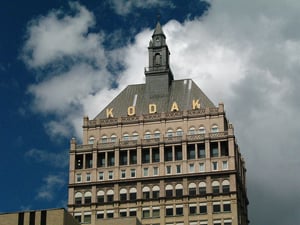
Big enough to fail: Kodak headquarters, Rochester, New York. Photo: DragonFlyEye | Flickr.com / Creative Commons License.

Related

While the announcement last week of Kodak's filing for bankruptcy protection may have surprised some, there are thousands around the Lower Mainland who no doubt barely raised an eyebrow.

These would be the former employees of a company called Creo.

You might remember Creo. It was the Burnaby- and Richmond-based high-tech darling of those heady dot-com days of the late '90s and early '00s. Unlike the dot-com-ers, though, Creo actually built things. Physical things. Large machines, in fact. Large machines that sold for hundreds of thousands of dollars. These machines and the software that went with them revolutionized the commercial printing process and helped build a company of more than 4,000 with a global reach.  

I was one of those 4,000. And I was there in early 2005 when it was announced that Kodak had bought Creo. Here's what I remember.

Shortly after the announcement, the president of Kodak rolled up to the Burnaby offices in a big black limo. He'd just flown in from Rochester on the corporate jet, we'd been told, to welcome us and tell us how we were to be the lynchpin of his remediation plan (Kodak was already in severe decline). I seem to recall bodyguards. I could very well be wrong about that. At the very least, he was surrounded by a posse of suits.  

All eyes were on him as he walked down the aisle of the quiet meeting room where he was to speak. Quiet, that is, until someone in the assembled audience of about 50 started whistling the Death Star theme song. You know, the ominous, brassy soundtrack that plays whenever Darth Vader graces enters a scene.

We laughed. The president, Antonio Perez, didn't.

He likely didn't hear it, of course. He turned out to be quite charming and personable. (But something told me he might still be able to crush my windpipe with a glance.)  

It was a small bit of gallows humour, one that would have been irreverently appropriate for any similar scene in any other company that had just been taken over. But here, at Creo, it felt especially apt, if not prescient.

A (very) brief history of Creo

The word "creo" appears in various languages and stands for, variously, "imagine, create, or believe." Three words that were also the company motto.

That's the kind of place Creo was.

Founders placed an emphasis on innovation, free-thinking, no politics, no bullshit, open information sharing, and as little bureaucracy and empire-building as possible. It rose to success in the late '90s, the golden age of West-Coast high-tech startups, where buzzwords like the oxymoronic "flat hierarchy" and "synergies" whizzed around corporate boardrooms, uttered by people often dressed in shorts or, less often, pajamas (true story).

While many were the companies mouthing the empty rhetoric and trying to trade free pop for never-ending all-nighters, few were actually putting that rhetoric into practice in a way that valued and respected the employee. Creo, for the most part, was one of those few.

Through that idealistic prism came concepts like "unit presidency," wherein you, whoever you are and whatever you're doing, are considered the expert in your own job. And you have the autonomy and decision-making power to go along with that. Your "team leader" -- the word "boss" was uttered rarely, usually in jest -- was there to take advice from you. His or her job was to help define the objective, then remove obstacles and get the Hell out of the way.

Of course, we couldn't resist turning the phrase around and saying that we were "presidents of our own units." Wink wink, nudge nudge. But that was precisely though unintentionally the point. Work didn't have to be a place where you went to be emasculated for simply entering into a simple labour-for-wages agreement.

It was Art of War concepts put into practice -- small, informed semi-autonomous groups that were nimble and responsive to frontline conditions and where few decisions needed to climb the slow ladder of command and await the decisions of out-of-touch generals, who, in all likelihood, were more focused on their personal ambitions.   

As a result, there was little talk of "us" (the people who do the work) and "them" (the people who tell you to do the work). Team leaders at every juncture wanted and expected to be challenged. And whoever could argue the greatest ROI (return on investment) held the company trump card.

That was the theory, anyway.

In later years, when the high-tech lustre faded and our millionaire futures were no longer one good idea away, there was lots of talk of having drunk the Creo-cyan Kool-Aid.

Such talk became more pervasive after the company leaders sold (which included multi-million-dollar buyouts for themselves) to Kodak after what some argued were a series of management missteps that led to a stockholder revolt and a potential hostile takeover. (To be fair, they also negotiated a better than market price for all employee options as part of the deal.)

Regardless, if you have to work (and I do) and you want to be respected and fairly compensated for your abilities (who doesn't?), such an environment felt better than the alternative, which, it turned out, was Kodak.

Geoff's baby-faced Creo card

Back to the Death Star

After Perez gave his address to the troops, Creo-ites in the audience peppered him with challenging questions, as we'd always been encouraged to do. One asked a specific question about strategic directions. Another asked about Kodak's reputation as one of the biggest polluters in North America. Perez handled the questions deftly, at one point turning off the cameras to speak to us directly. It felt intimate. We felt valued. There was even a little hope the Creo way would serve as a model for the notoriously old-fashioned and bureaucratic Kodak.

It didn't last.

Shortly thereafter we learned of a new Kodak-mandated travel policy that hinted at our bureaucratic future. No travel allowed unless Perez approved it himself. We laughed but were not amused. Was the president of one of the largest companies in the world really going to vet everyone's travel plans? What was the opportunity cost and ROI on THAT?

With this and other new policies (Requisitions for office supplies? Centralizing IT support in Rochester? Please turn out the lights before you go to save the company money...), the message was clear. No more nimble. No more imagine, create, or believe. It was like you'd played soccer all your life and suddenly there was a quarterback on the field who stole the ball and was trying to tell you where and how to run.   

Soon divisions were outsourced to Mexico and China. Much research and development moved to Rochester and Israel. (Don't get me started on how a foreign company can come into Canada to purchase and essentially dismantle a research and development company that was incubated with generous tax breaks in order to create jobs here.)

Many good people left. Some started spin-off companies (some of which are creating nuclear havoc in Burnaby). And Creo became a rump of its former self. For me, a career in the world of independent media, my first love, suddenly seemed a more stable career choice.

A colleague and good friend always used to say, "With behaviour like this, it's a wonder capitalism survives."

But it does. And it will, I suppose. Creative destruction is the air it breathes. It's just a shame when the creative parts get taken down by the destructive parts.

As for Kodak's filing for bankruptcy protection? Well, they say it's not the real end, that this is just a way to further restructure and pay down some outstanding debts related, in part, to thousands of layoffs. Still, with behaviour like this, it's a wonder it's survived as long as it has.  [Tyee]

15  Comments:

Login or register to post comments

  • Granville

    3 weeks ago

    This is a seismic event.

    Kodak was the epitome of technological progress and forward planning. For them to go into Chapter 11 is a sad evnet. We all need to rethink our assumptions.

    Empires are crumbling so fast these days, that their foundations are decaying even before the top floor is finished.

    Look at it this way; digital cameras freed up the global supply of silver for other uses in the same way that fibre optics and cell phones liberated copper. We still use silver and copper.

  • suburb_guy

    3 weeks ago

    A little overstated...

    but an interesting acticle. I worked at Creo for a couple of years in the mid 90's after graduating from BCIT. The author is correct that the Creo culture did empower people but there was still lots of politcal BS. I always felt part of something really great and that my work was valued. I was sad to see what happened to Creo as a lot of good people lost their jobs.

    As for me I moved on to something more in my field. I stil apply many of the of the things I learned at Creo.

  • RockyRacoon

    3 weeks ago

    No capitalism won't die by itself...it will tranform itself into

    Fascism during times of crisis. There is only one alternative but the powers that be who control the economic world also control the intellectual world and have put the kybosh to any reasonable debate regarding socialism-usually through the demonization of Stalin's crimes against humanity which were many but no less than that of the West-hey Black people didn't even have a right to vote in the USA 55 years ago. Most of what we hear about Soviet crimes agaisnt humanity are nothing but Western porpaganda that same propaganda that propagates free trade mentality and capitalists as job creator's rather than wealth appropriator's. The same propaganda that demonizes resource rich Muslim countries and their leaders as tyrannts and war criminals the minute they take a stand for the people they govern and send in the mercenary NATO troops. If we don't see the mote in our own eye....were doomed. We have change the capitalist social order and get rid of it if we don't want to end up as serfs or in some privatized prison system and share in the benefits created by humanity.

  • motorcycleguy

    3 weeks ago

    palm trees

    ....and tiled floor in the machine shop....good people, good machinery...some of the highest end programming/machining in North America right in our back yard....I was always jealous when visiting ex-coworkers that moved there

  • dorothy

    3 weeks ago

    The really important question

    Why was it sold to Kodak? It seems to me that those on the top should have 'spoken to their people' instead of just sitting on the information and then acting over the heads of people they (obviously) didn't respect after all. I believe the missing parameter here is that commitment does not, or is not being assigned, a tangible value, although without it, things go nowhere. Commitment is always that part of the equation that gets to be right under the drainpipe whenever the dirty stuff goes down. One cannot help but wonder if there was rot in the company beforehand, and whether what brought it down was the hidden costs that Edwards Deming always pointed out. Those that show up in the wake of people in the top not respecting commitment.

  • igbymac

    3 weeks ago

    RockyRacoon

    "No capitalism won't die by itself...it will tranform itself into Fascism during times of crisis."

    Why you make the distinction between capitalism and fascism?

    Through the private ownership of capital the relation between creditor and debtor is formed, thus being the basis of capitalism.

    Without a check on the accumulation of wealth -- call this socialist intervention, stronger holdings of wealth naturally overtake lesser holdings -- call this competition. In due time, wealth and power become dangerously centralized.

    Understood this way, fascism arrives not when capitalism dies or enters a crisis, but when it blossoms.

  • Fritz

    3 weeks ago

    One more trifling sum of misery

    I bought a Kodak instant camera for about 54 bucks
    and then Kodak lost a court case for infringing on
    Polaroid's patent. Unfortunately the judge didn't
    make Kodak refund our money but instead I had to
    swap the camera for one of their newer inferior cameras
    which I never used because Kodak wasn't getting
    anymore of my money for film or anything else.

    So I paid a little over $100 for a Polaroid camera but
    it used inferior stock for the photos and it took inferior
    pictures and one day I went to buy refills and was told
    I couldn't.
    One more trifling sum of misery to add to the foot of my
    companies to boycott account.

  • Granville

    3 weeks ago

    I owned as Kodak camera once too.

    I took a photograph in 1965 and it didn't turn out. Can I sue for damages? I am still dealing with it. Grief counselling hadn't been invented back then. I am almost sure it was the cause of my divorce.

  • freewilly

    3 weeks ago

    End of Days

    A great story and so familiar. The heady days of internet startups created all sorts of possibilities and dreams especially for geeks, developers, designers and artists. Problem was the powers that created many of these startups, never intended anything to last for ever. A small company that I worked for was more concerned with creating the perception that we were cutting edge, creating something new, going public, make some doe and leave. I dont think they really beleived any of us could actually invent anything. In fact we all made new things, collaberatively or by ourselves, built tools and defined best practices that are still used today.
    While I came out of the dotcom boom unemployed, I learned all sorts of skills, I never realized I was capable of. Even though I was a lowly artist with no science degree, I learned how to program in numerous languages and became proficient at setting up all flavours of relational databases. Even if I had a computer science degree(s) I was too old to go back into that field. Even when I did land a few jobs or contracts with various companies or schools I was considered an old fart back then even though I was in my mid to late thirties.
    I applied at CREO numerous times, as did many of my artsy peers who upgraded their skills, going back to bcit or university after art school. Everybody wanted to work for them, especially geeky artists and those with print experience.
    TOday, Im happy with what I know, and putter about with computational design, struggle with fractals and javascript. Kinda like a newer version of solitaire or knitting for the modern elderly.

  • RickW

    3 weeks ago

    Kodak Ahead of it's Time?

    It seems Kodak was "prescient" in outsourcing R&D (and basically destroying Creo) - considering that Mr. Harper thinks R&D in Canada is a waste of time and money.

  • Fritz

    3 weeks ago

    Statue of Limitations

    Granville thanks for the laugh...
    It's too late to sue; but it is never too
    late to drown the dreams of your
    mis-spent youth in alcohol.

  • pwlg

    3 weeks ago

    taxpayer dollars

    Thanks Gregg for telling your personal story of an adventure in the workings of big time capitalism.

    I too have worked for and witnessed the swallowing up of what used to be BC-based family-sized businesses (non-taxpayer funded).

    Even when I tried to escape the large US based corporate bosses by going to work for at least a Canadian company with BC roots those were swallowed up too.

    The same corporate HQ commands were delivered to us including some that would not have stood up in court due to our Canadian Rights and Freedoms.

    Unlike Kodak, the profit taking companies I used to work for under US management are still in business funneling profits from their Canadian operations to their losing subsiduaries in the US and US shareholders.

    In terms of Granville's comments on high tech materials shifting uses of copper, silver and other minerals. The life span of computers, cell phones and other electronics is so short that any savings of minerals, pollution and toxins and energy consumption is negligible or worse. It is said that 4% of the waste stream in developed countries is now electronic waste. Read Nikiforuk's article in the Tyee just before Xmas 2011.

  • Brysonic

    3 weeks ago

    Those were the days....

    Nice bit of writing Geoff...Creo was not with out its blemishes (succumbing to shareholder pressure comes to mind) but there were some fine people there and I hope some what is left of the company presence in Burnaby can be salvaged.

  • Bithammer

    3 weeks ago

    Phoenix rising from the ashes

    The car companies came back from bankruptcy protection, so it is possible. Unfortunately, unless the shareholders boot out the Antonio Perez and the rest of the board, they haven't a hope in hell. According to this source, http://people.forbes.com/profile/antonio-m-perez/28112, Mr. Perez pocketed a cool $5.7M in 2010. As a 10 year Creo-Scitex-Kodak veteren, it almost makes me want to hop on the next plane and join the Occupiers on Wall St.
    Someone had the (late) insight to buy Creo in the hopes that Creo would help to change the Kodak culture, unfortunately those old farts in Rochester were too stuck in their ways and they ended up changing the Creo culture.

  • dp

    3 weeks ago

    Corporate take-overs

    When the take-over happened, the destruction of the enterprise that Creo built was the most likely outcome. I think that most people understood that.

    In spite of that understanding, the regulators said that the take-over was in the best interest of Canada. I would love to know who those people actually were - and what they think about it now.

    I think that these sort of people should understand that they are going to stand up for their decisions in the future.

    • The discussion for this story is closed. No more comments can be added.