

 SHARE:
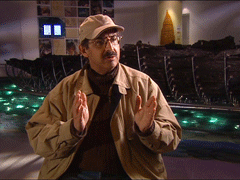
It was one of those conversations that can only happen in the Middle East. About a year and a half ago we were in Israel filming the splendid Roman ruins at Beit She'an for a CNN documentary on early Christianity (the premise: how did an itinerant rabbi and his illiterate fishermen friends wind up founding the religion of the Roman Empire?), when we spotted one of our crew engaged in animated conversation with an American tourist -- white running shoes, blue ball cap -- who was taking a quick peek at ancient history before the tour bus whisked him off in search of same, but elsewhere.
We were on a tight schedule, but when I went to extricate our guy from the tourist on his history buffet, it turned out -- as it often does over there -- to be much more than met the eye. And it would change our view of history -- about then, and about now.
It is, at heart, a Passover story.
'Come with me to Yavneh'
Passover, which begins at sundown on Saturday, is the Jewish commemoration of the liberation of the Jews from centuries of slavery in Egypt. Its name derives from the belief that God "passed over" the homes of Jews when he was killing off the first-born of Egypt as part of His divine assistance to the monotheistic Jews.
Once freed from slavery, and having completed their hasty departure across the Red Sea to "the Holy Land" (receiving the Covenant or Ten Commandments en route; you can read the whole story in Exodus 1-15), the Jews were then free to practice their monotheism as they awaited the coming of the Messiah -- God's anointed Jewish king whose rule would usher in the Messianic Age of peace and justice.
Indeed, one of the Passover Seder rituals is to pour an extra cup of wine for the prophet Elijah, who is supposed to visit at Passover to announce that the Messiah is en route.
The Last Supper of Jesus was a Passover Seder, and a small band of Jews thought that he was the Messiah whom Elijah prophesied. Many others did not -- the Messiah certainly wasn't supposed to get executed by the Romans.
But Dr. Richard Freund, the running-shoed, ball-capped American archeologist and rabbi whom we so fortuitously met in Beit She'an pointed us in the direction of another messiah, a man whom most people have never heard of, but whose deeds and their consequence resonate around the globe.
"Come with me to Yavneh," said Freund. "I'm doing excavations there. It's an extraordinary story."
Last refuge of Judaism
Yavneh, a few miles outside Jerusalem on the coast, is itself, extraordinary. In 69 CE, with Jerusalem under siege by the Roman army, Rabbi Yohanan ben Zakki had himself smuggled out of the beleaguered city in a coffin -- for only the dead could escape the coming inferno.
But the rabbi was very much alive, and he had a bold plan: he would go into the very heart of the enemy's camp and ask the commanding Roman general, Vespasian, for a favour. He wanted the Romans to allow him to set up a rabbinical academy in Yavneh, not to preach insurgency against Rome, but to allow rabbis to study their faith and to teach it in peace after the Romans' inevitable victory in their war against the Jews.
Astonishingly, General Vespasian agreed. And the academy at Yavneh became much more than a rabbinical school -- its very existence would save Judaism from extinction after the Romans destroyed Judaism's holiest city and one of the great wonders of the ancient world, the Temple in Jerusalem, in 70 CE.
And even though its mission was ostensibly peaceful, the rabbis who came from Yavneh reminded the Jewish people of the terrible crime the Romans had committed against them, and their God. It would fuel the next fire against the Romans -- one lit by Simon bar Kokhba.
Leader of revolt
His birth name was Simon bar Kozeba, but the great Jewish sage of the day, Rabbi Akiva, christened him "bar Kokhba," meaning "Son of the Star," a Hebrew wordplay on a verse from the Book of Numbers that says "A star (kokhba in Hebrew) has shot off Jacob."
For more than three years, from 132-135 CE, Simon bar Kokhba led Jewish forces in a remarkably successful revolt against the overwhelming power of the Roman Empire -- piling up victories (and Roman corpses), setting up a provisional government, minting his own coins (thousands of which remain on the market) and inspiring the Jewish people with visions of biblical prophecy and political liberation.
Bar Kokhba and the Jewish rebels were fueled by a longstanding hatred of Rome, which for nearly two centuries had kept Israel under its imperial heel. Over the years, various rebels and so-called messiahs emerged to try to deliver the Jews from this yoke. One Jewish hope, Judas the Galilean, was killed about 4 BC, and a generation later messiah from Galilee, the carpenter's son from Nazareth, was nailed to a cross by the Romans.
Sensational new findings
But there's a twist to the story, one revealed recently in the ancient Jewish writings known as the Dead Sea Scrolls, discovered accidentally in the caves near Qumran overlooking the Dead Sea, by a Bedouin goat herd in 1947, but not translated for decades.
What emerged in the new translation caused a sensation: the revelation in the scrolls that Jews of the first century CE were actually looking for two messiahs. One would be a priestly leader and prophet who would raise up the faithful Jews and renew the faith of Abraham. The other, however, would be a monarch who would free the land of Israel and rule over a restored biblical kingdom.
Did Jesus of Nazareth and Simon bar Kokhba fit the bill, each in their own way? But why did the name of Jesus survive, and inspire a new religion, while Simon bar Kokhba disappeared from history?
The answer to this question lies in a dark forbidding cavern in the blistering desert east of Jerusalem, and it's at the heart of the Jewish-Christian divide. In the 1960s, an Israeli archeologist found a trove of letters -- the largest cache of ancient correspondence ever uncovered in Israel -- that included messages from Bar Kokhba.
Four decades later, convinced that more evidence of Bar Kokhba's reign was overlooked, Richard Freund returned to the desolate area with the latest in modern equipment, including ground-penetrating radar. And he discovered much more about the mighty Simon bar Kokhba.
The big split
The cave mouth is high up a craggy cliff face, and rare birds nest in the cool darkness, protected today by strict laws that mean wildlife officials must keep a lookout to prevent the archeologists from entering whenever a bird is spied bringing food back to the nest.
Despite the obstacles, Freund's team found yet another cache of artifacts and produced a sharpened new view of Bar Kokhba's revolt and place in Jewish history -- including evidence of Judaism's final breach with the religion founded by the first messiah, Jesus.
"I think the split occurred right in the middle of the Bar Kokhba rebellion," Freund told us, "when the Christians said 'This is not our Messiah' and the Jews said 'This is going be the liberation we have been praying for all these years.'"
Bar Kokhba's letters show him warning his followers not to trust the "Galileans" -- a common name for the followers of Jesus of Nazareth. The Galileans, who already were being called Christians, were in the ascendancy. While the Romans were fighting the Jews, the Christians were gaining power and influence and converts in the heart of the Roman Empire.
This was not their war with the Romans, for the Christian messiah was the Prince of Peace, and they would win in the end, with history-changing results. And without the support of the Galileans, Simon bar Kokhba's revolt was doomed.
Naming Palestine
When the Romans finally crushed the Bar Kokhba rebellion, the Pax Romana was harsher than ever: Nearly 600,000 Jews were killed, according to the Roman historian Cassius Dio, and more than 1,000 towns and villages were razed. The survivors were exiled or sold into slavery.
The Romans not only destroyed Bar Kokhba and his rebels, but they also declared the Holy Land to be "Jewish-free" -- Judenfrei, as a later persecutor of the Jews would fatefully term the policy -- meaning that no Jew could remain in the land that God gave to Abraham, that Moses restored to the enslaved tribes of the Exodus, that Solomon built up after the Babylonian captivity.
The "wandering and oft unwelcome Jew" became a harsh -- and with the Shoah, ineffable and immane -- reality for the next 2000 years, and Jesus became the Messiah, the universal Saviour worshipped in Christianity, which began its inexorable domination of the Roman Empire, and western civilization.
Meanwhile, Simon bar Kokhba, the star who very nearly established the Messianic Age by toppling Roman rule, brought down a punishment on his land whose consequence resonates to this day. In a final effort to eradicate Judaism from the geography, the Emperor Hadrian renamed Judea after the Philistines, an historic enemy of Israel -- but he used the Latinized name. And so, from the ashes of this passed over Jewish messiah began "Palaestina."
Related Tyee stories:
- Jesus as Trickster Rebel
His message of non-violence is no plea for passivity. He knew how to challenge power. - The God's Truth
Reviewed: The Hijacking of Jesus - Richard Dawkins Won't Repent
Reviewed: The God Delusion
![[Tyee]](/design-article.thetyee.ca/ui/img/yellowblob.png)
Read more: Travel












Tyee Commenting Guidelines
Comments that violate guidelines risk being deleted, and violations may result in a temporary or permanent user ban. Maintain the spirit of good conversation to stay in the discussion.
*Please note The Tyee is not a forum for spreading misinformation about COVID-19, denying its existence or minimizing its risk to public health.
Do:
Do not: