

 SHARE:
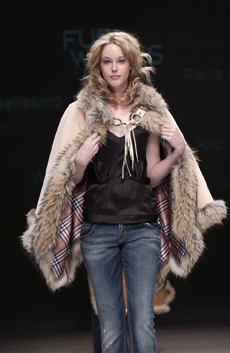
Five bronzed young women wear raccoon, chinchilla, fox and mink as hats, wraps and even flip-flops over designer clothes by Diane von Furstenberg, John Galliano and Vera Wang. They're models for the feature in June's Vogue magazine, shot by Steven Meisel. "Try fur and heavy knits over long skirts," the editorial suggests. "In nomads' land, fur hats are both a luxury and a necessity."
It's proof that fur can't be called a passing trend - in "nomad's land" or here.
A few years ago, fur was unthinkable for both designers and ordinary folk. Now, it appeals to the hearts and wallets of young people who sport fur on everything from hats to jackets, to t-shirts. It's been in style for a few seasons now, and fashions this fall will see even more of it.
Hip grannies?
The fur industry is feeling optimistic these days. Retail sales are up for the sixth consecutive year, hitting $11.7 billion worldwide according to the International Fur Trade Federation.
Grannies aren't driving this trend. In fact, the average fur buyer is 35 years old, and getting even younger, according to the Fur Information Council of America. (Only four years ago in 2001, the average fur buyer was 46). In Canada specifically, the top fur-buying province is Quebec and there, the age group most interested in buying fur is 18- to 34-year-olds, both men and women.
For some young people, fur's back because it's long been considered taboo. And for others, it's because fur's been re-positioned as casual, sporty, and luxurious, making it essential wear for mainstream, celebrity-idolizing youth.
Sports fur
"What we are seeing now is that there are fur styles that have nothing to do with the old idea of fur. Now fur is sheared, it's embroidered, and it's dyed. So it's attracted a new generation," explains Teresa Eloy, for the Fur Council of Canada.
The Canadian council has launched Fur Works Canada, which combines 12 design companies under one fashion director, all in an effort to create youthful fur clothing. There, they take youth styles like "active sports wear, or ski wear, and adapt them to fur," says Eloy.
Other designers have added fur because young people are asking for it. "Fashion is a cycle. Younger people are more interested in fur," he says. "Visible luxury is in, and some people think fur is luxury, so it's part of the trend. People also wear more jewelry for example," explains Zuki, a Montreal designer who says currently a larger segment of his clientele is made up of young customers, even teenagers.
'Real Animal'
Not surprisingly, anti-fur groups aren't in favour of the trend. "What we are seeing is fur being pushed in the form of trim, bright colours, sheared down. Frequently, it doesn't even look like fur. The fur industry is trying almost deliberately to censor itself from that look that it's coming from a real animal," says Liza Franzetta of PETA (People for the Ethical Treatment of Animals).
PETA and many other pro-animal groups thought fur-wearing was down for good. According to Statistics Canada, fur production and sales peaked in the early 1980s, reaching almost 5.5 million wild and farmed pelts per year and dropped dramatically in the 1990s to 1.8 million wild and farmed pelts per year. According to furriers, fur plummeted due to US economic recession, fashion trends that embraced an unsophisticated look, and anti-fur activism.
But in 2003, Canadian fur sales climbed back to 2.3 million wild and farmed pelts, its growth fueled by ranch-raised pelts.
Cheap luxury
Part of the appeal, is the new low cost. Rabbit fur is a cheap, low quality fur that lasts only a couple of years, according to George Clement from The BC-based Fur-Bearer Defenders.
"It's something poorer people can afford now that they haven't been able to in the past," he says. "I think we're going through a little fur era but I don't expect it to last long."
These cheap-fur-wearing people are the key part of the trend. Some of them are part of a phenomenon called "gold collar" youth. "Gold collar" workers aged 18 to 25 make up about 40 per cent of the 1.5 million young working class people in Canada. In the US, 61 per cent of its 17 million working class youth are "gold collar."
These gold collar workers live above their means, explains Ian Pierpoint, who conducted the study for Synovate Research. Although they may hold "blue-collar" jobs, they spend their money on luxury items.
These young people are driven by their love of celebrities and their desire to emulate them. They crave status symbols and define themselves through brands. They are the young people that could easily become fur buyers. "Stick a Prada label on it and they'll probably purchase it," he says.
'Morally acceptable fur'
And fur is now "ok." A Gallup poll conducted in the United States last year indicated 62 per cent of people aged 18 to 29 think buying and wearing clothing made of animal fur is morally acceptable. Overall, 63 per cent of all age groups found nothing wrong with fur.
That's one of the reasons Canada sold 90 percent of its fur to the US last year. But lucrative new markets like China, Japan and Russia are tantalizing prospects, according to Eloy. New buying power in these countries is making them top fur consumers and in the case of China, top fur producers.
China has stepped up its fur industry, producing five million mink skins in 2004, second only behind world leader Denmark with 12.6 million mink skins.
This all spells trouble to animal activists who say Chinese fur farmers keep their animals in appalling conditions, even skinning them alive. The China Fur Commission and the China Leather Industry Association have denied the accusations.
"We're seeing things like animals having the skin peeled off their body while they're still struggling, still fully conscious. And this is the inexpensive fur that is being sold as fur trim on jackets at major retailers, not just fur boutiques," insists PETA's Franzetta.
Gendered beasts
Words like these drive fur marketing into full swing, as they struggle to rebrand fur for the next generation. As part of their efforts, the marketers downplay the animal rights angle, and target men and women separately for maximum impact.
According to the Fur Council of Canada, in 2003 seven per cent of Canadian men owned fur, up from five per cent in 1999. Montreal is the city with the highest percentage of men who own fur coats and nearly 13.3 per cent of Canadian French speaking men wear fur. With the enduring metrosexual trend that emphasizes a sophisticated personal appearance, the Fur Council thinks there's room for them to grow.
They'll have to target these men in specific ways. Eloy says Canadian men prefer more subdued, classic styles while US costumers purchase large, long-haired coats inspired by rapper wear.
'Dying breed'?
Pro-fur groups insist that they industry is doing exceedingly well and speak of a fur renaissance. While Canada and the US have significantly reduced the number of wild pelts produced each year, farmed furs continue to do well.
And although sales will probably never reach their golden numbers of the 40s or 80s, Canadian furriers see a bright future. Eloy says that rising mink prices worldwide will mean more wild fur sales, a reason why the Fur Council of Canada will actively promote wild furs this year. Not surprising considering the rise in value of wild pelts like that of the seal.
In turn, anti-fur organizations proclaim that furriers are a dying breed. They still have high-profile celebrity spokespeople like Pamela Anderson, and scored several victories such as getting major retailers like Topshop and Forever 21 to stop selling fur items.
The truth is that for both fur foe and friends, the battleground is being quickly redrawn.
Silvia Moreno-Garcia's work has been published in The Christian Science Monitor, Terminal City and several Spanish language publications. She is based in Vancouver. ![[Tyee]](/design-article.thetyee.ca/ui/img/yellowblob.png)












Tyee Commenting Guidelines
Comments that violate guidelines risk being deleted, and violations may result in a temporary or permanent user ban. Maintain the spirit of good conversation to stay in the discussion.
*Please note The Tyee is not a forum for spreading misinformation about COVID-19, denying its existence or minimizing its risk to public health.
Do:
Do not: