Artsculture

'The Wire': Made for Us?

HBO show seems wired in on BC headlines.

By Michael Hingston, 7 Jan 2008, TheTyee.ca

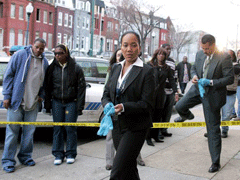
The Wire promo shot (cops at crime scene on street)

Cops show targets media this time.

At this point, chances are that if you've heard about HBO's crime drama The Wire, you've also heard that it's the best show on television. And if that's true, you'll also know that this praise comes from all directions: Time, Entertainment Weekly, The Guardian, Slate, friends, relatives, strangers on public transit -- it goes on. The show is loved by many (myself included), and that love is frighteningly contagious. The New Yorker recently spent 11,000 jubilant words profiling David Simon, the show's creator and executive producer. The Tyee has sung its praises too, on more than one occasion.

And now that its fifth and final season premiered yesterday evening, don't expect the bombast to die down anytime soon.

Reasons to like The Wire are numerous and well documented. It's a brutally honest look at a city plagued by drugs, murder, and a self-serving police department. Its attention to detail and intricate, often overlapping storylines rival anything in contemporary film or fiction. The drug dealers are often more sympathetic than the detectives. But there's another reason why Vancouverites in particular ought to be tuning in: you just might see something you recognize.

'Free zones' and newsroom cuts

While The Wire is filmed entirely on location in Baltimore, what it really offers -- like any good piece of art -- are glimpses into the viewers' own lives. Better still, it's a series about detectives, meaning that its starring character (as well as chief topic of conversation) is the city itself. This means that everyone will probably see their own neighbourhood somehow reflected in the gritty streets of Baltimore, but the parallels between there and Vancouver are downright eerie in their specificity.

Try and watch, for instance, Major Colvin's clandestine efforts in season three to move all drug traffic to a designated "free zone" without thinking of the Vancouver Police Department's containment strategy in the Downtown Eastside. Their motivations are remarkably similar -- both want to move the drug problem to society's margins rather than address its root causes -- and the effect is the same: to keep illegal drugs out of the downtown core, and out of the public's sight.

But The Wire's portrayal of the free zone gets more complicated almost immediately when Colvin cannot locate the heart of the drug trade in order to then relocate it. (He eventually settles on the mid-level dealers, who have authority over their runners as well as the customers -- they also manage the violence.) Before long, the community is split between the benefits of the somewhat-salvaged city blocks and the anarchy of the free zone. Churches and advocacy groups begin to demand medical treatment for the addicts and residents stuck there, and the language of human rights is invoked -- all of which is a reasonable paraphrase of what happens daily in Downtown Vancouver.

Even the terminology overlaps: our city's infamous marijuana crop has earned us the nickname "Vansterdam," while The Wire's drug dealers affectionately call their new territory "Hamsterdam."

Newspaper blues

Or consider the upcoming season, which aims to document the gradual and whimpering death of the daily newspaper. Shrinking newsrooms, an ever-expanding lifestyle section, indifferent corporate management -- strictly speaking, I'm talking about Simon's depiction of the Baltimore Sun (which retains the name and logo of its real-life counterpart), but it also sounds remarkably similar to the problems facing the big Vancouver dailies. There's one scene where a senior Baltimore Sun editor smiles and telling his dwindling staff to "simply do more with less." According to some reports, staff at Vancouver's big papers have already heard similar suggestions from management.

A Baltimore editor from the new season perhaps sums up the state of the media best when he wonders aloud, "How come there's cuts in a newsroom when a company is still profitable?"

How to catch up

Of course, this is only a brief skimming of the links between The Wire's Baltimore and our fair metropolis; I'll leave connecting the police brutality and scheming political dots (among many, many others) to someone else.

And if you're looking for a crash course in what's happened so far, the other seasons are all now on DVD, and HBO's website boasts exclusive interviews, preview clips, and even a free video podcast to more fully whet your appetite. From there you'll soon be joining the rest of us, crying "best show on TV" in no time at all.

Related Tyee stories:

 [Tyee]

30  Comments:

Login or register to post comments

  • Rick in PG

    4 years ago

    I agree

    I agree its the best show on TV. My wife and I have recommended this show to everyone we know. We're just starting season 4 since we don't have cable.

    My favorite line is when Bunk and (I think it was McNulty) are looking at an array of photographs of headless corpses and Bunk says something like "maybe there is some cop out there somewhere looking at a bunch of pictures of heads with no bodies" (or something like that).

    No doubt everyone has there own personal cast favourites - I have to go with Bunk now that Stringer Bell is gone.

  • verso

    4 years ago

    ...

    Yeah, easily the best show on TV, maybe ever...

    One of my favorite moments (can't recall what season) was the McNulty drunk driving scene. Classic.

    Several episodes from the 5th season have leaked, there out there on the web if you know how to find them. I've seen the first episode of the 5th season and it looks like it will be another great season.

    Quote:
    "No doubt everyone has there own personal cast favourites - I have to go with Bunk now that Stringer Bell is gone."

    So many great characters, can't pick one. I'll go with Bunk, Omar and Bubbles.

  • apollyon

    4 years ago

    Favourite Characters

    Definitely gotta love Omar.
    And don't forget the star - McNulty.

    And some of the lazy / corrupt cops are good for a laugh!

  • fullerbrushman

    4 years ago

    Never heard of it!

    Best show on TV, you say? Better than Intelligence?
    Must admit I've never heard of The Wire, but then I don't get HBO and don't pay much attention to American drama series.

  • siamdave

    4 years ago

    this stuff is dangerous ...

    - yea, shows like this are well done and absorbing - and if watched too much, they keep people from thinking about more important things. Like booze, in a way. It would be nice to see the Tyee at least trying to steer people towards useful stuff sometimes - things like Capitalism and Other Kids Stuff ( http://www.socialist-tv.com/ ) or The Story of Stuff ( http://www.storyofstuff.com/ ) - or even a book that talks about things like this and much else - They're Building a Box - and You're In It - http://www.rudemacedon.ca/dlp/box/box-intro.html . We're at a very dangerous time in history - a bit of relaxation between the periods of work is ok, but getting sucked into watching tv all the time rather than working to save things is not helping. Well - not helping us, anyway ....

  • mirpaz

    4 years ago

    corrupt cops are good for a laugh...

    They are good for a laugh if you don't meet them in a circumstance where they will taser you, shoot you or pin you down for no reason knowing full well that they can do anything they want and you are just SOL, if you get hurt or murdered by one of the

  • mirpaz

    4 years ago

    continuation

    member of the finests (VPD or RCMP).

    To look at a program like this and not make some serious questions is an form of obscenity more precise "mental masturbation" The questions should start like this:

    "If the mayor knows the middle manager dealers, the cops and the mayor knows how to eradicate the trade. why don't they?
    Because they benefit from various factors:
    1 - fear factor
    2 - more money factor;
    3 - good for re-election factor;
    5 - the real money behind the drug trade is probably a very important figure in the political, social, economical scene of the city, province or country
    (See:
    http://www.counterpunch.org/lindorff01072008.html

    or

    http://www.timesonline.co.uk/tol/news/world/
    middle_east/article3137695.ece

    and

    http://rebelresource.wordpress.com/

    Or the complete article from the Times of London (before it disappear from the WEB):

  • mirpaz

    4 years ago

    continuation

    Times Online

    From The Sunday Times
    January 6, 2008
    For sale: West’s deadly nuclear secrets
    Insight: Chris Gourlay, Jonathan Calvert, Joe Lauria

    A WHISTLEBLOWER has made a series of extraordinary claims about how corrupt government officials allowed Pakistan and other states to steal nuclear weapons secrets.

    Sibel Edmonds, a 37-year-old former Turkish language translator for the FBI, listened into hundreds of sensitive intercepted conversations while based at the agency’s Washington field office.

    She approached The Sunday Times last month after reading about an Al-Qaeda terrorist who had revealed his role in training some of the 9/11 hijackers while he was in Turkey.

    Edmonds described how foreign intelligence agents had enlisted the support of US officials to acquire a network of moles in sensitive military and nuclear institutions.

    Among the hours of covert tape recordings, she says she heard evidence that one well-known senior official in the US State Department was being paid by Turkish agents in Washington who were selling the information on to black market buyers, including Pakistan.

    The name of the official – who has held a series of top government posts – is known to The Sunday Times. He strongly denies the claims.

    However, Edmonds said: “He was aiding foreign operatives against US interests by passing them highly classified information, not only from the State Department but also from the Pentagon, in exchange for money, position and political objectives.”

    She claims that the FBI was also gathering evidence against senior Pentagon officials – including household names – who were aiding foreign agents.

  • mirpaz

    4 years ago

    continuation

    “If you made public all the information that the FBI have on this case, you will see very high-level people going through criminal trials,” she said.

    Her story shows just how much the West was infiltrated by foreign states seeking nuclear secrets. It illustrates how western government officials turned a blind eye to, or were even helping, countries such as Pakistan acquire bomb technology.

    The wider nuclear network has been monitored for many years by a joint Anglo-American intelligence effort. But rather than shut it down, investigations by law enforcement bodies such as the FBI and Britain’s Revenue & Customs have been aborted to preserve diplomatic relations.

    Edmonds, a fluent speaker of Turkish and Farsi, was recruited by the FBI in the aftermath of the September 11 attacks. Her previous claims about incompetence inside the FBI have been well documented in America.

    She has given evidence to closed sessions of Congress and the 9/11 commission, but many of the key points of her testimony have remained secret. She has now decided to divulge some of that information after becoming disillusioned with the US authorities’ failure to act.

    One of Edmonds’s main roles in the FBI was to translate thousands of hours of conversations by Turkish diplomatic and political targets that had been covertly recorded by the agency.

    A backlog of tapes had built up, dating back to 1997, which were needed for an FBI investigation into links between the Turks and Pakistani, Israeli and US targets. Before she left the FBI in 2002 she heard evidence that pointed to money laundering, drug imports and attempts to acquire nuclear and conventional weapons technology.

    “What I found was damning,” she said. “While the FBI was investigating, several arms of the government were shielding what was going on.”

    The Turks and Israelis had planted “moles” in military and academic institutions which handled nuclear technology. Edmonds says there were several transactions of nuclear material every month, with the Pakistanis being among the eventual buyers. “The network appeared to be obtaining information from every nuclear agency in the United States,” she said.

  • mirpaz

    4 years ago

    continuation

    They were helped, she says, by the high-ranking State Department official who provided some of their moles – mainly PhD students – with security clearance to work in sensitive nuclear research facilities. These included the Los Alamos nuclear laboratory in New Mexico, which is responsible for the security of the US nuclear deterrent.

    In one conversation Edmonds heard the official arranging to pick up a $15,000 cash bribe. The package was to be dropped off at an agreed location by someone in the Turkish diplomatic community who was working for the network.

    The Turks, she says, often acted as a conduit for the Inter-Services Intelligence (ISI), Pakistan’s spy agency, because they were less likely to attract suspicion. Venues such as the American Turkish Council in Washington were used to drop off the cash, which was picked up by the official.

    Edmonds said: “I heard at least three transactions like this over a period of 2½ years. There are almost certainly more.”

    The Pakistani operation was led by General Mahmoud Ahmad, then the ISI chief.

    Intercepted communications showed Ahmad and his colleagues stationed in Washington were in constant contact with attach�s in the Turkish embassy.

    Intelligence analysts say that members of the ISI were close to Al-Qaeda before and after 9/11. Indeed, Ahmad was accused of sanctioning a $100,000 wire payment to Mohammed Atta, one of the 9/11 hijackers, immediately before the attacks.

  • mirpaz

    4 years ago

    continuation

    The results of the espionage were almost certainly passed to Abdul Qadeer Khan, the Pakistani nuclear scientist.

    Khan was close to Ahmad and the ISI. While running Pakistan’s nuclear programme, he became a millionaire by selling atomic secrets to Libya, Iran and North Korea. He also used a network of companies in America and Britain to obtain components for a nuclear programme.

    Khan caused an alert among western intelligence agencies when his aides met Osama Bin Laden. “We were aware of contact between A Q Khan’s people and Al-Qaeda,” a former CIA officer said last week. “There was absolute panic when we initially discovered this, but it kind of panned out in the end.”

    It is likely that the nuclear secrets stolen from the United States would have been sold to a number of rogue states by Khan.

    Edmonds was later to see the scope of the Pakistani connections when it was revealed that one of her fellow translators at the FBI was the daughter of a Pakistani embassy official who worked for Ahmad. The translator was given top secret clearance despite protests from FBI investigators.

    Edmonds says packages containing nuclear secrets were delivered by Turkish operatives, using their cover as members of the diplomatic and military community, to contacts at the Pakistani embassy in Washington.

    Following 9/11, a number of the foreign operatives were taken in for questioning by the FBI on suspicion that they knew about or somehow aided the attacks.

    Edmonds said the State Department official once again proved useful. “A primary target would call the official and point to names on the list and say, ‘We need to get them out of the US because we can’t afford for them to spill the beans’,” she said. “The official said that he would ‘take care of it’.”

    The four suspects on the list were released from interrogation and extradited.

    Edmonds also claims that a number of senior officials in the Pentagon had helped Israeli and Turkish agents.

    “The people provided lists of potential moles from Pentagon-related institutions who had access to databases concerning this information,” she said.

  • mirpaz

    4 years ago

    continuation

    “The handlers, who were part of the diplomatic community, would then try to recruit those people to become moles for the network. The lists contained all their ‘hooking points’, which could be financial or sexual pressure points, their exact job in the Pentagon and what stuff they had access to.”

    One of the Pentagon figures under investigation was Lawrence Franklin, a former Pentagon analyst, who was jailed in 2006 for passing US defence information to lobbyists and sharing classified information with an Israeli diplomat.

    “He was one of the top people providing information and packages during 2000 and 2001,” she said.

    Once acquired, the nuclear secrets could have gone anywhere. The FBI monitored Turkish diplomats who were selling copies of the information to the highest bidder.

    Edmonds said: “Certain greedy Turkish operators would make copies of the material and look around for buyers. They had agents who would find potential buyers.”

    In summer 2000, Edmonds says the FBI monitored one of the agents as he met two Saudi Arabian businessmen in Detroit to sell nuclear information that had been stolen from an air force base in Alabama. She overheard the agent saying: “We have a package and we’re going to sell it for $250,000.”

    Edmonds’s employment with the FBI lasted for just six months. In March 2002 she was dismissed after accusing a colleague of covering up illicit activity involving Turkish nationals.

    She has always claimed that she was victimised for being outspoken and was vindicated by an Office of the Inspector General review of her case three years later. It found that one of the contributory reasons for her sacking was that she had made valid complaints.

    The US attorney-general has imposed a state secrets privilege order on her, which prevents her revealing more details of the FBI’s methods and current investigations.

    Her allegations were heard in a closed session of Congress, but no action has been taken and she continues to campaign for a public hearing.

  • mirpaz

    4 years ago

    continuation

    She was able to discuss the case with The Sunday Times because, by the end of January 2002, the justice department had shut down the programme.

    The senior official in the State Department no longer works there. Last week he denied all of Edmonds’s allegations: “If you are calling me to say somebody said that I took money, that’s outrageous . . . I do not have anything to say about such stupid ridiculous things as this.”

    In researching this article, The Sunday Times has talked to two FBI officers (one serving, one former) and two former CIA sources who worked on nuclear proliferation. While none was aware of specific allegations against officials she names, they did provide overlapping corroboration of Edmonds’s story.

    One of the CIA sources confirmed that the Turks had acquired nuclear secrets from the United States and shared the information with Pakistan and Israel. “We have no indication that Turkey has its own nuclear ambitions. But the Turks are traders. To my knowledge they became big players in the late 1990s,” the source said.

    How Pakistan got the bomb, then sold it to the highest bidders

    1965 Zulfikar Ali Bhutto, Pakistan’s foreign minister, says: “If India builds the bomb we will eat grass . . . but we will get one of our own”

    1974 Nuclear programme becomes increased priority as India tests a nuclear device

    1976 Abdul Qadeer Khan, a scientist, steals secrets from Dutch uranium plant. Made head of his nation’s nuclear programme by Bhutto, now prime minister

    1976 onwards Clandestine network established to obtain materials and technology for uranium enrichment from the West

    1985 Pakistan produces weapons-grade uranium for the first time

    1989-91 Khan’s network sells Iran nuclear weapons information and technology

    1991-97 Khan sells weapons technology to North Korea and Libya

    1998 India tests nuclear bomb and Pakistan follows with a series of nuclear tests. Khan says: “I never had any doubts I was building a bomb. We had to do it”

    2001 CIA chief George Tenet gathers officials for crisis summit on the proliferation of nuclear technology from Pakistan to other countries

  • mirpaz

    4 years ago

    continuation

    2001 Weeks before 9/11, Khan’s aides meet Osama Bin Laden to discuss an Al-Qaeda nuclear device

    2001 After 9/11 proliferation crisis becomes secondary as Pakistan is seen as important ally in war on terror

    2003 Libya abandons nuclear weapons programme and admits acquiring components through Pakistani nuclear scientists

    2004 Khan placed under house arrest and confesses to supplying Iran, Libya and North Korea with weapons technology. He is pardoned by President Pervez Musharraf

    2006 North Korea tests a nuclear bomb

    2007 Renewed fears that bomb may fall into hands of Islamic extremists as killing of Benazir Bhutto throws country into turmoil

    © Copyright 2008 Times Newspapers Ltd.

    As you all can see there is a lot going on and very few journalists willing to touch the real world out there on why there is a need to create a program like WIRE.

    Most citizens come to expect that their politicians are grossly incompetent (Provincial Liberal' MLAs - no exception- Sam Sullivan and the Harper government, just to name a few)and they are invested in continue to be mis-informed because they have nothing to strive for. They are too comfortable.
    The word excellence is not in their vocabulary nor in their lives.
    Media manipulation plays a role, consumerism and fear together make for an apathetic population.
    Close the TV. Change one's life upside down to "being alive" instead of rotting from inside.
    The Wire is just another indication of the way we are becoming: a "society of morons".

  • mirpaz

    4 years ago

    continuation

    Hi everyone I had to get creative to get everything in...
    Living life and loving it.
    Never had a TV in my life... Grand...

  • mirpaz

    4 years ago

    The Wire Israeli version

    Here is another version of the TV show:
    http://www.haaretz.com/hasen/spages/871239.html

    Last update - 01:18 15/06/2007
    The twilight zone / 'Now you are paralyzed, as we promised'
    By Gideon Levy

    "We have to make you do a little sports," the Shin Bet interrogator said, launching four successive days of questioning accompanied by brutal physical torture. The result: Luwaii Ashqar can no longer stand on his feet. He sits in his wheelchair, dressed in a fashionable quasi-military suit, super-elegant, new Caterpillar-brand shoes on his paralyzed feet.

    "I love this color," he says about his uniform. "It's the color of the soldiers who came to arrest me for the interrogation that did all this to me."

    His smile is captivating, his Hebrew rich and incisive. He is a young man whose world fell apart. He entered prison sound of body and mind and emerged a broken man. For four days and four nights nonstop, he says, he was interrogated and subjected to torture of the most brutal kind. The result is the person we see before us in the wheelchair, in the elegant home high in the village of Saida, north of Tul Karm, which was placed at his disposal by a friend after he was released from Israeli prison a month ago.

    Was there a judgment by the High Court of Justice? There was. It banned precisely the types of torture he underwent: the "banana posture," the "shabah" (body stretching with hands tied to a chair), "invisible" blows and the "frog posture" (being forced to stand for hours on the toes in a crouching position) - all the way to a vicious kick to his chest that bent his body backward while he was tied to a chair with his arms and legs, and which was the probable cause of the partial paralysis of his legs.

    Throwing up with the vomit entering his nostrils, losing consciousness and being given only saltwater to drink, relieving himself in his pants, not sleeping or resting - all of that for four consecutive days and nights.

  • mirpaz

    4 years ago

    continuation

    What does the interrogator Maimon tell his children when he goes home? What do Eldad and Sagiv tell their wives about their daily labors before they turn in? That they tortured another helpless prisoner until they turned him into a cripple? That they beat this charming young man brutally and that at the end of the interrogation he was tried for only marginal offenses? And where is the Supreme Court, which in 1999 prohibited precisely the chain of torture that Luwaii Sati Ashqar, 30, who was married three years ago, underwent in the Kishon detention facility?

    Ashqar is not alone. The Public Committee Against Torture in Israel has just issued a new report containing the testimonies of nine torture victims (English version: www.stoptorture.org.il//eng). As the authors of the shocking report say, the testimonies "paint a dismal picture in which can be discerned various categories of secret-keeping collaborators, who, in keeping silent, protect the [Shin Bet] system of torture." ...

    On the wall is a picture, a fine drawing of a kneeling prisoner, his head between his knees. The caption: "I am in the darkness of the prison, living on your memory. I am far from you, lying in my bed, my spirit cruising your land all night. God will release all the prisoners, the strong will triumph."

    Ashqar is sitting in his wheelchair, his left leg completely enclosed in a cast, his right leg shaking nonstop. When he tries to get up and lean on his crutches, he threatens to topple over. "I was married in 2004, and I started to work in aluminum in the village to provide for my new household. On April 22, 2005, at 2:30 A.M., the soldiers came and started to throw grenades and to shout for everyone in the house to go outside. They blindfolded me with whatever they use and handcuffed me. I was taken in a jeep to prison and I was examined by an army doctor. He looked over my body - no operations, doesn't take medication, no illnesses. Again I was taken in a military jeep, this time to Kishon. 'Yehuda, incoming,' the warder said and transferred me to the interrogation office. They opened my eyes: Good morning. An excellent morning. One of the interrogators, Maimon, told me: I am responsible for your file. What file? The one you were arrested for. This is the major, and this tall guy is the colonel, this is Sagiv and this is Eldad. Eight interrogators.

    "They said: We have no time, it will soon be our Passover and you have to finish everything in a short time. Finish what? You have to tell us what you have. I don't have anything to tell you. I begged. They said: We know all that nonsense. We are talking about security. Plans for terrorist attacks at Passover. I said: I don't understand what you are talking about. They said: The suicide bomber was at your place. What suicide bomber?

  • mirpaz

    4 years ago

    continuation

    "After two hours of talking they said to me: If you don't give everything you have, we will have to take it by a different way. What is the different way? Did you hear of a military interrogation? You might leave here with your body battered or crippled. I was taken to a military interrogation. Here you pray to God that you will die, they said, but we won't give you that. We will let you die only after you spill out what we are looking for. He gave me a prison uniform and I told him that if I was going to die, I preferred my own clothes.

    "They sat me down on a square chair without a back, which was attached to the floor and had sharp metal ends [sticking up]. My legs were tied to the legs of the chair with metal cuffs and my hands were tied behind my back with metal cuffs. One interrogator sat behind me and the other in front of me. The interrogator opposite me said: We have to give you a little sports, so you will be able to hold out in the military interrogation. The sports was that they pushed me backward by the chest, a backward somersault, and I would hold myself so my bones would not break. After a minute or two I would automatically fall on the floor, but the interrogator behind me would put his foot on my chest and press, and the interrogator in front would grab my hands and pull and pull behind the chair. They kept on like that until I don't know what happened to me, heat in every part of my body, puking everything I had in my stomach and it would go into my nostrils. I would wake up when they poured water on my face. When I woke up, we went back to the same situation. It went on like this 15-20 times an hour.

    "After that they made me crouch on my toes, not letting me lean on the back of my foot. I was in that position for 40-50 minutes, maybe an hour - that was my estimate - until I felt my soles swelling and they turned blue and there was tremendous pain. After that, stand up, and they tied my hands and pressed as hard as they could on the metal handcuffs until the metal dug into my hand. Here are the signs, you can still see them. Because of the pressure, the key of the handcuffs didn't always work and they would bring huge metal scissors, like they use in construction, and tear off the handcuffs and then bring new ones, to go on. The color of my hands changed to blue, and when they opened [the handcuffs] my hands shook. The interrogator stood on the table and pulled me with a chain of handcuffs. When I fell, they pulled me by the hair.

  • mirpaz

    4 years ago

    continuation

    "I would cry, beg, shout, and they came back to me with words, that it was impossible to stop, only after you start talking about what we want. I said to them: Tell me what you want. Tell me I am responsible for the attack on the Pentagon, I am ready to confess to everything, just tell me what. I want to end this death."

    "There were always four interrogators and two rotated every four hours, day and night. The new ones would tell me they were stronger than the ones before, that the ones before were a joke, we are the strong ones. And that was true. The new ones tied me and started to beat me all over my body. One interrogator pressed hard on my testicles and on my feet with his shoes. When they slapped me and I tried to pull back, the major would say: What are you doing? If you move back, I will break your nose, and if you move forward I will rip off your ear. Be strong and take it sportingly, because you are a soldier and a fighter. They broke this tooth."

    Ashqar suddenly stops talking. He turns pale and his face is covered with beads of perspiration. His father, Sati, quickly wipes his face with a damp cloth. "Every time I try to remember I get dizzy, even when I am alone." Quiet descends in the room. It will take Ashqar another few minutes to pull himself together.

    "I was taken into detention on Friday morning, and that was the last light of day I saw before the interrogation. I came out for the first time on Monday night or before dawn on Tuesday morning. On those long days I sat in a chair and did not even go to the toilet. So you won't kill yourself, they said. I urinated in my clothes, and a terrible stench started. For four days I didn't eat anything. They told me: If we give you something to eat, something will happen to your stomach and your intestines. Maybe they will explode under the pressure of the food when we push you backward. You will drink only half a cup of saltwater. That is what they gave me every time after they bent me and I vomited. Why with salt? I asked. Give me without salt. No, so nothing will happen in your stomach and intestines. I would drink it and vomit.

  • mirpaz

    4 years ago

    continuation

    "On Monday evening, they told me that five witnesses had testified that Luwaii had transported a wanted man. I told them that there was a famous wanted man named Luwaii Sadi, but my name is Luwaii Sati, and maybe they had mixed us up. He said to me: Are you saying the Shin Bet is that stupid? We know exactly what we're doing, and it is all correct. I said: Put me on trial for whatever you want. He said: Ya'allah, sports again. He pushes me backward in the chair. I will help you become a story in Palestinian history. He is talking to me and my head is down below. He pushes strongly with his leg and presses on my chest. I felt something like an explosion in my body. Like something broke. After that I don't know what happened. I woke up and they were pouring water on my face. Again they pushed me backward and again I fainted.

    "He said to me: Stand on your feet. I felt that my legs were cold, like pins and needles in the legs. I said: I can't. He said: Now you are paralyzed. I said: I guess I am. He said: That is what we promised you and that is what you want."

    "I discovered I had a wound in the back and it was bleeding - because of the sharp chair - and one of my bones was protruding. Because of the blood and because of the urine of four days there was such a stench that the interrogator could not come close to me. He said: Why do you stink like that? I told him: That is your perfume. A warder took me to the shower and threw me on the floor and said to me: Ya'allah, you have two minutes to shower. I looked at the faucet up above and I could not reach it. I pulled down my pants and the underpants stayed in place. I tried to pull them down - I could do it in front but behind it was stuck to my back. The two minutes went by and the warder started to pound on the door. Time's up. I told him: Give me another two minutes, I can't reach the faucet. He came in and asked: What do you have on your back? I said: I don't know.

    "He called the interrogator and said: Come and see the prisoner. The interrogator came and asked: What do you have, Luwaii? I said: I don't know what I have on my back, I can't pull the underpants down and I can't reach the faucet. He said: Ya'allah, we will go up and finish the story and take you to the doctor.

  • mirpaz

    4 years ago

    continuation

    "Two warders took me in a Prisons Service vehicle to Rambam [Medical Center in Haifa]. In emergency, my hands and feet were tied and a Russian doctor asked me: What hurts you? I told him: My whole body hurts from the interrogation. The Druze warder said: Shut up. The doctor turned me on the side and stuck a finger into my ass. I asked him: What are you doing? He said: I am checking whether you have hemorrhoids. Why didn't you ask me first? I am a professional, he said. I said: What about the wound on the back? He put ointment there and dressed it. After 10 minutes I was taken back to interrogation. Again I was tied to the square chair. The bandage fell off and the wound started to bleed again. After that, they stopped the military interrogation."

    He was interrogated for another two months, but without physical torture. He was told that his wife had been arrested because of him - a complete fabrication - and he was given a lie detector test ("the falsehoods machine," in his Hebrew). For two weeks he was placed in a cell with stool pigeons. In the end, he was indicted on only two counts, in Prosecution File 2157/05: assisting a wanted person to hide and using a forged document. No ticking and no bomb. Ashqar was sentenced to 26 months in prison and was released a month ago. In the meantime, his younger brother, Osaimar, disappeared. Soldiers came to the house looking for him, but he was not there. His family has not seen him since: He told them that he was not willing to undergo what Luwaii did.

    Luwaii is now looking for a way to get medical treatment in Israel or abroad, after his physician told him that he would not be able to get rehabilitation in the West Bank. His lawyer told him that the Shin Bet will almost certainly prevent him from going anywhere.

  • mirpaz

    4 years ago

    Shin Bet response

    This is the response received by Haaretz from the Shin Bet:

    Luwaii Ashqar was arrested in April 2005, after serious suspicions were raised against him concerning his involvement in terrorism, including possession of weapons and assistance to wanted individuals - terror activists from Islamic Jihad.

    One of the suspicions was that he had provided accommodation, ahead of a terrorist act, for Sirhan Sarhan, the perpetrator of the attack in Kibbutz Metzer, who murdered Revital Ohayon and her two children, Noam and Matan, of blessed memory.

    The suspect was tried and convicted in a plea bargain, and sentenced to 14 months in prison and another 14 months in prison stemming from a pending conditional sentence, so that all told he was sentenced to 26 months in prison. In addition, he received a 28-month suspended sentence.

    His interrogation was carried out according to the rules and directives, with constant review of the interrogation process.

    During the interrogation, the above-named put forward medical complaints, which were examined and treated by the appropriate medical authorities, including an examination he underwent in hospital.

    It should be noted that during the interrogation he did not cite medical complaints of the same seriousness as those mentioned in the query.

    Complaints relating to his interrogation, from, among other sources, the Committee Against Torture and the Red Cross, were referred to the State Prosecutor's Office for examination, which ordered an examination by the Ombudsman of Interogees' Complaints.

    The examination of the complaints did not turn up any excesses in the interrogation, and in the wake of this, the official in charge of the OIC in the State Prosecutor's Office decided to close the examination file.
    /hasen/objects/pages/PrintArticleEn.jhtml?
    itemNo=871239

  • mirpaz

    4 years ago

    or how about the British versus the Turkish TV version of the wi

    http://books.guardian.co.uk/comment/story/0,,1674478,00.html
    The Turks haven't learned the British way of denying past atrocities

    It is not illegal to discuss the millions who were killed under our empire. So why do so few people know about them?
    George Monbiot
    Tuesday December 27, 2005

    Guardian
    In reading reports of the trial of the Turkish novelist Orhan Pamuk, you are struck by two things. The first, of course, is the anachronistic brutality of the country's laws. Mr Pamuk, like scores of other writers and journalists, is being prosecuted for "denigrating Turkishness", which means that he dared to mention the Armenian genocide in the first world war and the killing of the Kurds in the past decade. The second is its staggering, blithering stupidity. If there is one course of action that could be calculated to turn these massacres into live issues, it is the trial of the country's foremost novelist for mentioning them.

    As it prepares for accession, the Turkish government will discover that the other members of the EU have found a more effective means of suppression. Without legal coercion, without the use of baying mobs to drive writers from their homes, we have developed an almost infinite capacity to forget our own atrocities.

    Atrocities? Which atrocities? When a Turkish writer uses that word, everyone in Turkey knows what he is talking about, even if they deny it vehemently. But most British people will stare at you blankly. So let me give you two examples, both of which are as well documented as the Armenian genocide.

  • mirpaz

    4 years ago

    continuation

    In his book Late Victorian Holocausts, published in 2001, Mike Davis tells the story of famines that killed between 12 and 29 million Indians. These people were, he demonstrates, murdered by British state policy. When an El Niño drought destituted the farmers of the Deccan plateau in 1876 there was a net surplus of rice and wheat in India. But the viceroy, Lord Lytton, insisted that nothing should prevent its export to England. In 1877 and 1878, at the height of the famine, grain merchants exported a record 6.4m hundredweight of wheat. As the peasants began to starve, officials were ordered "to discourage relief works in every possible way". The Anti-Charitable Contributions Act of 1877 prohibited "at the pain of imprisonment private relief donations that potentially interfered with the market fixing of grain prices". The only relief permitted in most districts was hard labour, from which anyone in an advanced state of starvation was turned away. In the labour camps, the workers were given less food than inmates of Buchenwald. In 1877, monthly mortality in the camps equated to an annual death rate of 94%.

    As millions died, the imperial government launched "a militarised campaign to collect the tax arrears accumulated during the drought". The money, which ruined those who might otherwise have survived the famine, was used by Lytton to fund his war in Afghanistan. Even in places that had produced a crop surplus, the government's export policies, like Stalin's in Ukraine, manufactured hunger. In the north-western provinces, Oud and the Punjab, which had brought in record harvests in the preceeding three years, at least 1.25m died.

  • mirpaz

    4 years ago

    continuation

    Three recent books - Britain's Gulag by Caroline Elkins, Histories of the Hanged by David Anderson, and Web of Deceit by Mark Curtis - show how white settlers and British troops suppressed the Mau Mau revolt in Kenya in the 1950s. Thrown off their best land and deprived of political rights, the Kikuyu started to organise - some of them violently - against colonial rule. The British responded by driving up to 320,000 of them into concentration camps. Most of the remainder - more than a million - were held in "enclosed villages". Prisoners were questioned with the help of "slicing off ears, boring holes in eardrums, flogging until death, pouring paraffin over suspects who were then set alight, and burning eardrums with lit cigarettes". British soldiers used a "metal castrating instrument" to cut off testicles and fingers. "By the time I cut his balls off," one settler boasted, "he had no ears, and his eyeball, the right one, I think, was hanging out of its socket." The soldiers were told they could shoot anyone they liked "provided they were black". Elkins's evidence suggests that more than 100,000 Kikuyu were either killed or died of disease and starvation in the camps. David Anderson documents the hanging of 1,090 suspected rebels: far more than the French executed in Algeria. Thousands more were summarily executed by soldiers, who claimed they had "failed to halt" when challenged.

  • mirpaz

    4 years ago

    continuation

    These are just two examples of at least 20 such atrocities overseen and organised by the British government or British colonial settlers; they include, for example, the Tasmanian genocide, the use of collective punishment in Malaya, the bombing of villages in Oman, the dirty war in North Yemen, the evacuation of Diego Garcia. Some of them might trigger a vague, brainstem memory in a few thousand readers, but most people would have no idea what I'm talking about. Max Hastings, on the opposite page, laments our "relative lack of interest" in Stalin and Mao's crimes. But at least we are aware that they happened.

    In the Express we can read the historian Andrew Roberts arguing that for "the vast majority of its half-millennium-long history, the British empire was an exemplary force for good ... the British gave up their empire largely without bloodshed, after having tried to educate their successor governments in the ways of democracy and representative institutions" (presumably by locking up their future leaders). In the Sunday Telegraph, he insists that "the British empire delivered astonishing growth rates, at least in those places fortunate enough to be coloured pink on the globe". (Compare this to Mike Davis's central finding, that "there was no increase in India's per capita income from 1757 to 1947", or to Prasannan Parthasarathi's demonstration that "South Indian labourers had higher earnings than their British counterparts in the 18th century and lived lives of greater financial security.") In the Daily Telegraph, John Keegan asserts that "the empire became in its last years highly benevolent and moralistic". The Victorians "set out to bring civilisation and good government to their colonies and to leave when they were no longer welcome. In almost every country, once coloured red on the map, they stuck to their resolve".

  • mirpaz

    4 years ago

    continuation

    There is one, rightly sacred Holocaust in European history. All the others can be denied, ignored, or belittled. As Mark Curtis points out, the dominant system of thought in Britain "promotes one key concept that underpins everything else - the idea of Britain's basic benevolence ... Criticism of foreign policies is certainly possible, and normal, but within narrow limits which show 'exceptions' to, or 'mistakes' in, promoting the rule of basic benevolence". This idea, I fear, is the true "sense of British cultural identity" whose alleged loss Max laments today. No judge or censor is required to enforce it. The men who own the papers simply commission the stories they want to read.

    Turkey's accession to the European Union, now jeopardised by the trial of Orhan Pamuk, requires not that it comes to terms with its atrocities; only that it permits its writers to rage impotently against them. If the government wants the genocide of the Armenians to be forgotten, it should drop its censorship laws and let people say what they want. It needs only allow Richard Desmond and the Barclay brothers to buy up the country's newspapers, and the past will never trouble it again.

    www.monbiot.com
    Guardian Unlimited © Guardian News and Media Limited 2007

  • mirpaz

    4 years ago

    As you all can see there are many versions of "The Wire"

    Anyone can read the above and be totally oblivious to the suffering and the environmental disasters we have accepted in far away countries and then we become inured to the suffering and disasters in our own back yard. We accept that the price of incompetence is murder and there is nothing that can be done about that> ( Remember the Polish immigrant murdered by incompetence and complascency and absolute power taken by the RCMP, the lack of caring by the Vancouver International Airport authorities and by the politicians at all levels?)
    We accept murder is a price to pay for the hundreds killed at the workplace every year (in BC and Alberta alone).
    We accept that the laws are bent for the people in position of power (have you heard of Bill C-45?) Have ever heard that is criminal ofense to have a worker murdered in your work site and the owner is responsible ? Have you ever heard that someone went to jail for the deaths of the hundreds killed due to negligence of the employer?
    See:
    http://www.worksafebc.com/news_room/news_releases/new_07_03_15.asp

    Read it carefully and you will see that the machine had a problem for many years.

    Hey life is a
    TV show isn't it?

  • mirpaz

    4 years ago

    Here is the right

    Here is the right website:

    http://www.worksafebc.com/news_room/news_releases/new_07_03_15.asp

    WorkSafeBC's investigation concluded that Weyerhaeuser was made aware of safety hazards associated with the hog machine and workers were exposed to the hazard for several years. In fact, twelve individuals in management or supervisory roles were aware that the existing process for clearing the hog posed a significant risk to workers, but the employer made no significant changes to address the hazard until after the fatality.

    The employer's prior knowledge of the risks associated with the hog raised the question of criminal negligence and WorkSafeBC referred the matter to New Westminster Police for investigation under the Criminal Code of Canada. After conducting a lengthy investigation, the police submitted a report to Crown Counsel on September 1, 2006. In November, 2006, Crown Counsel advised that they would not be proceeding with criminal negligence charges and referred the matter back to WorkSafeBC.

  • mirpaz

    4 years ago

    Here is the complete

    Here is the complete website.http://www.worksafebc.com/news_room/
    news_releases/new_07_03_15.asp

    • The discussion for this story is closed. No more comments can be added.