
- Mary Carlisle is a Tyee Builder. You can be, too.
- Prem Gill is a Tyee Builder. You can be, too.
- Nancy Flight is a Tyee Builder. You can be, too.
- Justin Everett is a Tyee Builder. You can be, too.
- John Westover is a Tyee Builder. You can be, too.
- Nora Etches is a Tyee Builder. You can be, too.
- Edward Henderson is a Tyee Builder. You can be, too.
- Bharadwaj Chandramouli is a Tyee Builder. You can be, too.
- Dean Chatterson is a Tyee Builder. You can be, too.
- Marius Scurtescu is a Tyee Builder. You can be, too.
- Robert Parkes is a Tyee Builder. You can be, too.
- James Murton is a Tyee Builder. You can be, too.
- Susan Doyle is a Tyee Builder. You can be, too.
- Vincent Strgar is a Tyee Builder. You can be, too.
- Helen Spiegelman is a Tyee Builder. You can be, too.
- Subir Guin is a Tyee Builder. You can be, too.
- Kimball Finigan is a Tyee Builder. You can be, too.
- Joanne Manley is a Tyee Builder. You can be, too.
- David Leach is a Tyee Builder. You can be, too.
- Joel Berger is a Tyee Builder. You can be, too.
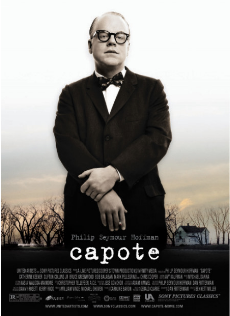
Truly Truman
'Capote' asks whether art and artists are above morality.
"There is nothing so powerful as truth -- and often nothing as strange." Daniel Webster
When a writer is born, a family is destroyed, or so goes a famous truism. In the case of Truman Capote, a writer was born, and a family was blown to bits with a shotgun, but the two events only became related later on.
Capote, the latest biopic about a famous person and his infamous doings begins in 1959, when the writer was researching and birthing his big bad baby of a book (In Cold Blood). The notion that writers will sell everyone they know down the river is evidenced by Capote himself, who sold out his subjects and his soul in return for a masterpiece of journalism. He got what he paid for, and so do we. There are no big surprises in this film. What you expect is exactly what you get: lots of Philip Seymour Hoffman acting up a storm and the other players adding more subdued, sedate performances.
It's a bravura one-man-show that feels somehow oddly empty, as if the void that existed in Capote himself is made manifest on the screen. The film does, however, pose some interesting questions about whether art is above morality. It's a moot question.
Small town planet
This film begins with an opening shot of wheat blowing in the wind. It is the late 1950s, and America is about to undergo all types of storms and squalls, but in Holcomb, Kansas, change is nowhere to be seen. This is small town America, full of girls in prim sweaters and men in fedoras. Into this staid place wafts Capote, with his Blanche Dubois manner and expensive clothes. The clothes jump out at you, not only as a statement of character and social function, but as the delineating line between high, low and middle class people. It's the drapes versus the squares; the bad men wear greasy duck-ass haircuts, and black leather jackets, and the good hardworking citizens don clothes from the Sears Roebuck. And Truman himself, with his camel hair coats, cashmere scarves (from Bergdorf's) and impeccable suits, is a visitor from another, much more fashionable, planet.
But despite his fancy wrappings, Capote also came from mean beginnings: an alcoholic mother who abandoned him. He's got poverty, pain and the dark side of Southern charm. He was, in essence, made for the story he was about to tell.
Director Bennett Miller's restrained approach has a clean, spare feeling that screams "QUALITY PICTURE!!!" but it's so quiet and understated, that the story occasionally threatens to disappear. The raunch that characterized Capote's work is nowhere to be seen here. The murder of an entire family, which precipitated Capote's trip to Holcomb, is initially given short shrift. The only blood in evidence is a discreet splash on the bedroom wall. As Capote sets about infiltrating the society of Holcomb, shots are interspersed of his other life as the toast of New York's glittering parties. Possessed of a skewering wit, and meanness to match, he was, often quite literally, a scream.
To kill a friend
More interesting, and indeed, more human, is Capote's childhood friend, Nelle Harper Lee who was busy producing her own masterwork To Kill a Mockingbird at the same time as she was acting as Capote's research assistant. Harper Lee (Catherine Keener) is the only presence that seems truly trustworthy. It's up to her to provide gravity and judgment, and she acts as the film's moral compass.
Capote and Harper Lee were friends, possibly even co-authors; they complemented each other well. Capote claimed that he had actually written large portions of To Kill a Mockingbird, and his spirit is evident in that book in the character of Dill, the odd little boy described as a "pocket Merlin, whose head teemed with eccentric plans, strange longings, and quaint fancies." Like the character of Dill, darkness drew Capote "as the moon draws water." Whether or not Capote actually ghosted Harper Lee's novel, these two works; To Kill a Mockingbird and In Cold Blood, stand as two very differing interpretations of the American experience. There are curious parallels. In one story, a brother and sister escape murder; while in the other, they do not. One might be fiction and the other horribly real, but the differences are negligible, "Actual drama, though technically a fiction, is...a search for truth," says David Mamet.
The six years that Capote spent bringing the book to life, ended with "a snap and a thud" when Perry Smith and Richard Hickock were hanged. There is something horribly parasitic about the book. So too, the film: despite its sheen and polish, it has an unsettled hollowness.
Slow motion crash
In the collision between Perry Smith and Richard Hickock, and the Clutter family, the two intersecting narrative lines move ever closer, it's the inevitability of their eventual meeting that gives Capote's book such force. The ending is preordained -- like most tragedy -- all the reader does is watch it play out.
What it needs, of course, is someone to tell the tale. And here, the writer is a lawless entity whose ultimate loyalty is only to his art. Perry Smith, as the sad shadow of the glittering, sleek Truman, is appropriately underplayed by Clifton Collins Jr. The scenes with Capote and Perry Smith are unnerving with their subtext of mutual usage, desire and constant manipulation. Who is the bigger user is difficult to determine, the charming murderer or the charming writer?
Capote's book offered the somewhat startling notion that murderers might be as much victims as their actual victims. The idea that acts of sudden, atrocious violence don't strike like thunder from a clear blue sky, but are laid down by years of systematic violence and abuse is old news to us jaded modern people but to the 50's naïfs, it struck horribly home. The horror of people randomly murdered in their beds used to sell newspapers, books, and of course, films, comes with its own horrors, to which numbness is the only reaction currently available.
The other stated purpose of Capote's book was to undermine capital punishment, even though the idea that the writer needed his subjects to die in order to end his book, is deliberately, and bluntly, stated throughout. Perry's jailhouse confessions are depicted with blond head and dark head bent together, bonded together by a terrible need to be seen. It is this one quality, more than ego, or ambition that seems to unite this unlikely pair.
Hard luck manipulation
Smith and Capote shared the same hard-luck childhood story of death, alcohol, suicide and abandonment -- one wrote, one killed -- but whether Capote's book was also a form of self-murder is the question that the film ever so quietly asks. If you sell your soul for art, the devil will eventually come calling. He accepts booze, pills and all major credit cards. Capote might have been a liar, a drunk and a general all-around jerk according to the many people that he variously used and abused, but he was one hell of a writer. But then again, Picasso and many other "great men," were great at being artists, and not so great at being men. Where sociopath ends and artist begins, is the central question. There is, of course, no answer.
The book seemed to have sucked Capote dry by the end of his life, but the parasitic nature of writers couldn't find a greater champion than Capote who used his way with words to construct an entire persona -- the society swans, the black & white balls, appearances on Carson etc. -- but to then also systematically dismantle that very spun-sugar edifice, biting the pretty manicured hands that fed him. Having struggled so mightily to escape his meager upbringing, the glamorous world of high society and Hollywood must have seemed heaven to this fey young man from the South. The realization that they were simply another version of hell may have prompted Capote's later social suicide in book form.
The genre of true crime fiction, which gets a special little section in the bookstore all to itself, was virtually spawned by Capote's work. From In Cold Blood to Henry, Portrait of Serial Killer, it's a hop, skip and jump from art to exploitation. Nonfiction seems the dominant mode of popular culture lately, but whether you can lay this heavy mantle on the elfin shoulders of Tru, is difficult to say. Capote believed that In Cold Blood, would change the way people wrote, and he may have been right. The later years of drugs, self-immolation and death are alluded to in the final epigram of the film taken from the words of Saint Theresa of Avila "There are more tears shed over answered prayers than over unanswered prayers."
In the life of Truman Capote, those were often the same thing.
Dorothy Woodend reviews films for The Tyee every Friday. ![]()


18
Login or register to post comments
dorothy
6 years ago
Comments on "Truly Truman "
'...must have seemed heaven to this fey young man from the South. The realization that they were simply another version of hell...'
Brings to mind these three stanzas of the Havamal:
54
It is best for man to be middle-wise,
Not over cunning and clever:
The learned man whose lore is deep
Is seldom happy at heart.
55
It is best for man to be middle-wise,
Not over cunning and clever:
The fairest life is led by those
Who are deft at all they do.
56
It is best for man to be middle-wise,
Not over cunning and clever:
No man is able to know his future,
So let him sleep in peace.
-----
Obviously, Truman C. did not follow this advice, or he was a compulsory truth-seeker, who did not then have the stuffing to live with the Truth, when he found it.
lynn
6 years ago
A great review, Dorothy.
The Grass Harp, a novel by Truman Capote was one of the first "grown-up" books I read as a kid. I think I probably just liked the name of it and picked it up off the library shelf. There was a lonely magic to the story....and being a little girl that liked treehouses it was the perfect story I thought.
I re-read it years later, much more grown-up by then, :-) and I can still remember the feeling of almost sweet eccentricity that permeated the book, the whole warm lilt of the language of the South, yet oddly a certain remoteness ran through it all.
You capture that same sense of conflicting juxtapositions so well in this review of "In Cold Blood" though obviously a very different kind of Capote story going on here. Really enjoyed reading it...
lynn
6 years ago
Sorry, Dorothy, (brain fog , on my part) that should read... "review of Capote"...
ROBBINS Sce Research
6 years ago
I liked the review, I never would have imagined trying to compare In Cold Blood with To Kill a Mockingbird other than the commonality of the two authors (one author?).
However, I find "where sociopath ends and artist begins is the central question" just a little mushy.
I thought the central question was 'is art above morality'? If as the article intimates that art seeks truth (presumably through liberation) and morality through central elements of reason and control (relative to the human condition at least), than isn't the relationship more theoretically juxtapose than subordinate?
Am I reaching here?
Truman Green
6 years ago
Glad I came back on internet just in time to read this beautiful review.
dorothy
6 years ago
Art does not seek anything. It bursts forth the same way germinal leaves and root shoot out from a seed. Whether it liberates, lays on a burden, poses a question, sends on a quest, or takes from you, or demands, depends entirely on the kind of house you live in for the moment. Art is not above, or subject to, morality (whatever that may mean). Rather, the distinction is pointless. Art lays out its own universe, atrictly bound by law, and thus 'moral'. But it also defines that moral, or blows holes in previous incarnations of 'moral', or narrows the focus of 'moral', or sends the whole kit and caboodle into a deep, dark dungeon. In other words: It changes the universe as we know it, never to be returned to its former shape, or it ain't art.
dorothy
6 years ago
One more thing:
I am not that Dorothy. Total coincidence that my 'handle' is the name of the author of the review.
ROBBINS Sce Research
6 years ago
Well, both Dorothy's are exceptional writers. I could spend all of my free time reading this, and feel somewhat embarassed at critiqueing it in any way, probably because at some level I would like to write in this manner much better than I presently am able to.
I understand in my previous blog that I should not have been so pretentious or presumptious to attemt to harnass art and parlay it into any type of assumption. Brevity is a skill I have yet to master, and the blogs (probably for the better) lend themselves to this (and therapy is $150 an hour). As an old streetfighter in my drinking days I am still somewhat accustomed to striking and provoking to see what might come back, and this is a troubling habit. In this case what came back (aside from a beautiful piece from Dorothy 1 was your equally beautiful response.
Dorothy #2 can you teach me if art is unto its own universe (which I can accept)how does it thus become moral or in the alternative how is it capable of defining moral or otherwise affecting moral (presumably in this universe)?
Your lofty lilting language which later concludes with In other words: it changes the universe as we know it....was like a friendly punch in the stomach, I could almost get the sense of Bowie's Major Tom moving from one universe which is so difficult (impossible) to define, to our 'universe' (human life/existence) which may seem definable, but is not.
Truman Green
6 years ago
I thought the second Dorothy was the writer of the article too. Perhaps another reason why we should all cut the anonymity crap.
ROBBINS Sce Research
6 years ago
TG-you snapped me out of my spell-out of the ether and I started talking like Broderick Crawford on Highway Patrol to someone on the telephone--- right after your posting-
My name is Glen P. Robbins-which I include, I wonder if people would write differently if they published their real name? The anonymity is sort of like a mask or personna. I agree that the anonymity might actually inhibit people in that they remain loyal to their writing label, and thus become less inclined to be receptive to other ideas or perhaps changing their mind about something they said.
Perhaps it might affect their jobs or their businesses if they were to post their name. My polling company had a rough time in the beginning with callers leaving offices and being asked questions about this and that by 'curious' strangers. Clients with government contracts or business interests would demand anonymity.
Now, far less people I do business with are concerned about the ramifications of what they are doing, but academics particularly tenured ones, don't like rocking the establishment boat, research grants etc. This is very troublesome. I agree it would be an improvement if people would stand on their name, and advance their thoughts.
Having said that, and having been an independent publisher, I can assure you that people out there are reading these blogs, and if people feel comfortable being anonymous, than that is probably how it has to be for now.
For me, I don't get too much negative feedback, save for the criticism's I get from time to time on the Tyee (some in retrospect richly deserved). Even my partners have gotten use to this, after an initial bit of 'what are you...nuts? blogging?
As a pollster, these blogs albeit ideologically somewhat abstract are extremely valuable.
I don't hold any of this against either Dorothy I (the author) or Dorothy II (the commentator, because many terrific authors have not used their real name for one reason or another, and Truman we need to encourage people to write.
Its still wrapped up pretty tight out there but its going to change and this is very exciting!
dorothy
6 years ago
This is from Dorothy #2, who is not maintaining any anonymity crap, but actually can lay claim to the name and had chosen it as a ‘handle’ prior to the appearance of dorothy #1’s article… I guess there are just more of us belonging in Kansas than many realize!
About art: Robbins, I shall try. Art is an entity if you will, from the uncharted territories just outside our own universe or city walls, the heath, where the heathens live. An artisan can paint a nice picture, can write a nice story, can weave a nice tapestry or make a nice piece of pottery. The artist, on the other hand does not make anything or own anything, he or she is the mediator, or possibly medium, being used with or without his will, as a window for us to look into this other reality, from whence the true work of art emerges. Anything that exists comes with an inherent law or morals as we call it. It may be a very simple one, such as eat, eliminate, eat, eliminate, procreate, die. Or it may be infinitely complex, such as the law of a symphony - and I am not talking about the wave physics, nor of ‘the minor fall, the major lift’, or such things. I am talking about the additon to one’s wisdom about life, which may be assimilated by experiencing, and adopting it from, a worthy piece of art. If an afternoon in the gallery, or an evening in a concert hall does not leave you feeling you have been run over by a ten-ton truck, you have been looking at pretty pictures, or listened to pretty tones, you have not met with art. I think W. Somerset Maugham said it better than anyone in ‘Christmas Holiday’, ‘the bottom had fallen out of his world’, of the main character, a young man.
This is a postulate, of course, than nothing can exist without an inherent law or moral, but try to experiment with it in your thoughts: For us to acknowledge the existence of something, which in our terms is the same at for it to exist, we must be able to go back to the place in which it lives, and experience it again. For us to be able to do that, we must be able to recognize it as the same thing we looked at before. And for us to do that, it must show a certain consistency, predictability if you will, it must own a set of rules by which it behaves or manifests itself, ergo, a moral. The problem, I think, is that when we say ‘moral’, we insist on the Christian division into good/bad, and everything that cannot be understood under this division is termed ‘lack of morals’. This is wrong. The good/bad system is only one kind of morals. We, being an intelligent species, can, of course adopt or assimilate sets of morals initially alien to our own, and we will become richer when we do. That, to my understanding, is the only kind of wealth worth pursuing. But, as the old poet said ‘that is another story’.
Truman Green
6 years ago
Thanks for including your real name, Mr. Robbins. May I conclude from this that you agree it is a moral issue? Dorothy 2, I wasn't suggesting that "Dorothy" isn't your real name or your "handle" only that it doesn't really identify you. These posts seem to be analogous to letters to the editor. I can't identify how they differ--and certainly no reputable print newspaper would accept anonymous letters to the editor for so many very elementary and obvious reasons, not least of which is personal integrity and morality.
dorothy
6 years ago
Once more around the mulberrybush on 'anonymity':
The Tyee knows who we are. The 'thing' with holding a discussion in this fashion is, that your opinions may be judged and responded to on their merits alone. I have seen forums develop into slanging matches, where the occupations, financial situations etc. of people were considered fair game. I believe if we were to insert anything not in accord with the letter and spirit of the Canadian constitution and other pertinent laws, then the Tyee would decline accepting our contribution. As I understand integrity, if it only applies when you believe yourself under scrutiny, then it is not integrity, but fear of the bigger club. Integrity is the quality of your choices, when no-one but you is looking.
Truman Green
6 years ago
If I am to believe your rationale for not identifying yourself it would follow that you remain anonymous for a moral reason, not wishing to subvert the egalitarian nature of the Tyee comments section. In all due respect-- you are quite clever-- but I think you're anonymous because you wish to make comments without everyone knowing who you are, and thus not take real responsibility for them. Did you notice that Mr. Robbins gave his real name, even though he presented a pretty good rationalization for not doing so--encouraging people to write? This all seems to be a mad dash for the bottom. Don't you think we're more likely to get the kind of world we want by acting as though it is already here, than by chosing to emulate the Ku Klux Klan rather than Martin Luther King? The mind boggles at how you have tried to make transparency and openness into a weakness and a detriment to reliable discussion.
Truman Green
6 years ago
Also: Dorothy 2, may I ask you a sincere question? When you posted your comment under the name, "Dorothy," did it occur to you that some readers might suppose that you were Dorothy Woodend, the writer of the article--and that there would be a certain logic in them doing so? If you answer in the affirmative do you not think that maybe you could have provided a caveat with your comment?
I mean, everyone knows that I'm not Truman Capote, eh, but your comments provided a much better opportunity for confusion--kinda like my younger brother, Jim Green, running against Jim Green for mayor.
dorothy
6 years ago
Hello, Truman:
To answer your sincere question: No, it never did occur to me, that anyone could take me for a professional writer, and I would say that those who do, underrate the amount of work that goes into a column as the one written by my namesake.
It was I, who wrote the first commentary to the piece, calling on resources representing a distinct cultural background. To effect such a second persona would have been a contrived thing to do for the author, which I believe she would be way above.
I only put in a ‘caveat’ later, because I misunderstood Lynn’s “brain fogâ€. I subsequently realised her reference is entirely to the column, not to confusion of identity.
Back to the beginning: No, I do not not remain anonymous for moral reasons, but for pragmatic reasons, as explained. I do not see a discussion of art as a fundamental, back-against-the-wall issue, where I am the representative of an oppressed people, such as Martin Luther King, junior was. I believe one needs reasons as weighty as his for risking one’s life, when one gets to look one’s children in the eyes on the other side and explain why they had to lose a parent. I do not believe anything Mr. King said expressed an arrogant assumption that the good times were already here. I distinctly remember “We shall overcome some dayâ€.
You mention the Klux, but miss the point. The unique, and some would say objectionable thing about that organization is not the secrecy of its membership. That is shared with mainstream political parties. No, the problem with the Klux is that its aims, goals, and means run contrary to the broader consensus of society, not to mention that some of its members have been known to break the law.
I also wish to respond to your remark, “The mind boggles at how you have tried to make transparency and openness into a weakness and a detriment to reliable discussion.â€
I am not deluded enough to believe I can alter reality with mere words. Consequently, I cannot ‘make’ anything into anything else; I can only state how I see it. You are free to see it otherwise, and to say so. We have freedom of thought, conscience, and expression.
You imply that I do not wish to take responsibility for my words and actions. I believe I do so by tempering my words and deeds so as to stay courteous and considerate. In a case like this, using a pen-name, I would take pains to not abuse the protected state of ‘anonymity’.If you think I have failed in this, please be specific instead of attacking me all over the map.
I ken that this discourse boils down to, that I have managed to say something, which does not please you, but you may feel that your argument on that particular point is not entirely rational, and so you launch into a personal attack, which only serves to make a good case for continued ‘anonymity’. Quite apart, of course, from the fact that anonymity is the rule rather than the exception on ‘blogs’. You are not correct about print newspapers not accepting such contributions. Vancouver Sun has its ‘sound-off’, and other papers their ‘rants’ on the web.
There is a bloody ironi, is there not, in that the book written by the man we are discussing, is about a nice family, who all died, because their protective cover of ‘nobodyness’ had been violated in front of the wrong people?
Mr. Robbins has a business persona, a sort of public façade, which makes it meaningful, perhaps even beneficial, for him to identify himself to a broad, and unknown, public. You yourself appear to be bursting to tell the world, how proud you are of your brothers’ accomplishments. All very legitimate. I, however, could tell you my full name and address till the cows come home, but seeing I am one of the grey mass of nine-to-fivers, it would tell you not half as much as me listing the virtues I strive for in my life, which I will therefore do. They are:
Hospitality, Courage, Truth, Loyalty, Honor, Self Reliance, Industry, Perserverance, Discipline
Truman Green
6 years ago
Dorothy 2, In my opinion you have not been able to make a virtue of secrecy so why not just come out into the open. I will admit that you have a rather unique facility with rationalization. Imagine bringing that murdered family into the debate as though killers can't find victims who do or don't present themselves in public or in a public forum. And yes, much of the evil of the Klan was expressed in the hooded adventures into terrorism. In fact in many of the small towns where they operated they could be just about anybody during the day--policeman, lawyer, farmer, cornerstore owner--and terrorist by night. Did you notice that Dorothy Woodend gave her real name after her article. What, in effect, is the difference? I think many tyee readers find as much enjoyment in the comments section as in the articles. We are presenting opinions in a way not unlike the lead writers. I think we should be governed by the same rule of disclosure. It just seems so cowardly to do otherwise. I mean, don't you feel a sense of obligation to all those who stood against tyranny in their own names, and often with their own bodies. If we're too frightened to disclose our identity in letters to the editor--especially in this comparatively safe and stable society, I personally don't believe we deserve the liberty that so many others have died for. For me, at least, morality is always what we OUGHT to do, not what is prudent or safe. So come on, eh, Dorothy 2, stand up and be counted. Add bravery to that list of virtues. Also: I can't speak for Mr. Robbins, of course, but I bet he gave his name because he felt a certain moral obligation to do so. He doesn't seem like the kind of person who would so allow me to bully him into doing something that he didn't wish to do.
Truman Green
6 years ago
Incidentally, Dorothy 2, you might wish to revisit my sentence regarding the two Jim Greens.