

 SHARE:
Last of a ten part series from The Troublemaker's Teaparty, A Manual for Effective Citizen Action.
In the past ten weeks I've shared insights gleaned from many effective organizers and community activists about how to gather people to a cause and have the best chance of winning the day.
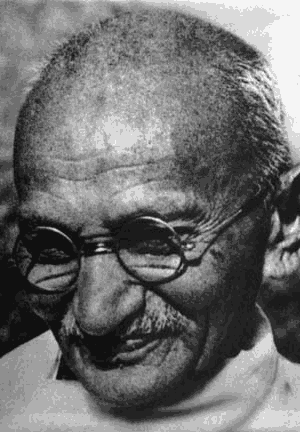
But when it comes to such advice, it's best to leave the last word to a pair of the most effective "campaigners" in history, Saul Alinksy and Mahatma Gandhi.
Saul Alinsky's Rules for Radicals
In 1971, Saul Alinsky wrote an entertaining classic on grassroots organizing titled Rules for Radicals. Those who prefer cooperative tactics describe the book as out-of-date. Nevertheless, it provides some of the best advice on confrontational tactics. Alinsky begins this way:
What follows is for those who want to change the world from what it is to what they believe it should be. The Prince was written by Machiavelli for the Haves on how to hold power. Rules for Radicals is written for the Have-Nots on how to take it away.
His "rules" derive from many successful campaigns where he helped poor people fighting power and privilege.
For Alinsky, organizing is the process of highlighting what is wrong and convincing people they can actually do something about it. The two are linked. If people feel they don't have the power to change a bad situation, they stop thinking about it.
According to Alinsky, the organizer -- especially a paid organizer from outside -- must first overcome suspicion and establish credibility. Next the organizer must begin the task of agitating: rubbing resentments, fanning hostilities, and searching out controversy.
As well, the organizer must attack apathy and prevailing patterns of community life to get people to participate. Alinsky would say, "The first step in community organization is a community disorganization."
Through a process combining hope and resentment, the organizer tries to create a "mass army" that brings in as many recruits as possible from local organizations, churches, services groups, labor unions, corner gangs, and individuals.
Alinsky provides a collection of rules to guide the process. But he emphasizes these rules must be translated into real-life tactics that are fluid and responsive to the situation at hand.
Rule 1: Power is not only what you have, but what an opponent thinks you have.
If your organization is small, hide your numbers in the dark and raise a din that will make everyone think you have many more people than you do.
Rule 2: Never go outside the experience of your people.
The result is confusion, fear, and retreat.
Rule 3: Whenever possible, go outside the experience of an opponent.
Here you want to cause confusion, fear, and retreat.
Rule 4: Make opponents live up to their own book of rules.
"You can kill them with this, for they can no more obey their own rules than the Christian church can live up to Christianity."
Rule 5: Ridicule is man's most potent weapon.
It's hard to counterattack ridicule, and it infuriates the opposition, which then reacts to your advantage.
Rule 6: A good tactic is one your people enjoy.
"If your people aren't having a ball doing it, there is something very wrong with the tactic."
Rule 7: A tactic that drags on for too long becomes a drag.
Commitment may become ritualistic as people turn to other issues.
Rule 8: Keep the pressure on.
Use different tactics and actions and use all events of the period for your purpose. "The major premise for tactics is the development of operations that will maintain a constant pressure upon the opposition. It is this that will cause the opposition to react to your advantage."
Rule 9: The threat is more terrifying than the thing itself.
When Alinsky leaked word that large numbers of poor people were going to tie up the washrooms of O'Hare Airport, Chicago city authorities quickly agreed to act on a longstanding commitment to a ghetto organization. They imagined the mayhem as thousands of passengers poured off airplanes to discover every washroom occupied. Then they imagined the international embarrassment and the damage to the city's reputation.
Rule 10: The price of a successful attack is a constructive alternative.
Avoid being trapped by an opponent or an interviewer who says, "Okay, what would you do?"
Rule 11: Pick the target, freeze it, personalize it, polarize it.
Don't try to attack abstract corporations or bureaucracies. Identify a responsible individual. Ignore attempts to shift or spread the blame.
According to Alinsky, the main job of the organizer is to bait an opponent into reacting. "The enemy properly goaded and guided in his reaction will be your major strength."
Mahatma Gandhi's Top Eight Methods for Converting an Opponent
Use these methods to convert opponents who control your group. Conversion refers to the process by which an opponent comes around to embrace your objectives.
1. Refrain from violence and hostility.
2. Attempt to obtain your opponent's trust
by --
being truthful,
being open about your intentions,
using chivalry (for example, being kind if the other side experiences an unrelated difficulty),
and making behavior inoffensive without compromising the issue at hand.
3. Refrain from humiliating an opponent.
4. Make visible sacrifices for one's cause.
Here it is best if the suffering of the aggrieved is made visible.
5. Carry on constructive work.
Address parts of the problem you can address. Make improvements where you can. Participate in activities that all people see as contributing to everyone's common welfare.
6. Maintain contact with an opponent.
This is absolutely necessary if conversion is to succeed.
7. Demonstrate trust in an opponent.
8. Develop empathy, good will, and patience toward an opponent.
This is the best you can do from your end. If you fail to convert an opponent it may be due to external factors beyond your control.
Charles Dobson teaches creative problem solving at the Emily Carr Insitute of Art and Design in Vancouver and is author of The Troublemaker's Teaparty, A Manual for Effective Citizen Action, available from bookstores and New Society Publishers.
You can find all ten parts of Dobson's series, plus an introduction by Tyee editor David Beers, by clicking on the CITIZENTOOLKIT button on left side of this page, or The Tyee's home page.
This section will continue to offer articles about what it means to be an engaged, effective citizen. ![[Tyee]](/design-article.thetyee.ca/ui/img/yellowblob.png)












Tyee Commenting Guidelines
Comments that violate guidelines risk being deleted, and violations may result in a temporary or permanent user ban. Maintain the spirit of good conversation to stay in the discussion.
*Please note The Tyee is not a forum for spreading misinformation about COVID-19, denying its existence or minimizing its risk to public health.
Do:
Do not: