

 SHARE:
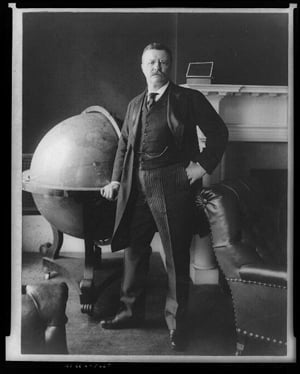
- The Imperial Cruise: A Secret History of Empire and War
- Little, Brown and Company (2009)
Theodore Roosevelt was in many ways the first modern American president: eager to project power overseas, a brilliant framer of political issues, an advocate for the environment, and amazingly good at using the media. In many ways, he set the United States on the course it still follows.
He was also, unfortunately, a thorough racist who built American policy on principles of white supremacy.
James Bradley is the author of Flags of Our Fathers and Flyboys, books about the Second World War. His father was one of the American soldiers who raised the flag on Mount Suribachi, and this book is Bradley's effort to understand why Americans were fighting the Japanese in the first place.
His well-documented conclusion: Teddy Roosevelt, like most Americans, believed in the self-evident superiority of the Aryan peoples, especially the Anglo-Saxons. Race alone determined who would be masters, slaves, or exterminated.
Poets and profs: endemic racism
Roosevelt believed that conquest was proof of Teutonic superiority: "The world would have halted," he once wrote, "had it not been for the Teutonic conquests in alien lands." In Cuba, he dismissed the people he was supposedly liberating: "The Cuban soldiers were almost all blacks and mulattoes... They were utterly unable to make a serious fight against even a very inferior number of Spanish troops."
Even the U.S. political system relied on race for success: "Nineteenth-century democracy needs no more complete vindication for its existence than the fact that it has kept for the white race the best portion of the new world's surface," he wrote in 1897.
Roosevelt was eager to annex Hawaii: "It was a crime against the United States, it was a crime against white civilization, not to annex it two years and a half ago."
He was not unusual in his views on race. They were shared by Ralph Waldo Emerson, Walt Whitman, and Columbia professor John Burgess, whose teaching Teddy Roosevelt considered "one of the formative experiences of my life."
Born to a wealthy New York family, Roosevelt had no reason to question the racism around him. Both history and current events seemed to confirm the superiority of whites and the inferiority of everyone else. What was more, whites had to go on proving their superiority by conquering and ruling the lesser breeds.
From aristocrat to cowboy
Roosevelt had to prove his own superiority as well. A frail, asthmatic little boy, he drove himself to become physically fit. The occupational hazard of superior whites was the risk of "overcivilization." Roosevelt made sure he kept in touch with his inner barbarian.
With uncanny skill, young Theodore advanced in politics by rebranding himself. He had begun as an overdressed Harvard aristocrat, but he bought a ranch out west, played cowboy a bit, and went back east with a macho image that took him into the government as assistant secretary of the Navy -- just as war with Spain was about to break out.
His ability to manipulate the media got him prominent attention as the leader of the Rough Riders, a volunteer cavalry unit in Cuba, and he kept his more civilized behaviour under wraps: he never allowed himself, for example, to be photographed playing tennis.
Roosevelt's prominence in the Battle of San Juan Hill got him the vice-presidency. Then president McKinley died, and Roosevelt was in charge.
While McKinley had been a reluctant warrior, Roosevelt considered war a good in itself, at least for Anglo-Saxons. The conquest of Cuba and the Philippines was to him no different from the Indian wars that had ended with the massacre at Wounded Knee. While Cubans and Filipinos hoped that the Americans would liberate them, they found they simply had new overlords.
An early master of covert operations
Roosevelt was good at covert operations as well. In 1903 he instigated the separation of the province of Panama from Colombia, ensuring better terms for the U.S. builders of the canal.
With Panama, as with Cuba and the Philippines, Roosevelt created a model for colonial administration that has run all the way up to Iraq and Afghanistan: suppress anyone who wants self-government, then set up a few local aristocrats or opportunists as a puppet regime, perhaps under the control of an American proconsul.
And if the colony turns into a quagmire, keep the media in the dark. In the Philippines the U.S. fought, unreported, an almost genocidal war for years. Bradley argues that it's still going on in the southern islands, with American soldiers fighting Muslim dissidents.
Roosevelt wanted to influence events on the Asian mainland as well as in the Pacific. Seeing the Slavs as an inferior branch of the white race, he disliked the idea of Russian influence in China and Korea. He considered the Asians themselves incapable of self-rule, with one exception: the Japanese.
Japan had dramatically leaped from feudalism to regional power in less than a generation, and Roosevelt respected that achievement. So he was susceptible to the charm of Baron Kaneko, a Harvard-educated lawyer-diplomat who also defined the world in terms of racial hierarchies.
When the Russo-Japanese War broke out in 1904, the U.S. was ostensibly neutral, but Roosevelt made it clear where his sympathies lay. He even admired the Japanese surprise attack on Russian ships at Incheon and Port Arthur that began the war.
'Mission Accomplished,' 1905
In 1905, Roosevelt sent his vice-president, William Howard Taft, on a cruise to Japan, China, and the Philippines. In part it was a "Mission Accomplished" journey, celebrating American rule in the Philippines despite the ongoing war against the Filipinos.
The imperial cruise was enlivened by the presence of Alice Roosevelt, the president's 21-year-old daughter. She guaranteed media attention and frequent mentions of the family name, and she was a sensation in Japan. (She also bitterly disliked her father and stepmother.)
The cruise was also the occasion for another covert op: a secret and illegal diplomatic mission to the Japanese. Roosevelt wanted Taft to offer them a deal: in exchange for a free hand in the Philippines, the U.S. would grant the same to Japan in Korea and China.
This was a cold-blooded betrayal of Korea, which had signed a treaty with the U.S. in 1882. In 1910 Japan completely took over the country, plunging it into 35 years of oppression. (For North Korea, it's been a century.)
But it was also a betrayal of the U.S. Constitution, since no treaty was ever proposed, let alone approved by Congress and signed. The deal was a secret signal to the imperialist faction in the Japanese government that it could run wild.
Meanwhile, Japan and Russia were negotiating an end to their war. Roosevelt, brokering the deal, persuaded the Japanese not to demand reparations. Feeling as betrayed as the Koreans, the Japanese government and public turned against the Americans. When Alice re-entered Japan after a visit to Seoul, she had to go incognito, presenting herself as an Englishwoman.
Even so, Roosevelt stuck to his secret deal. As Bradley writes: "Americans remember the exact date of Pearl Harbor, but not the day Theodore Roosevelt gave Japan the keys to the kingdom. The date was November 28, 1905, when Roosevelt turned over the U.S. legation building in Seoul. Now the Honorary Aryans had a grand base from which to begin civilizing Asia."
So Japan was free to expand its new empire, but with a lingering resentment of Roosevelt's betrayal on Russian reparations. Anti-Japanese sentiment in the U.S. fed that resentment. Meanwhile, American racism toward other Asians would make it easy for future administrations to shrug off the brutalization of the Koreans and the Chinese.
And when the U.S. was repaid at Pearl Harbor, the American response was still racist: "Why, the little yellow bastards!" said Time magazine. The American media were as ignorant in 1941 as in 1905, and they remain ignorant.
No teddy bear
Almost 70 years later, and more than a century since the imperial cruise, most of us still think of Teddy Roosevelt as a kind of cool old guy with funny glasses and a moustache. Hey, the teddy bear was named after him.
No. He was the racist hero of his racist age, and he condemned generations to a nightmare century: Korean girls who died in sexual slavery, Chinese who died in the civil wars triggered by Japan's invasion, Jews who died at the hands of a Nazism Roosevelt would have admired, and even the B.C. Japanese who lost their homes and livelihoods because of our own racism.
Everything Roosevelt did, his successors imitated: the puppet governments in Saigon and Tehran and Kabul, the media manipulation, the covert operations, and the arrogant assumption that Anglo-Saxons knew what was good for the lesser breeds.
The curse of Theodore Roosevelt still hangs over the world. We are nowhere near expiating it. ![[Tyee]](/design-article.thetyee.ca/ui/img/yellowblob.png)




Tyee Commenting Guidelines
Comments that violate guidelines risk being deleted, and violations may result in a temporary or permanent user ban. Maintain the spirit of good conversation to stay in the discussion.
*Please note The Tyee is not a forum for spreading misinformation about COVID-19, denying its existence or minimizing its risk to public health.
Do:
Do not: