

 SHARE:
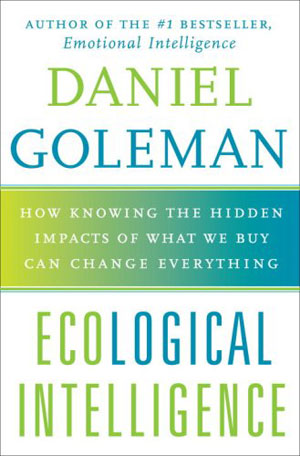
[Editor's note: The following is excerpted from the new book Ecological Intelligence by Daniel Goleman, published by Broadway Business, an imprint of The Crown Publishing Group, a division of Random House, Inc. Reprinted with permission. Copyright © 2010 by Daniel Goleman.]
For over a thousand years Sher, a tiny village in Tibet, has clung to its existence despite its dire location, perched on a narrow shelf along a steep mountainside. This site on the dry Tibetan plateau gets just three inches of precipitation a year. But every drop is gathered into an ancient irrigation system. Annual temperatures average near freezing and from December through February the mercury can hover below that mark by 10 to 20 degrees Fahrenheit.
The region's sheep have extra-thick wool that holds heat remarkably well; locally spun and woven wool makes clothes and blankets that help villagers endure the excruciatingly cold winters with little heating other than a fire in the hearth.
The stone-and-wattle houses need to be reroofed every 10 years, and willow trees planted along the irrigation canals provide the roofing. Whenever a branch is cut for roofing, a new one is grafted to the tree. A willow tree lasts around four hundred years, and when one dies a new one is planted. Human waste is recycled as fertilizer for herbs, vegetables, and fields of barley -- the source of the local staple, tsampa -- and for root vegetables to store for the winter.
For centuries Sher's population has stayed the same, around 300 people. Jonathan Rose, a founder of the movement for housing that is both green and affordable and a builder himself, finds instructive lessons in the clever ways native peoples have found to survive in perilous niches like Sher. Says Rose, "That is true sustainability, when a village can survive in its ecosystem for a thousand years."
Tibetans, of course, are not unique in their remarkable ability to find simple solutions to the daunting challenge of surviving, even thriving, in the most dire of environmental surrounds. From the Arctic Circle to the Sahara Desert, native peoples everywhere have survived only by understanding and exquisitely attuning themselves to the natural systems that surround them and designing ways of living that best interact with those systems. The tiny hamlet of Sher depends on three forces for its survival: sunlight, rainwater, and the wisdom to use nature's resources well.
Modern life diminishes such skills and wisdom; at the beginning of the 21st century, society has lost touch with what may be the singular sensibility crucial to our survival as a species. The routines of our daily lives go on completely disconnected from their adverse impacts on the world around us; our collective mind harbors blind spots that disconnect our everyday activities from the crises those same activities create in natural systems. Yet at the same time the global reach of industry and commerce means that the impacts of how we live extend to the far corners of the planet. Our species threatens to consume and befoul the natural world at a rate that far exceeds our planet's carrying capacity.
I think of the brand of wisdom that has kept that tiny Himalayan village alive for these centuries as "ecological intelligence," our ability to adapt to our ecological niche. Ecological refers to an understanding of organisms and their ecosystems, and intelligence connotes the capacity to learn from experience and deal effectively with our environment. Ecological intelligence lets us apply what we learn about how human activity impinges on ecosystems so as to do less harm and once again to live sustainably in our niche -- these days the entire planet.
Need for a new sensibility
Today's threats demand that we hone a new sensibility, the capacity to recognize the hidden web of connections between human activity and nature's systems and the subtle complexities of their intersections. This awakening to new possibilities must result in a collective eye opening, a shift in our most basic assumptions and perceptions, one that will drive changes in commerce and industry as well as in our individual actions and behaviors.
The Harvard psychologist Howard Gardner reinvented the way we think about IQ by arguing that there are several other varieties of intelligence besides the ones that help us do well in school, and that these other intelligences also allow us to do well in life. Gardner enumerated seven kinds, from the spatial abilities of an architect to the interpersonal aptitudes that make teachers or leaders great. Each of these intelligences, he argues, involves a unique talent or ability that helped us adapt to the challenges we faced as a species and that continues to benefit our lives.
The uniquely human ability to adapt our way of living to virtually any of the extremes of climate and geology the earth offers would certainly qualify. Pattern recognition of any kind, Gardner suggests, may have its roots in the primal act of understanding how nature operates, such as classifying what goes in which natural grouping. Such talents have been displayed by every native culture in adapting to its particular environment.
The contemporary expression of ecological intelligence extends the native naturalist's ability to categorize and recognize patterns to sciences like chemistry, physics and ecology (among many others), applying the lenses of these disciplines to dynamic systems wherever they operate at any scale, from the molecular to the global. This knowledge about how things and nature work includes recognizing and understanding the countless ways man-made systems interact with natural ones, or what I think of as ecological intelligence. Only such an all-encompassing sensibility can let us see the interconnections between our actions and their hidden impacts on the planet, our health and our social systems.
Ecological intelligence melds these cognitive skills with empathy for all life. Just as social and emotional intelligence build on the abilities to take other people's perspective, feel with them, and show our concern, ecological intelligence extends this capacity to all natural systems. We display such empathy whenever we feel distress at a sign of the "pain" of the planet or resolve to make things better. This expanded empathy adds to a rational analysis of cause and effect the motivation to help.
We are part of nature, not outside it
To tap into this intelligence, we need to get beyond the thinking that puts mankind outside nature; the fact is we live enmeshed in ecological systems and impact them for better or worse -- and they us. We need to discover and share among ourselves all the ways this intimate interconnectedness operates, to see the hidden patterns that connect human activity to the larger flow of nature, to understand our true impact on it, and to learn how to do better.
We face an evolutionary impasse: the ways of thinking that in the ancient past guided our innate ecological intelligence were well suited to the harsh realities of prehistory. It was enough that we had a natural urge to gobble as many sugars and fats as we could find to fatten ourselves against the next famine, sufficient that our olfactory brain would ensure that toxins triggered nausea and disgust in response to spoiled food, and that our neural alarm circuits made us run from predators. That hardwired savvy brought our species to the threshold of civilization.
But ensuing centuries have blunted the survival skills of the billions of individuals who live amid modern technologies. Career pressures drive us to master hyperspecialized expertise and in turn to depend on other specialists for tasks beyond our realm. Any of us may excel in a narrow range, but we all depend on the skills of experts -- farmers, software engineers, nutritionists, mechanics -- to make life work for us. We no longer can rely on our astute attunement to our natural world nor the passing on through generations of the local wisdom that lets native peoples find ways to live in harmony with their patch of the planet.
Ecologists tell us that natural systems operate on multiple scales. At the macro level there are global biogeochemical cycles, like that for the flow of carbon, where shifts in the ratios of elements can be measured not just over the years but over centuries and geologic ages. The ecosystem of a forest balances the entwined interplay of plant, animal, and insect species, down to the bacteria in soil, each finding an ecological niche to exploit, their genes evolving together. At the micro level, cycles run their course on a scale of millimeters or microns, in just seconds.
How we perceive and understand all this makes the crucial difference. "The tree which moves some to tears of joy is in the eyes of others only a green thing which stands in the way," wrote the poet William Blake two centuries ago. "Some see Nature all ridicule and deformity, and some scarce see Nature at all. But to the eyes of the man of imagination, Nature is Imagination itself. As a man is, so he sees."
When it comes to seeing nature, these differences in perception have huge consequences. A polar bear stranded on an ice drift or a vanishing glacier offer powerful symbols of the perils we face from global warming. But the inconvenient truths don't stop there -- only our collective ability to perceive them does. We need to sharpen the resolution and broaden the range of our lens on nature, to see how synthetic chemicals disrupt the cells of an endocrine system as well as the slow rising of ocean levels.
We have no sensors nor any innate brain system designed to warn us of the innumerable ways that human activity corrodes our planetary niche. We have to acquire a new sensitivity to an unfamiliar range of threats, beyond those our nervous system's alarm radar picks up -- and learn what to do about them. That's where ecological intelligence enters the picture.
The brain's survival centre
The neocortex, the thinking brain, evolved as our most versatile neural tool for survival -- what the hardwired reflexive circuits of our brain cannot help us understand, the neocortex can discover, comprehend, and marshal as needed. We can learn the now hidden consequences of what we do, and what to do about them -- and so cultivate an acquired ability to compensate for the weakness of our pre-programmed ways of perceiving and thinking.
The variety of ecological intelligence humanity so urgently needs demands that this generalist zone work along with the brain's prededicated modules for alarm, fear, and disgust. Nature designed the olfactory cortex to navigate a natural universe of odors we rarely encounter today; the amygdala's neural web for alarm innately recognizes with effectiveness only a limited -- and largely antiquated -- range of danger. Those hardwired areas are not easily reprogrammed, if at all. But our neocortex -- through what we intentionally learn -- can compensate for our natural blind spots.
Smells are just combinations of volatile molecules wafting from some object and reaching our nose. Our olfactory brain assigns a positive or negative valence, separating the desirable from the repulsive, the putrefied meat from the fresh bread. But life now requires learning that the scent of newly applied paint or that distinctive aroma in a just-bought car comes from volatile, man-made chemical compounds, which act like low-grade toxins in our body and should be avoided. Likewise we need to acquire a learned early warning system for toys laden with lead and gases that pollute the air we breathe, and to dread toxic chemicals in our foods that we cannot taste or see. But we can "know" these are dangers only indirectly, through scientific findings -- a different order of knowing. What may eventually become a learned emotional reaction must begin with intellectual comprehension.
Ecological intelligence allows us to comprehend systems in all their complexity, as well as the interplay between the natural and man-made worlds. But that understanding demands a vast store of knowledge, one so huge that no single brain can store it all. Each one of us needs the help of others to navigate the complexities of ecological intelligence. We need to collaborate.
Seeking collective intelligence
Psychologists conventionally view intelligence as residing within an individual. But the ecological abilities we need in order to survive today must be a collective intelligence, one that we learn and master as a species, and that resides in a distributed fashion among far-flung networks of people. The challenges we face are too varied, too subtle, and too complicated to be understood and overcome by a single person; their recognition and solution require intense efforts by a vastly diverse range of experts, businesspeople, activists -- by all of us. As a group we need to learn what dangers we face, what their causes are, and how to render them harmless, on the one hand, and, on the other, to see the new opportunities these solutions offer -- and we need the collective determination to do all this.
Evolutionary anthropologists recognize the cognitive abilities required for shared intelligence as a distinctly human ability, one that has been crucial to helping our species survive its earliest phases. The most recent addition to the human brain includes our circuitry for social intelligence, which allowed early humans to use complex collaboration to hunt, parent, and survive. Today we need to make the most of these same capacities for sharing cognition to survive a new set of challenges to our survival.
A collective, distributed intelligence spreads awareness, whether among friends or family, within a company, or through an entire culture. Whenever one person grasps part of this complex web of cause and effect and tells others, that insight becomes part of the group memory, to be called on as needed by any single member. Such shared intelligence grows through the contributions of individuals who advance that understanding and spread it among the rest of us. And so we need scouts, explorers who alert us to ecological truths we have either lost touch with or newly discover.
Large organizations embody such a distributed intelligence. In a hospital, a lab technician does one set of jobs well, a surgical nurse another, and a radiologist still another; coordinating all these skills and knowledge allows patients to receive sound care. In a company, the sales, marketing, finance, and strategic planning departments each represent unique expertise, the parts operating as a whole via a coordinated, shared understanding.
The shared nature of ecological intelligence makes it synergistic with social intelligence, which gives us the capacity to coordinate and harmonize our efforts. The art of working together effectively, as mastered by a star performing team, combines abilities like empathy and perspective taking, candor and cooperation, to create person-to-person links that let information gain added value as it travels. Collaboration and the exchange of information are vital to amassing the essential ecological insights and necessary database that allow us to act for the greater good.
The swarm rules
The way insects swarm suggests another sense in which ecological intelligence can be distributed among us. In an ant colony, no single ant grasps the big picture or leads the other ants (the queen just lays eggs); instead each ant follows simple rules of thumb that work together in countless ways to achieve self-organizing goals. Ants find the shortest route to a food source with simple hardwired rules such as following the strongest pheromone trail. Swarm intelligence allows a larger goal to be met by having large numbers of actors follow simple principles. None of the actors needs to direct the group's efforts to achieve the overall goal, nor is there any need for a centralized director.
When it comes to our collective ecological goals, the swarm rules might boil down to:
- Know your impacts.
- Favor improvements.
- Share what you learn. \
Such a swarm intelligence would result in an ongoing upgrade to our ecological intelligence through mindfulness of the true consequences of what we do and buy, the resolve to change for the better, and the spreading of what we know so others can do the same. If each of us in the human swarm follows those three simple rules, then together we might create a force that improves our human systems. No one of us needs to have a master plan or grasp all the essential knowledge. All of us will be pushing toward a continuous improvement of the human impact on nature.
Signs of the dawning of this shift in collective consciousness are amply visible globally, from executive teams working to make their companies' operations more sustainable to neighborhood activists distributing reusable cloth shopping bags to replace plastic ones -- wherever people are engaged in creating a way of interacting with nature that transforms our propensities for short term trade-offs into a long-term, saner relationship. High- profile investigations into the innumerable dangers human activity poses to our planet's ecosystems, like the growing study of global warming, are a bare beginning. Such efforts help raise our sense of urgency. But we can't stop there. We need to gather the on-the-ground, detailed, and sophisticated data that can guide our actions. That takes a thorough and ongoing analysis, determined discipline -- and the pursuit of ecological intelligence. ![[Tyee]](/design-article.thetyee.ca/ui/img/yellowblob.png)
Read more: Environment








Tyee Commenting Guidelines
Comments that violate guidelines risk being deleted, and violations may result in a temporary or permanent user ban. Maintain the spirit of good conversation to stay in the discussion.
*Please note The Tyee is not a forum for spreading misinformation about COVID-19, denying its existence or minimizing its risk to public health.
Do:
Do not: