

 SHARE:
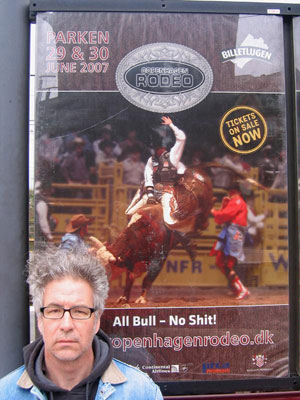
We've all been stuck in a lousy line of work at some point, but David P. Smith had it real bad. "The worst job I ever had," he laments in "Worst Job", his classic 2006 bitchfest, "was eating shit out of a bucket." Dolefully, Smith continues, "The second worst job I ever had -- I used my face as a shovel."
With all that misery behind him, Smith is now a house painter on the dark side of his forties, and one of the more enigmatic creatures in Victoria's already eccentric music community. His weapon of choice is the accordion -- "a big harmonica," in his own words -- which he uses to produce something closer to a consumptive wheeze than a Polish dance party, complimenting it with his morbid and strikingly imaginative lyrical wit.
Along with "Worst Job," listeners to Smith's last, not-quite-breakout album Striving For a New Tomorrow entered a frequently hilarious and always phantasmagoric world populated by "Fat kids with big tits eating barbecue ribs" ("Jackhammer Man"), and where bad Chinese takeout "smells like an animal's bum" ("Monday").
He calls his music "21st Century Hillbilly Rhythm 'n' Booze", and it's usually characterized either by a lot of banjo, fiddle, clatter, and crash, or it's comically mournful and plodding. In general, Smith and his five partners in Dad's Juice create the impression of a funereal oompah band stumbling into a backwoods barn dance, with Smith's pungent words and gallows mirth taking it even further into something unclassifiable.
His instinctive sense of the gloomily absurd was perfectly captured in the artwork for Striving For a New Tomorrow, which depicted Smith wearing an expression of beatific insanity while two woodpeckers attacked his head. Christ only knows why Americana UK named it the worst cover of the year, although it's the kind of reverse-honour that somehow suits him. Smith's previous album, Hurtin' Dance Party, was hammered even more comprehensively in the same magazine a couple years earlier -- much to the artist's delight.
"It was so negative that I e-mailed the link to everybody I know," he told me in a 2006 interview. "Do people read a review and then go out and buy a record?” Smith reasoned. "I remember when Dylan's Slow Train Coming came out and Rolling Stone gave it this glowing review, so I went and got it, and I think that's the last time I trusted a review."
Even if he cared, it's too early for anybody to dump on Smith's latest, Mantennae, and I don't intend to start here. But let the record show at least that Smith has cleverly pre-empted any possible 'worst-cover' blowback by adorning Mantennae with a strange and beautiful illustration by his real life partner, the artist BA Lampmann. She later steps up to provide Mantennae with a self-assured vocal on one of the less characteristic tracks on the album. "Liquor Soaked Road" also has Gary Cherwonka's pedal steel to lift matters out of Smith's usual mood of hangdog, dilapidated weirdness, although the lyrics are definitely business-as-usual:
"There ain't no lie any thicker,
than the one about the romance of liquor,
and there ain’t a road to ruin any quicker,
than one of inebriation,
darkness and degradation,
one paved with sorrow,
and one they call the liquor soaked road."
Smith breaks format all over Mantennae. There's an unusually aggressive and loud guitar solo from Dave Henderson on "Ghosts," and a splendid cover of the Silver Jews' "Random Rules" augmented by a flyblown Salvation Army brass band. "Songs We Sing" is given a fairly lush and jazzy preamble on piano that sits well outside of Smith's usual rhythm and booze template, and it ends with an atypically exclamatory choir of hopeful voices belting out the words, "We will find the power!" But not before Smith works in a few existentially sick zingers about hobbling through the streets, "on stumps, not feet," or how our "eyeballs will hang on muscular strands / dark, empty sockets, dangling like lockets..."
"Kind of Like a Roger Miller Song" is more like the Smith we're used to, in which he moans about everyday desolation. "It's kinda like a Roger Miller song," he sings, "nothing wacky, one of the serious ones, only much, much sadder, and a whole lot less beautiful."
"Rotten Old World" is a dirge, and a beautiful hymn to despair. The odd thing about it and Smith in general is that he's at his most alive when he howls about the grim and endless shittiness of it all. You'd almost hate for the rotten old world to repair itself if it meant an end to such an uplifting descent into the murk, and I think we can assume Smith enjoys the work based on the gusto he brings to Mantennae. As for reviewing records -- there are worse jobs, but right now I'm on my break.
David P. Smith n' Dad's Juice play tonight (Thursday, April 1) at the Wise Hall (1882 Adanac Street). ![[Tyee]](/design-article.thetyee.ca/ui/img/yellowblob.png)
Read more: Music







Tyee Commenting Guidelines
Comments that violate guidelines risk being deleted, and violations may result in a temporary or permanent user ban. Maintain the spirit of good conversation to stay in the discussion.
*Please note The Tyee is not a forum for spreading misinformation about COVID-19, denying its existence or minimizing its risk to public health.
Do:
Do not: