
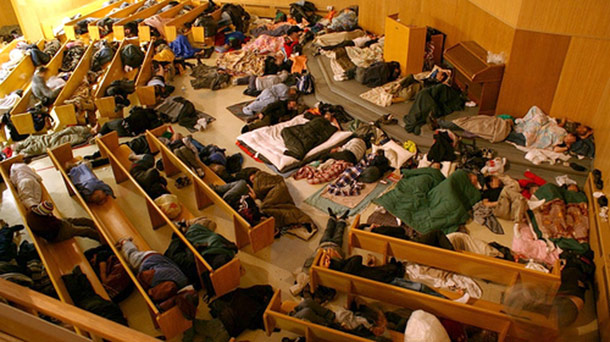
1/37 This shelter, at First United Mission in the Downtown Eastside, is regularly filled to capacity (250) each night.
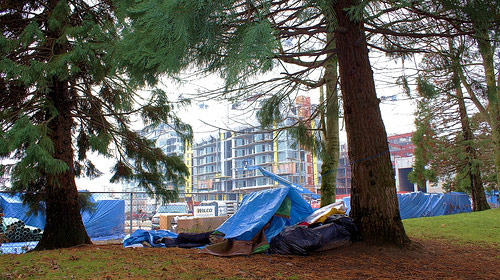
2/37 A homeless Vancouverite's campsite, with the $1.1 billion Olympic Athletes Village construction site in the background.
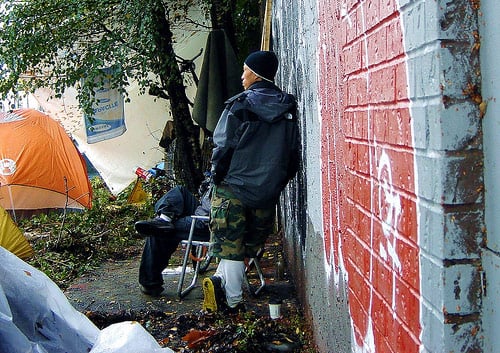
3/37 A young homeless aboriginal man stands his ground at a week-long squat on vacant, city-owned property in autumn 2007.
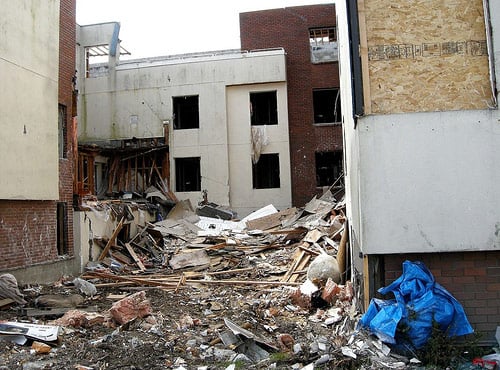
4/37 This demolished Downtown Eastside social housing project once offered 76 units. It was condemned due to mold in January 2008 and scheduled for replacement in four years. (For more, see "Death of a Nightmare Hotel.") Critics were concerned about the temporary loss of social housing at a critical time.
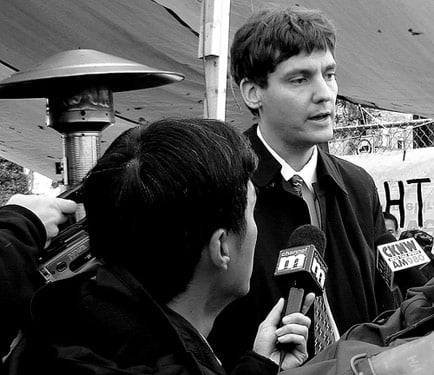
5/37 October 2007: David Eby, then Pivot Legal Society lawyer and housing advocate, addresses media at a tent-city squat on vacant, city-owned land. Earlier, the then ruling NPA mayor and council voted against recommendations made by the 2010 Games Organizing Committee on the grounds that the Inner City Inclusive Commitment Statement was not a legally binding document.
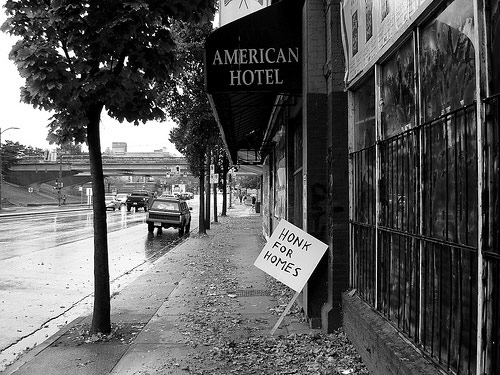
6/37 October 2006: 37 low-income suites were lost with the closure of the American Hotel.
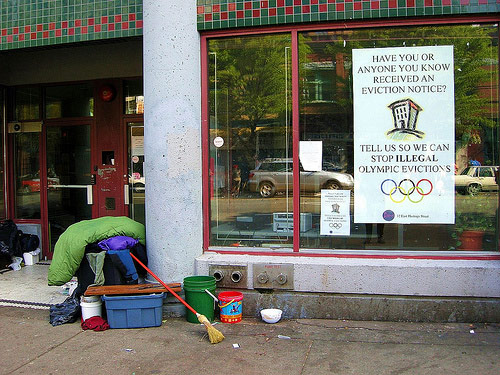
7/37 Downtown Eastside Residents Association (DERA) storefront on East Hastings Street in Vancouver.
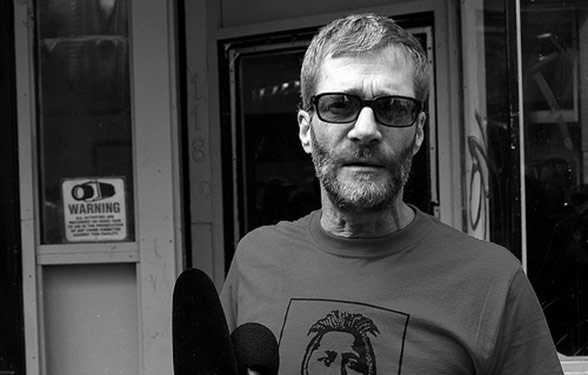
8/37 Representing the Downtown Eastside Residents Association, Mr. Kerr has been a strong voice advocating for many Downtown Eastside residents who have been or are at risk of eviction.
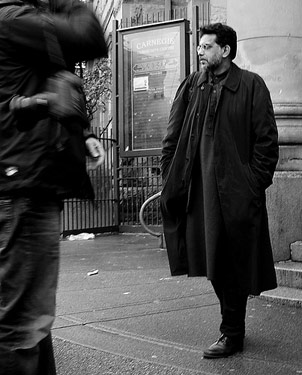
9/37 October 2007: Miloon Kothari, the UN special rapporteur on adequate housing, visits the Downtown Eastside as part of his investigation into Canadian homelessness. He reported that in a nation as wealthy as Canada and in a city as affluent as Vancouver, it is shocking that the depth of poverty in our midst is permitted to exist.
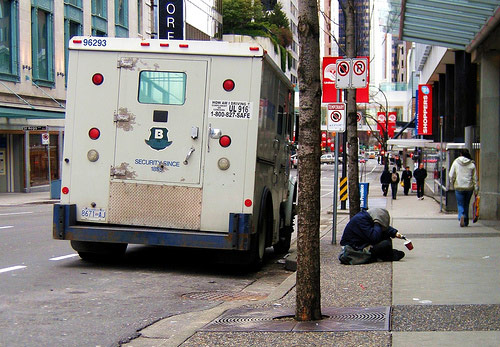
10/37 "I was repeatedly struck by the contrast that I see because it is such a beautiful city, because there has been so much investment. It is striking that a few blocks from million-dollar condominiums, that there is such immense poverty." -- Miloon Kothari, UN Special Rapporteur for Adequate Housing.
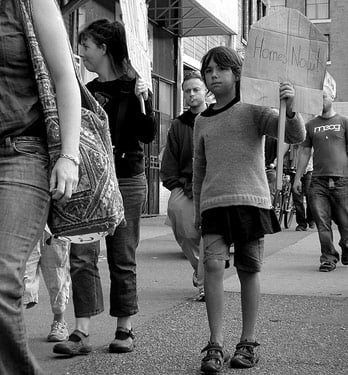
11/37 A child protests government inaction on the homelessness crisis in Canada's poorest urban neighbourhood, the Downtown Eastside.
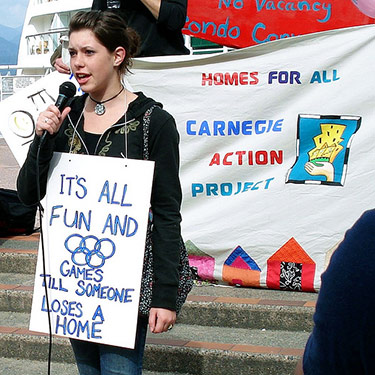
12/37 October 2007: This girl lives in the Downtown Eastside. She spoke of losing friends she has known her whole life because their buildings were closed by property owners who were selling or renovating.
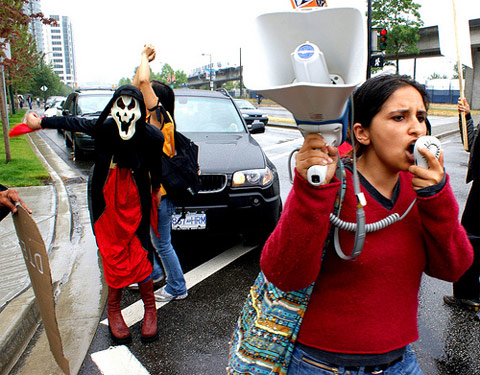
13/37 Harsha Walia demands community consultation at a protest against Concord Pacific's all-market development proposals and the pace at which the creation of condo construction is outstripping that of social/affordable housing.
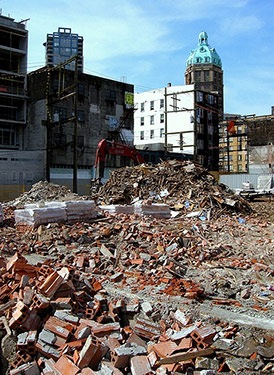
14/37 A large-scale, all-market condominium tower developed by Concord Pacific, Canada's largest real estate developer, is planned for 58 W. Hastings Street in Vancouver's Downtown Eastside. Demanding consultation, residents of the neighbourhood mobilized.
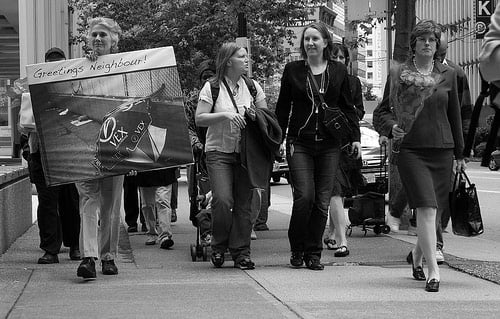
15/37 Carnegie Community Action Project activists send a welcome wagon to new neighbour Terry Hui, CEO of Concord Pacific. Activists hoped to engage the developer in a consultation process that might address the impacts of gentrification on the neighborhood.

16/37 October 2008: this longtime Anti-Poverty Committee activist was arrested by police for uttering threats. He had publicly threatened to evict VANOC officials from their homes and offices a week earlier. Cunningham stated the action would have been symbolic, with perhaps a box of office supplies thrown into the corridor, in protest against increased evictions of impoverished tenants from low-rent hotels into homelessness.
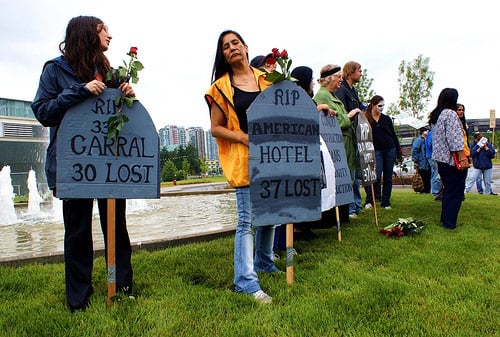
17/37 July 2008: Downtown Eastside housing activists stage a mock funeral for their neighbourhood on the front lawn of real estate developer Concord Pacific's presentation centre. The gravestones mark those evicted from low-rent buildings in the lead-up to the Games.
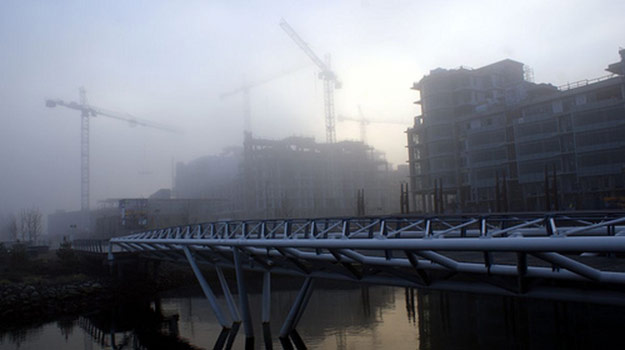
18/37 Fog and a global recession engulf the new Olympic Athletes Village as Vancouverites learn they are now financially responsible for the billion dollar project. After the Games, the units are to be sold as condos in the $450,000 to $6 million price range. The 252 units of social housing planned for the site are now jeopardized by the city's need to recover the construction costs. The mayor has said it may be necessary to build the social housing off-site.
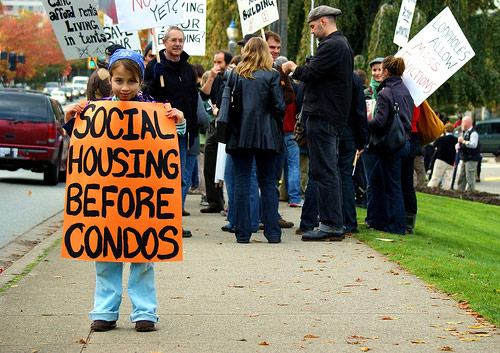
19/37 "The world can't come to Vancouver in 2010 and see this." Gregor Robertson, Vision Vancouver's candidate for mayor, October 2008. This protest drew housing activists from the city's West End, Little Mountain and Downtown Eastside neighbourhoods weeks before a civic election that saw the ruling NPA party reduced from five councillors (including the mayor) to one.
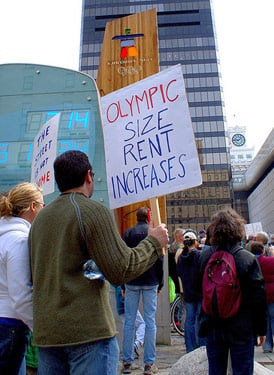
20/37 Several hundred protesters from three different starting points in the city converged on the grounds of the Vancouver Art Gallery where the Olympic countdown clock stands to rally against eviction and displacement caused by provincial tenancy legislation, the loss of affordable housing units across the city and rising numbers of homeless citizens, particularly in the Downtown Eastside. A month after this rally, the province re-elected the BC Liberal Party to a third consecutive term.
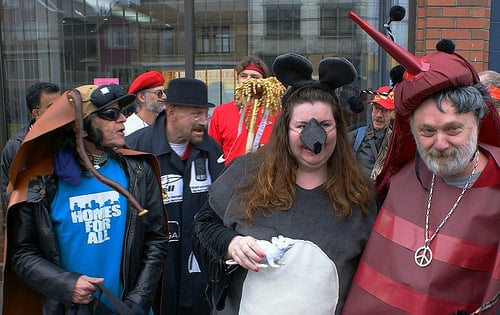
21/37 Creepy the Cockroach, Chewy the Rat and Itchy the Bedbug remind onlookers of the substandard conditions in which many of the city's low-income residents must exist. Still, even hotels infested with such pests have evicted their tenants, displacing many into homelessness, so owners could renovate in the lead up to the Games.
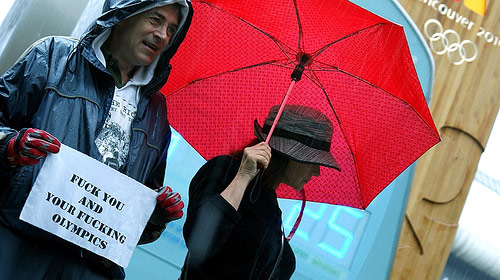
22/37 Taken before the official Olympic Countdown Clock at a June 2009 press conference organized by the Olympic Resistance Network. The housing crisis is one of several issues on the ORN's list of reasons for its opposition to the Games.
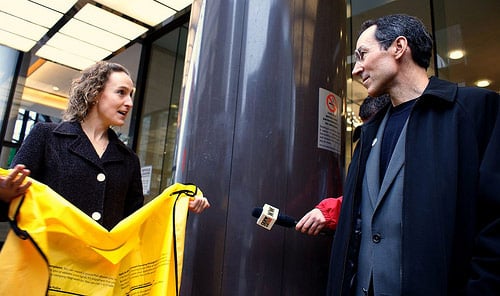
23/37 During the 2008 municipal election campaign, Pivot Legal Society lawyer and housing advocate Laura Track handed out blankets printed with the legal rights of the homeless. Here she presents NPA mayoral candidate Peter Ladner with a sample. Ladner lost his mayoral bid and all but one of his party's candidates for council was defeated by a centre-left coalition that made homelessness one of the main issues of the campaign.
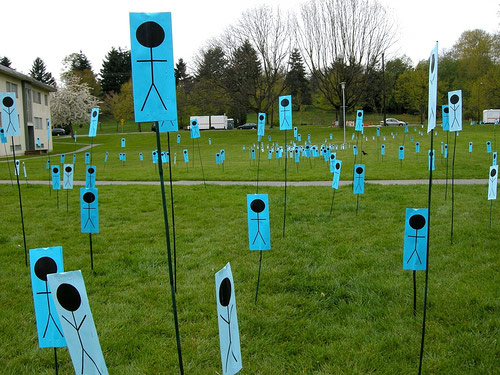
24/37 May 2008: Each stick figure represents a former tenant displaced by the redevelopment plan. The protest, organized by remaining residents of Little Mountain Social Housing, is meant to highlight short term, low-rent housing losses at a time when thousands already lack homes, and it to mourn the loss of a tight-knit community.
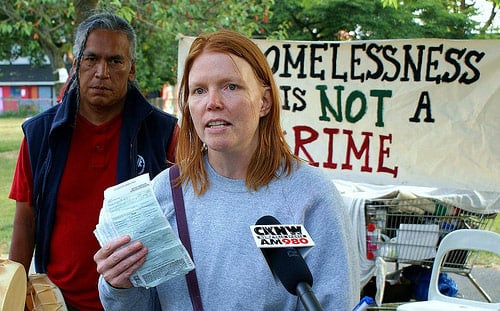
25/37 Wendy Pedersen of Carnegie Community Action Project clutches a stack of tickets issued by police to homeless citizens who, with no where left to go, set up tents in Oppenheimer Park in the summer of 2008.
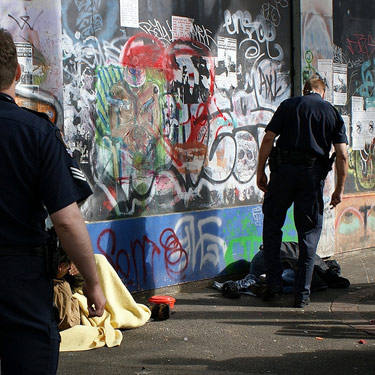
26/37 Police officers enforce vagrancy bylaws by moving homeless people found sleeping in public areas along.
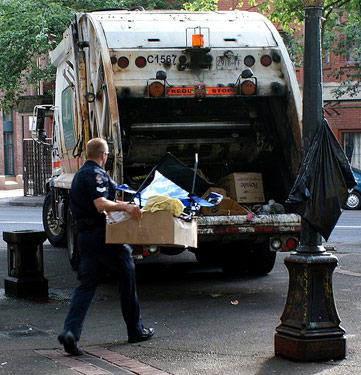
27/37 A police officer disposes of a homeless person's unattended possessions.
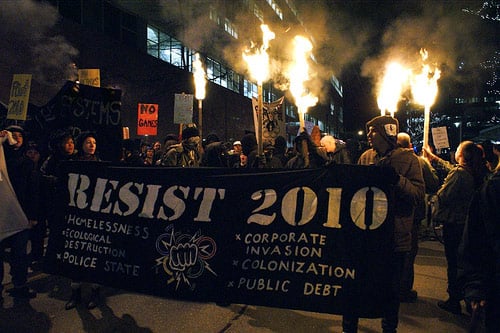
28/37 Olympic Resistance Network activists hold a torch-light parade through downtown Vancouver streets to protest numerous issues, one of which is the rising rate of eviction, displacement and homelessness that accompanies host-city gentrification. The stated goal of the ORN is to disrupt the 2010 Games.
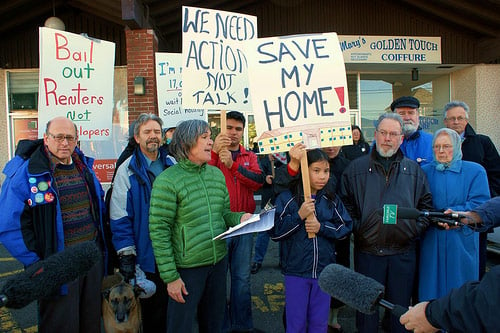
29/37 November 2008: Housing activists, soon-to-be-displaced tenants and local municipal and provincial politicians rally in front of two Fraser Street low-rent buildings that have housed low-income families but will soon be demolished to make way for developer Ledingham McAllistair's "new community," Century. Another 128 affordable units lost to make room for condominiums.
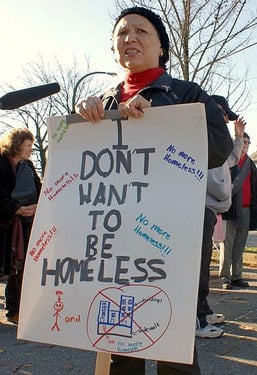
30/37 Roberta Pierro, tenant of another site to be developed into a new commercial condo complex, protests her imminent eviction. This development is in the southeast area of Vancouver called Kensington-Cedar Cottage.
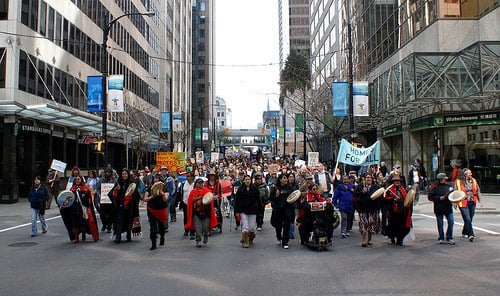
31/37 April 2008: Housing activists from the Downtown Eastside march between lampposts decorated with Olympic Games banners in Vancouver's central business district on their way to meet other groups for a larger rally at the Vancouver Art Gallery. Leaders in the activist community anticipate an escalation in protests as the Games near.
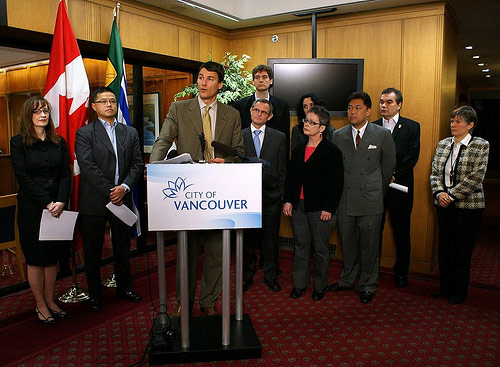
32/37 Recently elected Mayor Gregor Robertson announces HEAT. "The Homeless Emergency Action Team will seek out, coordinate, and provide immediate actions that the City can do to get people off the street and indoors," said Robertson. The city has also called on the provincial government to change the provincial residential tenancy legislation to stop renovictions.
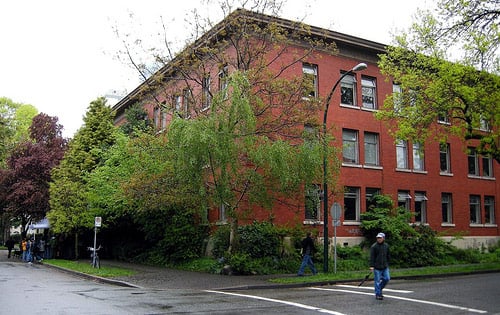
33/37 May 2009: Tenants of this apartment block in Vancouver's West End are issued eviction notices by the new property owners. The landlord can do so because he plans to renovate the building.
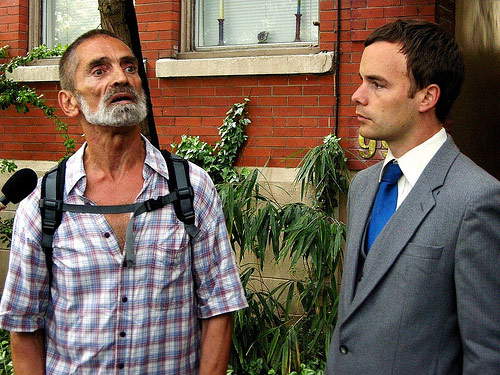
34/37 Brian is a resident of The Berkley. He lives with AIDS and receives treatment for his condition at nearby St. Paul's Hospital. Like the rest of The Berkley's tenants, Brian was issued an eviction notice by his landlord who plans to renovate. The expected rent increase will make it difficult for the current residents to stay. Standing next to Brian is Spencer Herbert, provincial MLA for the area and member of the official opposition NDP.
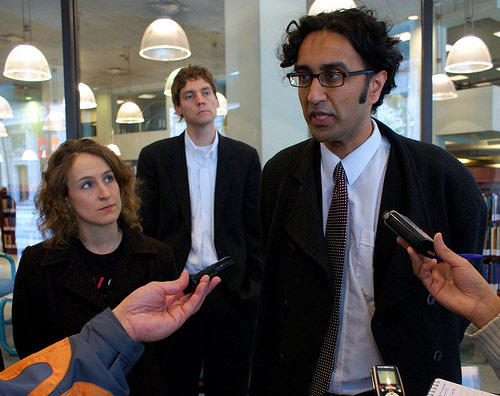
35/37 Am Johal is co-founder and chair of the Impact [of the Olympic Games] on Community Coalition and first wooden spoon bearer of the 2010 Homelessness Hunger Strike Relay. He claims there have been 1,400 conversions of low-rent, single-room-occupancy units since the Olympic bid began. Am's voice was one of the earliest warning of the likelihood of a spike in evictions, as tends to accompany mega events.
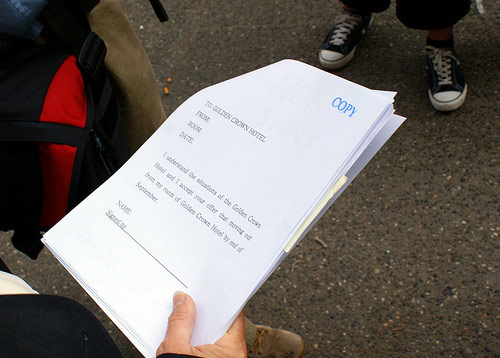
36/37 Eviction notice issued by the owner of the Golden Crown Hotel in Vancouver's Downtown Eastside to tenants occupying rooms in the building, a story covered by Megaphone.
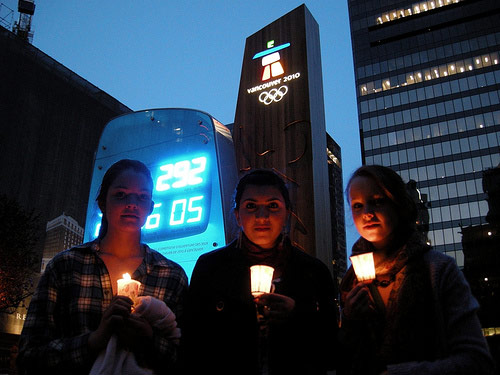
37/37 Between 200 and 300 private and public secondary school students from across Vancouver's lower mainland marched up Robson Street from BC Place Stadium to the Olympic Countdown Clock where they held a candle-light vigil to end homelessness in the region.
If Vancouver's citizens could have looked ahead in time and seen these photographs, would they have voted six years ago to support Vancouver's bid to land the 2010 Olympics?
The photos, taken over the past two years, document the growing organized resistance to homelessness in Vancouver, and the connection drawn by protesters between the erosion of low-income housing and the approach of the 2010 Games.
In recent years, for example, Vancouver has seen an accelerating trend called 'renovictions' -- landlords forcing people from their rental apartments with the excuse of needing to make fixes, and then hiking the rent so steeply that often the residents can no longer afford to remain in their homes.
We were promised differently.
In 2001, when Vancouver was still an Olympic hopeful, the Impact on Community Coalition http://iocc.ca/, a local Games watchdog group, was already concerned about problems that come with large-scale events like the Olympics. Among other things, they were concerned about evictions and homelessness.
The Vancouver 2010 Bid Corporation responded by crafting, with its member partners, the Inner City Inclusive Commitment Statement, which made numerous housing-related promises. It promised that that low-income rental stock would be protected, that people would not be made homeless as a result of the Games, that residents would not be involuntarily displaced, evicted or face unreasonable increases in rent due to the Games, that there would be an affordable housing legacy on which planning should begin immediately.
But the number of homeless on Vancouver's streets has continued to rise, the already inadequate supply of SRO rooms has dwindled, and renovictions continue.
According to a recent study by the Carnegie Community Action Project, only a few Downtown Eastside hotels still offer rent at less than $425 per month. The provincial shelter allowance for income assistance recipients is $375. Thus, as Vancouver city councillor Ellen Woodsworth has indicated, evictions caused by rent increases in more affluent areas have a ripple effect throughout the city.
Most observers believe that while the coming Olympics have accelerated gentrification of Vancouver's Downtown Eastside, the Games cannot be held entirely responsible for the current lack of affordable housing in the city. There is little doubt about this. However, real estate speculation caught on like wildfire in Vancouver prior to the global economic meltdown of late 2008 and it is unlikely it would have blazed as strongly as it did without an Olympic Games on the horizon.
While some were making millions off this trend, hundreds of citizens have been organizing, marching and speaking out against it. This photo essay documents this resistance, a citizen's movement angry at the priorities set by business and political leaders in this province who, while spending billions on a two-week Olympics fest, have not found the resources needed to permanently house those most vulnerable in our society.
This photo essay is dedicated to the memory of Darrell Mickasko, Tracy, Francis McAllister and Curtis Brick, four homeless Vancouverites who have died during periods of extreme weather since Vancouver won the 2010 Olympic Host City bid competition.
HOMELESS ACTION WEEK EVENTS
Friday, Oct. 16th
Nelson -- STAND Demonstration Against Poverty
Where: Plaza in front of city hall, 310 Ward St.
When: Noon
Free hot soup by Ariah's Edible Creations. Please bring placards and banners. Organized by the Advocacy Centre. For more information call 250-352-5777.
Victoria -- Art Show
Where: The Victoria Conservatory of Music
When: 7 to 10 p.m.
Art and music of people who have experienced homelessness, including selected works from the Street Voice Project.
Vancouver -- Homelessness Action Week -- Film Night
Where: 10th Avenue Church (Ontario & 10th Avenue)
When: 7 p.m.
The Cats of Mirikitani and This Dust of Words
Special Guest Speaker: Judy Graves, homelessness advocate, City of Vancouver
Free Admission. For more information call Wendy Dubois 604-876-2181
Saturday, Oct. 17.
New Westminster -- Fund-Raising Dinner
Where: The Inn at Westminster Quay, 900 Quayside Drive
When: 6 p.m.
Tickets $75
MC for the evening: Belle Puri
Keynote speaker: Monte Paulsen, investigative journalist, The Tyee
For tickets to the fundraiser dinner, please contact Lydia Steer at lydia.steer(at)purposesociety.org or phone Purpose Society at 604-526-2522.
North Vancouver -- North Shore Lions Street Soccer Team Game
When: 12 p.m. BBQ served by the Lions Club, 1 p.m. game
Where: Kilmer Park
The North Shore Lions are a soccer team for homeless and those at-risk of homelessness.
Abbotsford -- Abbotsford Homeless Connect
Where: Sevenoaks Alliance Church
When: 8:30 a.m. - 3:30 p.m.
One-day event to link people who are homeless to services they need all under one roof. Volunteers are needed, contact Kathy Doerksen, Abbotsford Community Services 604-859-7681 or Warren Schatz, Grace Evengelical Church 604-859-9937.
Donations can be dedicated to 'Abbotsford Connect" through the United Way of the Fraser Valley, 604-852-1234.