

 SHARE:
[Editor's note: The Tyee is pleased to weekly showcase the best of the Vancouver Observer, the independent, online source of news, culture and blogs whose motto is, "All local -- all the time."]
You may not have noticed, but in the last week of May Vancouver hosted Vidweek 2010.Vidweek 2010 is short for Vancouver International Digital Week, and it's an event put on by the Digital Media + Wireless Association of BC (also known as DigiBC), which includes Electronic Arts, Disney Interactive, Rainmaker Entertainment, Nokia Vancouver and Sierra Wireless as members.Vidweek is actually an amalgam of several smaller events, including CONVERGENCE, the Pacific Northwest Wireless Summit, WIP Jam, Vancouver Enterprise Forum, Digital Kung Fu ("a crash course in digital martial arts!" according to the programme), and PechaKucha, which is a chance for young designers to show off their work, with each designer given 20 seconds to show off 20 slides. The Vidweek website can be found at vidweek.com.As with all such conferences, there were panel discussions, keynote speeches, gallons of coffee, headache-inducing PowerPoint slides, mountains of breakfast pastries and lots of opportunities for networking. Here's what I got out of the four-day conference:
1. Some advice for conference organizers
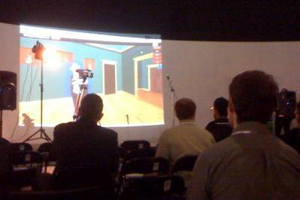
If your keynote speaker is not physically present in the hall but is appearing "virtually" over the Internet, you should let your audience know about it ahead of time. If you advertise your keynoter as Howard Rheingold (Stanford University professor and author of the 2002 book Smart Mobs), the assumption is that Rheingold will be there in person. Finding out that you'll be watching a virtual Rheingold on a large screen is a bit of a letdown.
Try to make sure your technology works, especially if it's a tech conference. Rheingold gave his talk using a Vancouver-developed technology called Mingleverse. Glad to see them using local technology, but there were some unfortunate glitches. For the first 10 minutes of Rheingold's presentation, we stared at an avatar while Rheingold's voice came out of the speakers. Then he realized he had forgotten to turn his camera on and in place of the avatar, we were able to look at Rheingold's grainy webcam image.
Other difficulties included Powerpoint slides that coyly refused to show themselves in the "Mingleroom" and a "they seek him here, they seek him there" Rheingold who twice disappeared from the screen during the question and answer session. Rheingold's talk was also disappointing. The programme promised an address on "The Future of Communications and Collaboration in a Convergent World," but what he gave us was a sketchy history of communications technology followed by an extremely irrelevant and incomprehensible argument between Rheingold and someone in the audience over a minor point in that history.
2. Statistical overload
1 billion people see a Google page every day.
55 per cent of people online are women.
Social media users are more positive about brands than non-users -- 35 per cent of them believe companies are genuinely interested in them.
There are 5 billion mobile phones in the world, compared to 1 billion personal computers and 1.1 billion televisions.
75 per cent of Canadians have mobile phones.
Canadians send 100 million text messages every day.
By the year 2014, more people will access the web from their phones than from their PCs.
2.7 million Nintendo Wiis have been sold in Canada.
The average Blackberry user looks at their phone 67 times per day.
These were some of the statistics that were bandied about by keynote speakers such as Marc Gobé ("the pioneer of emotional branding"), Bernard Lord (president of the Canadian Wireless & Telecommunications Association) and various panelists. It's hard to check up on these stats or put them into context, but they sure sound impressive when they zoom up at you in large type on a giant PowerPoint screen.
3. Wireless health
Wireless health applications are going to be big, apparently, once the issues of privacy, confidentiality and liability are sorted out. A full day of the conference was devoted to "Wireless Health & Mobile," and panelists discussed health apps for smartphones, health-based videogames, and technological wonders such as a sensor the size of a rice grain that sits in your aorta and monitors your blood pressure.
A key issue in the future, according to panelist Staffan Meij, the CEO of VoiceCorp (a Dutch company that makes speech-enabling software for people with visual disabilities) is going to be how technology can enable older people to stay in their own homes and stay healthy. Two possibilities he mentioned were smart phone apps that can transmit information to medical practitioners and PCs "with big buttons" for the elderly.
Technology and the elderly came up in a later panel as well, this one on the importance of videogames in health. Matt Ryan, a senior public relations official with Nintendo Canada, said that "a lot of seniors" are using the Nintendo Wii. He sees seniors centres and retirement homes as a potential market for Nintendo, which has also come out with a Wii add-on called the Vitality Sensor that can measure a person's pulse and blood pressure. BrainAge, a game for the Nintendo DS that supposedly can stimulate your brain, is also popular with the elderly, Ryan said.
Why do kids willingly do chores in FarmVille (a Facebook-based game) and World of Warcraft, but not in real life, asked Michael Ferguson, CEO of local casual game company Ayogo. The answer, he said, is the appeal of competition and challenge. Ayogo is working with a large health research institute to see whether a health-based videogame can actually motivate people to develop a healthy lifestyle. But in order to work, the game has to be fun first, with the health benefits strictly secondary, according to Ferguson.
4. Wireless shoes
Does social media help increase sales? Stephen Bailey, marketing director for Vancouver-based Fluevog Shoes, thinks so. Bailey said Fluevog is an avid user of "web flue-point-oh" and has seen a marked increase in clickthroughs to its website from its recent Fluevog Everyday Shoes initiative. However, Bailey cautioned that "getting on social media won't change the world in a couple of days, but once you build your following it's invaluable."
Is social media becoming too trendy? Maybe, according to Future Shop's Allen Chen. Though it may have been difficult once to convince bosses of the value of social media, the popularity of Twitter, Facebook, et al. today has turned that situation around. "The issue is no longer getting a social media project approved. Social media is so trendy that the problem is getting the right project approved."
5. Final Thoughts
It was heartening to attend Vidweek 2010, to listen to the panels (and some of the keynotes), but most of all to talk to the people in attendance, representatives of new media companies both large and small, and to see the amount of talent, energy and enterprise in the local tech sector.
As keynoter Ginger Grant of Creativity in Business Canada Inc., put it, "The business perspective on Vancouver used to be that it's a beautifully wrapped present but there's nothing in the box. The Olympics showed that our athletes can kick ass. Now it's up to us to show that our creative people can kick ass as well." ![[Tyee]](/design-article.thetyee.ca/ui/img/yellowblob.png)
Read more: Media, Science + Tech












Tyee Commenting Guidelines
Comments that violate guidelines risk being deleted, and violations may result in a temporary or permanent user ban. Maintain the spirit of good conversation to stay in the discussion.
*Please note The Tyee is not a forum for spreading misinformation about COVID-19, denying its existence or minimizing its risk to public health.
Do:
Do not: