How to End Homelessness
Can Vancouver's new mayor deliver on his promise to house everyone? Yes we can. First of two.
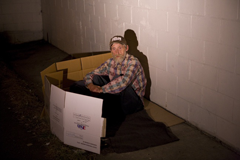
Vancouver, 2008. Photo by Ken Villeneuve.
Gregor Robertson will become mayor of Vancouver this Monday afternoon. He won the job in large part because he promised to end street homelessness by 2015.
His critics scoff. They either don't believe he can do it, or they don't believe it can be done by a mayor who must use his dwindling property tax dollars to fund police protection, garbage collection and other essential services.
His enemies swoon. They are quick to note that outgoing Mayor Sam Sullivan was tossed to the curb after he failed to deliver on a homelessness pledge -- and that Sullivan merely promised to cut the city's homeless count in half.
But homeless and mental health professionals believe Robertson will beat homelessness if he can persuade the province to throw its weight behind two bold but simple ideas: Housing First and Treatment on Demand.
And they warn that while senior government support is critical, Robertson must not limit his crusade to Victoria and Ottawa. They say Robertson will have to inspire nothing less than a movement to end homelessness -- one that engages a diverse coalition of governments, corporations, not-for-profit societies, faith-based groups and ordinary citizens.
This article explores the two policies. Tomorrow's proposes a list of specific projects to explore.
A goal that saves lives and money
The Tyee put the following question to nine local experts on the issue of homelessness: If you were mayor, what would you do?
Some of these professionals work for the city, some work for the province, and others receive government funding. All are concerned about becoming caught in future political crossfire between Victoria and Vancouver. So in order to free them to present completely candid and utterly unvarnished advice, The Tyee has provided anonymity to all.
All nine agreed that street homelessness could be ended by 2015. And each said that regardless of how one feels about the homeless, getting bodies off the street is sound city policy. Here's why:
1. It's the law. In the wake of the B.C. Supreme Court ruling allowing homeless camping in Victoria, cities may soon be required by law to either provide shelter or allow homeless camps. Since makeshift camps can deteriorate into magnets for crime and violence, providing shelter is the only reasonable course of public action.
2. It saves money. Taxpayers now spend an estimated $85 million a year providing emergency services to Vancouver's homeless. Vancouver property owners pay the lion's share of that, in the form of police and ambulance calls. Cut the number of street homeless, and you cut the cost to taxpayers.
3. It shifts the tax burden. Not only does it cost half as much to house the homeless as it does to service them on the streets, but the province pays the roughly $28,000 a year to house them while the city pays most of the estimated $55,000 a year to service them on the streets.
"We're headed into a recession," one longtime housing advocate said. "Taxpayers can no longer afford to subsidize these failed experiments in laissez-faire housing and deinstitutionalization."
Policy #1: Housing First
"Housing First" is an American term to describe a policy that treats basic housing as a right rather than a privilege.
Under a Housing First bylaw, the city would work with the province to provide basic housing -- such as a room in a residential hotel -- to everyone, without time limits or other conditions. Housing First prioritizes homes over shelters, and takes a harm reduction approach toward drug and alcohol use.
The evidence supporting this approach is overwhelming. Residents who live in Housing First housing are healthier and more law-abiding than those who live in shelters or on the street. Housing First residents are more likely to enter treatment for addiction or mental illness, and once enrolled they succeed in higher numbers.
"They don't become model citizens overnight," noted one local expert. "But most do become better citizens in a remarkably short period of time."
Enacting a Housing First policy will be easy. Enforcing it will require unprecedented commitment and more than a little political wrangling in the face of tremendous resistance.
For example, a true Housing First bylaw would make it illegal for an institution to discharge clients to "no fixed address," as federal prisons and provincial hospitals routinely do.
(An aside: A frequent objection to Housing First arises from the mistaken assumption that homeless would flock to Vancouver for the free housing. In fact, by halting the release of ex-cons to the city, Vancouver would plug a route by which many B.C. residents wind up homeless in the Lower Mainland.)
Thus, by adopting a Housing First policy, Vancouver would be asking senior governments to arrange housing for every discharged prisoner and hospital patient.
In all likelihood, the city would have to take the federal government to court in order to collect fines for any infractions. Several who spoke to The Tyee for this article believe that after years of polite but fruitless lobbying in Ottawa, the time has come to take such a confrontational stance in an effort to drag the federal government back into meaningful discussions about the funding of homeless housing.
Policy #2: Treatment on Demand
Gregor Robertson's bid to end homelessness will fail without a massive commitment to addiction and mental health treatment. On this point, the experts who spoke to The Tyee were unequivocal.
How big? The view among several of the experts who spoke to The Tyee is that Vancouver currently needs up to 1,000 additional treatment slots.
It can be done. Here are but two of many examples of creative and aggressive approaches that could quickly provide treatment to the homeless:
There are hundreds of additional addiction treatment beds scattered across the Lower Mainland in the form of "recovery houses," but because Vancouver Coastal Health clings to a narrow medical model of treatment, it refuses to fund them. With funding and much-needed oversight, these private facilities could begin receiving homeless addicts within weeks.
Likewise, if the province were to throw out the residential treatment stereotype altogether and embrace an in-situ approach, hundreds more could be treated where they live by visiting professionals. The old-fashioned house calls approach could prove particularly beneficial for those who are both addicted and mentally ill, and therefore do not fit easily into residential facilities designed for one group or the other.
But there's no way the City of Vancouver can provide treatment. It has neither the mandate nor the money.
And so it is that Mayor Gregor Robertson, a former NDP lawmaker who has staked his career on ending homelessness in Vancouver, has placed his political fate in the hands of Premier Gordon Campbell, who is leading his BC Liberal Party into a May election.
Robertson needs Campbell to bring the same creative zeal to addiction treatment that he has recently brought to social housing.
"I can't say this strongly enough," one knowledgeable source told The Tyee. "Unless there are rapid and radical changes at the top of Vancouver Coastal Health, Mayor Robertson's plan to end homelessness will fail -- and fail spectacularly -- just as Mayor Sullivan's effort failed because he did not recognize that treatment is the master key without which this puzzle will not be solved."
Tomorrow: 50 ways to help the homeless
There are other hurdles to ending street homelessness in Vancouver, of course. Tomorrow's list of "50 ways to help the homeless" will address finding enough homes, creating places for pets, and involving surrounding communities.
But most of those wind up being tactical challenges that ultimately can succeed only in the context of Housing First and Treatment on Demand.
"We already know that it's cheaper to house the homeless than to leave them on the streets," said a veteran of the Downtown Eastside. "My guess is that in the same vein, it's cheaper to provide treatment than to keep building more housing... It costs $200,000 to build a new unit of social housing. If Coastal Health were to spend even $100,000 treating an addict, and that addict ultimately cleans up and returns to market housing, then it seems to me that BC Housing just saved $100,000. But our politicians aren't thinking like that... and the two agencies aren't working together."
Another longtime social worker summed it up this way: "If everyone who wants a home were given one, and if everyone who wants treatment could get it, there'd be like a dozen people left on the streets of Vancouver."
Related Tyee stories:
- Up to 15,500 Homeless: Report
Tally of BC homeless by health profs far higher than housing minister's. - More Homeless than Athletes in 2010
Can Vancouver's Olympic pride be saved? First in a series. - Vancouver plays Whack-a-Mole with homeless campers


26
Login or register to post comments
Rolf Auer
3 years ago
Housing First--shelters vs. housing
As well, it costs more to house the homeless in shelters than to build supportive housing for them.
http://www.canada.com/ottawacitizen/news/story.html?id=b406b16b-3257-45d6-bc1b-1ac5e5f3cdde&k=81399
This is just one report (on a report) indicating that. I'm sure that there are many others.
driftwolf
3 years ago
Calgary
Just make sure Calgary or anyone else in Alberta doesn't get the idea to send their homeless west with a one-way ticket. They've done it before, they might be tempted to do it again.
I have a sad feeling that unless the program is national in scope, it will just bankrupt whichever city decides to do it first as the other cities will probably dump their problem on that first one.
murdock
3 years ago
Instant Ghetto
Such a city funded scheme will certainly encourage the dumping of more unwanted on Vancouver's door step.
Moreover the area(s) where these 'communities' are permitted to set-up shop will become instant ghettos. Not once yet have I heard of the miraculous reaching up from such conditions. Once an area gets this sort of designation -> as a destination with free room (and probably board) has that area ever recovered from this without the city or district or region having to basically bulldoze the whole thing and seal it off for a time.
That is right. Wherever this 'plan' gets put into place will instantly drop in value...by 30% or more. Then the crime wave will really get going, if the thought of a tent city causes nightmares to people, imagine whole city blocks filled to the brim! This is the sort of approach that has caused the inner city rot in many large US cities...places where the police do not go after dark, nor enter by day without body armor and in groups of no less than 5.
Gregor's plan sounds nice and pleasant.
Looks like it will work 'on paper'.
...has a history of failure on the ground.
Vancouver is going to have to take some real pain I guess before tearing a page from New York and getting serious about 'broken windows' and really coming up with an urban renewal plan that will do more than make a bigger ghetto.
Fiat lux
3 years ago
I was a refugee in Europe
I was a refugee in Europe after WW2 and for all practical purposes homeless for 5 out of the following 6 years in Austria and England.
Europe was a sea of ruins, with people living in ruins and the basements of bombed out houses, plus, to the best of my recollection, about 4 million refugees from the Soviet occupied countries.
Money was worthless, there were no materials, food, or resources to build.
Yet, nobody ever slept on the streets. One of the main reasons were the extensive military and POW camps that could be used as DP (Displaced Person) camps. In England, where there was a terrible housing shortage, I've lived, with other guys in a former Canadian army hut for 3 years.
In short, there are all kinds of solutions, if the politicians get off the ideological kick of sending more and more benefits of our immense resource base abroad to foreign owners so they can colonize more of the world.
As far the drug addiction is concerned, has anybody ever considered why people become drug addicts, when the consequences have been known for 50 or more years?
Is it really a sickness, or a psychological craving to block out realities in a world built on fraud and lies everywhere we turn ?
This should be the first area to explore, not just moaning and groaning about it.
But then, what would happen to our glorious "wealth creating" economic system
and the garbage taught in our universities to brainwash students with, if the fraud and lies were cut out and replaced with logic and facts ?
Ed Deak.
Crawford1946
3 years ago
Crawford1946
I agree on most of the points made in this story on Robertson and Homelessness. But, the point that 'Homelessness' is merely the symptom of the larger problem of 'Affordable Rental Housing' has not been made. Most Canadian cities today have a severe shortage of affordable rental housing. There are more people living in rental housing than in their own property. Since the Federal Governments dropped their assistance in building rental housing and passed that responsibility to the Provinces - we have seen only a small fraction of needed rental housing being built. We need to change this inaction to action. Perhaps if rental housing were to be considered needed 'infrastructure', we could see that much needed void filled!
Bobby Peru
3 years ago
Welcome to My Neighbourhood
Vancouver needs to experience much more pain and social strife before the electorate elects officials who can combine New York's 'broken windows'- law enforcement style along with effective and practical homeless policies that are not politically motivated against 'the rich'.
These ideas and Robertson's misguided beliefs will only worsen the homeless problems. Obviously, the Mayor of Vancouver has few resources and authority to deal with the homeless. I hope the left doesn't expect him to fight Victoria because Robertson's policies are totally dependent on his good relationship with the BC govt.
Vancouver citizens don't need a mayor on a national crusade for the homeless- there's lots of other issues for the mayor to deal with. A mayor should stick to his practical duties and not engage in social engineering. If he wants to change the wold then run for the federal govt.
Providing housing on demand will only make Vancouver a magnet for the homeless from all over the country. Homelessness will never come to an end. It will always exist. There'll always be destitute addicts and mentally unstable people on the street. Devoting an inordinate amount of our resources to eliminating all homelessness is an impossible endeavour.
Advocates bat around their simplistic math without considering the real world of addicts. Simply giving housing to drug addicts will result in trashed housing units and ghetto formation. Drug addicts need treatment in cost effective centres located in cheaper areas outside of Vancouver. These institutions would be designed to house and treat addicts- they may not be a pink house with a white picket fence, but we should solve the roots of homelessness.
And those roots aren't Vancouver's high real estate prices. If you're mentally unstable or an addict there's no way you can afford Vancouver housing even if prices fall by half. Why? Because they are incapable of holding down a job.
Of course it would be soooo nice for health care providers to treat addicts where they are living- such a luxurious service level isn't even available to others. 'Old fashioned' house calls- how ridiculous. Centralize BC's drug addiction treatment so professionals would not waste time and money travelling. Stop trying to integrate addicts and homeless into our neighbourhoods in order to teach us about community values. We don't need morality lessons. We don't want addicts and their drug dealers- in BC's liberal drug market around our kids and properties.
Robertson needs to quickly come to grip about what he can achieve within his boundaries of authority otherwise he'll worsen Vancouver's homeless problem.
sunshine coast girl
3 years ago
Those are good ideas...
Here's another.
I don't live in Vancouver but I have a 30 year old daughter who does. No one knows what exactly is wrong with her. She has a
multitude of mental, emotional and physical problems. Doesn't drink, but periodically falls off the wagon and does drugs to self-medicate herself. She cannot work; exists on a pitiable disability pension.
Sometimes she is able to get it together enough to find an apartment. But she never keeps it long; can't pay the bills. Her
life is a revolving door of a few months in an apartment and a few days on the street before she can convince a friend or
acquaintance to let her stay for awhile, usually bunking with someone who has some dumpy place through BC Housing.
All she wants is a place of her own where she can keep her stuff that she can afford. Here's a progressive solution the Americans have started with.
http://www.cnn.com/video/#/video/international/2008/12/07/gutierrez.us.tiny.house.cnn
It would be cheap to build a bunch of these for the homeless, place them on Vancouver-owned land and pay someone to ensure that the grounds stay relatively pleasant looking. What a great idea!
monty
3 years ago
Some ideas for consideration
Campbell was asked by Bill Good in Dec. /07 (when he was en route to Hawaii) if he would re-open Riverview. The answer was "No" and gutless Good did not pursue this. Instead of using these buildings for filming (and revenue) this facility should be re-opened. Murdock your attitude to homeless persons is appauling. In 1996 I got a facility opened in the old Marpole Correctional facility as a shelter for the homeless. Lookout and Al Mitchell ran it to 2002. NO ONE IN THE NEIGHBOUR EVER COMPLAINED.
Libs came to power. End of facility. Where are the 14 hotels bought for housing? What about the closed down buildings in Gastown that Geller talked about restoring as art galleries? There is space around. Let Roberston get on with it and quit the complaining.
driftwolf
3 years ago
Japanese example
In Japan, there are many homeless communities in public parks. Far from being centres of crime or addiction, these are often people who have little or no work and can't afford to rent or buy, but still manage to keep their areas clean and tidy. They use public bath houses to keep themselves clean. Yes, I know it's a very different culture, but there are lessons to be learned there should we but look.
So it's possible that not all homeless would trash their place. It's just likely that if you concentrate ALL the homeless into a few residences, without taking care of the underlying issues (mental illnesses, including addiction being the main one it seems), then you're just asking for trouble.
carfreed
3 years ago
homelessness
Been there and done that in my now 28 years on the Wet Coast.
I came armed with 5 years of university and big hopes to become a Yuppie after years of living in rural Quebec in a sweet little eco house on my own % acres with my 2 children.
I thought they needed for their teen years, a more urban existence. And I needed a a fat salaried job. That didn"t happen. Every year we had to move, Sometimes twice.
I could go on at length, and having experienced for a period the shelters, I have some suggestions.
One thing is obvious: buy a bulk order of tobacco.
The other: people lose their life skills out on the street. A rom in a hotel style accomodation won't help much.Its just a disguise.
gassyandy
3 years ago
Good Luck
good luck on getting the Feds involved! do not forget Mr Harper is so busy trying to save his skin
he wouldn't and never has cared about any homeless people. When you have a prime minister who
has increased the size of his motorcade to satisfy his ego you should not expect him to care
about the homeless. BUT if we all make it an issue that could cost him his ego (PM job) then
perhaps we might have a tool after all.
idiosyncratic
3 years ago
Bedbugs
It's important to remember that, if the goal is to get people indoors, the housing needs to keep the bedbugs down to a dull roar. Most of the hotels in the Downtown Eastside are ridden with these horrid pests, and some people would rather sleep outside than in these bug-infested rooms.
The bedbug situation is a terrible and now well-entrenched aspect of homelessness in Vancouver.
Fii
3 years ago
Good point
"Tomorrow's list of "50 ways to help the homeless" will address finding enough homes, creating places for pets, and involving surrounding communities."
I can afford to pay market rent on my own in this city but if I hadn't found a pet friendly place I'd choose the street (well, more likely another city). Point being- devotion to one's pet cannot be underestimated.
G West
3 years ago
Broken theory - not broken windows
Why do we have to go through this same wringer of lies from Rudy Guiliani every few months...broken window theory has been totally discredited...you might care to order the DVD http://www.giulianitime.com/
And learn a little bit more about the snake oil salesman, his family roots in the mafia and what 'broken windows' theory is really all about.
Latarnik
3 years ago
How to deal with homelessness
Do what most socialists would do:
Hire 15,000 social workers to take care of 1,000 homeless. Throw some taxpayers money at crooked builders who use the most expensive union labour to produce antisocial housing, like leaky co-ops in Vancouver BC. Receive a graft from the crooked builders and election fund from the Union leaders.
If that does not help, do what other, famous and very effective, socialist leaders did in the past. Round up the homeless and ship them in cattle box cars to Dachau or to Gulag called Yukon Archipelago, which needs to be populated.
Streets will be nice and clean like for 1936 Olympics in Berlin or United Nation Conference in Rio de Janeiro, where 10,000 undesirables were kidnapped by the police and shipped to the wilderness 1,000 kilometers away.
There is plenty of scenic wilderness in British Columbia, Alberta and North West Territories. Like in Soviet Union give to all undesirables Internal Passport (preferably tattooed on the forearm or implanted as a chip under the skin of unwashed masses) which would prevent them from ever entering cities with a population of over 10,000, without the permission of an omnipotent and arrogant Social Worker.
The Law is already there. Enshrined in a Trudeau's "Constitution", which is only an amendment to the Colonial Decree of 1867:
Rights to move and gain livelihood
(2) Every citizen of Canada and every person who has the status of a permanent resident of Canada has the right
(a) to move to and take up residence in any province; and
(b) to pursue the gaining of a livelihood in any province.
Limitation
(3) The rights specified in subsection (2)
are subject to:
(a) any laws or practices of general application in force in a province other than those that discriminate among persons primarily on the basis of province of present or previous residence; and
(b) any laws providing for reasonable residency requirements as a qualification for the receipt of publicly provided social services.
THE PREVIOUS 2 PARAGRAPHS ARE THE CLUE
borealis
3 years ago
Unique solution
I have been researching affordable housing over the last 5 years. What I discovered is that affordable housing is within grasp of most communities, and very few public funds have to spent.
The easiest way to increase housing is to use common sense. There are many areas in urban settings where land is temporarily available at very low cost which is both serviced by sewage and water.
U install the most affordable type of structure which in some places might be the use of used shipping containers. These are very strong, and only need insulation, and some finishing, and they are cheap.
A 20'X 8'X 8' 1/2 shipping container, used in Vancouver costs about $2,500. These can be insulated and new waterproof roofs can be made for them. If you put 2 of these together and join them with a hallway the total living area is about 320 square feet. If you use 3 of them, the living area is about 480 square feet.
The total cost would be less than $100 per square foot, or no more than $48,000 for a 1 or 2 bedroom suit.
In the southern interior of BC here, there are many many trailer parks with trailers made from 1X3 inch stud frame walls, and covered in aluminum siding. The trailers are much less durable and strong than a modern shipping container. Yet because these trailers (mobile homes) pay pad rents at the parks, even though they are as many as 50 years old, worth very little, they still provide a huge amount of good housing which is affordable even though the pad rents are in excess of $300 per month.
These older mobile homes do not meet current building code standards either.
But the municipalities do not legislate new by-laws to force parks to meet the new building code. The only problem with these older mobiles is that it is difficult to get financing for the mobile if it is very old and not built to current building code standards.
Recently a School District in Spain decided to build a High School entirely out of used shipping containers. They saved a huge bundle in doing that, and you cannot even determine looking at the completed structure that it was made from used shipping containers. The High School was designed for 170 students.
Frank
3 years ago
Latarnik
You at it again? Dachau? That would be the capitalists of Nazi Germany. I know you fall asleep every night chanting "Hitler was a socialist" and refuse to read books on the subject not written in crayon but I'm afraid until you expand your education you'll continue to be ignored.
audreylaferriere
3 years ago
Homelessness
I take exception to Rolf Auger's stance that it is more expensive to provide shelters than housing. The report he referred to says chronically homeless people cost $51.00 a day in shelters. (I find this difficult to believe. A mat on a floor does not cost $51.00 a day). The report goes on to say when policing, hospital stays and jail resources are added in the costs increase to $400 - $500 a day per person. Perhaps it would cost $400 to $500 for some chronic homeless if they are on the street. If this population is in shelters there would be a drastic decline in this $400 to $500 a day. You cannot lump those in shelters with the street homeless. Shelters are not only for the chronic homeless. Most shelter usage is for short term stays: one to three days.
This thing about recovery has to be rethought considering less than 5% of those that go to treatment are successful. The "do nothing theory" would eliminate this horrendeous exense.
As to Vancouver "experts" I would question their vision as it is those experts that have sustained the exisitng homeless situation by hiding behind political inaction rather than putting their names and positions on the line. If experts have no name then they have no expertise. These people seem to be in the business of making a simple problem into a horrendeous seemingly unsolvable problem (job description (justification) model). I have personal experience with this. For two years I advocated for city-owned Storyeum to become a shelter and all the "experts" negated this simple solution. Now Claude Richmond is saying he will work with the City if there was an available building. Although the City knew of Storyeum and the need for more shelters they secretly (in camera) it is rumoured have let 142 Water Street be leased to a highend furniture store. As we speak the City is paying big dollars for gutting the interior. The other side is rumoured to become a highend bowling alley.
If these recommendations are followed then the "experts" will be getting what they want: a logistic nightmare and chaos rather than a centralized uniform solution.
audreylaferriere@yahoo.ca
dave49
3 years ago
A coat of paint is not enough
I've heard one of the on-the-ground problems is that while the province bought the DSE hotels, the social service agencies don't know how to be landlords. They need to: get people who know renovation construction, gut these buildings, get rids of the pests, redo and modernize these buildings so they will be durable and secure for the tenants. Then they need some property managers used to dealing with challenging tenants.
A coat of paint is not enough!
morechatter
3 years ago
BC Government & Feds & City Govermemt Experts
At creating homeless crisis. So I imagine they certainly will not be solving it although Robertson's committment may help bring on the answers and 2015 is not one of them . Disease(uncurable), addiction, crime, corruption, rape, death, suicide, and so much more comes from being homeless. Feds under Martin endorse putting people to the streets while taking transfer payments and putting money into general revenue. Campbell puts British Columbians to the streets by the thousands and other premiers follow. Now why would they fix what they started and nourished to ensure it grew and became a crisis across Canada? And this is going to prove to be a real bad mave as governments have grown to rely on transfer payments for other things like the Olympics and stuff. They will be cut significantly now what? As many new homeless enter the picture people will be fighting for sidewalk space and no need to build I'm positive we'll be able to pick up the property for a dime as markets takes a tumble. And there is going to be a whole lot more but one thing at a time.
morechatter
3 years ago
Government Out Of My Face
And thats what you get when you get Social Housing you Get Government in your Face someone who is better playing with numbers rather than people. No supplements are the way to go is with experts to solve the problem of the housing crisis while getting a return on the investment of housing Canadians while leaving it in the hands of Landlords. BC House says it gives out 750 supplements for the province now thats just sad as most money has been put into bed bug infested shelters while Government uses money for other things as people are the least of their concerns when they have trains and the Olympics they are buildings, right? And before I let them build you anymore building I think it may be wise to see how well they are doing building and running the thing they are? A true picture I mean not a feel good one. Translink is in trouble? Who else is in trouble or better yet who isn't in trouble?
zalm
3 years ago
Latarnik
What ARE you talking about?
sicntired
3 years ago
Ending homelessness/treatment on demand
This is probably the single most important issue to face in the plan to end homelessness.It depends on the kind of treatment we are willing to include.If we take a drug free approach the whole thing falls apart before it begins.Young people need treatment,absolutely.Long time hard core addicts,especially heroin addicts will not respond in significant numbers no matter what the threat.People with long time drug addictions would be better served,as would the public by reopening the NAOMI project as soon as possible.Recent court rulings have made this possible.We already have data supporting this approach and there is much more available from Europe that shows this works with far less cost and it's humane.Forced treatment for long term hard core addicts is no better than prison.It's a waste of time,money and the emotional damage is unfathomable.
Latarnik
3 years ago
Homelesness
First answer to FRANK. Refrain from personal attacks. My Father was in Auschwitz as a prisoner of National Socialist (NAZI) and later suffered from genocidal Soviet Socialists. I have seen it.
The difference between wise man and a fool is that wise man knows what he says, when fool says what he knows. You do not know me Frank and your insinuations are not funny.
Hitler was a socialist, he was an avid student and without realizing it, an agent of Stalin. German Communists instead of forming coalition with socialists, on Stalin's order, joined Nazi Party to let them win.
But let's leave their rotten corpses alone.
I propose that there are thousands of shipping containers left in North American ports, because it is not worth it to send them back to China. They are strong and big enough to form comfortable one bedroom apartment. Joining few of them in the shape of the star with an open space in the middle to form place for communal kitchen and bathroom facilities would make comfortable living for less than $20,000 per person. Compared to $55,000 a year spent on each homeless person by feeding army of social workers and other parasites it's a bargain.
There is a serious problem of security, but hopefully with video cameras it could be solved.
30 years ago city of Baton Rouge Louisiana, had to demolish big complex of public housing containing 10,000 apartments, designed for poor Blacks. After several years pipes and electric wires were ripped off and sold for scrap metal. Long hallways were ideal for shooting matches and police was installed on every floor. All the tenants left and city was forced to demolish empty structures. Does it teach us something?
Government can not do anything right. Private charities like Salvation Army or Catholic Church are doing much better job at it.
During Socialist NEW DEAL of Roosevelt, private charities in US raised and distributed twice as much money than US Government borrowed from International Bankers on behalf of the future generations of taxpayers. No more fast ferries in BC, it's a scam. Executives of private corporations would have been fired and prosecuted for such a malfeasance. Not in Canada! We value our thieves and reward them. In US even Governors of the State go to jail. Should we learn something?
zalm
3 years ago
2nd question to Latarnik
"Do what most socialists would do:
Hire 15,000 social workers to take care of 1,000 homeless. Throw some taxpayers money at crooked builders who use the most expensive union labour to produce antisocial housing, like leaky co-ops in Vancouver BC. Receive a graft from the crooked builders and election fund from the Union leaders.
If that does not help, do what other, famous and very effective, socialist leaders did in the past. Round up the homeless and ship them in cattle box cars to Dachau or to Gulag called Yukon Archipelago, which needs to be populated."
Where on earth does THIS come from? What does this have to do with ANYTHING in the article? You'll have to explain yourself with a bit more coherence - I understand your dad was a victim of the fascist nationalists who I say were socialist in name only, rejecting most of what other nations deem successful about true socialism - but you're going in the wrong direction to get any kind of agreement or support right now.
You're advocating population transfer based on ability to pay. That's completely against the Canadian constitution as well as a substantial body of jurisprudence, not to mention it's simply unfair.
Try again.
sbach12
3 years ago
We as citizens do a lot...
I think it's time for the government to stop wasting money on elections and worrying about a "minority" and actually help with ending homlessness... it's easy if we all work together, but co-operation is a huge problem.
There are few who want to help. andf thousands who don't care. Everyone needs to pitch in, and not sit around and act as if they are better than everybody.