


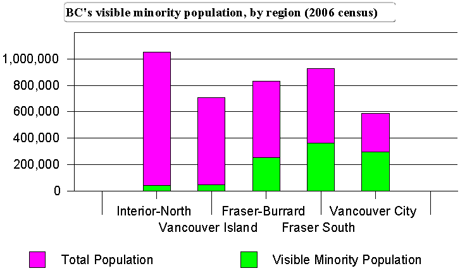
British Columbia has a total population of about 4.3 million, of whom just over one million are visible-minority Canadians. At 21.6 per cent, or better than one in every five B.C. residents, our province has the greatest proportion of visible minority residents in Canada.
According to the 2006 census, more than five million Canadians, or 16.2 per cent of the country's total population, are visible minorities. That's nearly a five-fold increase in real numbers over the last quarter century -- in 1981 Canada's visible minority population numbered just 1.1 million, or 4.7 per cent of the total.
The census also found that South Asians -- which include East Indians, Punjabis, Pakistanis and others -- have become, at 1.26 million, Canada's largest visible minority group. Canadians of Chinese heritage, historically the country's largest visible minority population, were close behind at 1.22 million. Together, the two groups represent half of Canada's visible minorities.
(Visible minorities are defined under the federal government's Employment Equity Act as non-aboriginal Canadians who "are non-Caucasian in race or non-white in colour.")
Concentrated in urban, suburban areas
About one in three members of the visible minority population are Canadian-born; the remaining two-thirds immigrated to the country. Statistics Canada reports that 29.3 per cent of South Asians were born in Canada, as were 25.5 per cent of Chinese.
In British Columbia, Chinese represent the largest number of visible minorities, with a total population of 407,000 (or about 10 per cent of the total). South Asians are counted at 262,000 (6.4 per cent).
Other sizeable groups in B.C. include Filipinos at 88,000; Koreans, 50,000; Southeast Asians (primarily Vietnamese), 41,000; Japanese, 35,000; West Asians (mostly Persians or Iranians, and Arabs) 30,000; Latin Americans, 29,000; and Blacks, 28,000.
Yet B.C's visible minority population is not spread evenly across the province, but rather is concentrated heavily in Vancouver and many of the city's suburbs. In other parts of the province -- notably the North, the Central Interior, the Okanagan, the Kootenays and Vancouver Island -- visible minority residents compose a very small percentage of the local population.
For purposes of analysis during the current general election, The Tyee has divided British Columbia into five regional agglomerations of federal electoral districts. The chart above shows the number of visible minority residents within the total population of each of those regions.
Breaking it down by region
In the Interior-North region -- which includes 10 mainland ridings located outside the Lower Mainland -- visible-minority residents add up to 43,000, or just 4.1 per cent of the region's one million total population. South Asians in the region number almost 15,800, and Chinese residents total 7,400.
On Vancouver Island -- which has six federal ridings -- the visible minority population is 7.1 per cent of the total, or just over 50,000 in a total population of 705,000. The region is home to 15,400 Chinese, and 11,900 South Asians.
Fraser-Burrard encompasses five Lower Mainland electoral districts located on the north side of the Fraser River -- from Mission in the east, through Maple Ridge, Coquitlam and New Westminster to Burnaby -- plus the two on the north shore of Burrard Inlet.
The total population in this region is 830,000, of which 252,000 -- 30.3 per cent -- are visible minorities. Chinese total 105,000, followed by South Asians at nearly 41,000.
In this region, the visible minority populations are lowest in the two ridings at the geographic extremities: to the east, just 11.0 per cent of residents in Pitt Meadows-Maple Ridge-Mission are visible minorities, and to the west, in West Vancouver-Sunshine Coast, the figure is 13.9 per cent.
Two electoral districts in the centre of the region, Burnaby-Douglas and Burnaby-New Westminster, boast the heaviest concentration of visible minorities. In both ridings, slightly more than half of the total population is visible minority, with Chinese, at a combined total of nearly 63,000, representing the largest proportion.
The visible minority populations are about one-in-four in North Vancouver (22.9 per cent) and New Westminster (24.6 per cent), and one-in-three in Port Moody-Westwood-Port Coquitlam (34.6 per cent).
Fraser South (eight Lower Mainland ridings on the south side of the Fraser River) has a total population of 928,000. Of that number, 366,000 -- 39.4 per cent -- are visible minorities.
South Asians are the largest visible minority group in this region, with a total population of over 161,000. That number is 17.4 per cent of all residents, and 44 per cent of the total visible minority population.
The South Asian population is concentrated in four of the region's eight ridings: Newton-North Delta, 50,500; Surrey North, 33,700; Fleetwood-Port Kells, 31,000; and Abbotsford, 23,400.
The Chinese population totals 107,000, of whom three-quarters live in two ridings: Richmond, 57,000; and Delta-Richmond East, 20,400.
Five federal electoral districts are located in the city of Vancouver, and have a combined population of 590,000. Of that total, the visible minority population is 298,000, or more than half of the total -- 50.5 per cent.
Chinese, at 172,000, are the largest visible minority population in the city, representing 29.1 per cent of all residents. Vancouver South has the largest number of Chinese, 89,600, followed by Vancouver-Kingsway, 81,400; Vancouver East, 49,900; Vancouver Quadra, 40,600; and Vancouver Centre, 36,500.
The city's South Asian population numbers 32,800, with more than half, 18,000, living in Vancouver South.
Increasingly influential
In conclusion, because B.C.'s visible minority population is so heavily concentrated within the city of Vancouver and other select areas in the Lower Mainland, it is easy to overstate its electoral importance. In well over half -- 20 -- of the province's 36 federal electoral districts, visible minorities represent less than 15 per cent of the total population.
Put another way, non-visible minority British Columbians make up more than 85 per cent of the population in a majority of federal electoral districts.
Yet the trend is clear: visible-minority British Columbians have become increasingly influential in the province's economic, social and political affairs in recent years, and that importance will grow even greater in the foreseeable future. ![[Tyee]](/design-article.thetyee.ca/ui/img/yellowblob.png)
Read more: Politics



Tyee Commenting Guidelines
Comments that violate guidelines risk being deleted, and violations may result in a temporary or permanent user ban. Maintain the spirit of good conversation to stay in the discussion.
*Please note The Tyee is not a forum for spreading misinformation about COVID-19, denying its existence or minimizing its risk to public health.
Do:
Do not: